
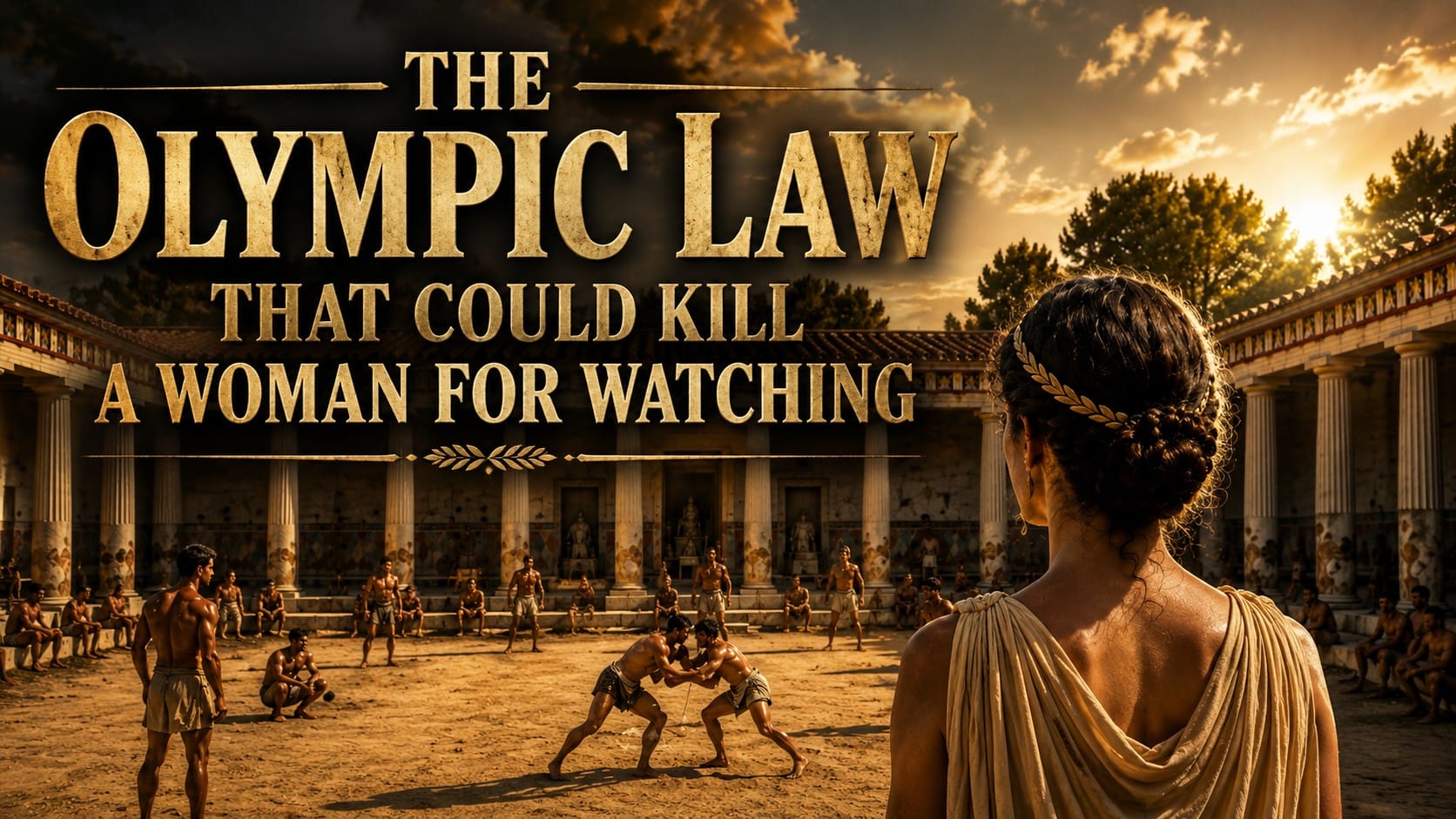
You think you know what the Olympics were — the glory, the crowns, the champions remembered for centuries. Now picture the part the story leaves out: a woman taken toward the cliffs named in the law, just for watching a game.
For close to a thousand years, the ancient Games ran under a rule that sounds almost too dark to be real. A married woman who came to watch risked the harshest punishment written into the law. And for most of that time, no one dared test whether the threat was real.
The place was Olympia, in the western Peloponnese. The time, somewhere around 388 BC. The rule was written down by a Greek travel writer named Pausanias, and it was specific in a way that still feels cold to read.
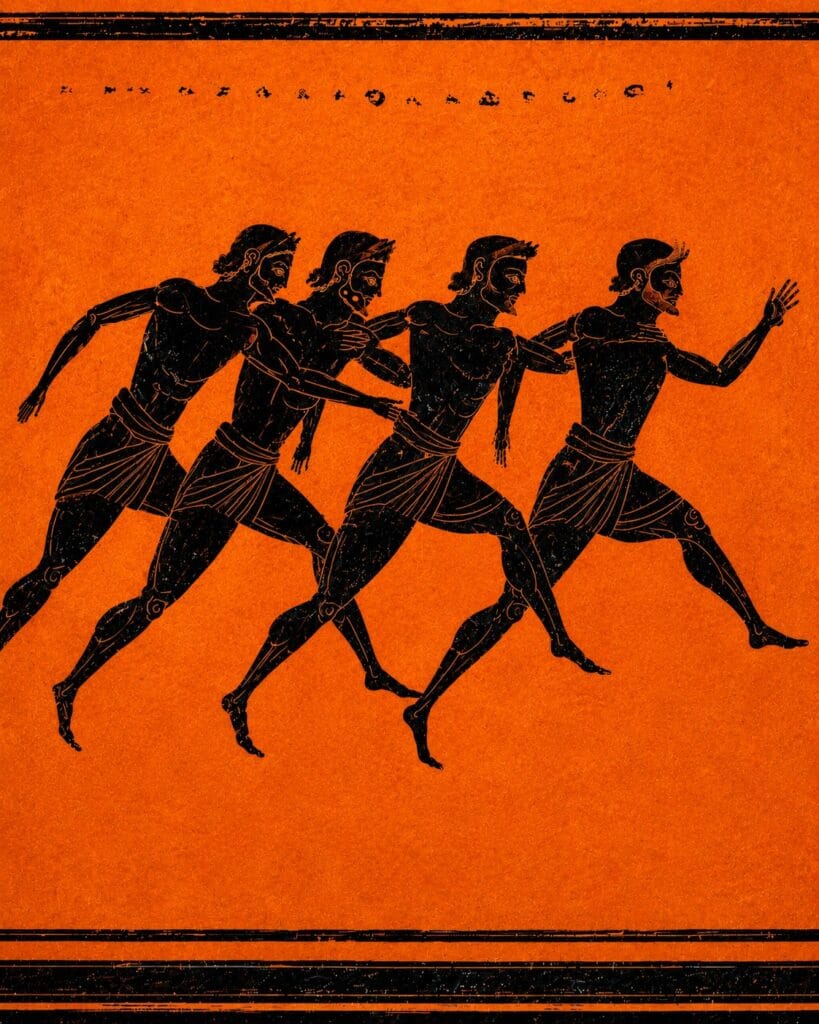
Picture the morning at Olympia
Picture arriving before sunrise. The dust is already in the air. Merchants shout from stalls thrown up overnight, and priests move between the altars with offerings for Zeus while the sky is still gray.
This was not a weekend tournament. It was one of the largest gatherings in the entire Greek world. Men traveled for days, some for weeks, crossing mountains and sailing rough water to reach this single valley.
For much of Greece, there was nothing bigger. Cities sent their best. Families staked their names on a single afternoon. And every four years the crowd swelled until the valley could barely hold it.
Into that crush of bodies, one rule drew a hard line.
The Games Were Built Around Physical Excellence
One detail makes everything else click into place. Ancient sources describe athletes as competing without the uniforms we know today, following the customs of their era.
It was not always that way. Later writers said a runner named Orsippos lost his loincloth in a race and won anyway, and that the custom spread after him. Whether it happened exactly like that or not, the result was the same. Athletes stepped onto the track according to the athletic customs of their era.
There is even a word hiding inside all this. The Greek word gymnos became the root of gymnasium, the place where athletes trained. Physical excellence was a central part of the athletic culture of the Games.
And these were not quiet sports. They were a religious festival for Zeus, loud, crowded, and physical. Tens of thousands of people pressed into the valley to watch bodies push past what bodies should do.
Now ask the obvious question. If that was the custom, who exactly was allowed to look?
A wife could die for crossing a river
The answer was strangely split. Unmarried girls could attend. Married women could not. One was welcome at the edge of a sacred spectacle. The other could be killed for getting close to it.
Pausanias laid out the geography of the punishment in his book on Greece. On the road to Olympia, before you reach the Alpheios river, there is a mountain with steep cliffs called Typaeum. The law of Elis, he wrote, was blunt. Any married woman caught at the Games, or even found across the river on the forbidden days, was to be thrown from those rocks.
The boundary was not the stadium wall but a river, and crossing it on the wrong day meant the cliff.
And this was supposed to be a time of peace. During the Games a sacred truce held across the Greek world, and wars were meant to pause so travelers could reach Olympia unharmed. Tens of thousands of men poured into that holy quiet. Not one lawful wife among them.
There was exactly one adult woman with a standing seat. The priestess of Demeter Chamyne watched from an altar, alone, while every other wife in Greece stayed away. One law. One river. That was enough.
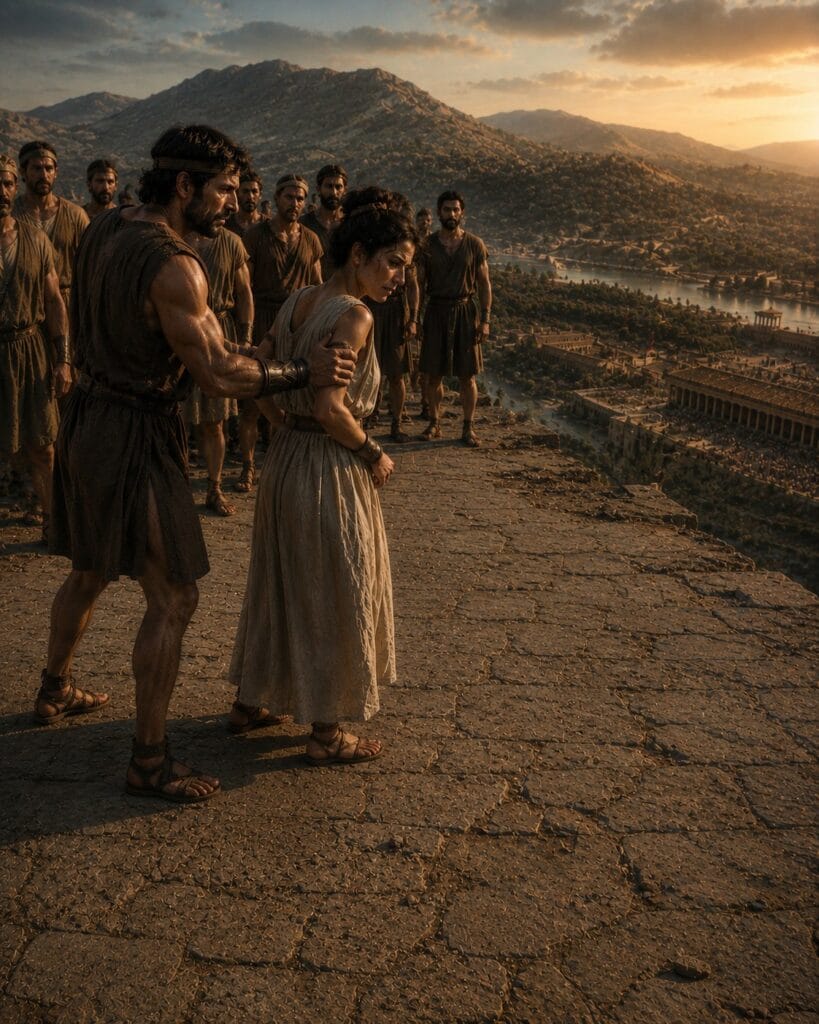
What made the law frightening was not only the punishment. It was that everyone knew exactly where the cliff was. Travelers passed it on the road to Olympia. Locals knew its name.
You did not need to witness a single execution. The cliff stood there, year after year, in plain sight, and that was enough. A rule you can see is a rule you never forget.
For centuries, no one dared. Then one did.
So who would gamble their life for a seat at a sporting event? For generations, the answer was nobody. The rule sat there like a loaded threat, and people simply obeyed it.
Then Pausanias adds one line. No woman, he says, was ever caught under the law. Except one.
Her name was Kallipateira. A few ancient writers call her Pherenike instead. She is remembered for a reason, and it begins with the family she was born into.
To understand that family, you first have to understand what winning here meant.
Her family was Olympic royalty
To the Greeks, victory at Olympia stood above every other athletic honor. A win there did not just make you famous. It made you something close to sacred.
A victor went home treated like a half-god. Some towns tore open a section of their own city wall to carry a champion through, as if a normal gate was too small for the man. Poets were paid to turn winners into living legends.
Her father was Diagoras of Rhodes, and in the boxing ring that name meant something close to a god. He won across the great festivals of Greece, and his sons grew up to win too. The poet Pindar honored him with an entire victory ode.
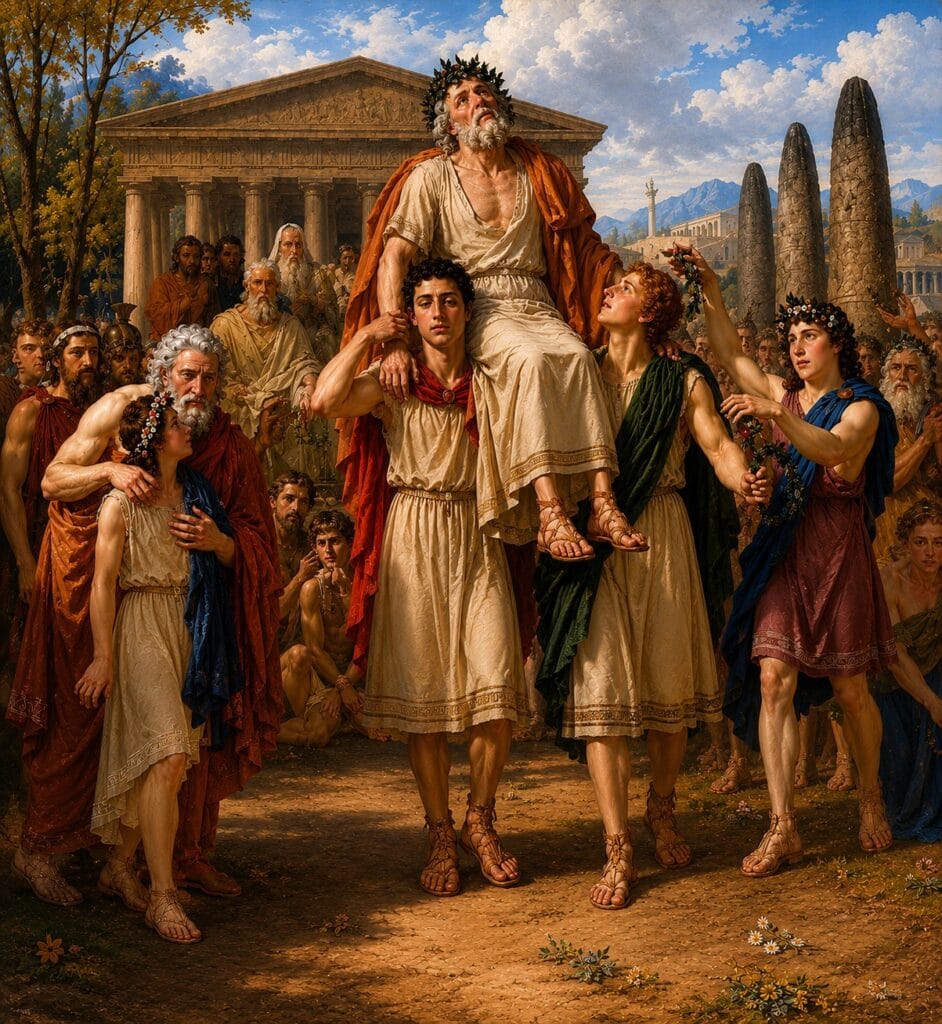
There is a scene about Diagoras that ancient writers loved to repeat. After two of his sons won on the same day, they lifted their aging father onto their shoulders and carried him through the roaring crowd. A spectator shouted a line that would echo for centuries: “Die now, Diagoras. You cannot ascend to Olympus.” (Κάτθανε, Διαγόρα, οὐκ εἰς Ὄλυμπον ἀναβήσῃ.)
It was meant as the highest compliment imaginable. The man had reached the very top of human glory, and the only step left was to become a god. And there, in his sons’ arms, he is said to have died of joy.
That was the blood in Kallipateira’s veins. A father the whole Greek world had cheered. Brothers who wore the same crowns. A name that opened every gate in Greece, except the one she most wanted to walk through.
Because there was one prize her family could not hand her. The right to watch her own son.
She had grown up inside these stories. As a girl on Rhodes, she would have heard how her father stood unbeaten in the ring, how crowds chanted his name, how her brothers carried the same crowns home one by one. The Olympic victory was the proudest thing her family owned, and it was told and retold at every table she sat at.
And here was the cruelty of it. The one event that defined her bloodline was the one place she was forbidden to stand.
She could memorize every detail of Olympia. She could raise a champion for it. She just could not be there to see her own blood win. For a daughter of that house, it must have felt like being locked out of her own home.
She walked in dressed as a man
Her husband was gone. So she took over her son’s training herself, and became, in every real sense, his coach.
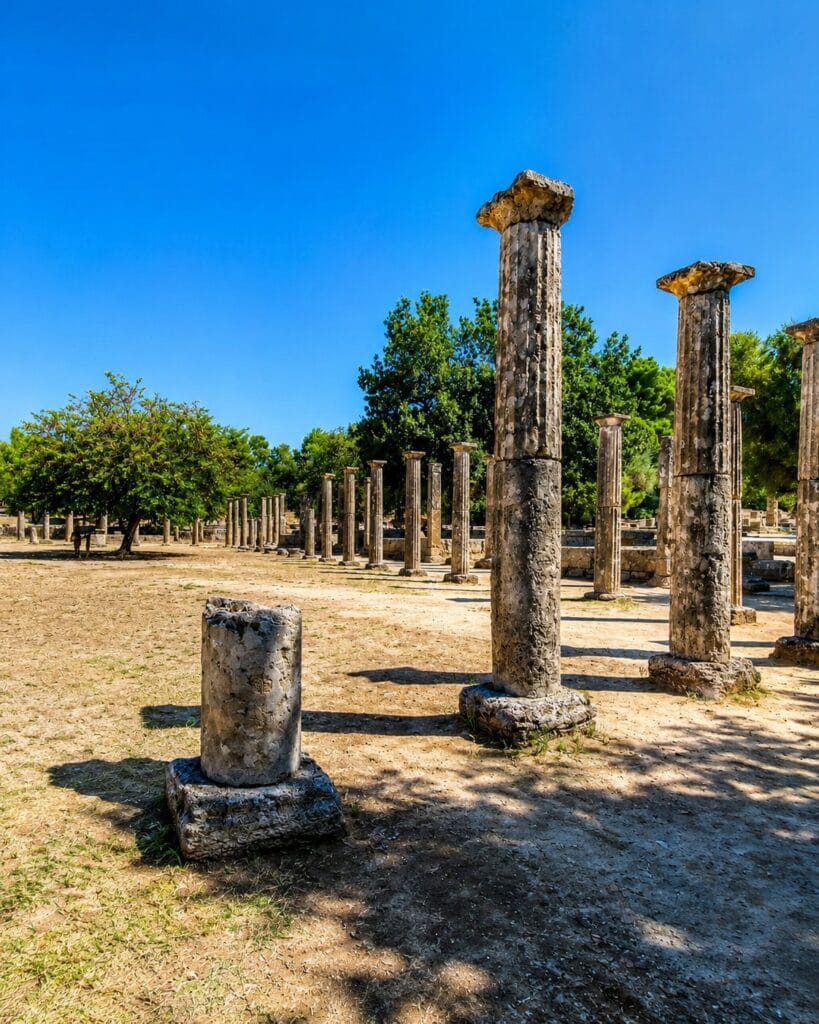
Training for Olympia swallowed years. A young fighter repeated the same movements thousands of times. Wrestle. Run. Box. Fall. Stand up. Again.
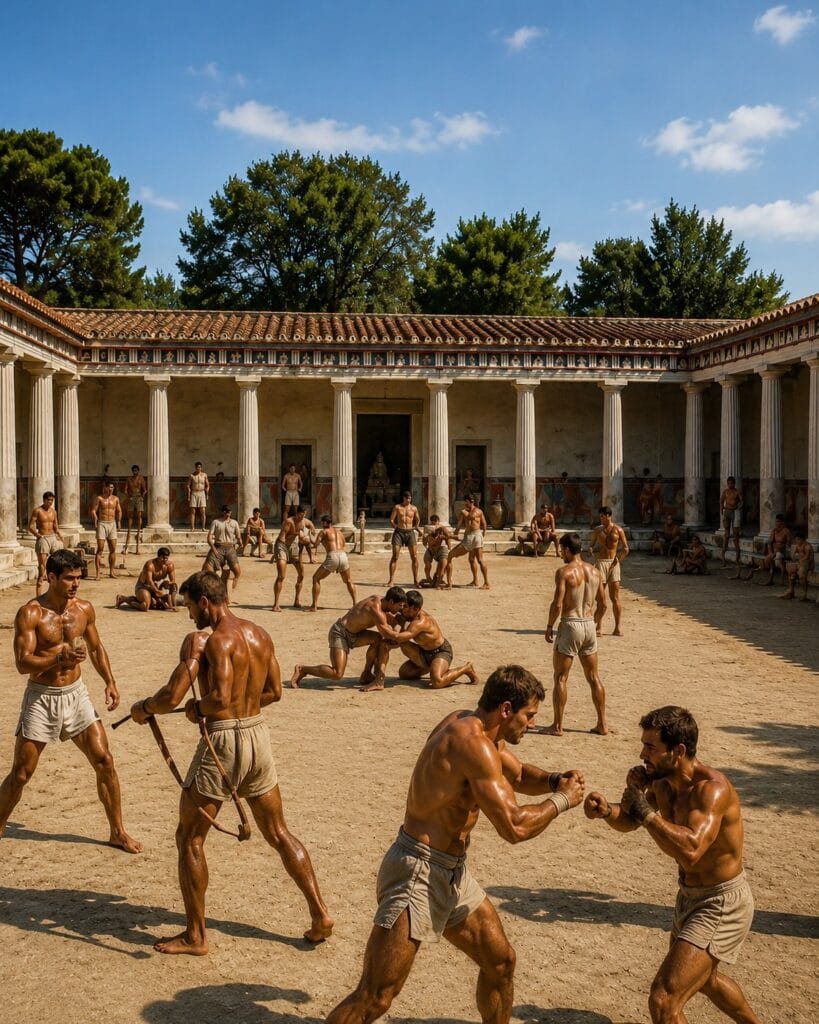
The palaestra was not just a gym. It was a factory for champions, and the work inside it was relentless and exact. Every drill had a purpose, and every one of them pointed toward a single day in a single valley.
Kallipateira watched all of it. She corrected his stance, timed his breathing, and learned his weaknesses better than he did. She poured years into the boy who would step onto that sand.
And the law said she could never see the one thing all of it was for. She could build a champion. She just could not watch him become one.
The law had her trapped twice over. A woman could not compete. A woman could not coach. A woman could not even sit in the crowd. So she did the only thing left.
She cut her hair into a man’s, put on a trainer’s clothes, and walked straight through the gate as one of the coaches. Nobody looked twice. Nobody stopped her. She stood at the edge of the field and watched her boy step into one of the hardest combat events the ancient world ever staged.
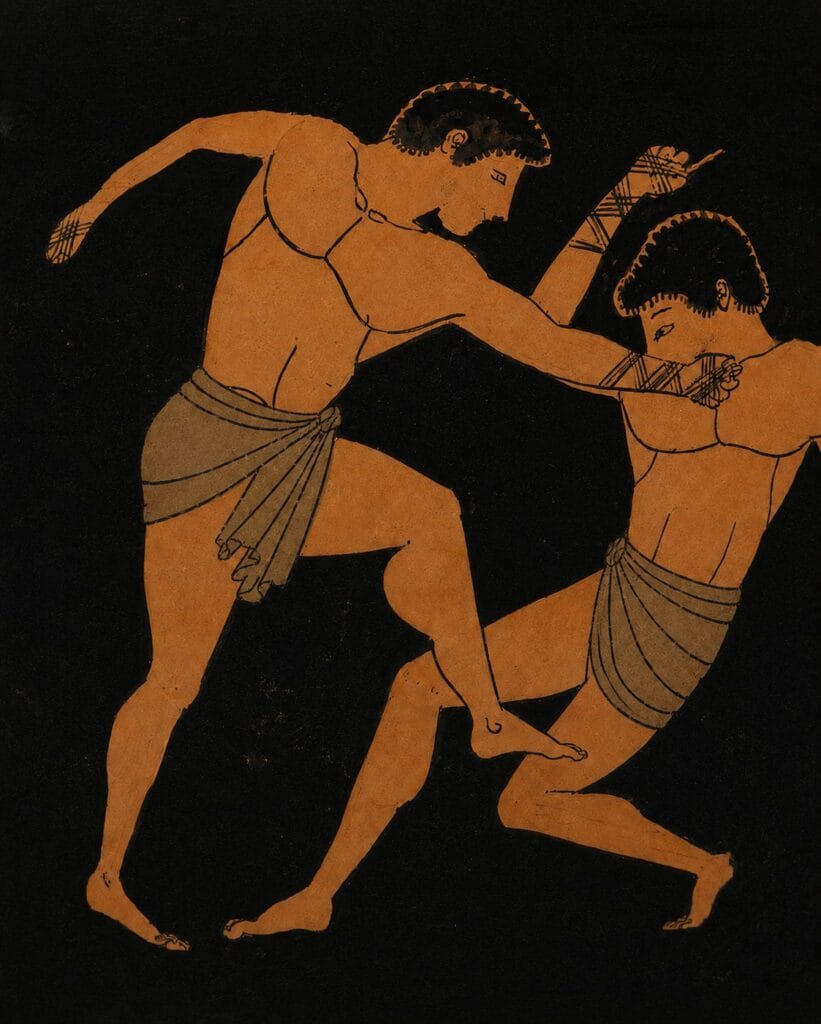
Ancient boxing had no timed rounds and no soft gloves. Fighters wrapped their hands in hard leather and traded blows until one of them could not stand. There were no points and no breaks, so a match ended only when a man quit or simply could not go on.
Injuries were common, and some fighters carried the marks for years. A fighter gave up by lifting a hand or a finger toward the crowd, admitting he was done.
Around the fighters, the day pressed in from every side. Hot sand underfoot, churned dark in patches. A wall of noise from a crowd that had traveled days for this single afternoon. The smell of oil, sweat, dust, and fear.
Off to the side stood the judges, switches in hand, ready to whip any man who broke the rules. There were no weight classes, so a smaller fighter could draw a giant. There was no clock to save you. You won by enduring longer than the man across from you, and everyone in that valley had come to watch exactly that.
This was the storm her disguise had carried her into. And then it got worse, because her son started to win.
Then her son won, and the disguise slipped
Then her son took the crown. And for one second, the careful, hidden woman was simply his mother.
She ran toward him. Coaches were kept penned behind a barrier, and she tried to leap it to reach her boy. Her disguise came loose as she rushed forward. In front of the judges, in front of the crowd, the disguise failed.
A woman. Inside the Games. The very thing the law was meant to prevent had happened in broad daylight. And the law was clear about what came next.
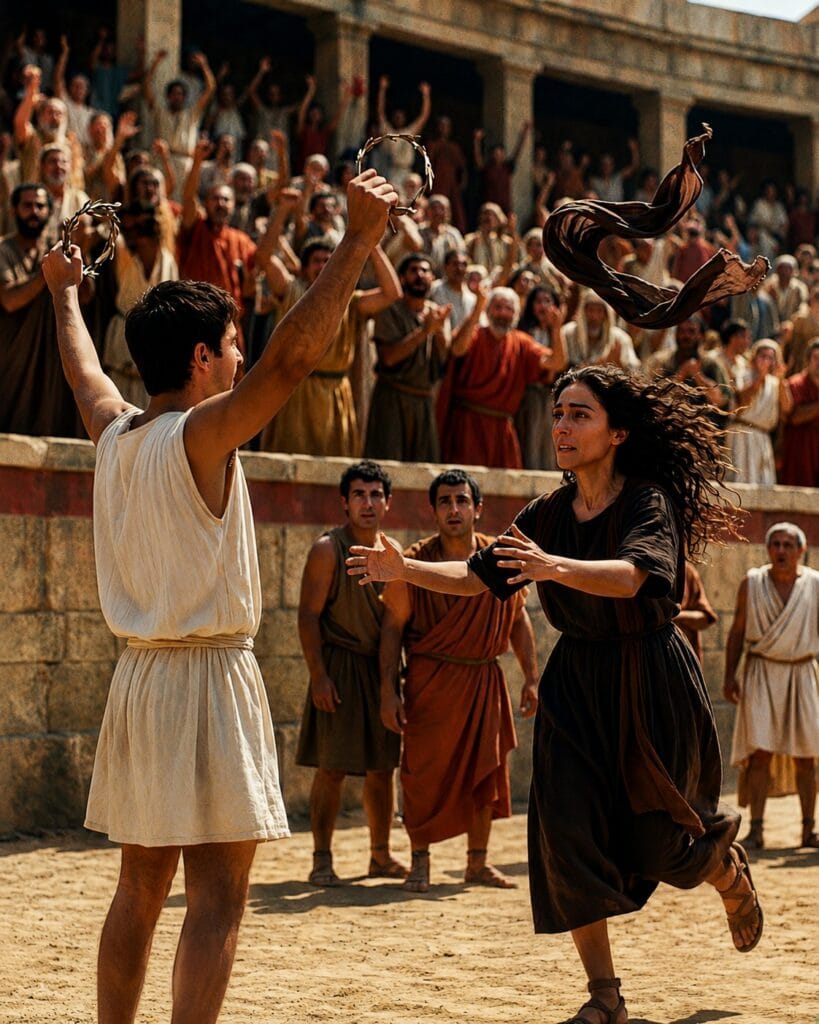
For a moment, nobody moved. The crowd had grown up on the same warning, repeated for generations. No wives. No exceptions. The cliff for anyone who tried.
Did Kallipateira think of the cliff in that second? She knew the law as well as anyone, and she knew exactly where the cliff stood, out past the river. So did every person now staring at her. That shared knowledge is what made the silence so heavy.
A woman stood revealed in the middle of the Olympic Games, breathing hard, her fallen cloak beside her. Judges, spectators, the whole valley knew exactly what the law said should happen next. The only question was whether anyone would actually do it.
The judges, the Hellanodikai, now held her life in their hands. By the letter of the law, it should have been the cliff. But the woman kneeling before them carried the most famous athletic name in Greece. Her father, her brothers, and now her son had all worn the crown, so the judges could not bring themselves to enforce it, and they let her go.
She walked out alive: the only recorded woman to break the rule and survive it. The strangest part came next.
The judges were rattled. If one woman could slip in dressed as a coach, another could too. So they changed the rule. From then on, Pausanias says, trainers also had to enter the grounds without their usual clothing, matching the athletes, so no disguise could ever hide a woman again. One woman’s nerve had rewritten the rules, and every trainer after her paid for it.
Her son had a name too. Peisirodos. And his part of the story did not vanish with hers. Pausanias claims a statue of the boy still stood at Olympia in his own day, set among the figures of his champion family. The mother who had risked a cliff-side punishment ended up with her bloodline carved in stone at the very place that nearly killed her.
What the record does, and does not, say
This is where the story has to slow down. The legend is thrilling. The evidence behind it is thinner, and more careful, than the dramatic version suggests.
First, the death. Pausanias names the cliff and the law, yet he also says the penalty was never actually carried out on anyone. On paper, the threat was real. In practice, the record shows no one was ever thrown. The fear lived in the wording of the law, not in anyone it actually killed.
But that leaves an uncomfortable question. If the punishment was never used, why did the threat hold for centuries?
Second, the ban itself. The clean line we love to repeat is “no women allowed,” but the text points to married women, while unmarried girls could watch. Some scholars even argue a later copyist muddled the passage. So the reality is messier than the slogan suggests.
Third, her son’s event. Many retellings call it boxing, which fits the family. Pausanias only says the boy was victorious, and at least one major source describes a running event instead. So treat the rougher scenes here as the world he entered, not as a settled fact about which crown he took home.
And then there is her name. Some ancient writers call her Pherenike, others Kallipateira, and a few read them as two different daughters of Diagoras. The likeliest version is one woman, known one way before the leap and another after it. Even her name did not survive the centuries cleanly.
That is usually how one act of courage turns into legend. The big moments survive. The smaller details blur a little more each time the story gets told. The honest approach is to trust what the records confirm, and to enjoy the rest for the story it grew into.
Archive Notes
Were all women really banned from the ancient Olympics
Not exactly. The surviving text points to married women being barred from the men’s Games on the forbidden days, while unmarried girls could attend. A single priestess of Demeter Chamyne held the one permanent seat reserved for an adult woman.
Did women have their own ancient games
Yes. A separate festival called the Heraia, held at Olympia in honor of the goddess Hera, featured footraces for unmarried girls on a track shorter than the men’s. It ran on its own schedule and its own rules, apart from the men’s Olympics.
Where can the original account be read today
The story comes from Pausanias and his work on Greece, Book Five, in the passages numbered around 5.6.7 and 5.6.8. English translations of the full text are freely available through public scholarly archives online.
One mother decided a single glimpse of her son’s victory was worth a cliff, and the men in charge could not bring themselves to enforce their own law against her. If that kind of nerve stays with you, you will feel it again in the musicians who kept playing as the Titanic went down, in the shattered marble that somehow became the most perfect statue in history, and in the performer who pushed his body and fame to a scale no human was supposed to reach.
What You Now Know
The ancient Olympics protected their festival with a death sentence aimed at wives, then broke their own rule for a woman whose family was too glorious to punish. The cliff was meant to keep wives away from the Games. In the end, it is remembered for the one who got past it.
Tip For Readers
If you want the primary source rather than the retellings, read the relevant passage of Pausanias yourself through the Perseus Digital Library, where the full translated text of his Description of Greece is open to the public.
Verified Sources
Pausanias — Description of Greece, Book 5 (5.6.7–5.6.8)
Pindar — Olympian Odes, including Olympian 7 for Diagoras of Rhodes
Foundation of the Hellenic World — Ancient Olympic Games reference materials
Perseus Digital Library, Tufts University — Classical Greek texts and translations
Historical references were cross-checked using publicly available classical and educational sources.
Visual materials used in this article were adapted, restored, or recreated by the VELLA TEAM based on public-domain artworks, archaeological evidence, museum collections, and historical source materials for educational and editorial purposes.
Some scenes are modern historical reconstructions created to illustrate events associated with the ancient Olympic Games.