

Around 190 BC, an unknown sculptor stood in a workshop — probably on the island of Rhodes — and began carving a block of white Parian marble into a goddess. The figure represents a goddess in motion, captured at the moment of landing. Wings back, chest forward, robes pressing against her body as if driven by sea wind, the moment her feet touched the prow of a warship after delivering the news of a naval victory. The sculptor demonstrated a high level of technical skill and control. The passage of time has reinforced that assessment.
Time took its toll on the sculpture, but the resulting damage created a new kind of aesthetic power. The statue now stands in the Louvre without a head, without arms, and without feet. It has stood that way since 1884. Millions of Louvre visitors encounter it each year at the top of the Daru staircase. A large number of visitors pause to observe it.
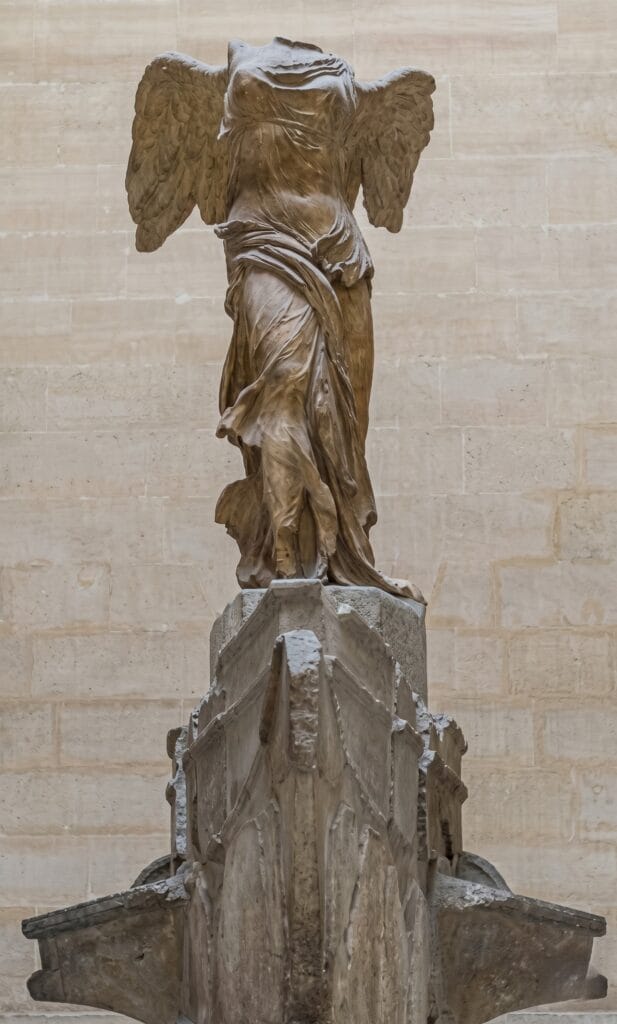
Winged Victory of Samothrace (Nike of Samothrace), Parian marble, ca. 190 BC. Louvre Museum, Paris. Photo: Marie-Lan Nguyen, 2007. Public Domain via Wikimedia Commons. The statue stands 2.75 meters tall and has been displayed at the top of the Daru staircase since 1884.
The Object Itself
The statue is carved from Parian marble — white stone quarried from the Greek island of Paros, prized in antiquity for its translucency and fine grain. The figure alone stands 2.75 meters tall, approximately nine feet. Including the ship base, the full monument reaches 5.57 meters, just over eighteen feet. The total weight of the monument is approximately 30 tons. The ship base is carved from a different stone: gray Lartos marble from Rhodes, which is part of the reason scholars have long associated the work with a Rhodian sculptor.
The statue was found on April 13, 1863, on the Greek island of Samothrace, in more than 110 separate fragments. The 2013 to 2014 restoration, which cost five million euros — approximately 6.8 million US dollars at the time — allowed conservators to examine the statue in detail for the first time in decades. The head, both arms, and both feet have not been recovered. The right hand was found in 1950 and is displayed in a case near the statue. What remains is a torso, two wings, and the drapery carved around the lower body.
The drapery is central to the technical analysis of the sculpture.
The Thing Nobody Notices First
When most people see a photograph of the Winged Victory, the first thing they notice is the wings. The second thing is the missing head. Both reactions overlook the most technically extraordinary feature of the sculpture.
Look instead at the fabric.
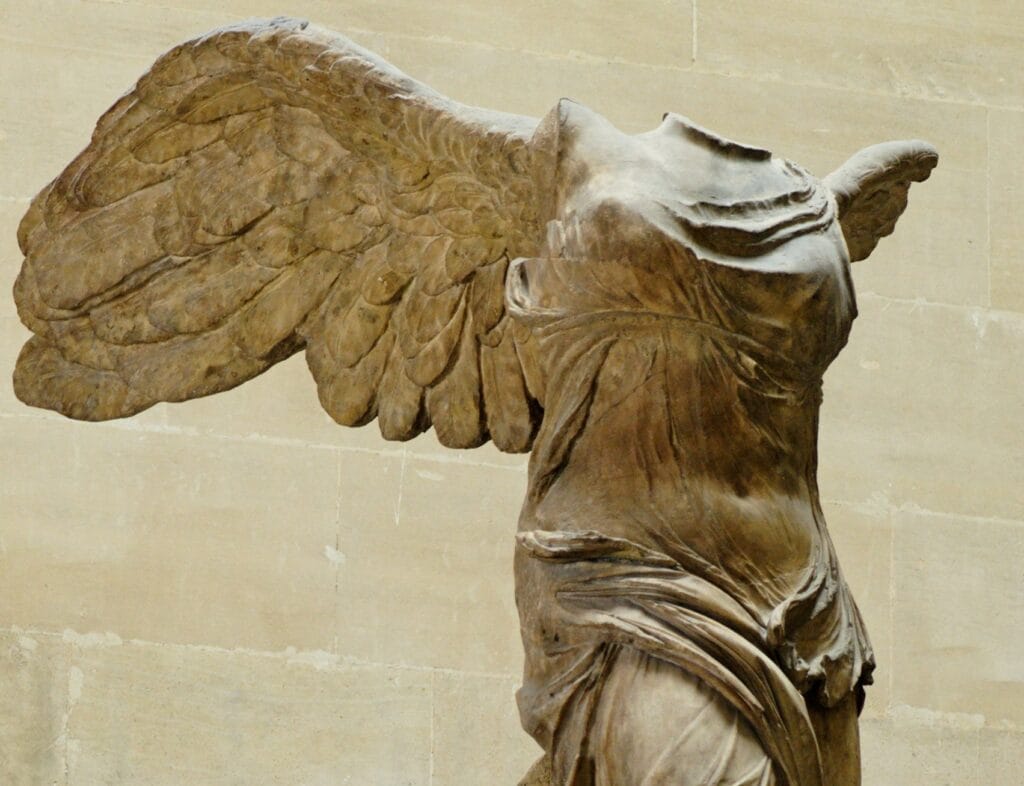
The goddess is wearing a tunic called a chiton, a thin garment belted twice — once below the chest, once at the hip. Over that, a heavier mantle called a himation is wrapped around her lower body. The wind from the battle has pressed the tunic flat against her body. You can see the outline of her stomach through it. You can trace the curve of her legs beneath it.
Although it appears to be fabric, it is carved from solid marble — the same block as the rest of her body, as hard as any floor, able to survive two thousand years buried in pieces under a Greek hillside.
The technique that produced this effect is called wet drapery. While the technique originated earlier in Greek sculpture, it reached a technical peak during the Hellenistic period. The method involves carving cloth so thin, and plotting the folds with such precision, that the marble reads visually as fabric soaked in water and pressed against skin. The sculptor determined in advance where the fabric would stretch, where it would bunch, and carved those details directly into the stone.
During the 2013 to 2014 restoration, when the statue came off its base for the first time in decades, Louvre conservators were able to examine it under direct light. They reported that in certain sections of the drapery, light can pass through some of the thinnest sections of the marble. The sculptor carved the stone so thin that parts of it approach the limits of structural stability.
The marble, over two thousand years old, is thin enough in places to allow light to pass through.
What the 2014 Restoration Found
The restoration team used ultraviolet light, X-ray fluorescence, and spectrographic analysis to examine the statue’s surface in detail. Among the findings: the wings were originally painted blue. A strip along the bottom of the mantle was also blue. The pigment identified was Egyptian Blue — an early synthetic pigment identified through analysis, used widely in antiquity because it does not fade under sunlight and adheres well to stone surfaces. Under ultraviolet light, it fluoresces in a distinctive pale blue-white glow that allowed the restoration team to map exactly where it had been applied, even after two millennia.
The rest of the statue — the torso, the robes, the carved feathers — was left in the natural white of the Parian marble. Over two thousand years, that marble had darkened to a yellow-brown from surface grime and environmental deposits. The restoration cleaned it back to translucent white, closer to what it would have looked like in 190 BC.
The conservators also confirmed the marble’s origin through isotopic analysis. Parian marble has a specific ratio of stable oxygen and carbon isotopes that allows it to be distinguished from other white marbles used in antiquity. The statue’s torso is confirmed Parian. The ship base is confirmed Lartos, from Rhodes. The materials originate from two different quarries on separate islands, indicating a single coordinated commission.
She had blue wings. The rest of her was white. That combination, at the top of a monument overlooking the sea, would have been visible from a considerable distance.
What Actually Happened in 1863
Charles Champoiseau was a French diplomat, not an archaeologist. In the spring of 1863, he was directing an excavation at the ruins of the Sanctuary of the Great Gods on Samothrace, a small island in the northern Aegean Sea, when his crew began pulling marble fragments from a rock niche cut into a hillside.
On April 13, they found the main body of a large female statue in white marble, surrounded by fragments of drapery and carved feathers. Champoiseau recognized the figure as Nike, the goddess of victory. Nearby was a collection of fifteen large blocks of gray marble. He concluded they were the remains of a funerary monument. This interpretation was revised approximately twelve years later.
He shipped the statue to the Louvre, where it arrived in May 1864 as a torso — no head, no arms, no feet, no wings. The initial reception was relatively limited.
In 1875, Austrian archaeologists working the same site recognized that the fifteen gray marble blocks were not a tomb. Once assembled, they formed the tapered bow of a warship. The monument — goddess landing on the prow of a ship — finally made architectural and narrative sense. Champoiseau returned to Samothrace in 1879 and shipped the blocks to Paris. The Louvre assembled them. The wings were attached. Following reconstruction, the statue attracted significantly more attention.
It has stood at the top of the Daru staircase since 1884.
Where the Statue Stands and Why It Was Placed There
The Daru staircase in the Louvre is not an arbitrary location. The staircase rises from the ground floor of the Denon Wing, and the Nike of Samothrace sits at its apex, visible from the bottom of the stairs before a visitor has climbed a single step. The positioning was deliberate. The architect and museum administrators who placed the statue there in 1884 understood that a figure of this scale — 2.75 meters of forward-leaning motion, wings spread, drapery caught in imaginary wind — functions differently depending on the viewing angle and approach distance.
Viewed from the base of the staircase, the statue appears to be descending toward the viewer, a visual effect reinforced by the forward tilt of the torso and the angle of the wings. The gray ship-prow base, tapering at the front, adds to this impression by suggesting movement through space rather than static placement. At the top of the stairs, viewed up close, the scale of the figure — nearly three meters of stone — becomes physically present in a way that photographs do not convey.
The Louvre’s curators have periodically proposed relocating the statue to a more accessible space with better visitor flow. Each time, the proposal has been declined. The Daru staircase placement, however inconvenient for crowd management, produces a viewing experience that a flat gallery wall cannot replicate.
The viewing approach significantly affects how the sculpture is perceived.
Why the Missing Parts Produce a Different Effect
This effect may initially seem counterintuitive. Art historians have noted for decades that the absence of the head and arms changes how a viewer processes the statue. With a face present, the eyes go there first — faces are the most powerful attractor the human visual system processes. A viewer would read the expression, the direction of gaze, the features. The drapery, the wings, the implied movement would compete with the face for attention.
Without the head, that competition does not exist. There is nothing above the collar for the brain to anchor on. The visual system processes the whole figure instead: the forward lean, the wings swept back, the fabric pressed flat by wind, the weight shifted onto one foot as the figure absorbs the landing. The motion becomes the subject rather than a supporting detail.
Psychologists describe a related phenomenon called the Zeigarnik Effect — the documented tendency for incomplete information to occupy more mental space than complete information. An unfinished task, an unanswered question, a missing face. The brain does not resolve it and move on. It returns to fill in what is absent.
The damage altered the way the statue is perceived, emphasizing its sense of motion. What the sculptor built was a figure designed to convey a single instant of arrival. What time removed was everything that would have divided attention away from that instant. The result is a sculpture that communicates motion more directly in its damaged state than it likely would have in its complete one.
Detail view of the drapery on the Winged Victory of Samothrace, ca. 190 BC. Louvre Museum. Photo: Marie-Lan Nguyen, 2007. Public Domain via Wikimedia Commons. The wet drapery technique produces the visual impression of fabric pressed against skin, carved in marble approximately two thousand years ago.
FAQ
Q: Who made the Winged Victory of Samothrace?
A: Unknown. The sculptor has never been definitively identified. Based on the style and the gray Lartos marble used for the ship base — which comes from Rhodes — scholars have long associated the work with a Rhodian sculptor, possibly named Pythokritos. This remains a hypothesis. No inscription names the sculptor.
Q: What was the Winged Victory originally commemorating?
A: A naval victory, almost certainly. The monument was dedicated at the Sanctuary of the Great Gods on Samothrace, a major religious site for sailors and travelers in the ancient Aegean. The specific battle it commemorates has not been confirmed. It is one of the enduring unanswered questions about the statue.
Q: How much did the 2014 restoration cost, and who funded it?
A: The total cost was five million euros, approximately 6.8 million US dollars. Nippon Television Holdings contributed 2.3 million euros. The remaining costs were covered by 6,705 individual donations totaling one million euros, plus contributions from Fimalac and the Bank of America Merrill Lynch Art Conservation Project. The restoration ran from September 2013 to July 2014.
What You Now Know
The Winged Victory of Samothrace was created around 190 BC from Parian marble, likely by a Rhodian sculptor whose name has not survived. It was discovered in more than 110 fragments on April 13, 1863, on the island of Samothrace and has been displayed at the top of the Louvre’s Daru staircase since 1884. The head, arms, and feet have not been recovered. The right hand was found in 1950 and is displayed in a case near the statue.
The 2013 to 2014 restoration, which cost five million euros, confirmed through spectrographic analysis that the wings were originally painted with Egyptian Blue — calcium copper silicate — a synthetic pigment identifiable under ultraviolet light even after two thousand years. The drapery was carved using the wet drapery technique, and in certain sections the marble was carved thin enough that light passes through it. The statue’s placement at the head of the Daru staircase was deliberate, producing a visual approach in which the figure appears to descend toward the viewer from the top of the stairs. The absence of the head removes the strongest attractor in the human visual system and directs attention instead to the implied motion of the figure — a result of damage that reinforces rather than diminishes the original intent.
Tip for Readers
The next time you encounter the Winged Victory — in person, in a photograph, or on a screen — look past where the head should be. Look at the abdomen. Look at the way the tunic presses flat across the stomach and the curve of the thighs visible beneath the mantle. The marble was carved to produce that response. That it still works, two thousand years after the sculptor intended it, is the more interesting fact.
Verified Sources
Louvre Museum — Winged Victory of Samothrace Research and Restoration, louvre.fr, 2013–2014
Louvre Museum — Collection and Conservation Records, louvre.fr
Emory University — Winged Victory of Samothrace Research Collaboration, 2014
Smithsonian Institution, Archives of American Art — Samothrace Excavation Records
Kunsthistorisches Museum Vienna — Antiquities Collection, Winged Victory of Samothrace Fragment Records