On December 24, 1968, at 16:39:39 UTC, a shutter clicked for 1/250 of a second inside a spacecraft orbiting the Moon. The man pressing the button had not planned to press it. The resulting image was used in the first Earth Day logo, sent by the U.S. President to world leaders, and eventually hailed as a defining environmental photograph of the modern era. It almost did not happen at all.
Most people overlook a striking irony in this story. The Cold War space race was fundamentally an argument about which ideology could project the most power into the cosmos. NASA sent Apollo 8 to the Moon to demonstrate American dominance. What the crew brought back instead was a striking reminder of how small humanity is. They went to explore space and returned with an image that challenged the idea of conquest itself.
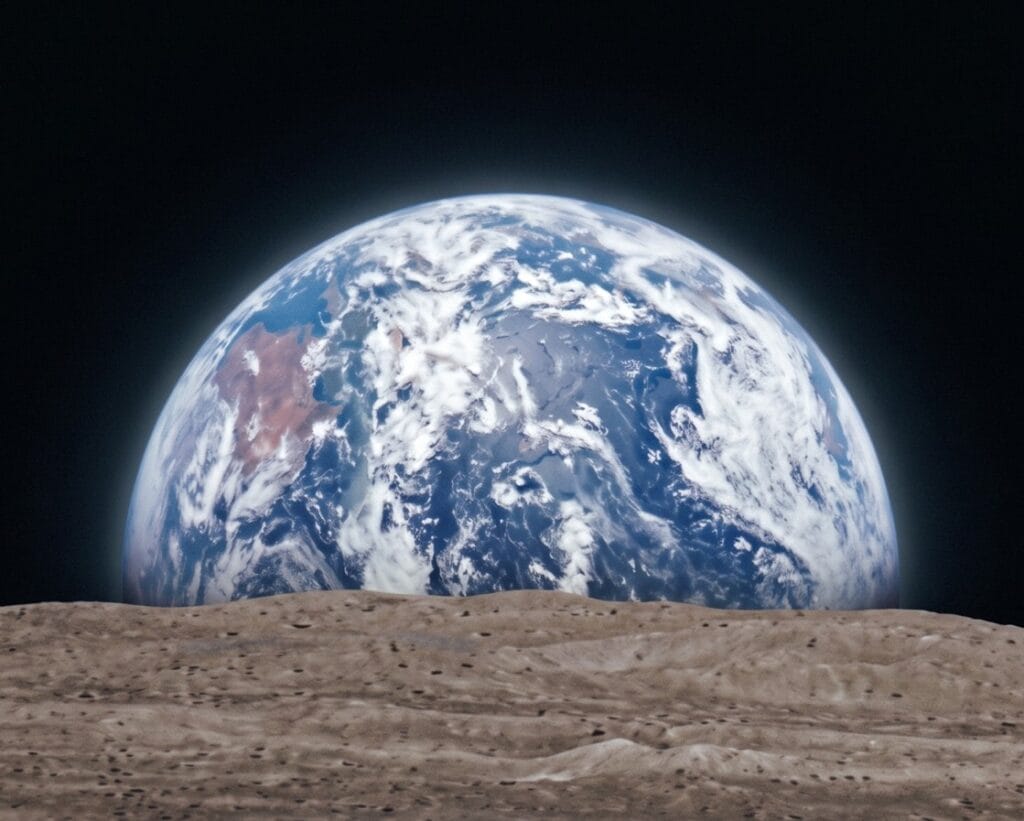
A color reconstruction of Earthrise produced by NASA’s Lunar Reconnaissance Orbiter, matched to Apollo 8’s fourth orbit on December 24, 1968. Source: NASA / Goddard Space Flight Center / Arizona State University (Public Domain).
A Mission That Was Never Supposed to Include This Photograph
Apollo 8’s official flight plan listed Earth photography as what NASA called “targets of opportunity” — the lowest priority designation in the mission hierarchy. Commander Frank Borman was explicit with his crew before departure: the mission was to orbit the Moon ten times, document the lunar surface, test systems, and return. Borman reportedly warned his crew against wasting time at the windows. Touristic photographs of Earth were not part of the program.
What overturned that plan was geometry. On Apollo 8’s fourth orbit around the Moon, Borman was executing a scheduled rotation of the spacecraft. That rotation brought a specific side window — the one occupied by lunar module pilot William Anders — into alignment with a view no human had ever seen. The Earth appeared above the barren lunar horizon. It was there on every previous orbit too, but the spacecraft’s orientation had prevented any of the three men from seeing it. Three orbits of the Moon had passed. Nobody looked.
The audio transcript from that moment is still publicly available through NASA. Borman spotted it first: “Oh, my God! Look at that picture over there! Here’s the Earth coming up. Wow, is that pretty!” Anders’ initial reaction was far from enthusiastic. According to NASA’s own recording, he said: “Hey, don’t take that, it’s not scheduled.” Within seconds, he reversed course. He had been shooting the Moon with a black-and-white Hasselblad 500 EL fitted with a 250 mm telephoto lens. The Earth in the window was in color — vivid blue against absolute black — and he was burning through monochrome film.
What followed was a scramble. Navigator Jim Lovell was searching the cabin for a roll of color film. Anders was working the camera settings by instinct, shooting at 1/250 of a second at f/11. The Earth was moving out of the window’s frame. He managed two color exposures before it receded. One of those became Earthrise. The other was slightly out of frame. The margin was that thin.
The Technical Reality Behind the Icon
The camera was a Hasselblad 500 EL with an electric drive, extensively modified from its commercial specification for use in microgravity. Think of it as a professional camera stripped of every comfort feature a photographer would normally depend on — no conventional viewfinder, no automatic exposure, no second chance. The film was 70 mm Kodak Ektachrome, chosen for its color fidelity under extreme lighting conditions. The precise moment of exposure has been established by researchers using NASA’s Lunar Reconnaissance Orbiter data, which provided high-resolution terrain maps of the exact strip of lunar surface visible in Apollo 8’s orbit at that time. Matching those terrain maps with the Earthrise photographs pinpointed the exposure to 16:39:39.3 UTC — a precision that would have been impossible to establish from mission logs alone.
The image as most people know it is not the image as Anders captured it. The original orientation placed the lunar horizon at a diagonal, with Earth appearing at the left side of the frame rather than rising from the bottom. NASA rotated the photograph 95 degrees clockwise before releasing it to the public, a decision made to communicate the visual metaphor more clearly — Earth rising, like a sun, over a dead world. The published version also shows Earth rotated approximately 135 degrees clockwise from the standard north-south orientation, with south placed to the left. These are not corrections; they are editorial choices made in the hours after the film was processed. The film itself was developed at R&R Photo Studio in Corpus Christi, Texas, immediately after the mission concluded, under significant time pressure from NASA.
Anders himself had been tasked as the mission’s scientific crew member specifically because he held a master’s degree in nuclear engineering, not because he was a photographer. Commander Borman described him as “the scientific crew member also performing the photography duties.” One of the most well-known space photographs of the 20th century came from an engineer’s split-second instinct, not a calculated artistic plan. That fact has never been fully absorbed.
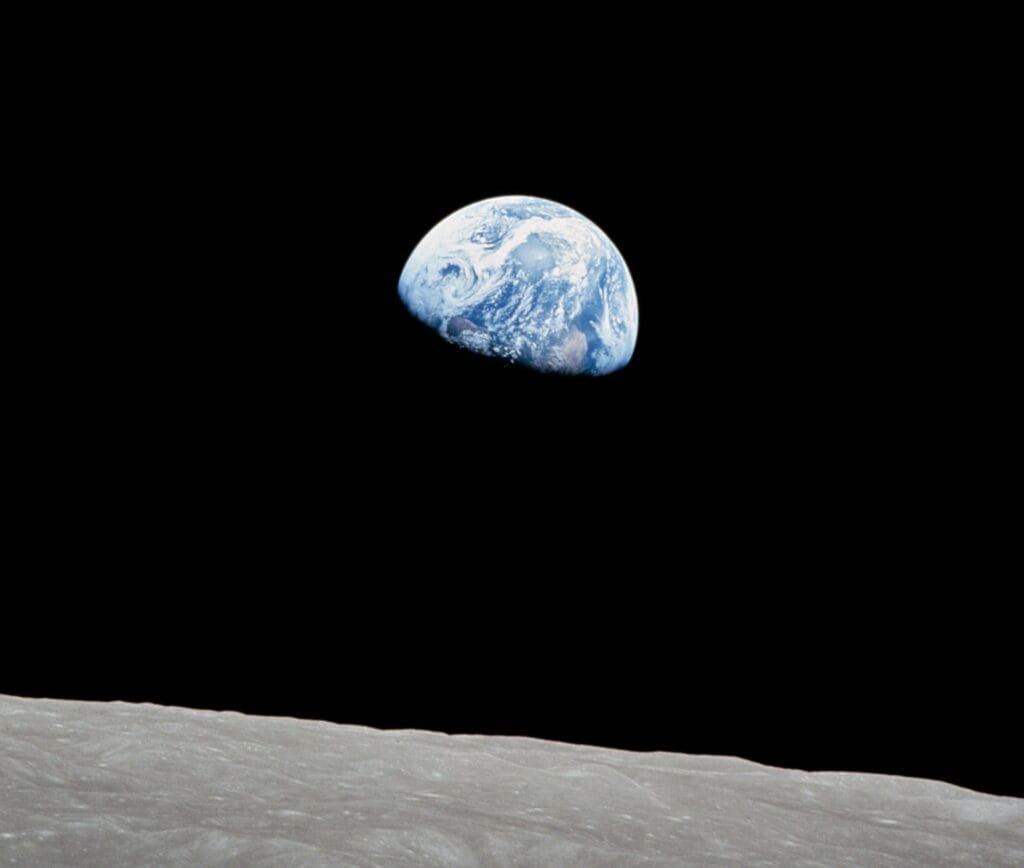
Earthrise (AS08-14-2383), photographed by William Anders on December 24, 1968, Hasselblad 500 EL, 70mm Kodak Ektachrome. Source: NASA / William Anders (Public Domain). NASA rotated the image 95 degrees clockwise before public release. At the moment this frame was exposed, every human being alive — save for three — was contained within that blue disk.
1968: The Year That Made the Image Necessary
The cultural weight of Earthrise cannot be understood without accounting for what 1968 was. In that single year, Martin Luther King Jr. was shot dead in Memphis, Robert F. Kennedy was shot dead in Los Angeles, Soviet tanks crushed the Prague Spring, and the Tet Offensive shattered public confidence in the Vietnam War. The United States was fractured along racial, generational, and ideological lines in ways that seemed, at the time, possibly irreparable. The country needed something it could not name yet.
The timing of the mission itself was driven by Cold War pressure. In 1968, NASA received intelligence suggesting the Soviet Union was preparing to send a cosmonaut around the Moon before the end of the year. Apollo 8’s launch date was moved up by months. The spacecraft had not been fully tested. Borman later calculated the crew had a one-in-three chance of returning alive. That pressure — not scientific readiness — is what put three men in position to accidentally take the photograph.
On Christmas Eve of that year, while the Apollo 8 crew was preparing for a live television broadcast from lunar orbit, Jim Lovell told mission control: “The vast loneliness is awe-inspiring, and it makes you realize just what you have back there on Earth.” That evening, the three astronauts read the opening verses of Genesis and signed off with “Merry Christmas, and God bless all of you, all of you on the good Earth.” The broadcast reached an estimated quarter of the world’s population — one of the largest simultaneous audiences in the history of television at that point.
When NASA released the color Earthrise photograph on December 30, 1968, three days after splashdown, the image landed in a society primed to need exactly what it offered: a view from outside. From 380,000 kilometers away, there were no visible borders, no armies, no assassinations. There was one object, rotating slowly in darkness, that contained every human being alive at that moment in history. The Smithsonian Institution would later describe it as “the most influential environmental photograph ever taken.” President Lyndon Johnson sent a print to every world leader on the planet — a fact documented in Robert Kurson’s 2018 book “Rocket Men,” which draws on mission archives and direct crew interviews.
The Legislation That One Photograph Helped Trigger
The connection between Earthrise and the environmental movement is well documented but frequently reduced to a vague statement about “changing perspectives.” The specifics are more concrete and more striking than that summary suggests.
Wisconsin Senator Gaylord Nelson, who founded Earth Day, later cited the photograph directly as a catalyst for public mobilization. The first Earth Day, held on April 22, 1970, brought 20 million Americans — roughly 10 percent of the national population at the time — into peaceful demonstrations across the country. The Apollo 8 Earthrise image was used in the official logo for that first Earth Day. By the end of 1970, the movement had produced the Clean Air Act and the creation of the United States Environmental Protection Agency. The Clean Water Act followed in 1972. The Endangered Species Act followed in 1973.
This contributed to a wave of legislation that helped shape modern environmental law within a few years. The causal chain is not direct in any simple sense; the environmental movement had roots stretching back to Rachel Carson’s “Silent Spring” in 1962, and to decades of industrial pollution that had made rivers literally flammable. But Kathleen Rogers, president of the Earth Day Network, described Earthrise’s role precisely: “Earthrise was a confirmation of the righteousness of the endeavor, building confidence in what was a scattered movement into something more cohesive.”
This raises a critical question about how historical change actually works. The environmental movement had data, science, and documented harm available to it for years before 1968. None of it achieved what one unplanned photograph achieved in months. The image did not add new information to the public’s understanding of ecological fragility. It shifted the emotional register in which that information was received. That is a different mechanism of change entirely — and it is poorly understood even now.
The Three Men Outside the Frame
When Anders took the photograph, Earth’s population stood at approximately 3.5 billion people. Every one of them was inside the image. The three men looking at the Earth from the window of Apollo 8 were the only humans not visible within that blue disk, even in principle. In that moment, they were the only humans who actually lived the perspective the rest of us could only see in a frame — viewing Earth not as an idea, but as a physical object the size of a basketball held at arm’s length.
Anders reflected on this in a 2018 essay: “We set out to explore the Moon and instead discovered the Earth.” Borman, the commander who had spent the mission trying to keep the crew focused on the flight plan, later described his reaction to the sight of Earth over the lunar horizon as “this is what God sees.” Lovell, who would return to the Moon’s vicinity two years later aboard the nearly fatal Apollo 13, called Earth from that distance “a grand oasis in the big vastness of space.”
What is worth noting is that all three men described a version of the same experience: the Moon, which was the destination, became secondary. The barren gray landscape that Anders had been documenting with professional discipline suddenly struck him as, in his own word, boring. “It was like dirty beach sand,” he told The Guardian in 2018. “Then we suddenly saw this object called Earth. It was the only colour in the universe.”
This raises a question that is easy to overlook: why did trained astronauts, men selected for their ability to stay focused under extreme pressure, stop and stare? The answer is that no amount of training prepares a human brain for seeing home from the outside for the first time. It is like spending your entire life inside a house and suddenly seeing it from a mile away — the structure you knew room by room becomes, in an instant, a single object surrounded by everything that is not it. Anders had that experience at 380,000 kilometers. The photograph is what he brought back.
Bill Anders died on June 7, 2024, when the small plane he was piloting alone crashed into the waters off the San Juan Islands in Washington state. He was 90 years old. In the weeks after his death, the photograph he took in under thirty seconds was reprinted across the front pages of newspapers on six continents. The image that nobody planned to take outlasted the man who made it.
What the Photograph Could Not Change — and Why That Matters
The environmental legislation that followed Earthrise has been partially dismantled, weakened, and contested in the decades since. The EPA has faced repeated budget cuts and regulatory rollbacks. Global carbon emissions in 2024 reached record highs. The photograph that sparked a movement now exists in a world where toxic air still claims millions of lives each year, accounting for an estimated 6.7 million premature deaths according to the World Health Organization’s 2024 data.
This underscores a fundamental limit: a single image, however powerful, cannot sustain systemic change on its own. The photograph changed what people felt; it did not change what people did for long enough to matter at a systemic level. The environmental scholar Adam Rome, writing about Earth Day’s legacy, noted that the bipartisan consensus that made the first Earth Day possible — the coalition of Democrats and Republicans who agreed that clean water and air were worth protecting regardless of party — collapsed in the decades that followed, and no subsequent image has rebuilt it.
There is also a technical footnote that complicates the mythology. Earthrise was not, technically, the first photograph of Earth from the vicinity of another world. NASA’s Lunar Orbiter program had captured robotic black-and-white images of Earth above the lunar surface in 1966, two years earlier. Those images received negligible public attention. The difference between those and Earthrise was color, human authorship, and historical timing. The content alone was not sufficient. The context was doing most of the work.
The Lunar Orbiter images were also framed differently — released as technical documents, not cultural objects. Nobody sent them to world leaders. Nobody used them in an environmental movement logo. The same subject produced almost no response in 1966 and transformed global consciousness in 1968. The difference lay not only in the image itself, but in the context surrounding it.
In April 2026, the crew of Artemis II completed the first crewed lunar flyby since Apollo 17 in 1972 and photographed an Earthset — Earth sinking behind the lunar limb. The images are technically superior to Earthrise in every measurable way. Whether they carry the same weight is a question historians will answer over the next fifty years. Some photographs arrive at exactly the right moment. That moment cannot be manufactured. It can only be recognized after the fact.
FAQ
Q: Who actually took the Earthrise photograph — Borman, Lovell, or Anders?
A: William Anders took all the color Earthrise frames. This was disputed for decades because Borman initially claimed credit in a 1969 Life magazine article. The question was settled definitively using data from NASA’s Lunar Reconnaissance Orbiter in 2013, which reconstructed the exact orbital position and spacecraft orientation at the moment of exposure and matched it to Anders’ camera position at the side window.
Q: Why was the Earthrise photograph rotated before publication?
A: Anders captured the image with the lunar horizon running diagonally across the frame and Earth appearing at the left side. NASA rotated the photograph 95 degrees clockwise before releasing it to the public so that Earth appeared to be rising above the horizon from the bottom of the frame — reinforcing the visual metaphor of a sunrise. The rotation was an editorial decision, not a technical correction.
Q: Has the original Earthrise negative survived?
A: Yes. The original 70 mm Kodak Ektachrome film from the Apollo 8 mission is held in NASA’s archives. The film was processed at R&R Photo Studio in Corpus Christi, Texas, immediately after the mission in December 1968. High-resolution digital scans of the original negative have since been made available through NASA’s image library at images.nasa.gov under catalog number AS08-14-2383.
What You Now Know
The Earthrise photograph was taken on December 24, 1968, by William Anders during Apollo 8’s fourth orbit of the Moon, at 16:39:39.3 UTC — pinpointed using Lunar Reconnaissance Orbiter terrain data. It was not scheduled. Anders shot it in under thirty seconds with a modified Hasselblad 500 EL, no viewfinder, 70 mm Kodak Ektachrome, at 1/250 of a second at f/11. NASA rotated the image 95 degrees clockwise before release. The photograph is widely cited as influencing the environmental movement that led to the Clean Air Act, the EPA, the Clean Water Act, and the Endangered Species Act — all within five years of the shutter click. The man who took it died in June 2024.
Tip for Readers
The next time you see Earthrise — in a book, on a screen, on a wall — look past the obvious. Look at how small the Earth actually is in the frame. Most of the image is black. The planet occupies a fraction of the upper left quadrant. That ratio is the point. The emptiness is not background. It is the actual context in which every human event has ever taken place. Anders understood this the moment he saw it. “We came all this way to the Moon,” he said, “and yet the most significant thing we’re seeing is our own home planet.” He was right. He just hadn’t planned to be.
Verified Sources
NASA Image and Video Library — Apollo 8 Earthrise Archive, images.nasa.gov
NASA Science — Apollo 8 and Earthrise Resources, science.nasa.gov
NASA Goddard Space Flight Center — Scientific Visualization Studio
Smithsonian National Air and Space Museum — Earthrise Resources
Library of Congress — Earthrise Collections
National Geographic — Earthrise Features
Random House — Rocket Men
World Health Organization (WHO) — Air Pollution and Global Health Resources
International Astronomical Union (IAU) — Planetary Nomenclature Records