
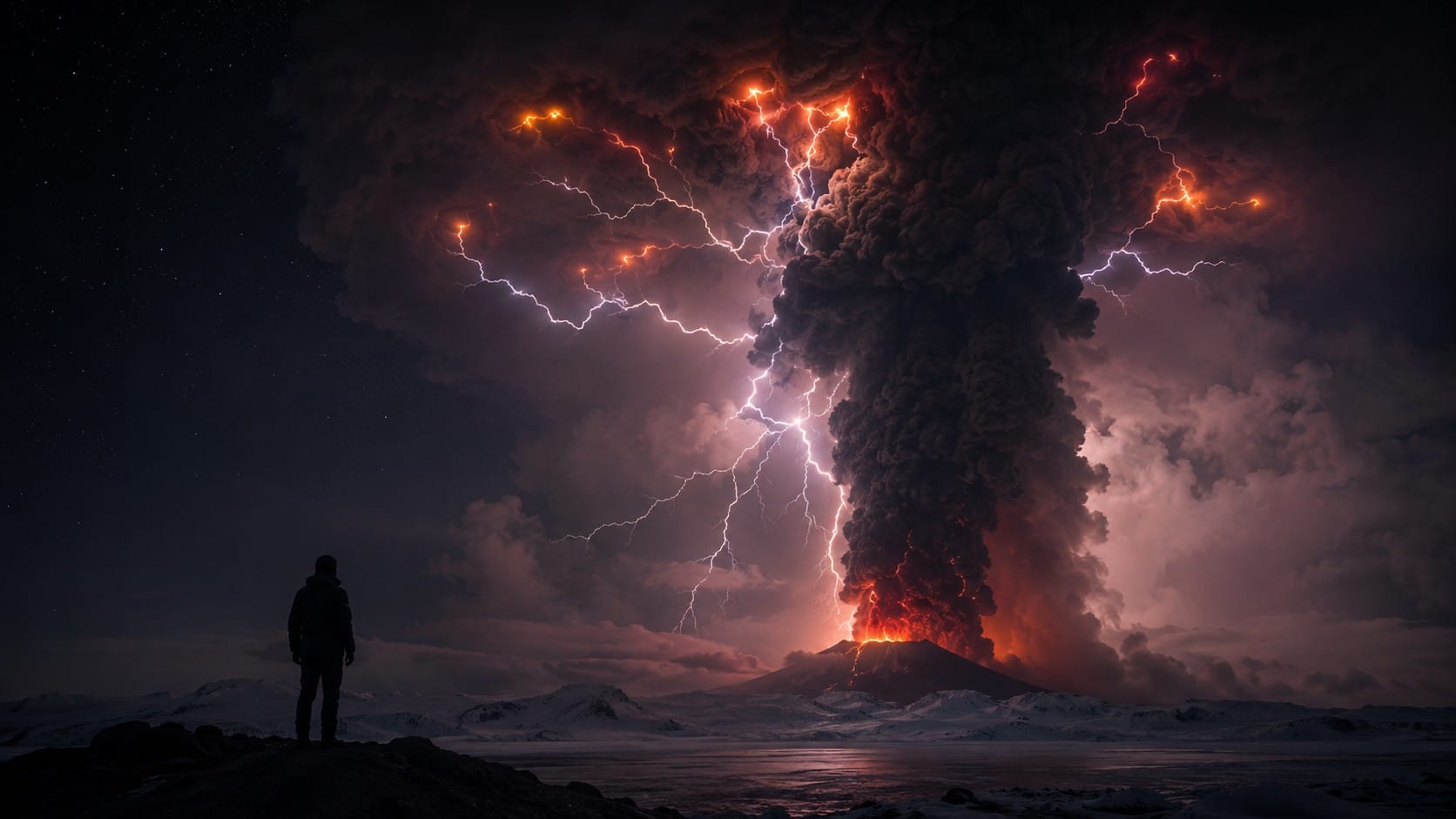
On January 28, 2006, instruments 100 kilometers from Alaska’s Mount St. Augustine detected an intense electrical burst. Within seconds of the eruption, hundreds of lightning bolts tore through the ash column. Some flashes extended over distances approaching 15 kilometers. There were no storm clouds. No cold front. No rain. The electricity came from the eruption itself.
The Augustine event was no freak occurrence. It reveals a process as old as the first volcanoes — and still not fully understood. Scientists call it volcanic lightning. A better name is a dirty thunderstorm — not from clouds, but from ash and rock blasting upward.
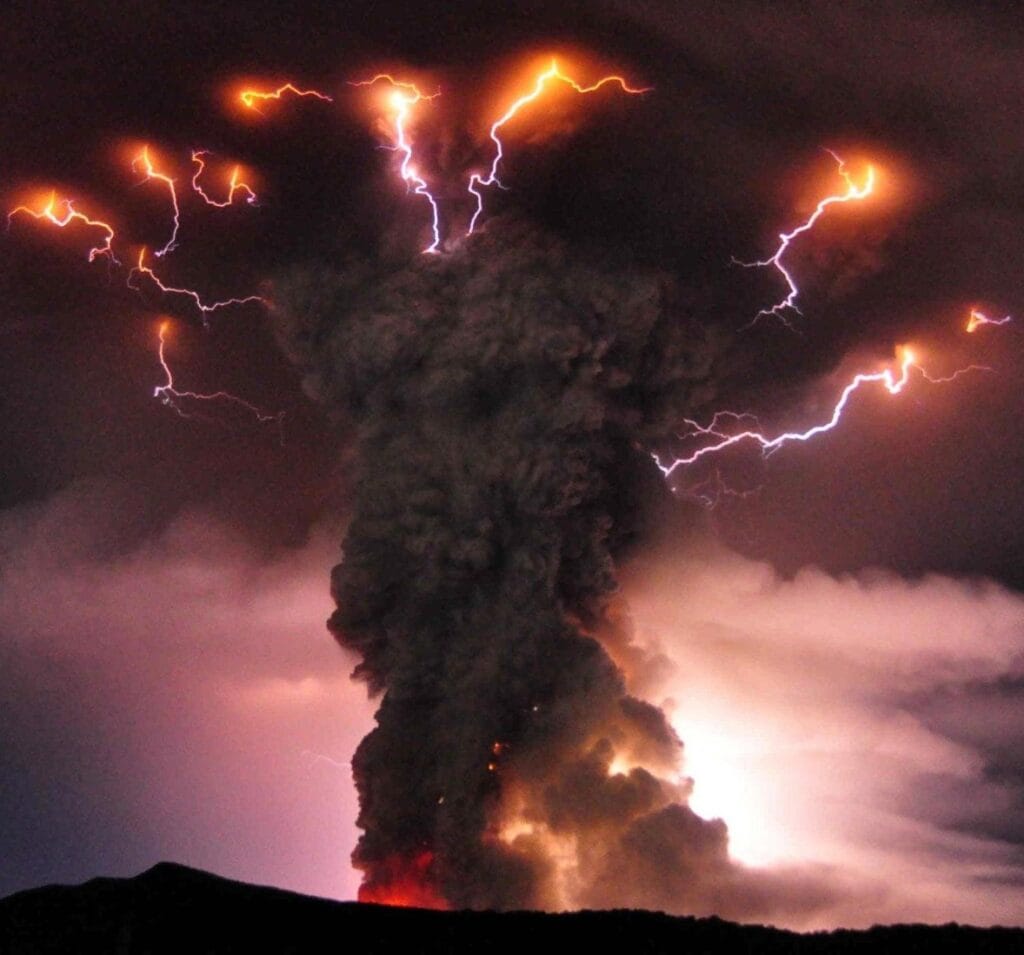
Multiple simultaneous lightning bolts discharge through the ash column during a volcanic eruption, with orange lava glow visible at the base of the plume. Each bolt is generated by triboelectric charging among billions of colliding ash particles. Source: U.S. Geological Survey (USGS), Volcano Hazards Program (Public Domain).
A Record That Goes Back to the Year 79
The earliest documented account of volcanic lightning was not written by a scientist. It came from Pliny the Younger, who watched Mount Vesuvius erupt and bury Pompeii in AD 79. He described the sky above the eruption column as lit by “the transient blaze of lightning” cutting through a darkness so total that torches were useless. He had no framework to explain what he was seeing, but the observation was accurate enough that volcanologists still cite it today.
For nearly eighteen centuries after Vesuvius, volcanic lightning was treated as a curiosity rather than a subject of systematic study. Professor Luigi Palmieri at the Vesuvius Observatory documented electrical activity during eruptions in 1858, 1861, 1868, and 1872, but the instruments available to him were crude. The phenomenon required high-speed cameras and sensors. Only then did researchers start tracking where the charge comes from and how it builds.
Those tools only became available in the late twentieth century, and even now, after eruptions like Eyjafjallajökull in Iceland in 2010, Chile’s Calbuco in 2015, and Taal in the Philippines in 2020 provided researchers with rich data sets, the mechanism is not fully resolved. Volcanic lightning sits between volcanology, atmospheric physics, and electrical engineering. No single field fully claimed it.
Three Ways a Volcano Builds a Charge
When a volcano erupts, it does not simply push rock upward. It injects energy, chemistry, and particles into the atmosphere at velocities and temperatures that overwhelm the surrounding air. As that column rises, charge separation happens through at least three distinct mechanisms, and in large eruptions, all three can operate simultaneously.
The first is triboelectric charging, the same process that makes a balloon stick to a wall after you rub it against your hair. Inside the eruption column, billions of ash particles and rock fragments collide continuously at high speed. Each collision transfers electrons between particles, building opposite charges in different regions of the plume. Think of it as the entire ash cloud becoming a gigantic, chaotic battery. When the charge difference between regions grows large enough to overcome the electrical resistance of the surrounding air, it discharges as lightning. This mechanism dominates in shorter ash plumes, roughly one to four kilometers high, where the column is dense and collisions are most frequent near the vent.
The second mechanism is ice charging. It works by the same physics that generates lightning in ordinary thunderstorms. When an eruption column rises above seven kilometers, it enters air cold enough to freeze the water vapor from the magma, nearby glaciers, and the surrounding atmosphere. Ice crystals form, collide with larger frozen particles called graupel, and transfer charge. Volcanic lightning increases sharply once the plume rises above the freezing level — one of the clearest signs that ice plays a major role in tall eruption columns.
The third mechanism, fractoemission, occurs when rock physically fractures near the eruption vent. The breaking of chemical bonds releases charged particles, and in the violence of an explosive eruption, rock is being fractured on a continuous basis at the point of highest energy. Picture it as shaking a box filled with charged dust — every crack and collision pushes electrons loose and sends them in opposite directions. Fractoemission is thought to produce the earliest discharges in an eruption, the micro-lightning that appears within the first seconds above the crater before the full plume has even developed.
What the 2006 Augustine Data Actually Showed
Ronald Thomas of the New Mexico Institute of Mining and Technology was positioned 100 kilometers from Mount St. Augustine when it erupted in January 2006. His instruments recorded radio wave emissions from every electrical discharge in the column, allowing him to reconstruct in detail what happened electrically during each phase of the eruption.
The first phase lasted only seconds. Immediately above the crater, the instruments detected a dense burst of micro-discharges — thousands of tiny sparks created by fractoemission and triboelectric charging as the initial explosion hurled rock and ash upward at extreme velocity. This phase produced some of the most energetic flashes recorded in the sequence, not because the column was large, but because the charge density near the vent was extraordinary.
Then, about three minutes after the first explosion, a second phase began. More than 300 flashes spread through the growing ash cloud. The longest extended nearly 15 kilometers. The plume was now behaving like a conventional thunderstorm, with charge continuing to build as the column drifted downwind. One instrument registered a bolt four kilometers long that shot vertically from the summit and then broke off horizontally into the moving ash cloud. The discharge is brief but highly energetic.
Why Plume Height Changes Everything
Not every eruption produces volcanic lightning. Scientists have spent years trying to figure out why. Plume height turns out to be one of the most reliable clues — not simply because taller plumes carry more charge, but because the relationship between height and charging mechanism is more complex than it first appears.
In plumes between one and four kilometers high, the primary charging mechanisms are triboelectric and fractoemission. The column stays relatively warm, below the freezing level, so ice does not contribute. Lightning in these shorter plumes tends to cluster near the vent and is often intense but brief, corresponding to the most explosive moments of the eruption. Volcanoes like Japan’s Sakurajima, Italy’s Etna, and Indonesia’s Anak Krakatau produce this type of vent lightning during Strombolian eruptions, with flashes appearing between five and ten seconds after each explosive burst.
In plumes above seven to twelve kilometers, ice charging becomes the dominant mechanism. The water content of large volcanic plumes can exceed that of ordinary thunderstorms — a counterintuitive fact given that volcanoes are associated with fire rather than water. That water, initially released as vapor from the magma and from vaporized glaciers, rivers, or lakes near the volcano, freezes as the plume cools at altitude. The result is an ash cloud that behaves increasingly like a conventional cumulonimbus storm cell, generating sustained lightning activity that can persist long after the initial explosive phase has passed.
Colder ambient temperatures amplify this effect regardless of plume height. An eruption in Alaska or Iceland will generally produce more lightning than an identical eruption in a tropical region, because the atmosphere above the eruption is already closer to the freezing point. A volcano erupting beneath a glacier, as Eyjafjallajökull did in 2010, introduces enormous quantities of ice and water directly into the plume from the moment of eruption, creating conditions for intense electrical activity from the start.
Lightning as an Eruption Detection Tool
The most immediate practical application of volcanic lightning research is aeronautical. More than 200 flights carrying roughly 25,000 passengers travel over North Pacific air routes on a daily basis, many of which pass near or over the volcanically active Aleutian Islands of Alaska. A volcanic ash cloud can destroy jet engine turbine blades, melt ash into glass that coats instrument sensors, and cause total engine failure. Several near-catastrophic encounters with volcanic ash clouds occurred in the 1980s and 1990s before the aviation industry established coordinated ash warning protocols.
The U.S. Geological Survey’s Alaska Volcano Observatory, operating as part of the National Volcano Early Warning System, now uses a combination of seismic data, infrasound sensors, satellite imagery, and lightning detection networks to monitor Aleutian volcanoes in near-real time. Many of those volcanoes are remote enough that no ground observers would detect an eruption for hours. Lightning detection works regardless of visibility, cloud cover, or distance. When an explosive eruption begins at an unmanned Aleutian volcano in the middle of the night, the electrical signature can appear in detection networks within seconds of the first eruption, potentially before the ash cloud has even risen high enough to threaten aircraft.
The Icelandic Met Office, prompted by the extensive lightning from the 2011 Grimsvötn eruption, began experimenting with lightning detection as a supplementary warning system. Scientists at Oxford University measured the triboelectric charging properties of ash from both Grimsvötn and Eyjafjallajökull. They found that ash with a wider range of particle sizes charged more effectively. Grimsvötn ash charged far more easily in lab tests — and produced far more lightning in the actual eruption. The electrical properties of ash may one day help predict how energetic a given eruption’s lightning will be before it starts.
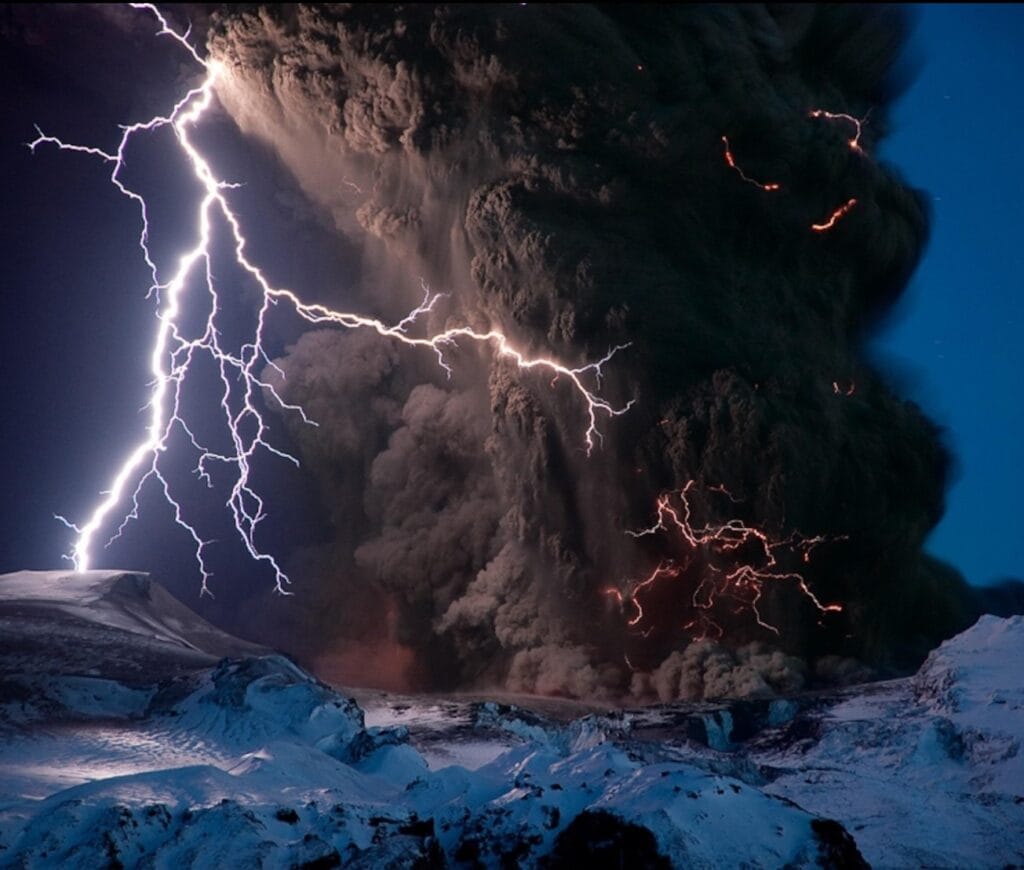
A large-scale lightning bolt discharges through the ash plume of Eyjafjallajökull, Iceland, during its 2010 eruption, with glacier snowfields visible at the base. Source: U.S. Geological Survey (USGS), Volcano Hazards Program (Public Domain). The ice from the surrounding glacier contributed directly to the ice-charging mechanism responsible for the intense electrical activity recorded during this event.
The Origin of Life Argument, and Its Limits
Volcanic lightning carries one more implication that reaches further back in time than any aviation warning system. In 1953, chemists Stanley Miller and Harold Urey passed electrical discharges through a flask containing gases meant to simulate Earth’s early atmosphere — ammonia, methane, hydrogen, and water vapor. Amino acids formed spontaneously. Electricity drove inorganic chemistry toward organic complexity in a sealed container over a single week.
Ordinary atmospheric lightning strikes ocean water in an oxygenated modern atmosphere. Primeval volcanoes, however, concentrated exactly the conditions the Miller-Urey experiment required: water vapor, a reducing atmospheric environment near the eruption plume, inorganic compounds from the magma, and energetic lightning from the column itself. The volcanic vent environment may have been the most chemically suitable site for life’s first molecules.
The evidence for volcanic life-seeding is powerful, yet it stops short of a confirmed conclusion. The volcanic vent hypothesis competes with deep-sea hydrothermal vents, which generate their own chemical gradients without any lightning. Reconstructing the exact atmospheric conditions of Earth four billion years ago remains speculative. Volcanic lightning is a serious scientific candidate for the origin of life — not a confirmed one. The question remains open.
FAQ
Q: Can volcanic lightning be predicted before an eruption happens?
A: Not with the eruption itself, since lightning follows the explosion rather than preceding it. However, USGS monitoring networks at the Alaska Volcano Observatory now use lightning detection as one component of a multi-sensor early warning system. When an eruption begins at a remote, unmanned volcano, the electrical signature from vent discharges can appear in detection networks within seconds, potentially faster than seismic or infrasound alerts in some cases. Research into ash electrical properties could eventually improve predictions of lightning intensity for specific volcanoes.
Q: Is volcanic lightning more dangerous than regular lightning?
A: In terms of individual bolt temperature, volcanic lightning reaches approximately 30,000 degrees Celsius, comparable to ordinary lightning. The primary danger difference is location. Regular lightning strikes exposed surfaces and structures that can be protected with rods and grounding systems. Volcanic lightning occurs inside an eruption column filled with toxic gas, flying rock, and temperatures that no person can survive at close range. A single major eruption can produce hundreds of lightning bolts within minutes — the 2006 Augustine eruption produced more than 300 in one phase alone.
Q: What are lightning-induced volcanic spherules, and where are they found?
A: When a lightning bolt at approximately 30,000 degrees Celsius strikes ash particles inside a volcanic plume, it either vaporizes the particles or melts and rapidly cools them into tiny glass spheres called lightning-induced volcanic spherules. These microscopic orbs form through a process analogous to fulgurites — the glass tubes created when lightning strikes sand — and can survive in volcanic deposits long after the eruption has ended. Geologists have found them in ancient volcanic ash layers, meaning volcanic spherules can serve as geological evidence that a prehistoric eruption produced lightning, even when no observer was present to record it.
What You Now Know
Volcanic lightning is not a side effect. It is the atmosphere’s response when a volcano blasts millions of colliding particles and enormous quantities of water vapor into the sky at extreme velocity. The charge builds through friction, ice formation, and rock fracture — the same physics that drives ordinary thunderstorms, operating here at temperatures and scales no storm cloud ever reaches. A single eruption column can become, within minutes, both a geological event and an electrical one. Scientists now use that electricity to detect eruptions faster than seismic networks alone can manage. The same phenomenon may have catalyzed the first organic chemistry on a young, volcanic Earth. The volcanic column functions as a vertical circuit, connecting the deep earth directly to the electrical state of the atmosphere. The lightning has always been there. Scientists are only now learning how to read it systematically.
Tip for Readers
If you want to track volcanic lightning in real time, the USGS Volcano Notification Service at volcanoes.usgs.gov/vns allows you to subscribe to alerts for individual U.S. volcanoes, including Aviation Color Code changes that are triggered partly by lightning detection data. For the most extensively documented vent lightning displays, eruptions at Sakurajima in Japan have produced some of the richest historical records — the Japan Meteorological Agency maintains a public monitoring archive that includes lightning event records alongside seismic and visual data from each eruption.
Verified Sources
U.S. Geological Survey (USGS) — Volcano Hazards Program and Alaska Volcano Observatory
U.S. Geological Survey (USGS) — National Volcano Early Warning System
Journal of Geophysical Research — Volcanic Lightning Studies
University of Oxford — Volcanic Ash Electrification Research
Bulletin of Volcanology — Volcanic Lightning Research