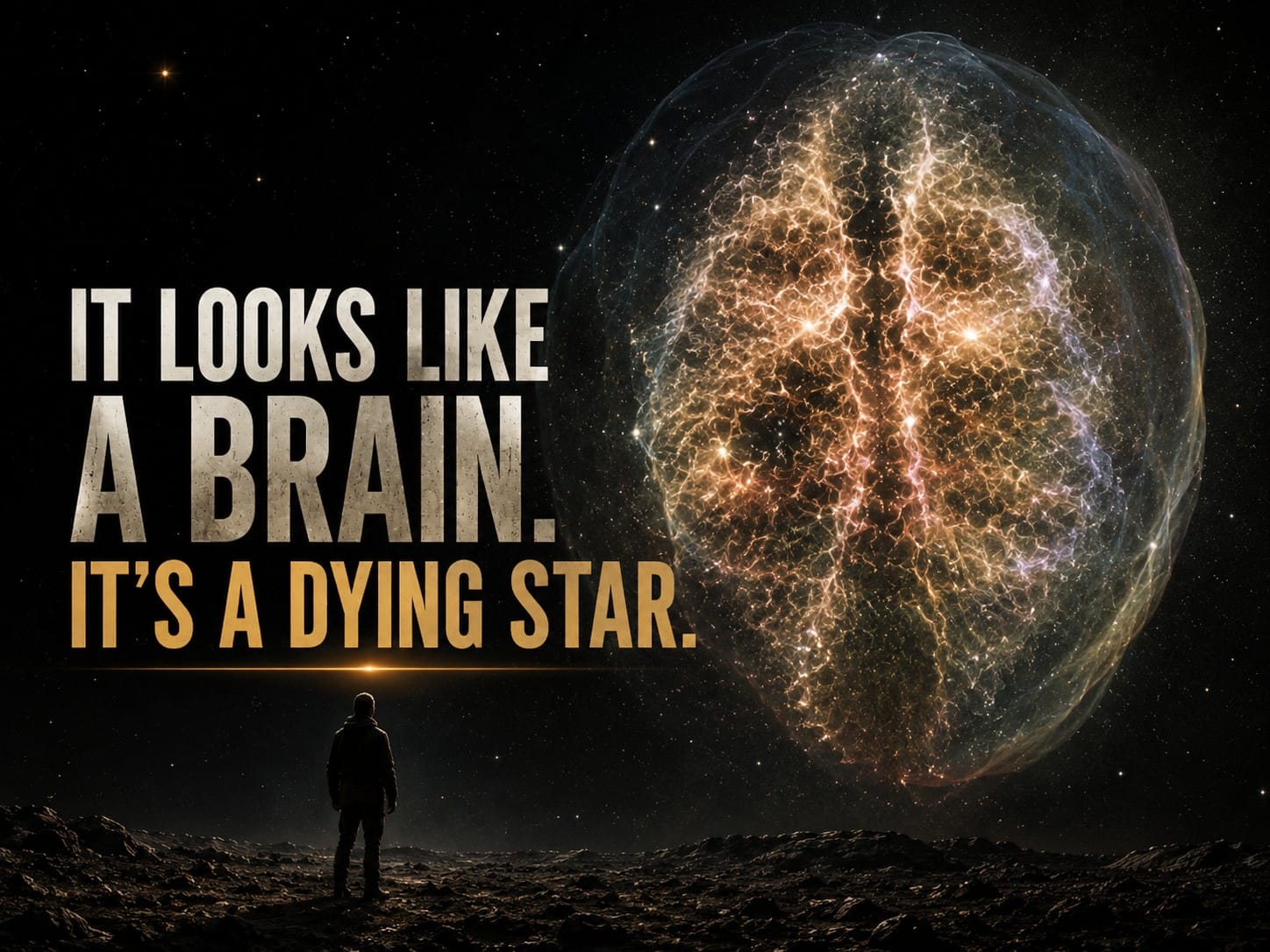
On February 25, 2026, NASA released new James Webb Space Telescope images of PMR 1, a planetary nebula located approximately 5,000 light-years from Earth in the constellation Vela. Many viewers initially thought they were looking at a medical scan. A pale outer bubble reads as a skull. Two glowing inner regions suggest hemispheres of tissue. A dark vertical lane runs down the center like the brain’s longitudinal fissure. To the naked eye, the structure looks remarkably like the internal folds of a human brain. What it actually is, however, is a cloud of gas and dust — the slow-motion disintegration of a star that has been dying for thousands of years.
This pattern has a physical explanation. The resemblance to a brain is not coincidence in any mysterious sense — it is a product of gas dynamics, ejection geometry, and the specific infrared wavelengths in which Webb observes. What matters more is not the resemblance itself but what the image reveals about the object and the limits of how well we currently understand it.
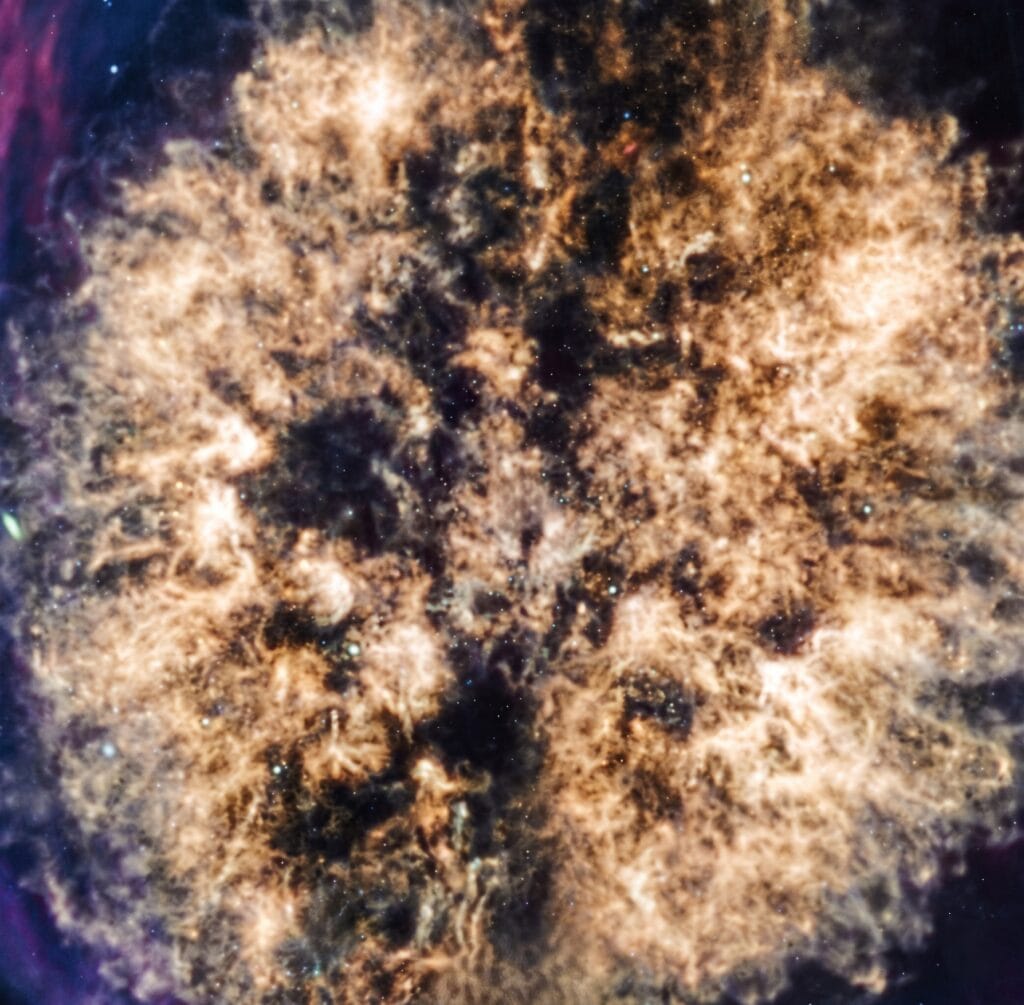
PMR 1, the Exposed Cranium Nebula, captured by the James Webb Space Telescope’s MIRI instrument, February 2026. Source: NASA, ESA, CSA, STScI; Image Processing: Joseph DePasquale (STScI). CC BY 4.0 (Public Domain equivalent for NASA imagery). The pale outer shell is an older hydrogen layer; the inner glowing regions are denser mixed gases ejected in a later phase of the star’s evolution.
What Planetary Nebulae Actually Are
Planetary nebulae are among the more misleadingly named objects in astronomy. They have nothing to do with planets. The term dates to the 18th century, when early telescopes produced low-resolution images and these glowing clouds looked vaguely like the disk of Uranus or Neptune. The name stuck after the true nature of these objects was understood. All planetary nebulae are remnants of dying stars, unconnected to planets in any way.
PMR 1 — also cataloged as IRAS 09269-4923 — is one of these objects. It sits approximately 5,000 light-years from Earth in the constellation Vela, the Sails, a region of the southern sky named after a Roman warship. The nebula spans roughly 3.2 light-years across, meaning that light takes more than three years to travel from one side of the structure to the other. The star at its center is in active decline, losing mass at a measurable rate and exposing its hot inner core to the surrounding gas.
That exposed core is the reason the nebula glows. Ultraviolet radiation from the hot central star ionizes the surrounding gas, causing it to emit light at specific wavelengths. Different gases emit at different wavelengths, which is why Webb’s infrared instruments — each sensitive to different parts of the spectrum — revealed different details within the same structure. What looks uniform to the eye is, in infrared, a layered record of the star’s history of mass loss.
The structure reflects the star’s history of mass loss recorded in surrounding gas.
The Features That Produce the Brain-Like Shape
The pale outer bubble visible in the Webb image is not a skull. It is an older shell of hydrogen gas, ejected first during an earlier phase of the star’s mass loss, expanding outward and now forming the outermost boundary of the nebula. The two glowing inner regions that suggest brain hemispheres are not tissue. They are denser clouds of heavier mixed gases, ejected during a later phase of the star’s evolution, still closer to the center and glowing more brightly under the radiation of the exposed core.
The dark vertical lane running down the center of the structure — the feature most responsible for the brain-like appearance — is likely not a gap in the gas. Current analysis suggests it is connected to a jet or outflow driven by the central star. In NIRCam imagery, it reads as a sharp dark streak. In MIRI imagery, that streak appears connected to paired eruptions at the top and bottom of the nebula, consistent with a bipolar outflow: material being ejected in two opposing directions along the star’s polar axis. The brain’s apparent central fissure is, in this reading, an active structure rather than an absence.
The bright dense region at the core — what some descriptions compare to a brain stem — is the dying star itself, still shedding its outer layers and driving the entire visible structure through its radiation. The faint objects visible in the background of the NIRCam image are actual background stars and distant galaxies, visible through the outer shell of the nebula. The nebula is transparent enough at those wavelengths to show what lies behind it at 5,000 light-years’ distance.
The observed structure is explained by geometry, timing, and infrared wavelength, not biological processes.
What Webb Revealed That Spitzer Could Not
PMR 1 was featured in a Spitzer Space Telescope release in 2013, when scientists first popularized the nickname Exposed Cranium. Spitzer’s resolution was limited, however, and for more than a decade the nebula remained a curiosity with a striking nickname and relatively little structural detail behind it.
Webb changed that on February 25, 2026. Using two separate instruments — NIRCam, sensitive to near-infrared wavelengths, and MIRI, sensitive to mid-infrared — the telescope captured the nebula at a resolution and sensitivity that Spitzer could not match. Webb’s primary mirror is 6.5 meters across, roughly 2.5 times the diameter of Spitzer’s. Webb also operates at significantly lower temperatures, reducing interference from the telescope’s own infrared emission and allowing it to detect fainter signals in the mid-infrared range. This type of multi-wavelength comparison is one of Webb’s key capabilities, and PMR 1 is a useful demonstration of why it matters.
NIRCam’s image shows the outer shell, the glowing inner clouds, and thousands of background stars and galaxies visible through the gas. MIRI’s view suppresses much of that background and instead emphasizes the nebula’s dustier, cooler material, including the bipolar outflow structure at the top and bottom. The dark central lane looks different in each image, revealing that what reads as a simple gap in one wavelength is a dynamically active structure in another. Thirteen years passed between Spitzer’s first close look and Webb’s corrected one.
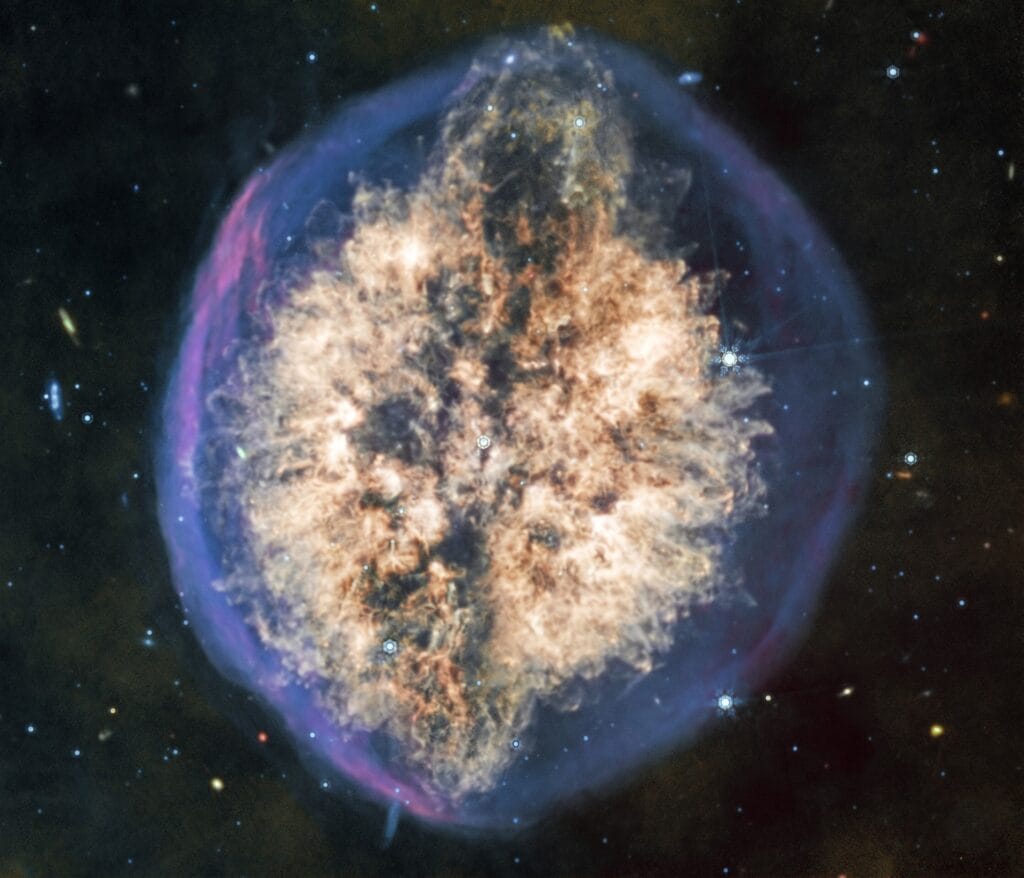
PMR 1 in wider context, captured by Webb’s NIRCam instrument, February 2026. Source: NASA, ESA, CSA, STScI; Image Processing: Joseph DePasquale (STScI). CC BY 4.0. Background stars and distant galaxies are visible through the nebula’s outer shell, demonstrating its partial transparency at near-infrared wavelengths.
Two Stages of Dying, Visible at Once
The Webb image captures multiple stages of the star’s evolution simultaneously, which is one of the features that makes PMR 1 scientifically useful. Stars in the late stages of their lives do not shed material at a constant rate. They go through multiple episodes of mass loss, each with different velocity, composition, and direction. The outer shell of PMR 1 is older material — mostly hydrogen, ejected first and expanding outward for longer. The inner cloud is more recent, consisting of a denser, more complex mix of gases including heavier elements produced during later stages of nuclear burning.
What makes PMR 1 notable among planetary nebulae is that both layers happen to sit at angles and distances that produce the specific visual geometry visible in the image. The alignment is a product of the viewing angle from Earth, not an inherent symmetry in the object itself. Viewed from a different angle, the same nebula would look entirely different. The brain resemblance is, among other things, a consequence of the particular direction from which the constellation Vela happens to face Earth.
Most planetary nebulae do not appear this way, and the observed shape depends on the viewing angle from Earth.
What Happens Next — and Why It Is Not Yet Known
The future of PMR 1 depends on the mass of the central star, which has not been determined with certainty. Some reports describe the central star as Wolf-Rayet-like — a classification associated with very high surface temperatures and strong, rapid mass loss — though its exact classification and current mass remain under investigation.
If the mass is low enough, the star will keep shedding layers until only a white dwarf remains — an Earth-sized core that stays incredibly dense as it cools over billions of years. That is the expected outcome for stars similar to or somewhat more massive than the Sun. If the central star proves to be unusually massive, a supernova remains one possibility, though astronomers have not confirmed that scenario. Under that outcome, rather than a slow fade, the core would collapse under its own gravity and rebound in a shockwave that briefly outshines the entire galaxy.
Astronomers are still actively investigating which path PMR 1 will take. This uncertainty is part of why Webb’s data is scientifically valuable — it provides a high-resolution baseline from which to track how the star and surrounding gas change over time. A single image is not sufficient for full interpretation, and continued observation will be required.
What the Brain Resemblance Actually Tells Us
The tendency to see familiar shapes in astronomical images is called pareidolia — a well-documented feature of human visual processing in which the brain actively searches for patterns, particularly faces and body structures, in ambiguous stimuli. The Exposed Cranium Nebula is a case where that tendency aligns with a genuine structural coincidence: the gas dynamics of a dying star, viewed from a specific angle, at a specific wavelength, happened to produce an image that mirrors a biological structure on the scale of centimeters. The star is 5,000 light-years away and roughly 3.2 light-years across. The brain it resembles fits inside a skull.
This highlights a question about how astronomical images are interpreted when widely shared. The image of PMR 1 spread widely because it looks like a brain. The scientific content — the bipolar outflow, the multi-phase mass loss, the unresolved question of the central star’s fate — received considerably less attention. Webb will release many more images in the coming years. The visual impact of those images and their scientific content are not always the same thing, and they are frequently reported as if they were.
FAQ
Q: Why is it called a planetary nebula if it has nothing to do with planets?
A: The term dates to the 18th century. Early telescopes produced low-resolution images, and these glowing clouds looked to astronomers of that era like the visual disk of planets such as Uranus. The name persisted after the true nature of these objects was understood. All planetary nebulae are remnants of dying stars, unconnected to planets.
Q: How does Webb see things that Spitzer could not?
A: Webb’s primary mirror is 6.5 meters across, roughly 2.5 times the diameter of Spitzer’s. Webb also operates at significantly lower temperatures, which reduces interference from the telescope’s own infrared emission and allows it to detect fainter signals. The result is considerably sharper images across a wider range of the infrared spectrum.
Q: Could the star at the center of PMR 1 become a black hole?
A: Only if it is sufficiently massive. Stars below roughly 8 to 10 solar masses typically end as white dwarfs. More massive stars can produce neutron stars or black holes depending on the core mass at collapse. The central star of PMR 1 has been described as Wolf-Rayet-like in some coverage, implying high mass loss rates, but its current mass and final fate remain undetermined as of April 2026.
What You Now Know
PMR 1 is a planetary nebula located approximately 5,000 light-years from Earth in the constellation Vela, spanning roughly 3.2 light-years. Webb captured it on February 25, 2026 using both NIRCam and MIRI instruments, producing the highest-resolution images of the object to date. The brain-like appearance results from two distinct phases of mass loss — an older outer hydrogen shell and a more recent, denser inner cloud — separated by a dark lane that current analysis connects to a bipolar outflow from the central star. The mass of that central star has not been determined, and whether it will end as a white dwarf or follow a different path remains an open question. The Wolf-Rayet-like classification referenced in some coverage has not been formally confirmed. Planetary nebulae like PMR 1 are the visual record of how stars similar to the Sun end — and the universe produces these structures without reference to biology.
Tip for Readers
In images of space that resemble familiar objects — a skull, a face, a human organ — the resemblance is always a product of viewing angle, wavelength selection, and the human tendency to find patterns in ambiguous shapes. When a Webb image stops you because of what it looks like, it is worth asking separately what physical process produced the shape. Those are two different questions, and popular coverage frequently answers only the first one.
Verified Sources
NASA Science — Webb Space Telescope Observations, science.nasa.gov, 2026
European Space Agency (ESA) — Webb Science Programme, esawebb.org, 2026
NASA Jet Propulsion Laboratory (JPL) / Spitzer Science Center — PMR 1 Observations, 2013
Space Telescope Science Institute (STScI) — Webb Space Telescope Image Processing and Data Release, 2026