

The two bright green cylinders visible through the transparent dome of a barreleye fish are eyes. The radiating filaments, rings of pigment, and dense concentric texture visible in an extreme close-up of a human iris look like something a space telescope photographed. The resemblance is visual and structural, not mystical. This is not accidental. Very different systems can produce surprisingly similar patterns under force. What matters more is not the visual resemblance itself — it is what science has confirmed about the pattern: how it forms, how stable it remains, and why it can serve as a premier biometric identifier.
The iris pattern forms before birth through developmental processes that DNA does not fully control. Once formed, it stays structurally stable for decades. That combination — developmental randomness producing long-term stability — is one factor that differentiates the iris from many other biometric identifiers and what makes it scientifically significant independent of what it looks like under a macro lens.
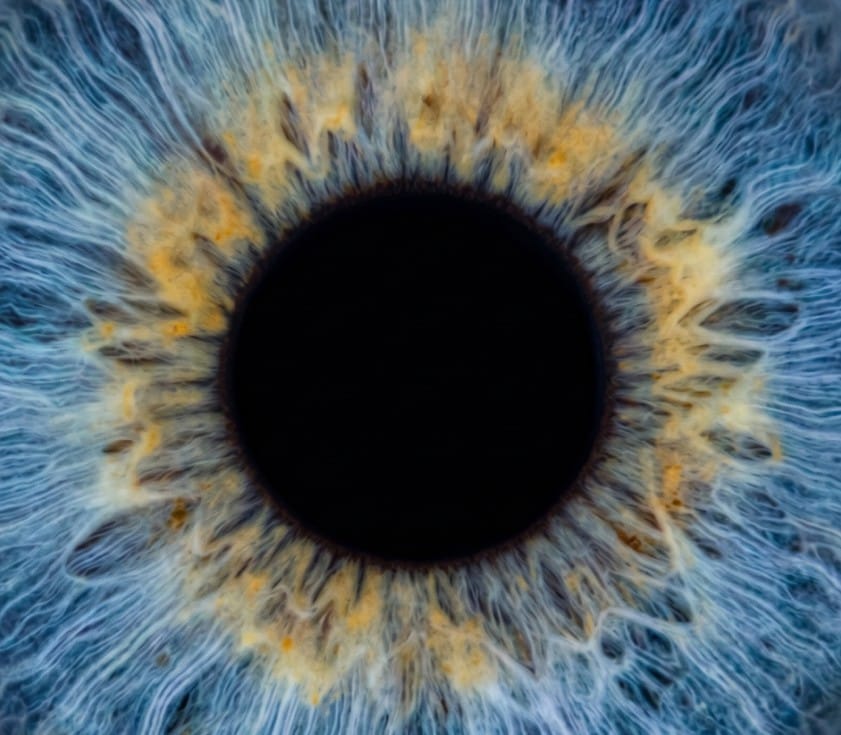
Extreme macro photograph of a human iris showing collagen fiber bundles within the stromal layer. Source: Wikimedia Commons (Public Domain / CC0). The radiating filaments are structural elements of tissue that contracts and dilates repeatedly in response to changing light.
What the Iris Actually Is
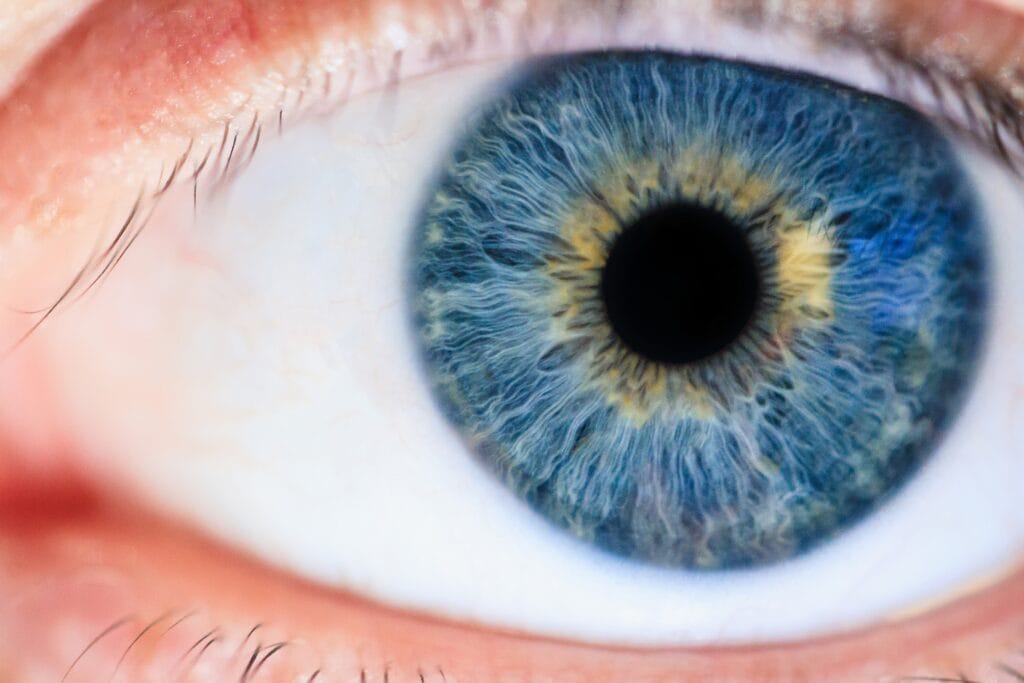
The iris is a thin, circular muscular membrane located between the cornea and the lens, roughly 12 millimeters in diameter in an adult. Its visible surface — the part that produces the pattern — is called the stroma: a layered matrix of collagen fibers, blood vessels, melanocytes, and smooth muscle tissue. As the eye develops before birth, the stromal fibers are shaped by growth, mechanical tension, and small local variations in the embryonic tissue, producing the radial and concentric structures visible in each iris.
At extreme magnification, this fiber architecture becomes clearly visible. The filaments radiating outward from the pupil are not decorative. They are structural elements of a tissue that must repeatedly contract and dilate in response to changing light conditions. The ring visible midway through the iris, called the collarette, is a prominent anatomical boundary and one of the most visually distinctive landmarks from person to person.
Eye color itself is not produced by a single pigment layer. It results from the interplay of melanin density and how light scatters through the stromal fibers — a phenomenon called structural coloration. Eyes with low melanin scatter short-wavelength light, producing blue and gray tones. Higher melanin concentrations absorb more light and produce brown. The blue color results from light scattering rather than pigment. There is no blue pigment in the human eye.
Structure precedes color. The stroma comes first.
Why DNA Cannot Fully Specify This Pattern
Eye development begins early in pregnancy, and the iris continues taking shape throughout fetal development. By the time development is complete, the iris has a structural architecture it will largely retain for life. However, DNA alone doesn’t dictate the iris’s complex, fine-grained texture.
John Daugman of the University of Cambridge, who developed the foundational algorithms for iris recognition and published the defining paper in IEEE Transactions on Pattern Analysis and Machine Intelligence in 1993, described iris texture as “stochastic or possibly chaotic” — shaped by initial conditions in the embryonic mesoderm and ectoderm that are not directly genetically determined. This is one factor that differentiates the iris from many other anatomical features. Height, nose shape, and general eye color are strongly heritable. The fine fiber arrangement of the stroma is not.
Daugman and Downing confirmed this in a paper published in Proceedings of the Royal Society: Biological Sciences in 2001. They found that the fine iris texture shows uncorrelated patterns even between irises sharing the same genotype. Identical twins, who share nearly identical DNA, have measurably different iris patterns. A person’s left and right irises are treated as independent identifiers in biometric systems — not because of convention, but because statistically they behave as if they belong to two different people.
This forces a real question about what genetics actually controls. Genome sequencing can identify disease risk, ancestry, and many physical traits. It cannot produce a copy of your iris pattern. The two types of information are not the same thing.
Each iris pattern is distinct, and even a person’s two eyes show independent structures.
How the Pattern Gets Measured
Using 9.1 million iris comparisons across trials conducted in the UK, USA, Japan, and Korea, Daugman’s 2003 paper in Pattern Recognition inferred approximately 249 degrees of freedom in iris patterns when encoded with Gabor wavelets — a mathematical tool that extracts phase information from localized regions of the iris image, similar in concept to how a prism breaks white light into component wavelengths. This generates a discrimination entropy of about 3.2 bits per square millimeter over the iris surface.
That figure matters because it determines how well the system can distinguish between different people at scale. The IrisCode algorithm encodes a 2,048-bit phase representation of each iris, and comparison between any two codes is performed using a simple XOR operation — fast enough to support real-time exhaustive database searches at national scale. Under the operating threshold of a Hamming distance of 0.26 or lower between two codes, the false match rate in Daugman’s analysis was better than 10 to the power of negative 11. That is a vanishingly small number: fewer than one false match per 100 billion comparisons under those specific conditions.
Standard fingerprint matching systems identify far fewer independent reference points under comparable conditions. The difference is not marginal. It reflects a fundamentally higher density of discriminating information per unit area in the iris compared to a fingerprint ridge pattern.
The comparison to fingerprints is not always framed correctly in popular coverage. Both are biometric identifiers. The iris encodes more degrees of freedom under current measurement methods, which is why it performs better in large-scale one-to-many searches — situations where a single sample must be checked against millions of stored records without a prior candidate list.
Higher information density allows more reliable large-scale identification.
From Algorithm to Airport
The modern history of iris recognition is relatively compressed. In a 1953 clinical textbook, F.H. Adler noted that iris markings were distinctive enough to propose as an identification method. In 1987, ophthalmologists Leonard Flom and Aran Safir filed the first patent for iris recognition as a concept, U.S. Patent 4,641,349. Daugman developed the first working automated algorithm in 1993 and patented it in 1994, U.S. Patent 5,291,560. In 1994, Iridian Technologies became the first company to commercialize the technology.
The UAE national iris recognition program, deployed across all 32 airports starting in 2001, has reportedly processed hundreds of billions of pairwise comparisons using Daugman’s algorithms. Documented field trials reported extremely low false match rates under specific conditions and operating thresholds — figures that are frequently cited without those qualifications in popular coverage, which distorts what they actually mean.
Under ICAO Doc 9303, the international standard governing machine-readable travel documents, facial recognition is the mandatory biometric for e-passports. Fingerprint and iris recognition are specified as optional additional biometrics at the discretion of issuing states. Iris recognition has been deployed in border control, secure access facilities, and national identity programs across multiple countries.
The Indian Aadhaar program began enrolling iris patterns of Indian citizens in 2010 and had processed approximately 393 million enrollments by mid-2013, with roughly one million new enrollments added daily at that point, according to University of Cambridge impact records. The scale of that deployment made it one of the largest biometric databases in existence within three years of launch.
Within a few decades, iris recognition moved from research to large-scale deployment.
Iris recognition scanner used in biometric enrollment testing. Source: NIST (National Institute of Standards and Technology), Public Domain. Near-infrared imaging allows the scanner to capture stromal detail invisible to the naked eye.
The Nebula Comparison and What It Actually Means
The visual similarity between a macro iris photograph and a nebula image is real but requires careful framing. Both show radial branching, concentric rings, and filament-like structures because matter under physical force often organizes in similar ways. This does not mean your eyes and the stars share a mystical bond; it is simply a matter of physics.
This kind of visual overlap belongs to what complexity researchers call convergent morphology: similar forms emerging from similar physical constraints in entirely different systems. The same principle explains why river deltas and bronchial trees look alike, or why lightning and neural dendrites share a branching geometry. The physics is analogous. The systems are unrelated.
What makes the iris worth examining is not the resemblance itself, but the contradiction it sits inside. The pattern forms through processes too variable to be genetically prescribed. And yet, once formed, it remains structurally stable for decades. Some iris identifications have remained reliable over approximately 30 years, according to data cited in the iris recognition literature. A pattern that begins stochastically ends up becoming one of the most stable biometric identifiers known to current science.
That combination is unusual. Most things that form randomly do not stay fixed. The iris does.
What This Technology Still Cannot Guarantee
Performance figures for iris recognition — false match rates, degrees of freedom, stability claims — reflect specific operating thresholds and imaging conditions. A false match rate quoted without those parameters tells you very little about how a system performs in real field deployment. Early deployments used near-infrared imaging under controlled lighting conditions. Performance in airports, border crossings, or mobile enrollment settings with variable lighting and less cooperative subjects differs from laboratory conditions.
Some older or weaker systems have been defeated by high-quality contact lenses with printed iris patterns, though newer systems are specifically designed to detect such attacks using liveness detection and near-infrared response analysis. A flat photograph is generally insufficient to pass modern systems, but the attack surface is not zero.
The comparison between iris and fingerprint biometrics also depends heavily on the evaluation methodology used. Daugman’s figures were derived from specific encoding methods, comparison thresholds, and image quality standards. Different implementations produce different performance profiles. The 249 degrees of freedom figure is not a property of the iris itself — it is a property of the iris as measured by a particular algorithm under particular conditions.
What this really reveals is a gap that recurs throughout biometric science: performance under ideal conditions is not the same as performance under operational conditions. The iris is a strong identifier. It is not an infallible one.
FAQ
Q: Can iris recognition be fooled by a photograph of someone’s eye?
A: A flat photograph is generally insufficient to pass modern systems that use near-infrared imaging and liveness detection. Some older systems have been defeated by high-quality contact lenses with printed iris patterns. Newer systems are specifically designed to detect such attacks, though no biometric system is entirely immune to spoofing under all conditions.
Q: Is the iris really more reliable than DNA for identification?
A: For real-time biometric identification — particularly distinguishing identical twins — iris patterns outperform DNA, which cannot differentiate between individuals who share identical genomes. DNA contains far more biological information overall. The statement is accurate within the specific context of one-to-many database identification, not in a broader biological sense.
Q: Does eye color change affect iris recognition over time?
A: Color can shift slightly in early childhood and rarely in adulthood due to changes in melanin concentration. Biometric iris recognition systems read the structural pattern of the stroma — the fiber architecture — not the color itself. That structural pattern is largely stable after development is complete, which is why long-term identification remains feasible.
What You Now Know
Iris patterns encode approximately 249 degrees of freedom in IrisCode analysis, as inferred by Daugman from 9.1 million iris comparisons published in Pattern Recognition in 2003. That density of discriminating information is sufficient to support exhaustive one-to-many database searches at national scale under documented field conditions. The fine-grained texture that produces those degrees of freedom is not fully specified by DNA — identical twins have distinct iris patterns, and a person’s two irises are treated as independent identifiers in biometric systems. Some iris identifications have remained reliable over approximately 30 years of follow-up. Performance figures for iris recognition reflect specific operating thresholds and imaging conditions. The iris is a strong identifier, but it is not infallible.
Tip for Readers
In reports about biometric systems — national ID programs, airport iris scans, or device authentication — it is worth checking whether the performance figures cited include the operating threshold and imaging conditions under which they were measured. A false match rate presented without those qualifications is not a meaningful data point. The same algorithm performing at better than 10 to the negative 11 under controlled near-infrared conditions may behave very differently in a poorly lit border crossing with uncooperative subjects. The number matters less than the conditions attached to it.
Verified Sources
Daugman, J. G. — “High Confidence Visual Recognition of Persons by a Test of Statistical Independence”, IEEE Transactions on Pattern Analysis and Machine Intelligence, 1993
Daugman, J. G., and Downing, C. — “Epigenetic Randomness, Complexity and Singularity of Human Iris Patterns”, Proceedings of the Royal Society B: Biological Sciences, 2001
Daugman, J. G. — “The Importance of Being Random: Statistical Principles of Iris Recognition”, Pattern Recognition, 2003
United States Patent and Trademark Office — Daugman, J. G., U.S. Patent 5,291,560, Biometric Personal Identification System Based on Iris Analysis, 1994
International Civil Aviation Organization — ICAO Doc 9303: Machine Readable Travel Documents, Part 9: Deployment of Biometric Identification and Electronic Storage of Data in eMRTDs (current edition)
University of Cambridge — Research Excellence Framework (REF) Impact Case Study: Iris Recognition and the Aadhaar Programme, 2013