
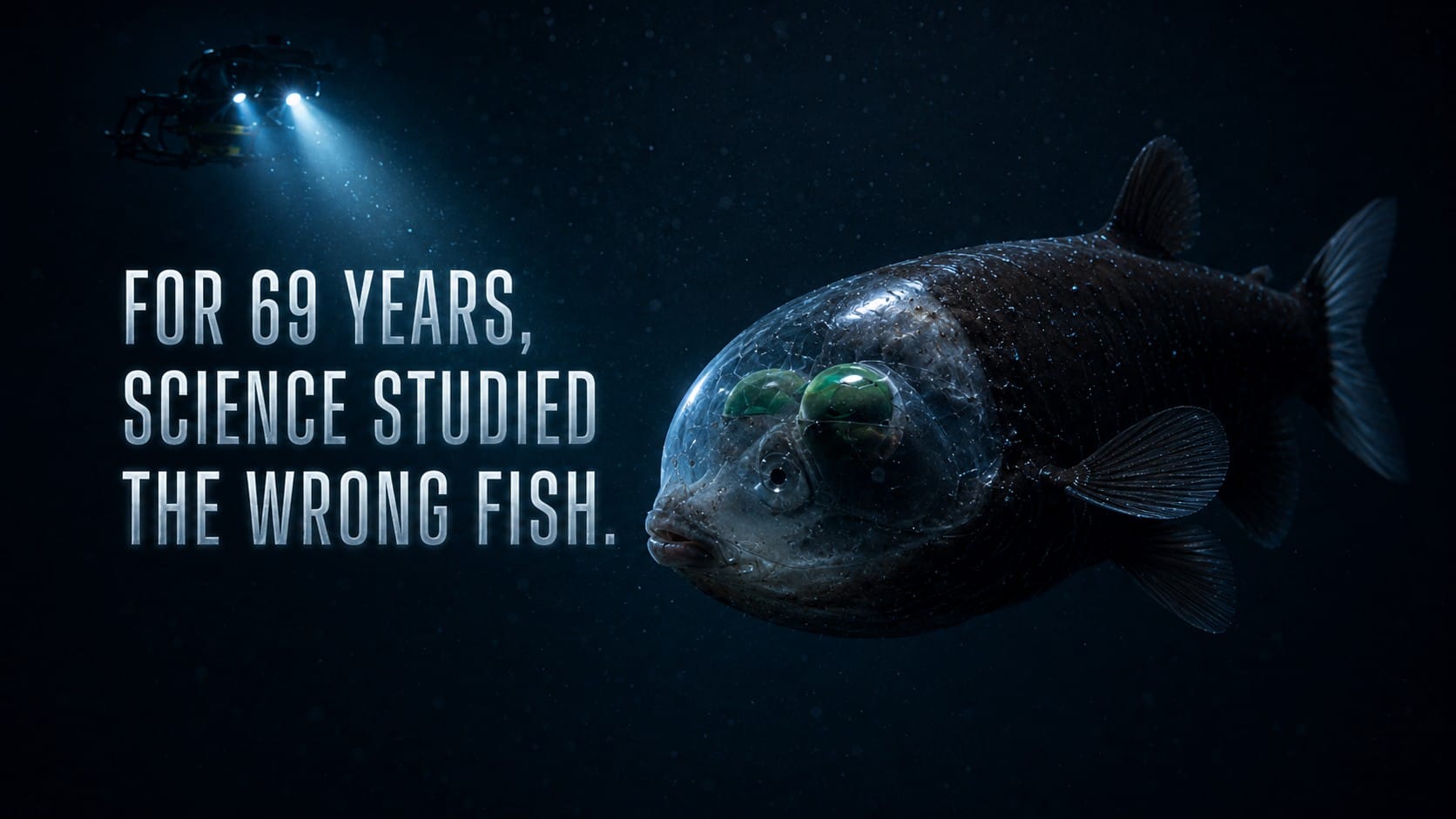
The two dark oval spots sitting just above the mouth of Macropinna microstoma are not eyes. They are nostrils. The actual eyes are the two bright green cylinders buried inside its transparent skull, aimed upward through a fluid-filled dome of soft tissue that covers the entire top of the animal’s head. This was not confirmed in scientific literature until 2008. The problem wasn’t a lack of curiosity; it was that trawl nets destroyed the delicate dome before the fish ever reached the surface. Researchers spent 69 years writing about a fish they had never observed intact in its natural state.
That gap — between what scientists believed and what the animal actually was — wasn’t a failure of intelligence. It was a failure of methodology. The tools used to study the barreleye fish defined what could be known about it, and for nearly seven decades, those tools were trawl nets. What they delivered to the surface was always a partial animal. Understanding what was missing required waiting for technology that didn’t yet exist.
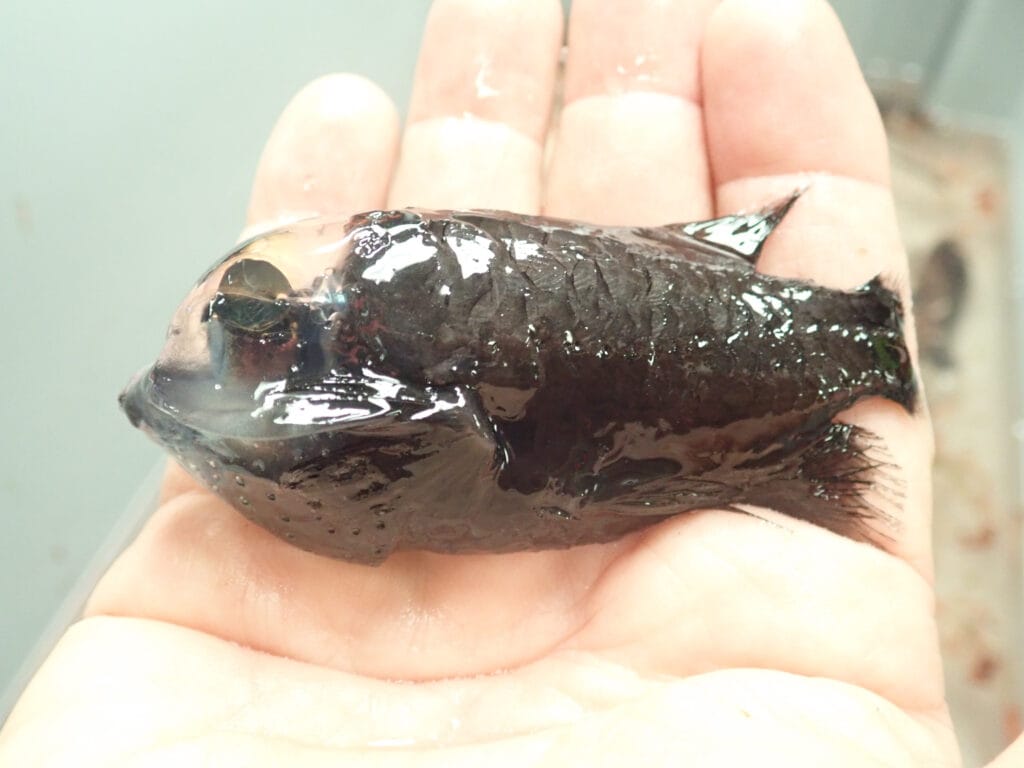
Macropinna microstoma photographed alive at depth by a Monterey Bay Aquarium Research Institute ROV. Source: MBARI (Public Domain). The transparent cranial dome, visible here intact, was unknown to science until this footage was captured in 2004.
A Fish Described From the Wrong Animal
Ichthyologist Wilbert McLeod Chapman first described the species in 1939 using damaged specimens pulled from the North Pacific. He noted the tubular, upward-directed eyes and the unusually small terminal mouth. What he could not note was the transparent dome, because by the time his specimens arrived aboard the research vessel, it was already gone. The pressure change during retrieval from depths of 600 to 800 meters collapsed the soft tissue. The dome, made of fluid-filled connective material flexible enough to allow the eyes to rotate freely inside it, simply did not survive the ascent.
Scientific illustrations of Macropinna microstoma published over the following decades showed the fish as Chapman had received it: eyes intact, dome absent. Those illustrations became the basis for subsequent papers. Over time, later papers repeated this assumption as if it were established fact, and a second problem grew directly from the first. If the eyes only point upward, and the mouth points roughly forward, how does this fish actually catch anything? The two did not connect anatomically under the accepted model. No one had a satisfying answer because no one was looking at the right animal.
The fish that lived at 700 meters was not the fish in the museum drawers. They had never been the same thing.
What an ROV Finally Showed
In 2004, a remotely operated vehicle operated by the Monterey Bay Aquarium Research Institute filmed a living barreleye off central California at approximately 600 to 800 meters depth. The ROV carried high-definition cameras and external lighting capable of illuminating subjects at pressure and temperature conditions that would destroy any conventional sampling equipment. What the footage showed was immediately unlike anything in the published literature.
The fish hung suspended in the water column with its large flat pectoral fins extended, holding its position with almost no visible effort — like a helicopter parked in mid-air. Covering the top of the head was the dome: a continuous, soft, transparent structure extending from just above the mouth to the crown of the skull. Under the ROV’s lights it glowed. The two green cylinders inside it, the actual eyes, were aimed directly upward.
This realization forces us to ask: if the dome was always there, what other parts of this animal have we been misinterpreting because of how we collect them?
The footage from 2004 made a paper possible that had not been possible before. It took four more years for that paper to appear in the literature.
The 2008 Paper That Changed the Record
Bruce Robison and Kim Reisenbichler at MBARI published their findings on Macropinna microstoma in Copeia in December 2008, under the title “Macropinna microstoma and the Paradox of Its Tubular Eyes.” The study revealed two key findings that had not been clearly observed before.
The first was structural. The transparent dome was confirmed as a real, intact anatomical feature: soft, flexible, continuous from mouth to crown, and filled with fluid. It was not an artifact of the live specimens. It was part of the animal’s normal biology, present in every individual that had ever lived at depth, and destroyed in every individual ever brought to the surface.
The second finding was behavioral. ROV footage captured the moment a barreleye detected prey above it, rotated both eyes approximately 90 degrees forward from their resting upward position, tilted its body from horizontal to nearly vertical, and tracked the target while swimming upward. The mouth — which under the old model seemed functionally disconnected from the eyes — was now clearly the terminal point of a coordinated strike sequence. The fish aimed with its eyes, oriented with its body, and intercepted with its mouth. The paradox that had puzzled researchers for six decades dissolved the moment anyone actually watched the fish eat.
Robison and Reisenbichler also succeeded in catching one live specimen in a midwater trawl and transporting it to a shipboard aquarium. It survived for several hours. During that time it confirmed in a controlled setting what the ROV footage had already established: the eyes rotate. The dome did not survive transport intact, but the rotational behavior of the eyes within it was observable even without the dome present.
Sixty-nine years compressed into one paper. The animal had not changed.
What Those Green Lenses Actually Do
Those green lenses aren’t just for show — they serve a specific purpose at these depths. At 600 to 800 meters below the ocean surface, almost all wavelengths of light from above have been absorbed by the water column. What remains is a faint ambient blue-green illumination and the bioluminescent flashes produced by other organisms. This is the visual environment Macropinna microstoma evolved to navigate.
The green pigmentation of the lenses is thought to involve carotenoid-based compounds — the same class of pigments responsible for the yellows and oranges in carrots and salmon. In the barreleye, these pigments are believed to function as a spectral filter. By absorbing certain wavelengths of the ambient downwelling light while allowing others through, the lenses may help the fish distinguish the bioluminescent signals of prey or predators from the background illumination of the water. Think of it like wearing yellow-tinted shooting glasses in low light: the tint doesn’t reduce overall brightness, it sharpens contrast against a specific background.
This has not been conclusively confirmed through direct biochemical analysis, and the precise mechanism of the pigmentation remains an area of ongoing investigation. What is confirmed is that the pigmentation is present in every observed specimen and is consistent across the species. Incidental coloration does not produce that kind of consistency.
The green pigmentation serves a functional role in the species’ visual system.
How Macropinna microstoma Evolved
Macropinna microstoma belongs to the family Opisthoproctidae, a group of deep-sea fish commonly called barreleyes or spookfish. The family contains roughly 20 species across 9 genera, distributed across the Atlantic, Pacific, and Indian Oceans from tropical to temperate zones. All share large tubular eyes, but the optical architecture within the family diverges considerably depending on species.
Dolichopteryx longipes, another opisthoproctid, represents one of the most unusual optical solutions found in any vertebrate. Rather than relying on a lens to focus light from the side and below, it uses a mirror — a reflective surface made of guanine crystals that bounces light onto a secondary retina positioned to capture lateral and downward fields of view. The primary lens handles the upward field. This represents a fundamentally different mechanism rather than a simple variation on the lens-based approach. No known land vertebrate has evolved a mirror-based eye. The deep sea apparently did it at least once.
Fossil evidence published in 2016 described a Macropinna-like specimen from Miocene sediments approximately 10 million years old on Sakhalin Island, Russia. The preserved anatomy showed the characteristic small mouth and elongated pectoral fins of the modern species. If the body plan was already stable 10 million years ago, the optical system driving it was stable too. Deep-sea environments — near-constant pressure, temperature, and light regime — may produce unusually low selection pressure for morphological change once a working solution is in place. The barreleye found something that worked. It has apparently kept it.
What the Data Still Cannot Tell Us
Across approximately 27,600 logged hours of MBARI ROV footage off central California, barreleyes were confirmed approximately 9 times. That works out to roughly one confirmed sighting per 3,000 hours of footage. Whether that reflects a genuinely sparse population, effective concealment behavior, or simply the difficulty of locating a small, slow-moving fish in a vast and poorly lit environment remains undetermined. The IUCN has not assigned a conservation status to Macropinna microstoma because population data are insufficient to support any estimate.
Nearly all behavioral data on this species comes from those 9 sightings, one brief captive observation, and ROV incidental encounters. Lifespan is unknown. Reproductive behavior has not been observed. Feeding frequency and prey selectivity are inferred from anatomy and opportunity, not from direct observation. The animal’s diet is assumed to include small crustaceans and gelatinous zooplankton based on what is known to inhabit the same depth zone, but no stomach content analysis of a fresh specimen has been published in the accessible literature.
This forces a real question about the limits of what we think we know. The 2008 paper corrected a 69-year misunderstanding about the animal’s basic anatomy. That correction required a remotely operated vehicle, a high-definition camera, and four years of analysis. The behavioral questions that remain unanswered may require technologies and observation periods that do not yet exist. The barreleye is better understood than it was in 2007, but the margin between what is known and what is assumed remains wide.
Improved tools often change the kinds of questions scientists can ask.
FAQ
Q: Why did it take until 2008 to confirm the transparent dome on Macropinna microstoma, when the fish was first described in 1939?
A: The dome is made of soft, fluid-filled connective tissue. Every specimen brought to the surface in a trawl net lost it due to pressure change during ascent. Without remotely operated vehicles capable of filming the fish alive at depth, there was no way to observe it intact. MBARI’s ROV program, which produced the footage used in the 2008 Copeia paper, did not exist until decades after the fish’s initial description.
Q: How rare is it to see a live barreleye?
A: Across approximately 27,600 logged hours of MBARI ROV footage, the species was confirmed approximately 9 times. Whether that reflects genuine scarcity or difficulty of detection is unknown. The IUCN has not assigned a conservation status because population data are insufficient.
Q: What are the dark spots above the barreleye’s mouth?
A: Those are olfactory organs, not eyes. The actual eyes are the two bright green cylinders visible through the transparent dome on top of the head. They are typically directed upward when the fish is at rest and can rotate approximately 90 degrees forward when the fish targets prey.
What You Now Know
Macropinna microstoma was formally described in 1939. For 69 years, every published illustration of the species was missing its most distinctive feature — the transparent, fluid-filled cranial dome — because trawl nets destroyed it during retrieval. The 2008 paper by Robison and Reisenbichler at MBARI corrected that record using ROV footage first captured in 2004. The corrected picture showed rotating eyes, an intact dome, and a feeding behavior that made anatomical sense for the first time. The dark spots above the mouth are olfactory organs. The green cylinders inside the skull are the eyes. In approximately 27,600 hours of ROV footage, the fish has been confirmed roughly 9 times. Lifespan, population size, and reproductive behavior remain unquantified as of 2026.
Tip for Readers
When reading deep-sea biology research or watching documentaries about deep-sea species, it is worth checking whether the behavioral claims are based on live observation or on preserved specimens. For many deep-sea animals, the specimen in the museum and the animal in the water are not the same thing. Collection methods can impose physical distortions — collapsed tissue, bleached pigmentation, lost structures — that shape what researchers describe and illustrate. The barreleye is a documented case of this problem running uncorrected for 69 years. It is not likely to be the only one.
More Stories from FramedTruth
The barreleye’s hidden dome is one case of an animal’s real anatomy staying invisible to science for decades. A similar gap runs through the 190-year debate over whether crabs feel pain, where the tools available to researchers — not the animal itself — defined what could be known and for how long. Both stories turn on the same limitation: an animal doesn’t change, but what science can see of it does.
Verified Sources
Robison, B. H. and Reisenbichler, K. R. — “Macropinna microstoma and the Paradox of Its Tubular Eyes” — Copeia, 2008
University of Tuebingen, Department of Zoology — Wagner et al., “Diversity and Evolution of Optically Complex Eyes in Opisthoproctidae” — Frontiers in Ecology and Evolution, 2022
Monterey Bay Aquarium Research Institute — “Researchers Solve Mystery of Deep-Sea Fish With Tubular Eyes and Transparent Head” — MBARI Public Release, 2009
NOAA Ocean Exploration — Gulf of Alaska Seamounts Expedition Summary and Species Documentation, 2024
Image sources: MBARI (Public Domain)