
Do crabs feel pain? For centuries, many scientists dismissed a crab’s reaction to boiling water as mere reflex. Yet a crab hitting boiling water triggers a sequence of physiological events. The animal recoils and sometimes attempts to escape the vessel. Its hemolymph — the fluid that functions like blood in crustaceans — also registers measurable chemical changes within minutes. For a long time, many scientists considered crabs to be largely reflex-driven organisms, incapable of anything resembling pain. Yet the question of whether crabs feel pain became harder to ignore as more evidence appeared. That earlier view proved less definitive than scientists once assumed. Anatomical evidence for a more complicated picture had also been sitting in a London archive since 1835.
The illustration published that year by anatomist Joseph Swan documented the crustacean nervous system with a level of detail that modern scientists still reference. Swan’s work did not prove that crabs feel pain. However, it showed with unusual precision how the system processed sensory information. That system was more organized than the simple reflex model suggested. This made it harder to dismiss the idea that crabs feel pain as nothing more than automatic reaction. What scientists chose to do with that observation took nearly two centuries to fully unfold.
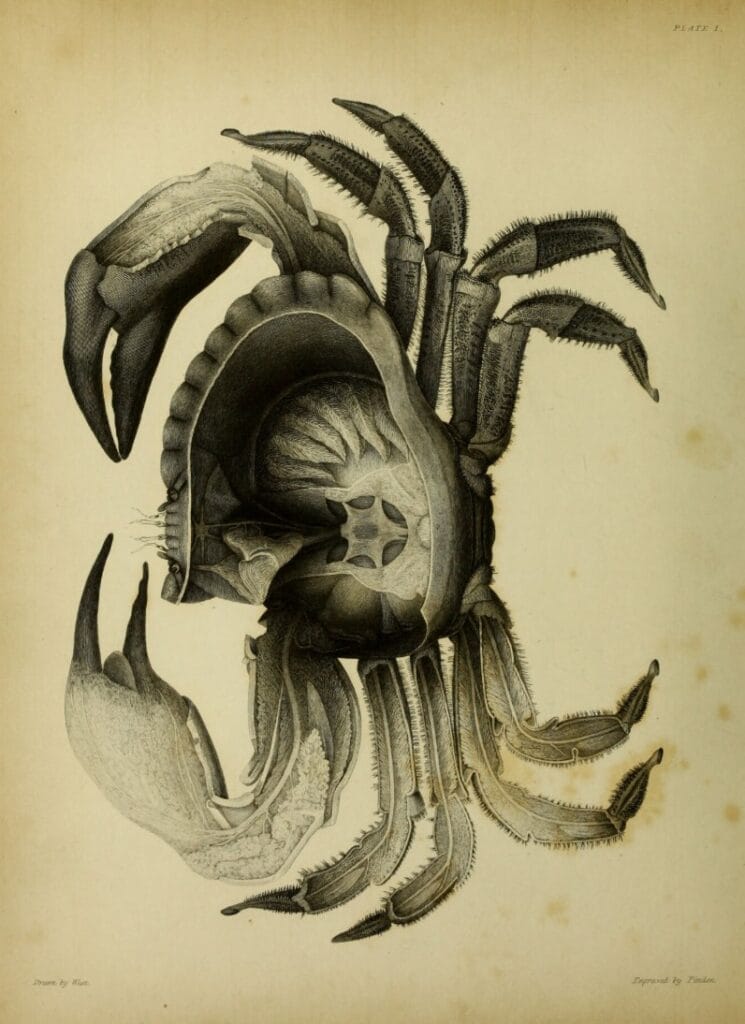
Anatomical dissection of a crab’s nervous system, originally illustrated by Joseph Swan in 1835. Source: Wellcome Collection, London (Public Domain). Swan’s engraving documented the ganglion architecture now central to modern nociception research.
How Crabs Feel Pain: Inside the Crab Nervous System
To understand how crabs feel pain, it helps to begin with their unusual nervous system. The central nervous system of a true crab — classified under the infraorder Brachyura — does not follow the blueprint familiar from vertebrate biology. There is no spinal cord running through the body the way a backbone anchors the nerve highway in mammals. Instead, the crab’s nervous system operates through a series of condensed ganglia: clusters of nerve cell bodies that work as regional processing centers, connected by nerve cords rather than a single continuous trunk. This different design is one reason scientists have had to rethink how crabs feel pain.
The dorsal brain, called the supraesophageal ganglion, has three functional regions. The protocerebrum processes visual information from the compound eyes. The deutocerebrum handles chemical signals arriving from the antennules. These structures work something like a nose embedded in the forehead. The tritocerebrum manages the antennae and connects downward to the ventral nerve cord. If the dorsal brain sounds small, that is because it is. In most true crabs, it is smaller than the tip of a pencil. However, its small size does not settle the question of whether crabs feel pain. Much of the animal’s sensory processing happens elsewhere in the nervous system.
How the Ventral Ganglion Helps Crabs Feel Pain
The real processing center sits lower in the body. During development, the subesophageal, thoracic, and abdominal ganglia fuse into a single enlarged ventral mass. This structure — the ventral ganglion — directly innervates each walking leg, each claw, and all associated sensory organs. Think of it less like a brain and more like a dense switchboard built into the chest cavity, routing signals from every moving part at the same time.
Tinikul’s 2014 study in Microscopy Research and Technique documented this system in the mud crab Scylla olivacea. The researchers identified five neuron size classes, including giant neurons capable of very fast signal transmission. These giant neurons help the crab process sensory information quickly without a vertebrate-style spinal cord. That fast signaling is part of the reason researchers continue to study how crabs feel pain.
This evidence suggests the crab’s system isn’t primitive — it’s just specialized. It is built for the motor demands of a bottom-dwelling animal with ten limbs and complex vision. The absence of a neocortex does not necessarily mean the system is simple. Instead, it reflects a different biological design built to coordinate movement and respond to the environment. That difference matters when scientists ask whether crabs feel pain. Their nervous system cannot be judged only by the standards used for mammals.
How the Evidence That Crabs Feel Pain Changed Over Time
For decades, the argument that crabs cannot feel pain rested on an anatomical premise: they lack the neocortex and anterior cingulate cortex that vertebrates use to process nociceptive signals into conscious experience. The argument was structurally accurate. It was also, researchers began to suspect, incomplete.
In 2009, Robert Elwood and Miriam Appel at Queen’s University Belfast published a study in Animal Behaviour using hermit crabs, Pagurus bernhardus. Researchers shocked the crabs to see if they would abandon their shells. This is a costly move for a crab, and it’s hard to explain away as just a simple, automatic reflex. The shocked hermit crabs showed behavioral trade-offs that researchers interpreted as evidence consistent with pain-related processing: animals weighed the stimulus against the risk of leaving shelter, a calculation that pure reflex cannot explain. This was not just a simple withdrawal response. It suggested a more complex behavioral pattern.
This leads to a bigger question: if the response involves behavioral calculation rather than just a flinch, what is actually being triggered? A reflex arc operates locally and automatically. A decision-like trade-off suggests something more coordinated is being activated, something beyond the simple stimulus-response pattern typically seen in reflex behavior.
The Gothenburg Experiment: Measuring How Crabs Feel Pain
In November 2024, a team at the University of Gothenburg advanced the question further. Researchers placed electrodes on crab shells to record electrical activity from the central nervous system — an approach analogous to an EEG in humans — while applying mechanical pressure and acetic acid to soft tissues at concentrations ranging from 0.1 percent to 10 percent solutions. Lead author Eleftherios Kasiouras and colleagues recorded clear neural signal transmission to the brain. The data showed a clear pattern: the neural response wasn’t flat.
The higher the concentration of acid applied, the larger the amplitude of the electrical response recorded at the central nervous system. This “dose-response” pattern is a big deal in pain research. Simple reflexes usually just fire or they don’t, but here, the crab’s brain signal actually got stronger as the acid got more intense. The graded response the Gothenburg team recorded suggests a more complex processing chain than reflex alone can account for. This pattern is not easily explained by a simple local reflex alone.
The study, published in the journal Biology, confirmed the presence of nociceptors in peripheral tissues and demonstrated ascending neural processing — signals traveling toward the brain, not just away from a stimulus point. The anatomical structures documented in 1835 later became relevant to nociception research, but direct measurement came much later. It is the closest science has come yet to answering, in a laboratory setting, whether crabs feel pain rather than simply react to it.
Why the Law Acted Before Scientists Could Prove Crabs Feel Pain
In 2021, the UK government commissioned the London School of Economics and Political Science to review the available evidence on sentience in decapod crustaceans and cephalopod molluscs. The review, led by Jonathan Birch and colleagues at the LSE Centre for Philosophy of Natural and Social Science, examined over 300 scientific studies. Its conclusion was not that crabs definitely feel pain. Its conclusion was that the weight of evidence met a sufficient threshold to justify precautionary legal protection.
That distinction matters. The reviewers applied a balance-of-evidence standard, not a certainty standard. They were not making a philosophical claim about consciousness. They were making a regulatory judgment about risk. Protecting crabs that may not feel pain adds a regulatory burden to the seafood industry. Failing to protect crabs that may feel pain could result in large-scale welfare concerns. The LSE team concluded that the second risk outweighed the first.
How UK Law Recognized Crabs as Sentient
The UK Animal Welfare (Sentience) Act 2022 incorporated their recommendation. Decapod crustaceans — including crabs, lobsters, prawns, and crayfish — were explicitly listed as sentient beings under UK law. The UK remains one of the clearest examples of statutory sentience recognition for decapod crustaceans. In practical terms, the legislation required that any future government policy affecting decapod welfare be assessed through an Animal Sentience Committee, a body with the authority to report to Parliament if it believes policy decisions have failed to give adequate weight to animal sentience.
How the Seafood Industry Responded to Crab Pain Concerns
The passage of the Act was not unopposed. Several seafood industry groups argued that the scientific evidence did not meet the threshold required for regulatory intervention, and that extending sentience protections without clear proof of conscious experience set a legally imprecise precedent. Some critics felt the LSE study relied too much on behavioral data. They argued that without direct proof of what a crab “feels,” these physical reactions shouldn’t be weighted so heavily. Birch’s team responded that waiting for certainty in consciousness science — a field that has not resolved these questions even for many vertebrate species — was itself a policy choice with welfare consequences.
The commercial implications were immediate in some sectors. Several UK seafood processors adopted the CrustaStun, a device developed collaboratively by Bristol University and Charlotte and Simon Buckhaven in 2009 that electrically stuns and kills crabs and lobsters before processing, reducing the duration of any presumed pain response during slaughter. The device was not legally mandated, but its adoption reflected the shift in the legal and ethical landscape the 2022 Act created.
The Gap Between Signal and Suffering
Here is where the science stops and the harder question begins. Nociception — the detection of harmful stimuli and the transmission of neural signals — is not the same thing as pain. Every organism with a nervous system, including organisms we are confident cannot suffer, can exhibit nociceptive responses. Plants close their leaves when damaged. Sea anemones retract when touched. The presence of a sensory detection mechanism does not establish that the organism experiences anything.
Pain, in the technical sense that matters for welfare, requires more than signal detection. It requires that the organism experience the signal as aversive — that there is, in the philosopher Thomas Nagel’s framing, something it is like to be that organism in that moment. Whether crabs possess the neural substrate for that kind of subjective experience is a question that current neuroscience cannot answer with certainty.
This forces a deeper question: are we measuring reaction, or experience? The Kasiouras data shows graded electrical responses in the crab central nervous system. But electrical activity in a ganglion does not tell us whether there is awareness behind it, any more than the electrical signals in a thermostat tell us the thermostat is cold.
Why Crabs Feel Pain Is Still Difficult to Prove
Critics of extending pain frameworks to crustaceans — including some invertebrate neurobiologists — argue that behavioral flexibility and systemic physiological responses can be explained entirely through mechanisms that do not require consciousness. A crab that avoids a previously shocked location may be exhibiting associative learning without experiencing fear. A crab whose hemolymph chemistry shifts under stress may be responding to damage signals without suffering. These alternative explanations are not refuted by the current evidence. They are simply not the only explanations the evidence supports.
Think of it this way: a smoke detector responds to heat and activates an alarm. No one argues the smoke detector is suffering. The question is not whether the crab’s nervous system detects and responds to damage — that is now supported by direct measurement. The question is whether there is a crab experiencing that detection. Current neuroscience does not yet have a reliable way to answer that question.
Why Scientists Still Cannot Prove Crabs Feel Pain
The 2021 LSE review was careful about this boundary. Its authors acknowledged that the evidence for subjective experience in decapod crustaceans is inferential. This is why the question of whether crabs feel pain remains difficult to prove with certainty. Crabs cannot report their internal states. Researchers cannot conduct the kind of self-report studies that form the backbone of human pain research. Everything known about crab pain comes from behavioral and physiological proxies — measurements of what crabs do and what their bodies produce, rather than what they feel.
The LSE team applied eight criteria for assessing sentience evidence, drawn from the Cambridge Declaration on Consciousness and subsequent literature. Decapod crustaceans met five of the eight criteria. The unmet criteria involve higher-order thinking. Specifically, researchers haven’t yet proven that crabs can represent their own mental states or show the kind of flexible behavioral control found in vertebrates. That missing evidence is one reason scientists still cannot say with certainty that crabs feel pain. Meeting five of eight was sufficient for the review’s precautionary recommendation. It was not sufficient to claim scientific certainty.
What Future Research Could Reveal About Whether Crabs Feel Pain
Several research teams are pursuing that work. The University of Gothenburg group has indicated interest in follow-up experiments examining whether crabs modify behavior in ways that require memory for aversive experience, rather than simple reflex conditioning. The distinction — reflex conditioning versus memory-informed avoidance — is one of the sharper empirical lines future research may be able to draw. If crabs show consistent behavior changes in new situations, it would be harder to explain with reflex alone and could strengthen the case for sentience. Future experiments may therefore help answer more clearly whether crabs feel pain rather than simply react to harmful stimuli.
FAQ
Q: Do crabs have a brain?
A: Yes, though it is organized differently from vertebrate brains. A crab’s dorsal brain — the supraesophageal ganglion — is very small, often smaller than the tip of a pencil. The primary processing center is the ventral ganglion, a larger fused structure lower in the body that controls limb movement and integrates sensory data from the legs and claws.
Q: What Did the Law Decide About Whether Crabs Feel Pain?
A: The United Kingdom did so through the Animal Welfare (Sentience) Act 2022, which explicitly listed decapod crustaceans — including crabs, lobsters, prawns, and crayfish — as sentient beings under UK law, following a 2021 government-commissioned review by the London School of Economics. The UK remains one of the clearest examples of statutory sentience recognition for these animals.
Q: What Does Nociception Tell Us About Whether Crabs Feel Pain?
A: Nociception is the detection of harmful stimuli by sensory receptors and the transmission of those signals through the nervous system. Pain is the subjective experience of that signal as aversive — it requires consciousness. The 2024 Kasiouras study confirmed nociceptors and ascending neural signals in shore crabs. Whether crabs consciously experience those signals as suffering remains scientifically unresolved.
What We Know About Whether Crabs Feel Pain
Crabs possess confirmed nociceptors — peripheral sensory receptors that detect harmful stimuli and transmit signals to the central nervous system. The 2024 Kasiouras study at the University of Gothenburg recorded graded electrical responses in the crab brain proportional to stimulus intensity, a pattern difficult to explain as a simple reflex. The 2009 Elwood and Appel study documented behavioral trade-offs in shocked hermit crabs that researchers interpreted as consistent with pain-related processing. The UK Animal Welfare (Sentience) Act 2022 legally recognized decapod crustaceans as sentient under UK law. None of this confirms that crabs consciously experience suffering. Nociception and subjective pain are distinct biological phenomena, and current science has evidence for the first while the second remains an open question.
Tip for Readers
When you encounter media coverage of live-boiling debates, seafood welfare legislation, or restaurant practices involving live crustaceans, look for whether the reporting distinguishes between nociception and conscious suffering. Most coverage collapses the two, treating “crabs feel pain” as either settled fact or dismissed myth when the honest answer sits in between. The presence of pain receptors and ascending neural signals is now supported by direct neurobiological measurement. Whether there is an experiencing subject behind those signals is not established. That gap — between detection and experience — is where the genuine scientific uncertainty lies, and it is the question that both animal welfare advocates and industry groups routinely skip past in opposite directions.
More Stories from FramedTruth
The question of whether crabs feel pain is really a question about how confident science can be in senses it can’t directly experience. That same blind spot shows up in The Fish With Eyes Inside Its Head, where a deep-sea fish’s transparent skull forced researchers to admit they had misread its entire sensory anatomy for decades. Both stories turn on the same uncomfortable fact: an animal’s inner experience is often the last thing science manages to see clearly.
Verified Sources
Elwood, R. W. and Appel, M. — “Pain Experience in Hermit Crabs?” — Animal Behaviour, 2009
Kornthong, N., et al. — “Neuronal Classification in the Central Nervous System of the Mud Crab” — Microscopy Research and Technique, 2014
Birch, J., et al. — “Review of the Evidence of Sentience in Cephalopod Molluscs and Decapod Crustaceans” — London School of Economics, 2021
UK Government — Animal Welfare (Sentience) Act 2022
Kasiouras, E., Hubbard, P. C., Gräns, A., and Sneddon, L. U. — “Putative Nociceptive Responses in a Decapod Crustacean: The Shore Crab Carcinus maenas” — Biology, 2024
Swan, Joseph — Illustrations of the Comparative Anatomy of the Nervous System, 1835
Image sources: Wellcome Collection, London (Public Domain)