
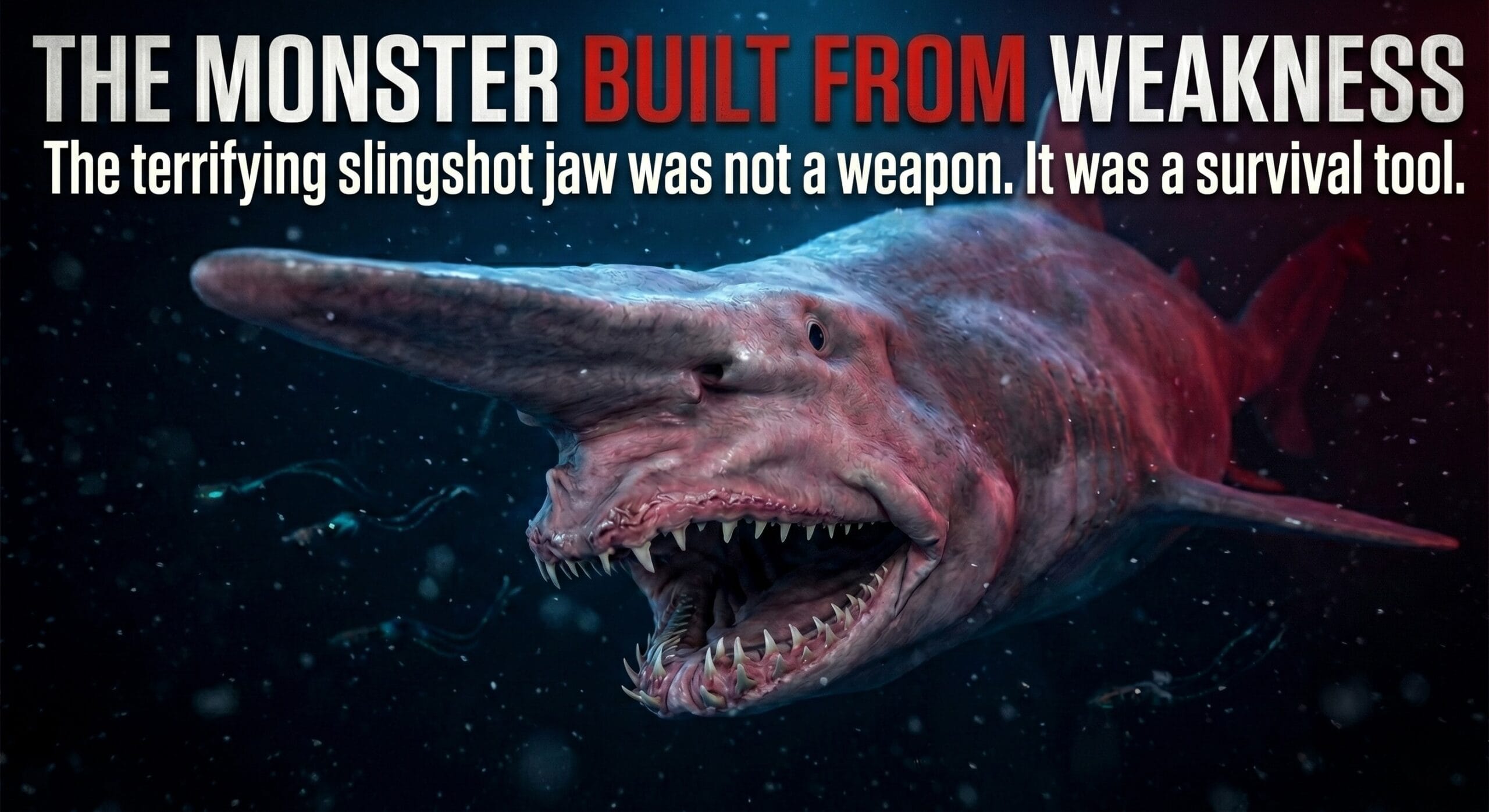
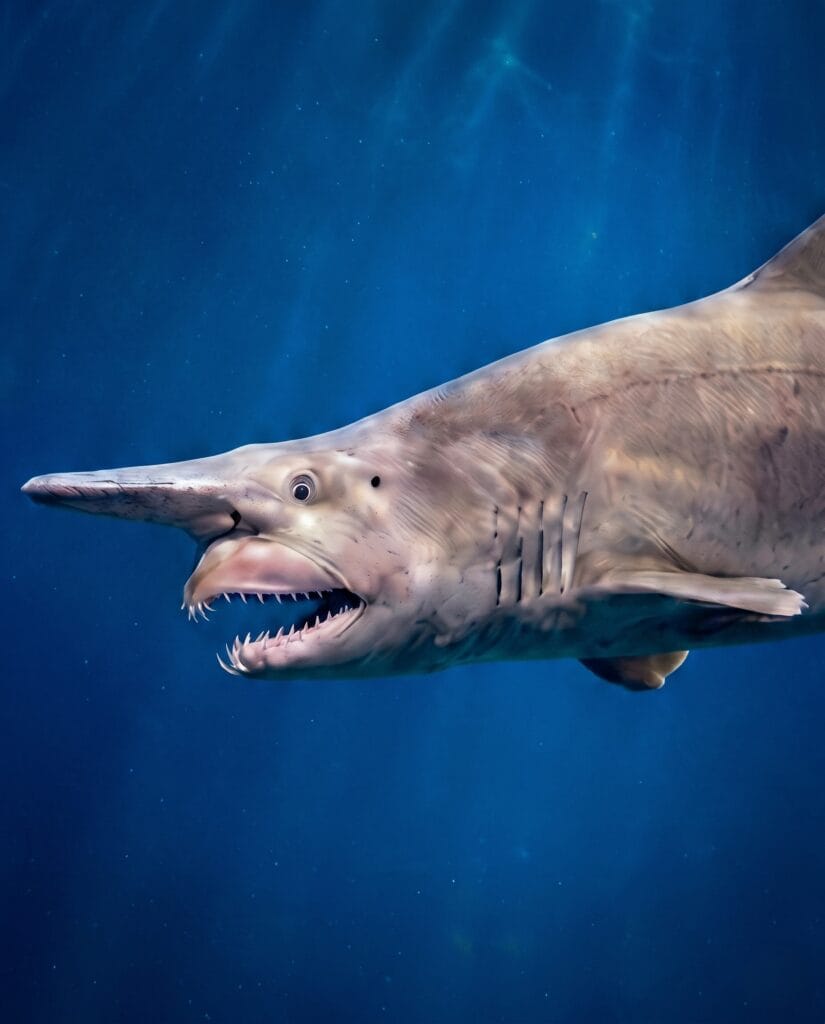
One look at its face and your brain files it under monster. The long blade of a snout. The pink, sagging jaw that looks like it was stitched on wrong. You decide what it is in half a second, and you are very likely wrong.
Most people never get past the teeth. They see a deep-sea nightmare, feel a small shiver, and move on. In doing that, they walk straight past one of the strangest survival stories the ocean has ever handed us.
In 1898, scientists formally described a strange young shark hauled from deep water off Japan, a single specimen barely a meter long. They gave it a name that sounds cursed and a reputation it never earned. More than a century later, the most important question about this animal still has no answer.
Its Name Was Never a Curse
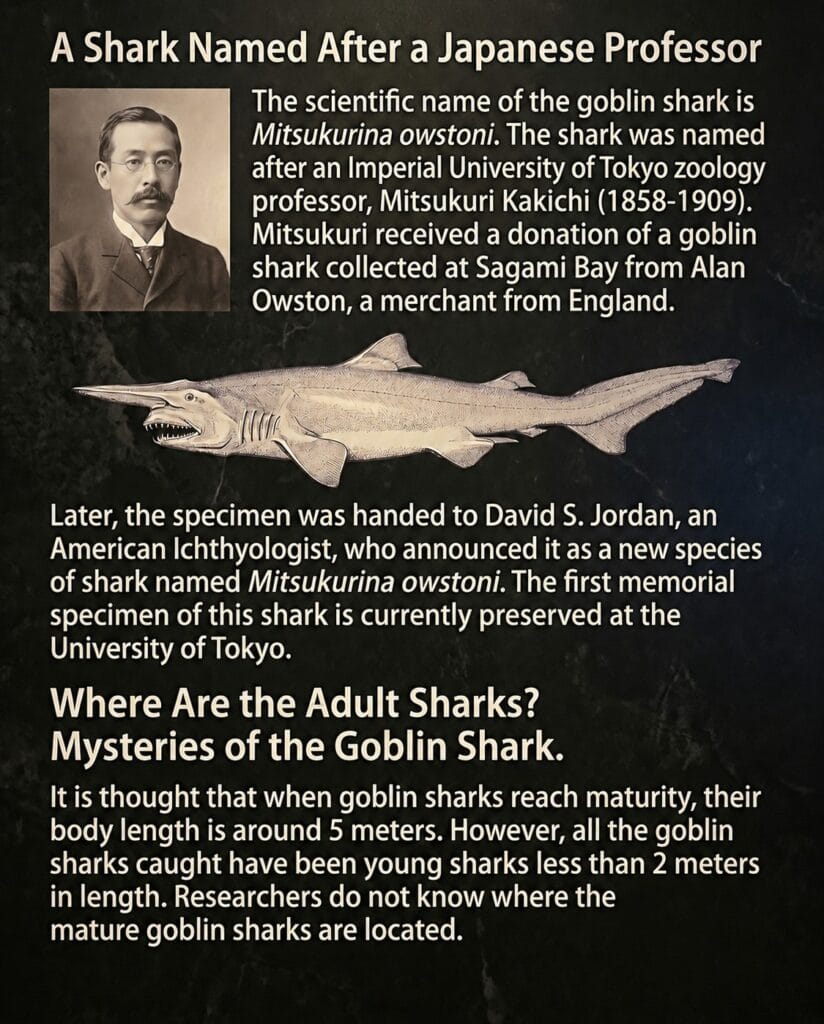
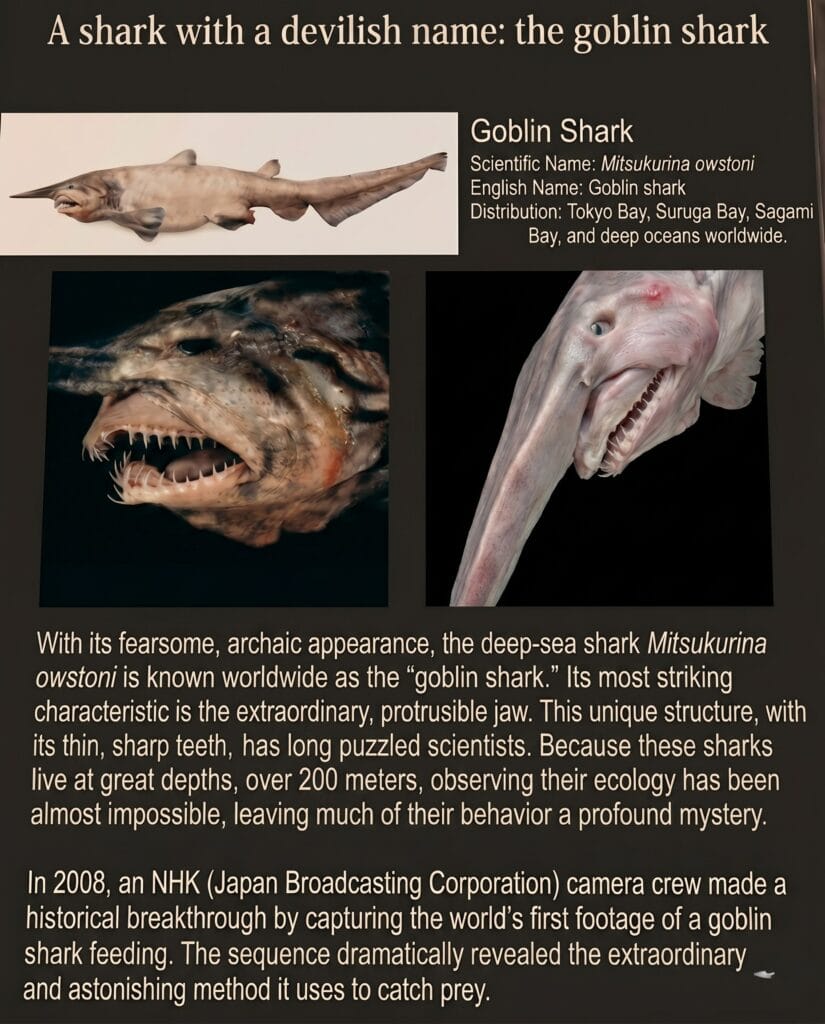
Goblin shark. Say it out loud and it sounds dragged out of a folktale. The English name is a translation of an older Japanese one, tenguzame, after the tengu, a long-nosed creature from Japanese myth. So far the legend holds.
Then you learn where the scientific name came from, and the spell quietly breaks. Mitsukurina owstoni. Two surnames. Two living men.
In the 1890s a bizarre shark caught in Sagami Bay near Yokohama passed through the hands of Alan Owston, an English merchant and collector based in Japan. He gave it to Mitsukuri Kakichi, a zoology professor at what is now the University of Tokyo. The American ichthyologist David Starr Jordan studied the specimen and described it in 1898 as an entirely new family of shark, naming it after both of them.
That first specimen was an immature male, only about 107 centimeters long. It was unusual enough that Jordan described not only a new species, but also a brand-new genus and family, which almost never happens.
The demon face hid a strangely human truth. This nightmare creature was not named after a real demon at all. It was named after two ordinary men who simply paid attention. Hold that thought, because almost everything people assume about this shark turns out to be wrong.
The Fastest Jaw in the Sea Belongs to One of the Slowest Swimmers
Here is the strange part. For around 110 years after that first specimen, nobody had ever seen this shark hunt. We had its body, its name, its teeth, and no idea how it actually caught anything.
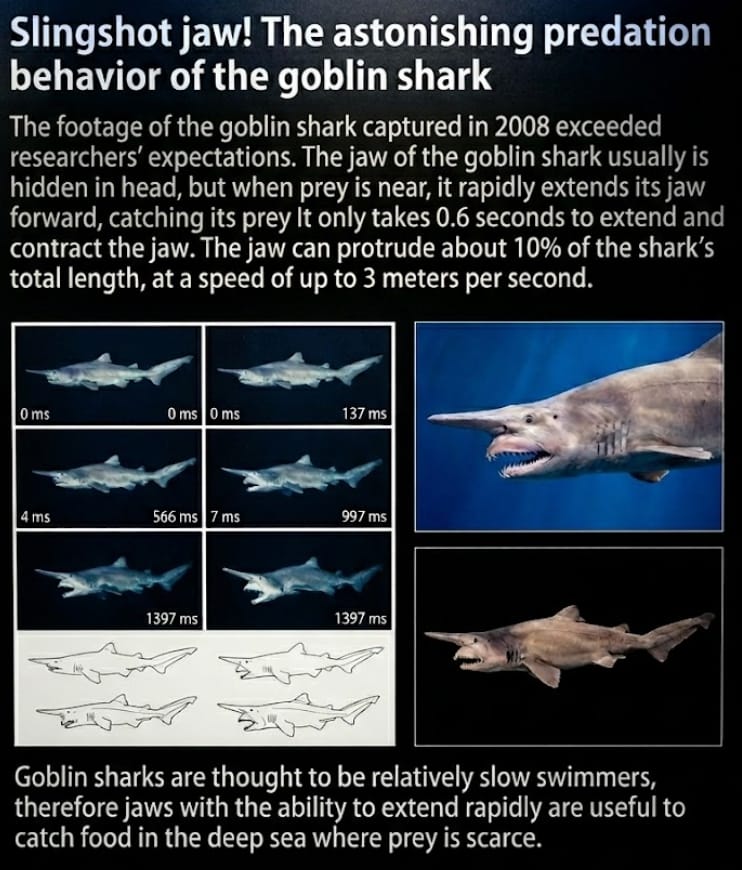
The animal lives below the reach of light, usually deeper than 200 meters, so its daily life stayed a blank. The footage that cracked the mystery open came from the Japanese public broadcaster NHK, which recorded two goblin sharks striking at prey on five separate occasions in the deep.
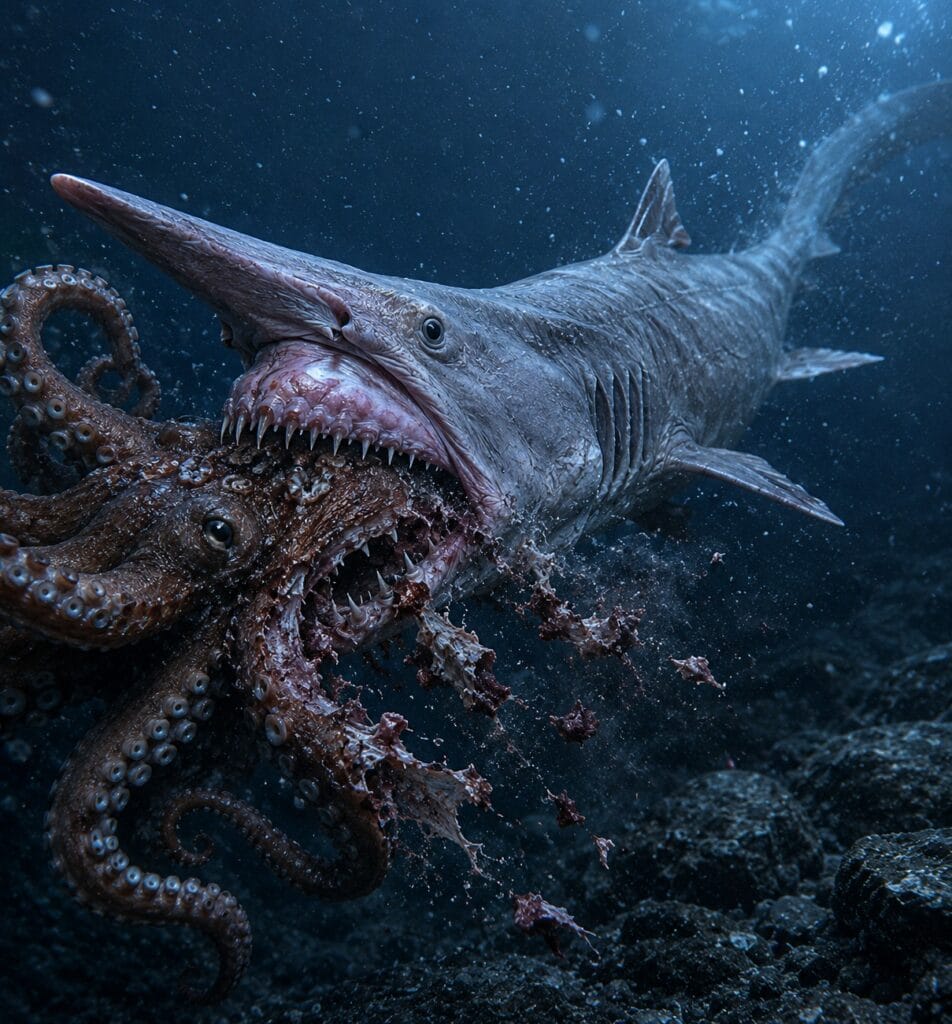
Before any of that speed matters, the shark has to find a meal in total darkness, and it does this without really using its eyes. Its long snout is packed with tiny sensors, called ampullae of Lorenzini, that pick up the faint electrical fields given off by living things, down to a heartbeat. In a place with no light, the goblin shark essentially listens for the electricity of life. Only once something drifts close does the jaw come into play.
In 2016 a team led by Kazuhiro Nakaya at Hokkaido University took that footage apart frame by frame and published the result in Scientific Reports. They named the move slingshot feeding. The entire strike is over in roughly a third of a second.
The jaw fires forward at speeds up to 3.1 meters per second, which the researchers describe as one of the fastest jaw protrusions ever measured in a fish. It shoots out to nearly a tenth of the animal’s body length, farther than any other shark can manage. On the way back, the mouth opens and closes a second time, and no one is sure why.
When the jaw is not in use, it folds back neatly under the eyes, and the shark looks almost normal. That is the trick of it. At rest you might mistake it for an ordinary fish, and then in a fraction of a second the whole face seems to come apart and reach toward you. Same animal, two completely different creatures, depending on the moment you catch it.
It is a spectacular weapon. And the reason it exists is almost sad.
The Monster Face Is a Confession of Weakness
Here is the part the teeth distract you from. The goblin shark is slow. It is a soft-bodied, sluggish swimmer drifting through cold, food-poor water far below the surface, and it could never run anything down.
Its body is built to drift, not to sprint. The flesh is flabby and low in dense muscle, and its oversized liver is loaded with light oils that keep it hanging in the water with almost no effort. Picture a creature designed to hover and wait rather than charge. That is the goblin shark, idling in the dark like a slow thought.
The same Hokkaido study suggested that the slingshot jaw evolved as a trade-off, a way to seize a meal when you cannot chase one. The phylogenetic evidence points to an adaptation for a deep sea where food is scarce and raw speed is useless. The famous weapon, in other words, is just a way to make up for a slow body.
This is where the story flips on you. A face that reads like the blueprint of a dominant predator is really the blueprint of an animal built to survive a place that offers it almost nothing. The horror was never a weapon. It was a workaround.
Even the famous teeth tell on it. The long, thin front teeth are made for grasping soft, slippery prey, not for sawing through anything tough, while smaller teeth toward the back help crush what does get caught. This is the dental kit of a careful grabber in the dark, not a brawler. Once you see that, the whole monster image quietly deflates.
In the dark, where chasing prey burns energy you may never earn back, slow is not a defect. Slow is a strategy. And it has been quietly working for an absurdly long time.
It Survived by Refusing to Compete
The goblin shark is a true living fossil, with a lineage that traces back roughly 125 million years. Read that again. Creatures closely related to this one were already swimming through the oceans while dinosaurs still ruled the land, and they kept going long after the dinosaurs were gone.
That is not a metaphor. It really survived that long.
Think about what surviving that long actually requires. Entire oceans reorganized. Mass extinctions erased the fast and the fierce, the apex hunters everyone feared. The goblin shark’s family stayed deep, ate whatever drifted within reach of that jaw, and simply kept going.
It never won by being the strongest thing in the water. It won by living somewhere the strongest things rarely bothered to go. The lesson has very little to do with sharks.
Its range is almost the whole planet, with records scattered across the Atlantic, the Pacific and the Indian Oceans. Yet wide range has never meant common. Since that first 1898 catch, only a small number of these sharks have ever been studied in any detail, which is a strange thing to say about an animal that lives nearly everywhere.
But here is the uncomfortable part. Almost everything written above, we learned from animals that were already dead.
Most of What We Say About It Comes From the Dead
We should be honest about how thin our knowledge really is. The vast majority of goblin sharks ever examined came up tangled in deep nets or already lifeless on a fishing deck. We almost never get to watch a living one behave.
That changes how much we are allowed to claim. The handful of feeding clips, as jaw-dropping as they are, show a tiny number of individuals. Behavior we casually call typical may only be the behavior of the few we happened to film. Reading an entire species through preserved bodies and a few short videos can mislead as easily as it informs.
So the confident headlines deserve a little caution, including the ones that brand it the fastest, the rarest, the most monstrous. The deep sea does not surrender its data willingly. What we hold is real, but it is also a sliver.
Consider how thin the record is on something as basic as birth. For more than a century, a pregnant female studied up close was treated as almost impossible to get. We still know very little about how long they carry their young, how many pups they have, or where those pups are born.
And that sliver leaves one enormous gap, a gap shaped almost exactly like a full-grown goblin shark.
The Adults Stayed Hidden
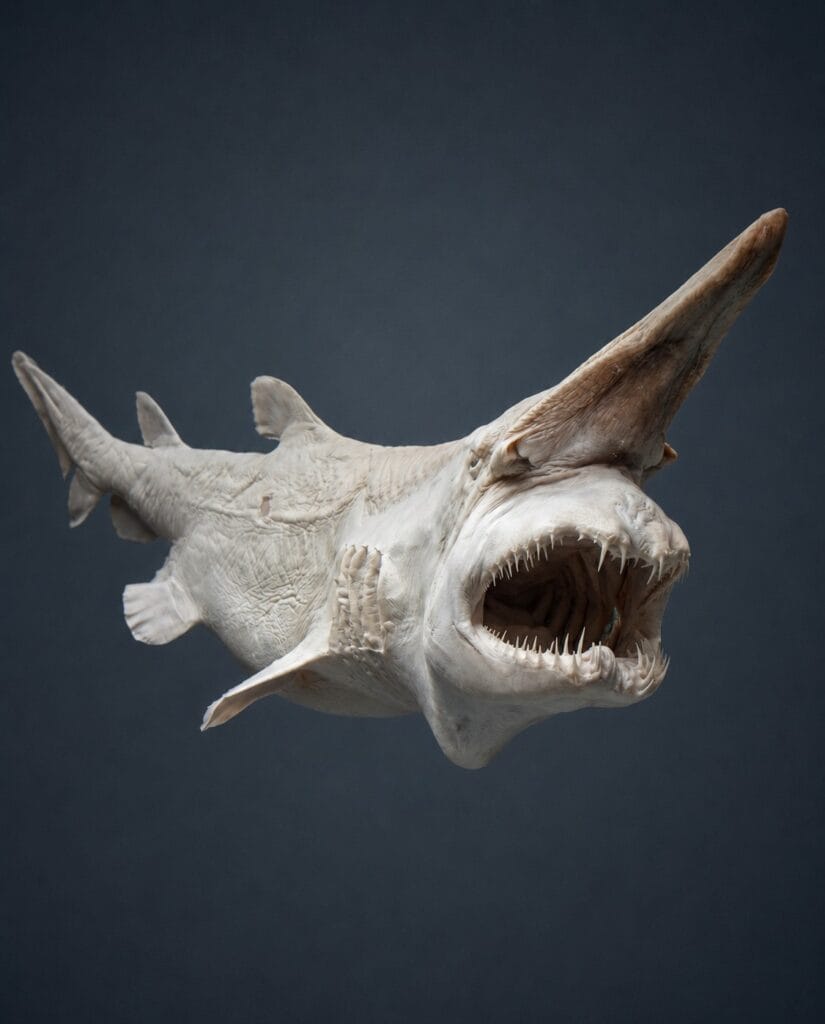
We have studied this creature for well over a century, yet fully mature goblin sharks have stayed exceptionally rare and poorly understood. Researchers believe an adult may reach close to five meters, roughly the length of a small bus. Yet the specimens people actually haul up tell a very different story. They are almost always young, often under two meters, sometimes barely bigger than that meter-long juvenile described back in 1898.
So where are the adults? They are not on any deck. They are not in any tank. The largest, oldest members of a species we have studied for well over a century remain almost entirely hidden from us.
That picture may be starting to crack. Footage gathered in 2024 by researchers, including a Minderoo-University of Western Australia deep-sea project, appears to show an adult goblin shark swimming at around 2,000 meters, deeper than the species was thought to go. If that holds up, the adults were not gone. They were simply living below the level we had bothered to look.
Sit with that for a moment. We have tracked blue whales across entire oceans and filmed giant squid in the black of the deep. Yet the grown form of this single shark stays mostly beneath us, beyond easy reach, barely accounted for.
The mystery was never the face. The mystery was the animal itself.
Then, in 2023, the Deep Sent One Back Up
In June 2023, a trawler working out of Nanfangao port in Yilan County, Taiwan, hauled up something that looked like a mistake. A goblin shark about 4.7 meters long and weighing close to 800 kilograms, roughly 1,760 pounds, one of the largest ever recorded in Taiwanese waters. And she was pregnant.
Inside her were six pups, each already around 1.2 meters long and carrying a small nutrient sac in the belly. Their teeth were already formed, which told staff at the Taiwan Ocean Artistic Museum she had been close to giving birth. For an animal whose reproduction had been a near-total blank for a century, this was a once-in-a-generation window.
It very nearly never opened. The fishers had planned to sell the rare catch to a restaurant, and the museum had to fight to buy it for marine education instead. A creature that survived 125 million years almost disappeared from science again, lost by a few hours.
And the way she was caught matters. Bottom trawling drags a weighted net across the seafloor and sweeps up everything in its path, which is exactly why so much of what we know about goblin sharks comes from accidents rather than study. The deep does not hand them over. We mostly stumble into them.
What Keeps a 125-Million-Year Survivor Alive
Strip away the horror-movie face and the goblin shark’s daily life is almost quiet. It drifts low over the seafloor and through the dark middle water, somewhere between roughly 100 and 1,300 meters down, hunting soft, slow targets rather than anything that could fight back.
Its menu is mostly squid, small deep-sea fish, and the occasional crustacean. In Japanese waters its stomach is often full of firefly squid, Watasenia scintillans, the tiny glowing creature that lights up Toyama Bay. A monster, it turns out, lives largely on glowing snacks the size of your finger.
That long snout is the key to all of it. Packed with electroreceptors called ampullae of Lorenzini, it works like a built-in metal detector, sweeping back and forth to feel the faint electrical pulse of hidden prey. The shark does not need to see its food. It feels the spark of a living thing in the dark and lets the jaw do the rest.
Archive Notes
Where does the goblin shark live?
It lives in deep water around the world, usually below 100 meters and frequently much deeper, with adults thought to stay deeper than juveniles. The best-documented catches come from the waters off Japan, including Sagami Bay, Suruga Bay and Tokyo Bay, though specimens have surfaced in the Atlantic, Pacific and Indian Oceans as well.
Is the goblin shark dangerous to people?
Not in any realistic sense. It lives far deeper than swimmers or divers ever venture, and almost every encounter happens when one is caught by accident in deep fishing gear. Its frightening reputation has far more to do with the slingshot jaw and its deep-sea biology than with any danger to humans.
Why is the goblin shark pink?
Its pale, pinkish color comes from blood vessels showing through semi-transparent skin, since pigment is largely pointless where almost no light reaches. After death the pink tends to fade toward a dull gray, which is why preserved specimens can look so different from a living animal.
What You Now Know
The terrifying face we feared was never built for power. It was an evolutionary workaround for a shark too slow to chase its food. The goblin shark turned its own weakness into one of the oldest survival stories in the ocean, and the biggest chapter of that story, the adults, is still missing somewhere below the dark.
Tip For Readers
If you want the real animal instead of the myth, read the slingshot-feeding research from Hokkaido University and the deep-sea collections kept by institutions like the Smithsonian. The living creature is stranger, and far more worth your time, than the monster on any thumbnail.
Sources and Image Credits
Scientific information referenced from Hokkaido University (Scientific Reports, 2016), the California Academy of Sciences (original 1898 species description), the University of Tokyo zoological collections, the Smithsonian Institution, the Australian Museum, the Taiwan Ocean Artistic Museum (2023 pregnant-specimen records), deep-sea footage reported by a Minderoo-University of Western Australia project (2024), and other publicly available scientific resources.
Images include photographs taken by the author at a Japanese public aquarium, AI-generated and AI-enhanced editorial illustrations created for storytelling purposes, and publicly available reference materials including Wikimedia Commons and museum collections. The AI-generated and AI-enhanced images are not part of the original scientific data and were added for editorial or entertainment purposes.
Reference specimen: Mitsukurina owstoni (Goblin Shark), Museums Victoria Collections, photographer Julian Finn, licensed under CC BY 4.0.