
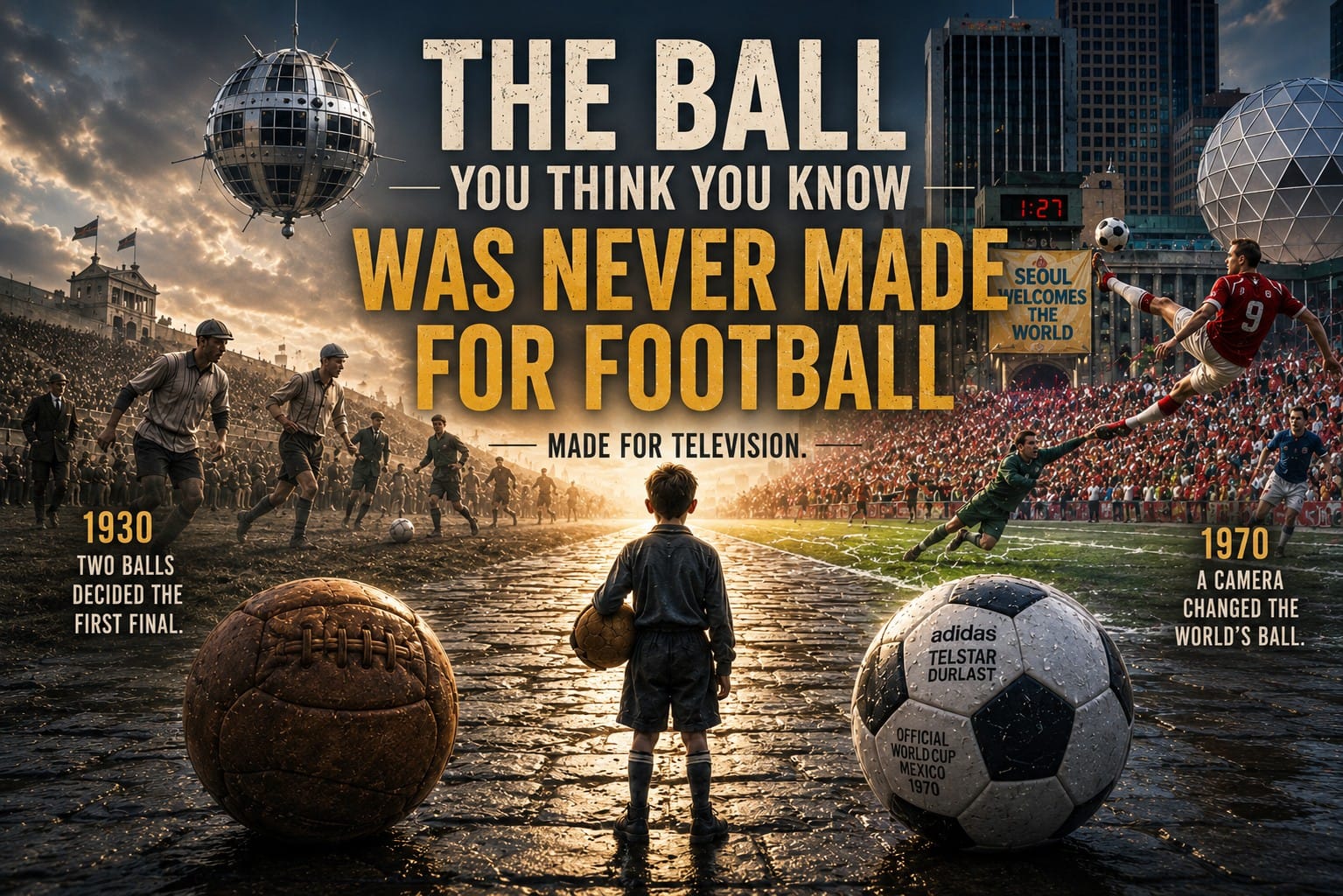
Everyone can draw a soccer ball. Go ahead — close your eyes and try. Black pentagons. White hexagons. You know exactly what it looks like. Now ask yourself one question. Who decided it should look like that?
Not a player. Not a coach. Not a committee of football men arguing in a room somewhere. A camera did. A black-and-white television camera, in 1970, in Mexico. And that decision — made for a machine, not a sport — dictated what the entire world would look at for the next half-century.
The ball has been deciding things for a long time. It shaped the first World Cup final before a single rule existed about what shape it should be. In Medellín, it became part of a tragedy that still haunts football. It drove NASA scientists into a wind tunnel looking for answers. Somewhere between a pig’s bladder in a Victorian workshop and a chip transmitting data in two milliseconds, the ball stopped being just sports equipment. Somewhere along the way, it became something people remembered differently.
The Cold War Had a Shape. So Did the Ball.
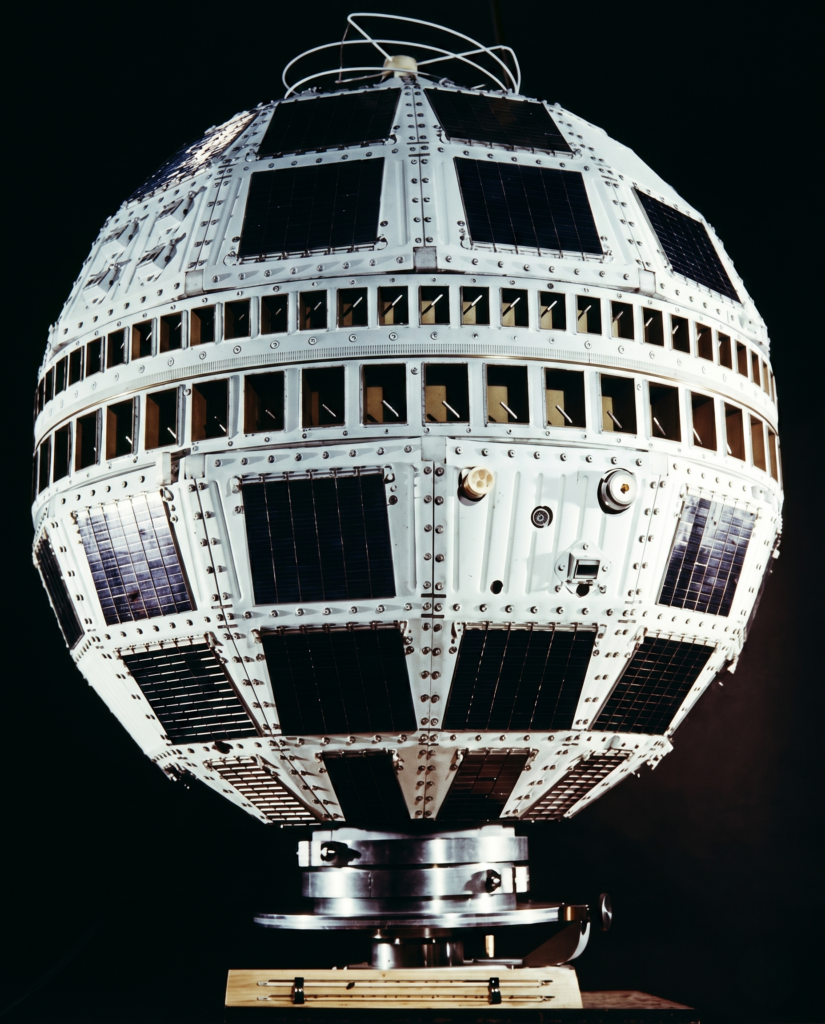
On July 10, 1962, a rocket launched from Cape Canaveral carried a 34-inch sphere into orbit. Its name was Telstar. Built by Bell Telephone Laboratories for AT&T, it became the first active communications satellite to relay live television signals across the Atlantic. It was covered in black solar panels arranged against a white aluminum frame.
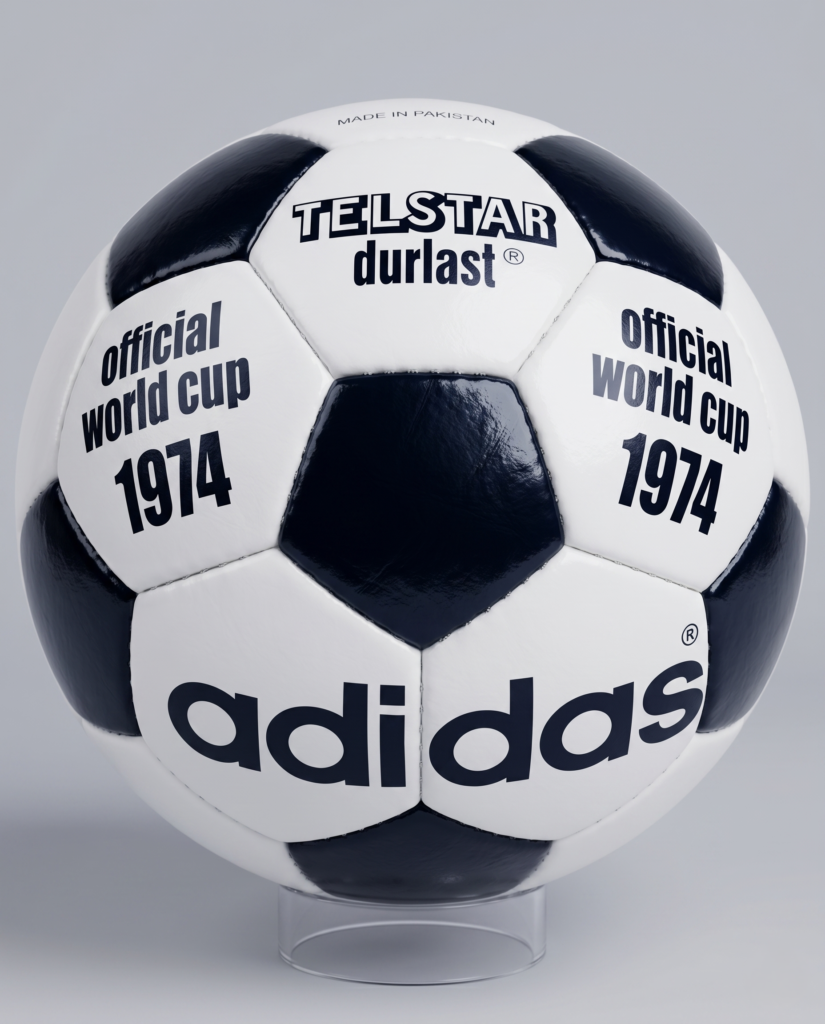
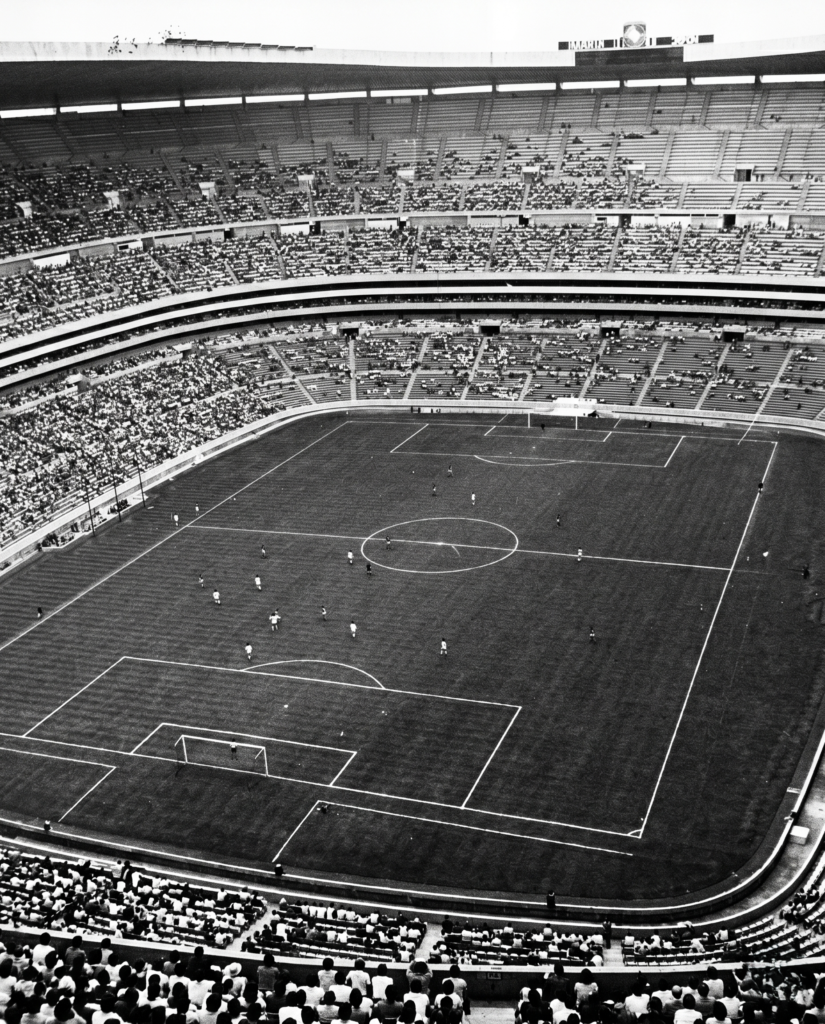
Eight years later, Adidas presented three balls to FIFA officials in Mexico City. One was orange. One was plain white. One was black and white. The black-and-white one looked almost exactly like Telstar. They chose it immediately. Not because it played better. Because the 1970 World Cup was the first to be broadcast live on global television, and the old brown leather ball vanished into gray mush on a black-and-white screen. Many viewers struggled to follow it.
The ball was renamed Telstar. Short for Television Star. Adidas made exactly 20 of them for the entire tournament. Twenty balls. Six hundred million viewers. The Cold War was happening above people’s heads — satellites, signals, the space race entering everyday life through television. The World Cup was happening below. And for one brief moment, they wore the same face.
That black-and-white design has effectively stayed with us. The soccer ball emoji on your phone right now — that is still the 1970 television fix. Fifty-five years later, a solution to a broadcast problem is what every child draws when someone says “draw a ball.”
Before the Rules Came, the Ball Chose the Champion
Go further back. Before Adidas. Before rules about what shape the ball had to be. Before anyone thought to standardize a thing that had been kicked around in one form or another for five hundred years.
July 30, 1930. Montevideo, Uruguay. The first World Cup final. Argentina versus Uruguay. Ninety-three thousand people packed into the Estadio Centenario. Armed guards with rifles and fixed bayonets ringed the field. The atmosphere was so tense that the referee, a tall Belgian named John Langenus, had negotiated a personal security guarantee before agreeing to officiate.
And then, before kickoff, the two teams could not agree on which ball to use.
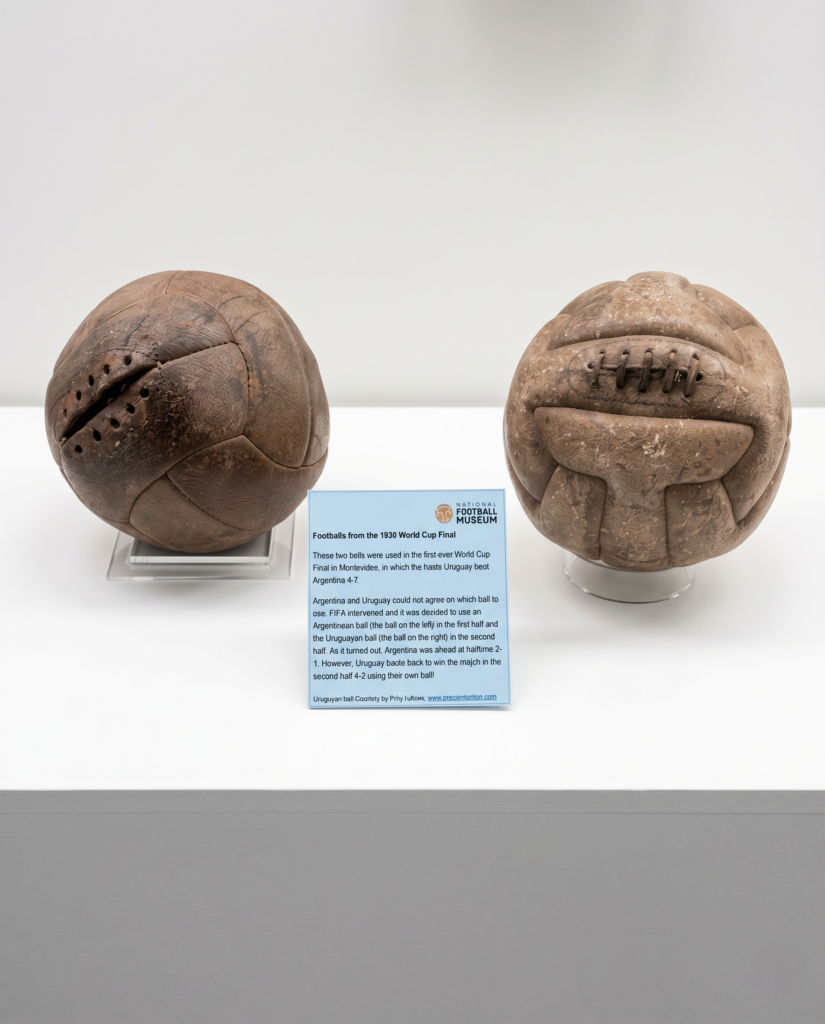
Argentina had brought theirs — the Tiento, a 12-panel leather ball, lighter, smaller. Uruguay wanted theirs — the T-Model, heavier, made from Uruguayan leather, shaped differently in the hand and on the foot. Neither side would yield. Langenus walked onto the field carrying one ball under each arm. He flipped a coin. Argentina won the toss. Their ball was used in the first half.
Argentina led 2-1 at halftime. The balls were switched. Uruguay’s heavier T-Model came out for the second half. Uruguay scored three unanswered goals. Final score: 4-2. Uruguay were world champions. The ball changed at halftime and the championship changed with it.
Both balls still exist. They are kept in a glass case at the National Football Museum in Manchester, England. A blue card between them reads: “Argentina was ahead at halftime 2-1. However, Uruguay came back to win the match in the second half 4-2 using their own ball.”
No rule had prevented this. Because there was no rule about the ball at all.
A Woman Died Making the Ball. Nobody Put Her Name on It.
Before the 1930 ball. Before the 1970 ball. Before any of it. Someone had to make the ball.
In Rugby, England, in the mid-nineteenth century, a leatherworker named Richard Lindon ran a small shop supplying balls to the boys at Rugby School. The balls were made the old way — a pig’s bladder inflated by mouth through a clay pipe, then encased in hand-stitched leather panels. The work of inflation fell to his wife, Rebecca.
If the pig was diseased, that disease went directly into her lungs. She inflated hundreds of bladders. She had seventeen children. She died of lung disease.
Richard Lindon spent the rest of his working life developing a rubber bladder so that no one would ever have to do what his wife had done. He built a brass pump modeled on a medical ear syringe. The rubber football bladder — the one inside every ball made since the 1870s — exists because a woman died building something the world would enjoy for centuries without knowing her name.
Before football became a billion-dollar industry, someone was coughing blood to build the ball. The highlight reels don’t show that part.
They Designed the Perfect Ball. NASA Called It a Disaster.
June 2010. South Africa. The first World Cup ever held on the African continent. Adidas had spent four years — four years — developing the match ball with engineers at Loughborough University in England. Wind tunnel tests. Robotic kicking machines. Player testing with AC Milan, Bayern Munich, Ajax Cape Town. They called the result the Jabulani, from the Zulu word meaning “to celebrate.” They announced it was engineered as a near-perfect sphere.
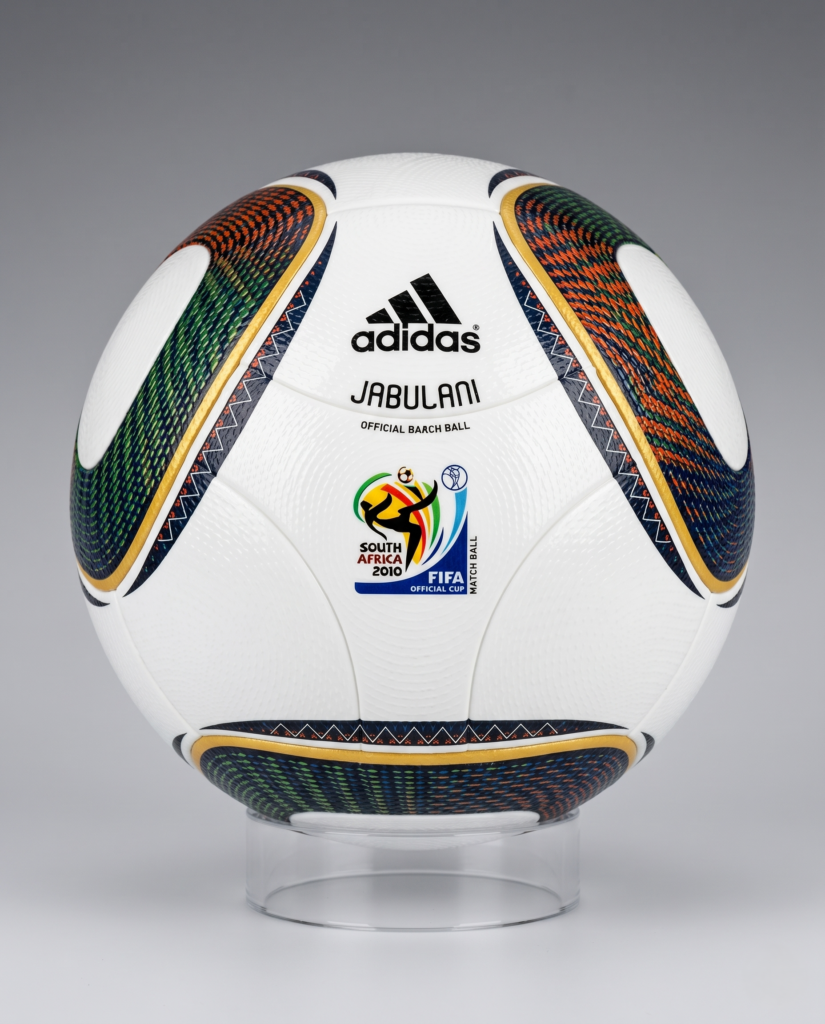
Eight thermally bonded panels. No visible seams. A surface Adidas called “Grip ‘n’ Groove.” They said it would give players maximum control, stable flight, perfect accuracy in all conditions. No other ball had undergone such rigorous technical scrutiny before its rollout.
Then the tournament started and goalkeepers began losing their minds.
Brazil’s Julio Cesar compared it to a ball you buy in a supermarket. Brazil’s striker Luis Fabiano said it was supernatural — that it moved as though someone unseen was guiding it. “You kick it,” he said, “and it moves out of the way.” Spain’s Iker Casillas called it rotten.
NASA scientists at the Ames Research Center tested it in a wind tunnel. Their conclusion was precise and almost cruel in its simplicity: the Jabulani was too smooth to fly straight. The smooth surface accidentally stripped away the natural drag that keeps a ball flying predictably. At speeds between 45 and 50 miles per hour — the exact speed of a free kick near goal — the ball began to knuckle. To swerve without warning. To behave, as Luis Fabiano said, like something supernatural.
The 2010 World Cup produced just 143 goals — one of the lowest-scoring tournaments of the modern era. A ball that had survived every technical test imaginable unexpectedly made players more cautious and goalkeepers deeply uncomfortable. What this really reveals is something the engineers could not have planned for: perfection, in a sport built on human imperfection, is its own kind of failure.
He Touched It for Less Than a Second. Colombia Never Forgave Him.
In Colombia, football was never just football. In the early 1990s, the country was living through something close to civil war — the cartels, the violence, the daily fear. Football was escape. It was pride. For millions of people living in poverty, it was the only form of national dignity that felt real and immediate and theirs.
The 1994 ball was called the Questra. Space-themed, designed to move faster, built with a polystyrene foam layer that made it lighter and more responsive. FIFA was worried. The World Cup was being held in the United States for the first time. Americans didn’t understand football. They wanted goals. They wanted action. They wanted something they could sell. So the ball was built for speed.
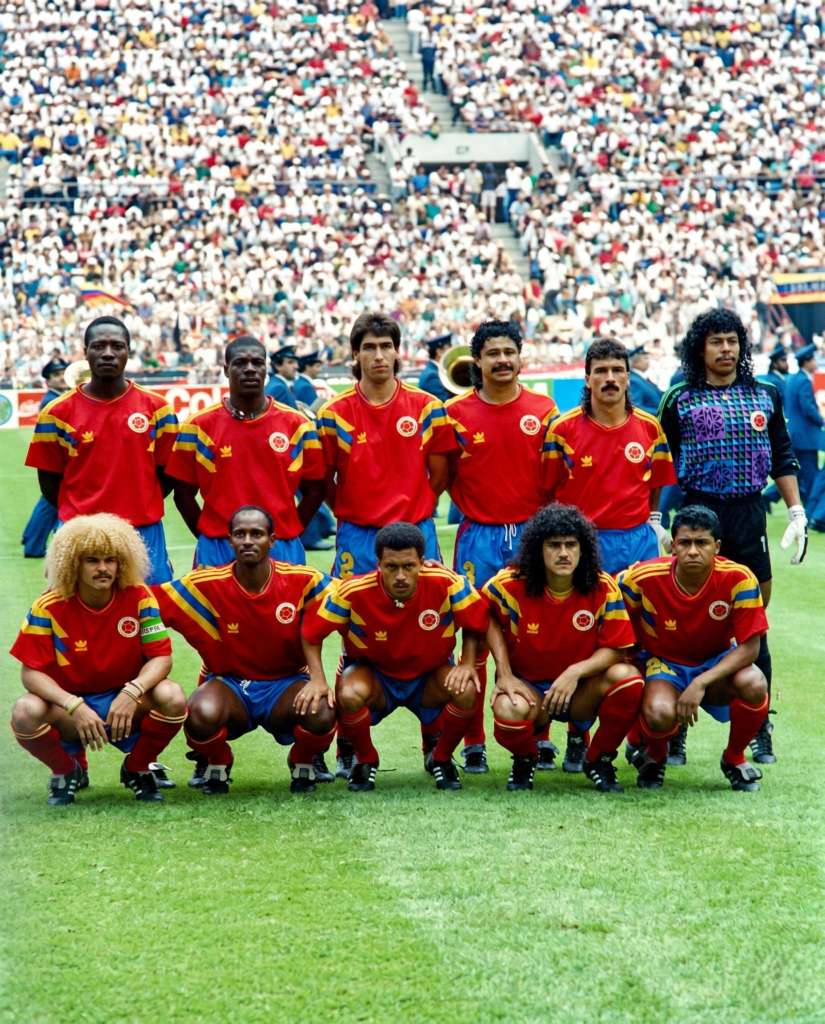
Andrés Escobar was Colombia’s captain. He was known as El Caballero del Fútbol — The Gentleman of Football. He was 27. He was engaged. He was about to sign with AC Milan. Pelé had predicted that Colombia would reach the semifinals. And on June 22, 1994, in Pasadena, California, at the Rose Bowl, Andrés Escobar stretched to block a cross from an American midfielder named John Harkes.
The Questra touched his foot for less than a second. It flew into his own net.
Colombia lost 2-1. They went home. Escobar came home with them. His friends told him to wait, to stay away for a while. He didn’t listen. On the evening of July 1, he went to a nightclub in his hometown, Medellín. In the parking lot outside, three men approached his car. They began shouting at him about the goal. He tried to reason with them. One of them pulled out a .38 caliber pistol.
He was shot six times. Witnesses later said the killer shouted “Goal” after the shots — once for each time a commentator had said it during the broadcast.
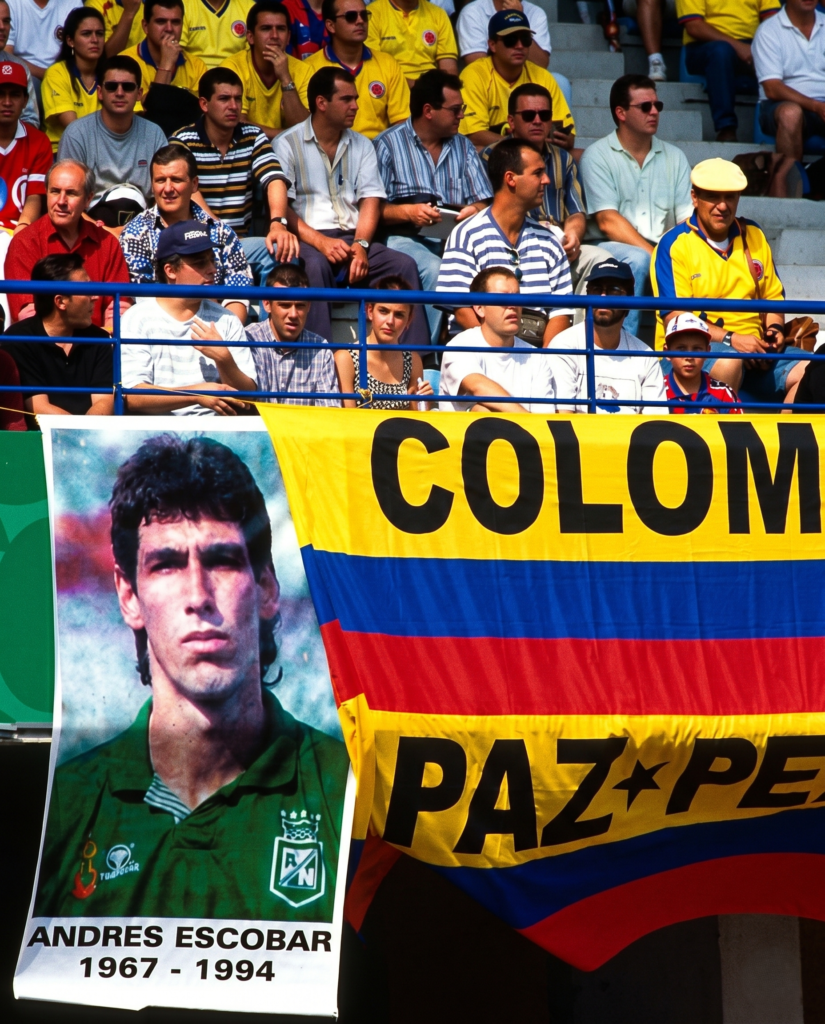
Andrés Escobar died 45 minutes later. He was 27 years old. In his last newspaper column, written after the own goal and before he went to that nightclub, he had ended with five words. Life doesn’t end here.
120,000 people came to his funeral.
The Ball Nobody Remembers
The 2002 ball was called the Fevernova. Football purists hated it before it was even used. No black pentagons. No white hexagons. Bold geometric patterns in red and gold and green. Critics called it a toy. A gimmick. An insult to the tradition of the sport.
Then South Korea happened.
That toy ball beat Spain. Beat Italy. Beat Portugal. People climbed buses to see the screens. Fathers lifted children onto their shoulders. Entire streets turned red.
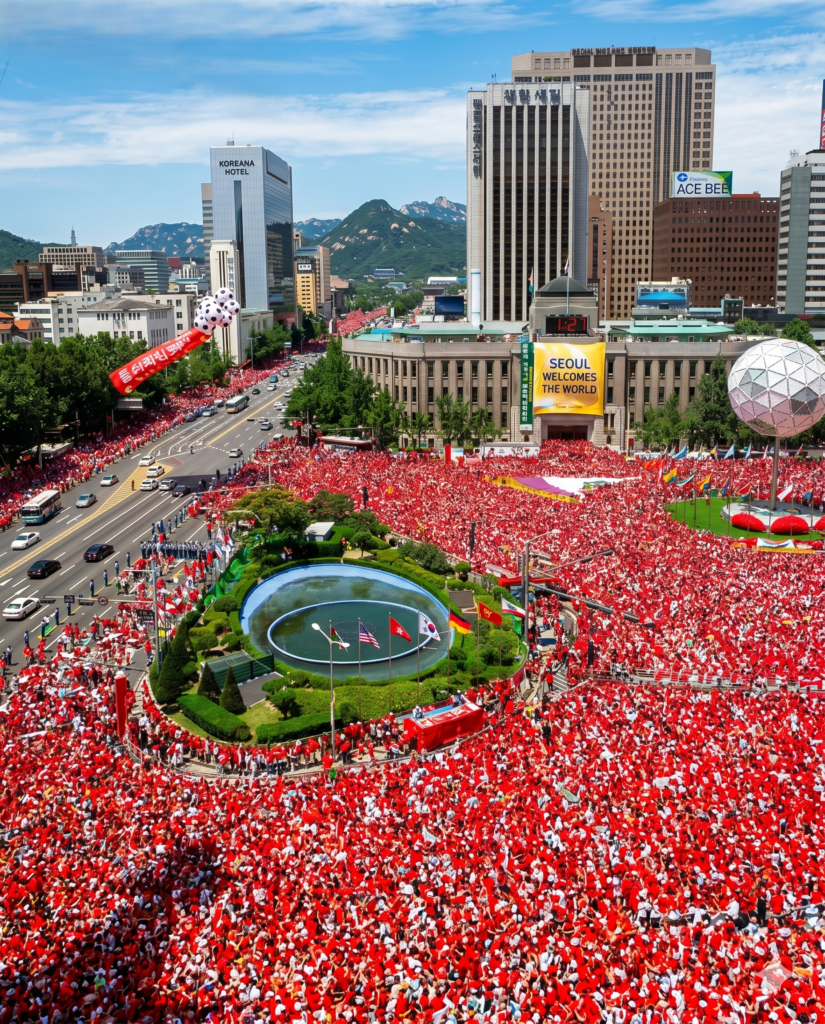
Very few people remember the Fevernova itself. Ask someone who lived through the summer of 2002 about the ball. They will look at you blankly. Then they will tell you about where they were standing. Who was beside them. What they ate. What their voice sounded like after three hours of screaming. They will tell you about fathers who grabbed their children and lifted them into the air when the goal went in. Fathers who didn’t live to see another World Cup.
Some of those men are gone now. Some of those street corners have been built over. The Fevernova is in a museum archive somewhere. But the summer of 2002 is preserved in something harder than any material — in the nervous system of everyone who was there.
Some of us were not watching from the streets. We were already inside it.
What Nobody Tells You About the Ball That’s Coming
The 2026 World Cup ball represents something the sport has never quite seen before. Adidas has already begun introducing sensor-driven match ball technology for the 2026 tournament. The United States, Canada, Mexico — three nations, one tournament, one ball. It contains an internal sensor that transmits its exact location within two milliseconds. Before the linesman raises his flag. Before VAR has time to pause the frame.
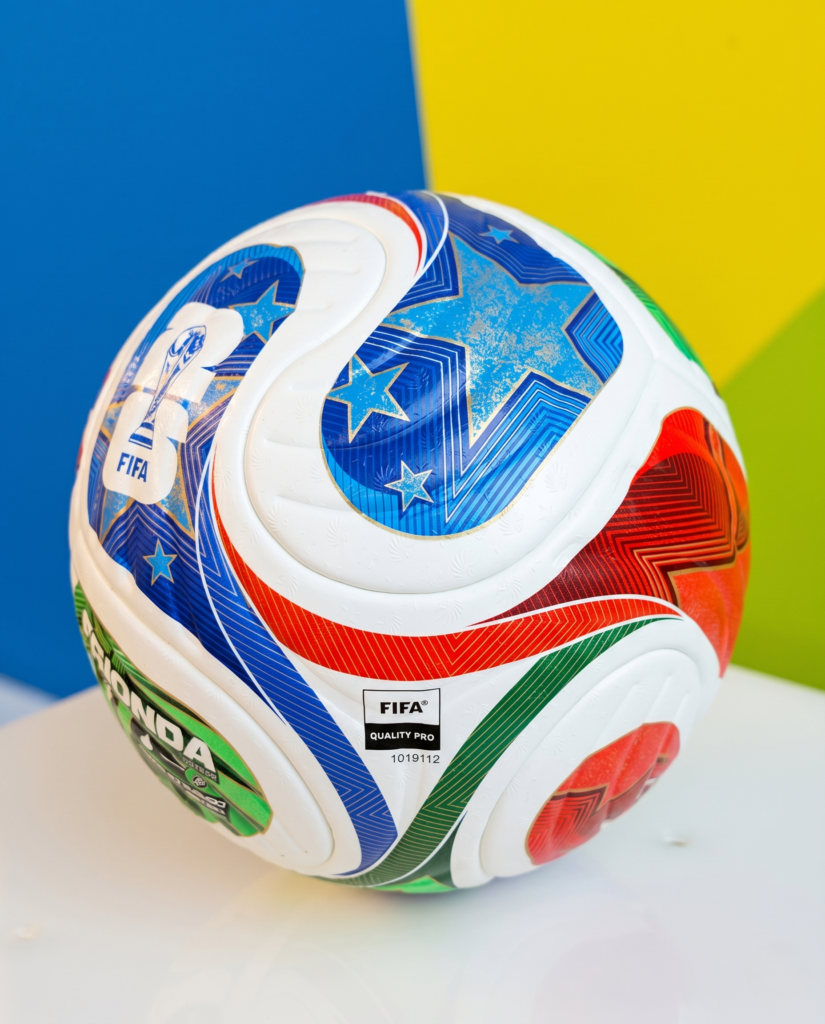
The ball that started as a pig’s bladder in a damp English workshop has a chip in it now. The ball two countries fought over at halftime of the first-ever final now corrects human judgment in real time. The ball a man was shot for touching now has more information about its own position than any referee in history.
For the first time in football history, the ball may process the game faster than the people watching it. That is either the future. Or it is the moment the sport stopped needing us to decide anything.
This is progress. Or it looks like progress. Every generation ends up building the ball that reflects itself. Every generation thinks it has gotten it right, this time.
In 2010, they thought perfection was the answer. NASA disagreed.
What This Really Changes — And What It Never Will
Here is what the technology cannot fix. The weight of a ball on a foot that is about to change everything. The sound of a stadium going silent. The six seconds between a free kick leaving a boot and the world knowing whether a country will celebrate or mourn.
The Jabulani exposed a lesson football engineers have struggled with ever since: the game is not improved by removing uncertainty. Uncertainty is the game. The knuckleball that terrified goalkeepers also produced some of the most astonishing goals ever scored. Diego Forlán mastered the Jabulani through months of obsessive practice. He won the Golden Ball. The ball rewarded the man who refused to complain about it.
None of this excuses what happened to Andrés Escobar. None of it explains how a piece of synthetic rubber and polymer foam could carry that much weight, that much rage, that much consequence. Colombia was not destroyed by a ball. Colombia was destroyed by something that had been building for decades — and the ball was simply the moment it broke through.
That is what the ball has always been. Not a cause. A surface. A place where everything human — the ambition, the beauty, the tribalism, the grief — becomes visible for a moment before it disappears back into the crowd.
Archive Notes
Why did the 1970 World Cup ball look different from every ball that came before it?
The 1970 Mexico World Cup was the first to be broadcast live on global television. Traditional brown leather balls were nearly invisible on black-and-white screens, which remained standard in most households worldwide. Adidas designed the Telstar with 12 black pentagonal panels and 20 white hexagonal panels specifically to create contrast visible on monochrome broadcasts. The ball was named after the Telstar 1 satellite launched in 1962, which bore a striking visual resemblance to the design. That design became the universal template for soccer balls globally and remains the standard icon used in emojis and illustrations to this day.
Was Andrés Escobar really killed because of the own goal, or was the cause more complicated?
The exact motive was never legally proven. Humberto Castro Muñoz, a bodyguard for the Gallón brothers — two powerful drug traffickers who had reportedly bet heavily on Colombia’s World Cup matches — was convicted of the murder and sentenced to 43 years, later reduced to 26. He served less than 12 years before release. The Gallón brothers themselves faced only obstruction charges and were never convicted of ordering the killing. Colombian prosecutors and historians suggest the murder likely combined multiple factors: gambling losses, cartel culture, and the volatile national mood after a catastrophic loss. The own goal was the trigger. The weapon had been loaded long before.
How did NASA get involved in testing a soccer ball, and what did they actually find?
Scientists at NASA’s Ames Research Center in California tested the Jabulani in their Fluid Mechanics Laboratory wind tunnel, comparing its aerodynamic behavior against the 2006 World Cup ball, the Teamgeist. They found that the Jabulani’s near-perfectly smooth surface caused a “knuckleball effect” — unpredictable lateral movement — at speeds between approximately 45 and 50 miles per hour. This speed range corresponds directly to the velocity of a free kick struck near goal. Traditional balls with more visible seams had a lower critical speed at which this effect occurred, around 35 mph, making it less likely to affect game-critical kicks. The Jabulani’s smoothness, designed to improve aerodynamic consistency, had accidentally shifted the problem zone directly into the most dangerous range of play.
What You Now Know
The ball changed shape. The stadiums changed. The cameras changed. But people still remember the same thing — where they were standing when it crossed the line.
Most people do not remember the ball itself. They remember where they were when it moved.
Tip For Readers
Both balls used in the 1930 World Cup Final are on permanent display at the National Football Museum in Manchester, England. The NASA aerodynamic study of the Jabulani and subsequent World Cup balls is available through the NASA Ames Research Center public research archive. The history of Richard Lindon and the development of the rubber football bladder is documented by the Rugby Art Gallery and Museum, Rugby, England.
Verified Sources
National Football Museum, Manchester — 1930 World Cup Final exhibition, permanent collection
NASA Ames Research Center, Fluid Mechanics Laboratory — Jabulani aerodynamic study, 2010
Bell Telephone Laboratories / AT&T Archives — Telstar 1 satellite records, 1962
Adidas AG — Jabulani match ball technical briefing, December 2009
Colombian national press archive (El Tiempo, Medellín) — Andrés Escobar final column, June 1994
Images: Wikimedia Commons (Public Domain / CC BY 2.0), National Football Museum, South Korean public archive, Italian public domain press photography