
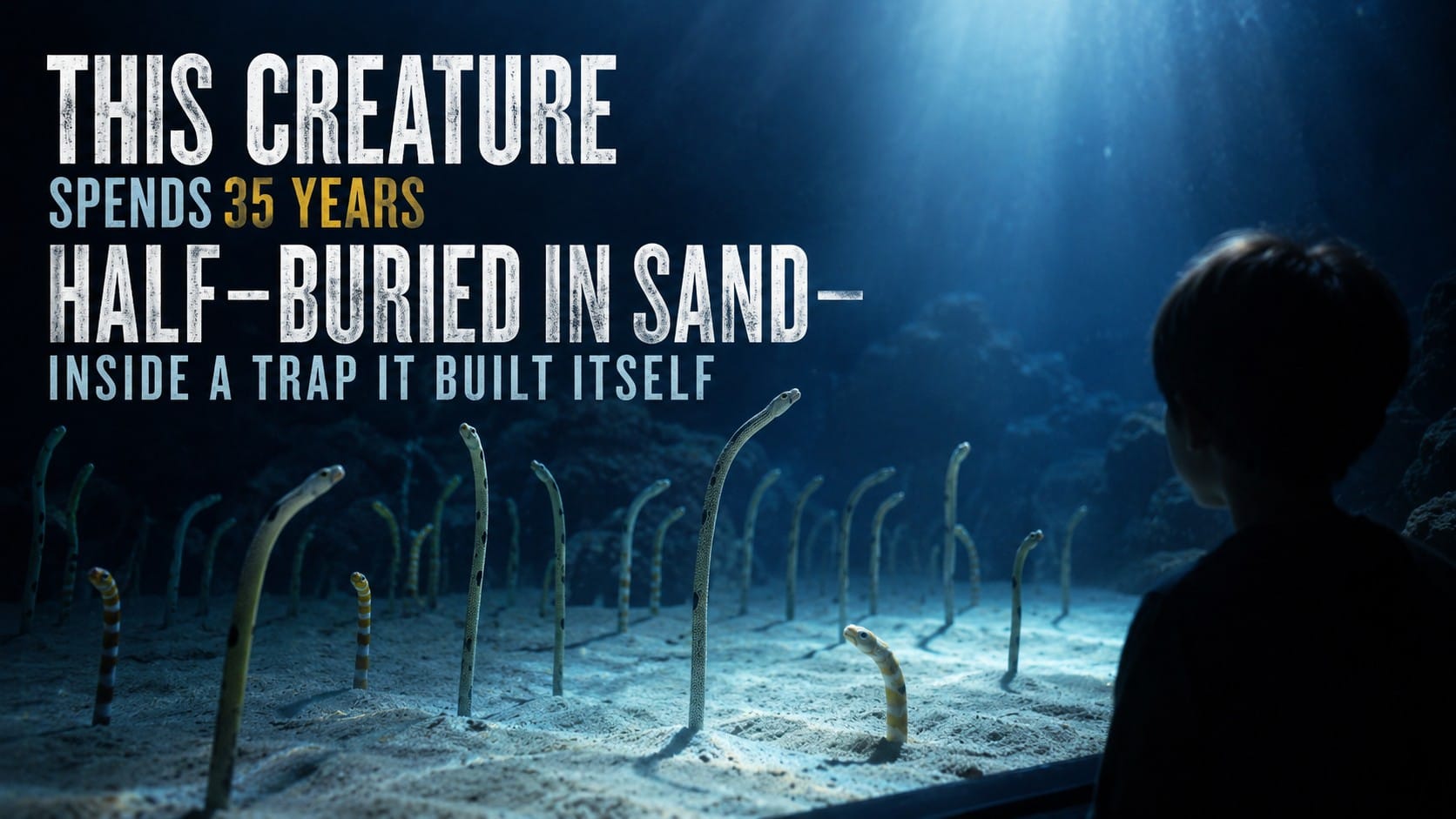
People were laughing. Kids pointed at the glass and said it was cute. I stood there in a quiet corner of an Okinawa aquarium, watching dozens of thin bodies sway in blue-lit water, and I thought — yeah, I get it. Cute.
Then I got closer.
Every single one of them had half their body jammed into the sand. Not resting. Not hiding temporarily. They never really leave. Their eyes, which seem too big for their bodies, constantly scan the water with an intense, unblinking focus.
This Is Not a Fish That Swims
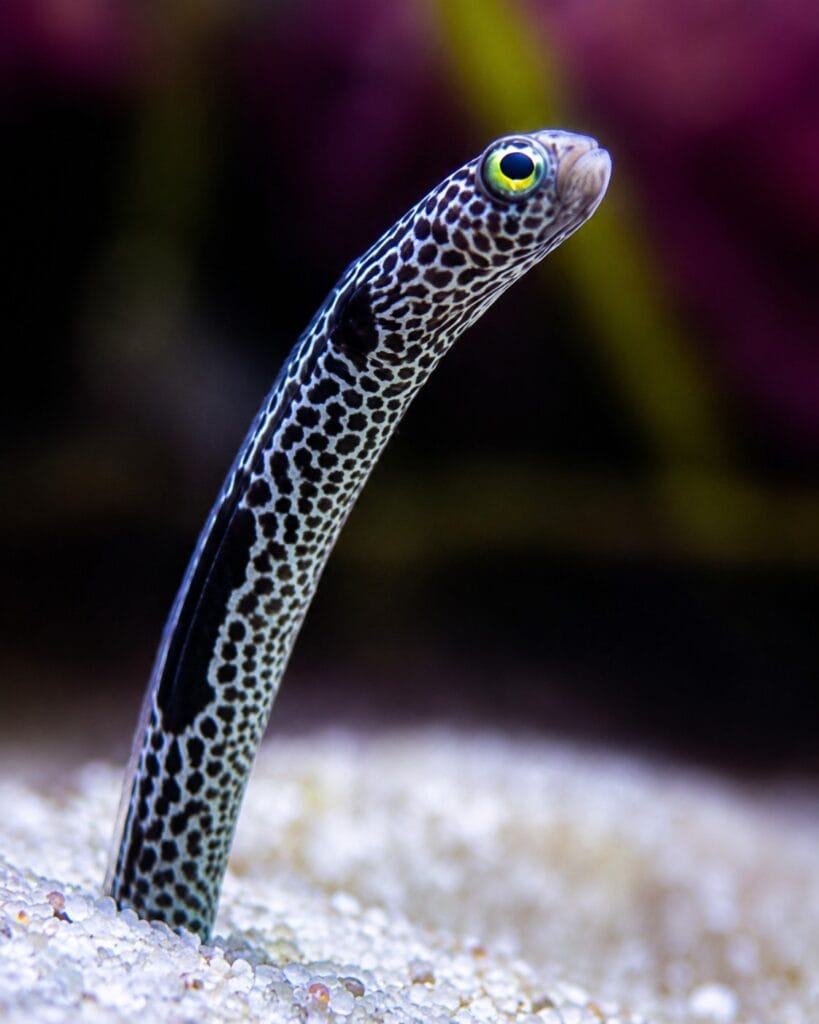
The garden eel — Heteroconger hassi, known in Japan as Chin-anago — does not live in the ocean the way other fish do. It does not patrol a reef. It does not chase prey. It stands in sand for the rest of its life.
From the moment it settles on the seafloor as a juvenile, it drives its tail into the sand like a nail into wood. Then it secretes mucus from its skin — a thick, sticky fluid that coats the sand grains and hardens them into a tube. A personal tube. One eel. One burrow. No leaving.
According to research published through marine biology institutions including the Okinawa Churaumi Aquarium and documented in Japanese aquarium association records, garden eels almost never fully exit their burrows after initial settlement. These exceptions are extremely rare. The swaying upper half is typically all you will ever see of them above the sand.
Only half their body ever leaves the sand. Most of their lives are spent underground.
They Are Not Dancing. They Are Holding On.
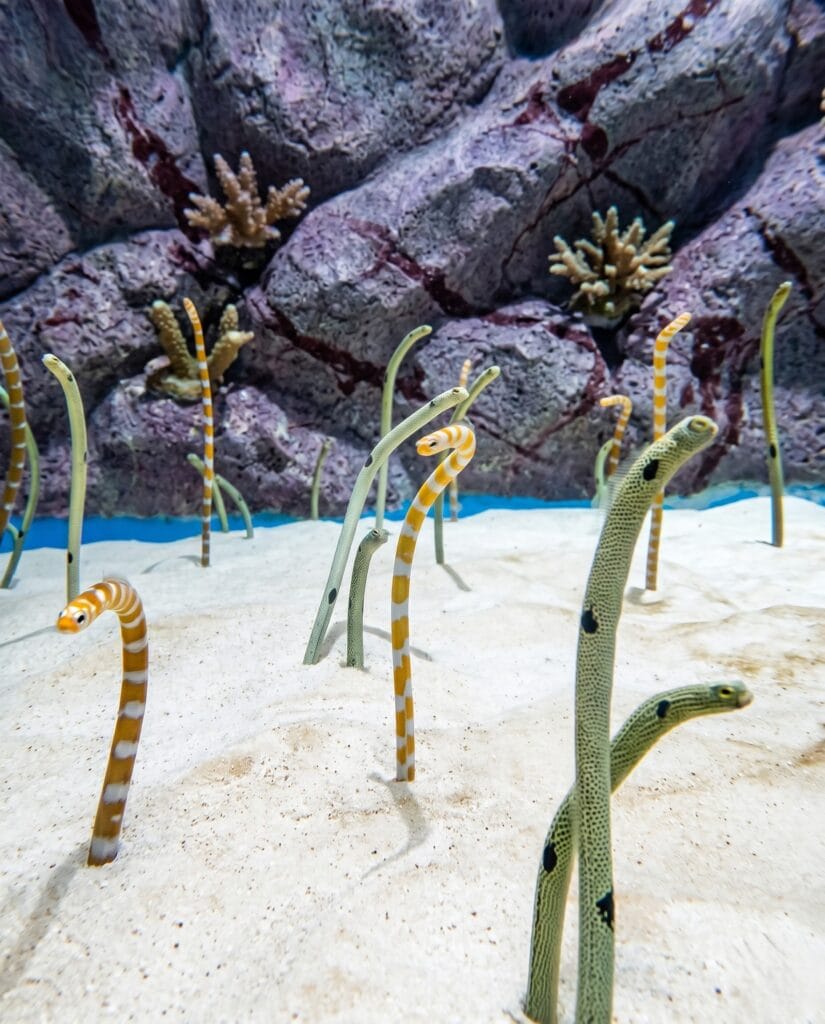
When you first see a colony of garden eels, the movement looks peaceful. Graceful, even. They sway together like tall grass in a slow wind. People take videos. People smile.
What is actually happening is this: they are fighting the current. Every second of every day, the water is trying to push them sideways. Their muscles are constantly making tiny adjustments to stay upright in the burrow they cannot leave. The swaying is not a choice. It is resistance.
They face the current because the current brings food. Microscopic plankton, drifting past. A garden eel opens its mouth and intercepts whatever the water delivers. It does not hunt. It waits. It holds position and waits, and the current decides whether it eats today.
And here is the part that stops you cold: they maintain spacing. Each burrow stays just far enough from the next — close enough to form a colony, far enough that neighbors do not compete for the same water current. Too close, and they fight. Too far, and they starve alone. Their entire lives depend on staying at that distance.
The Things Most People Never Notice
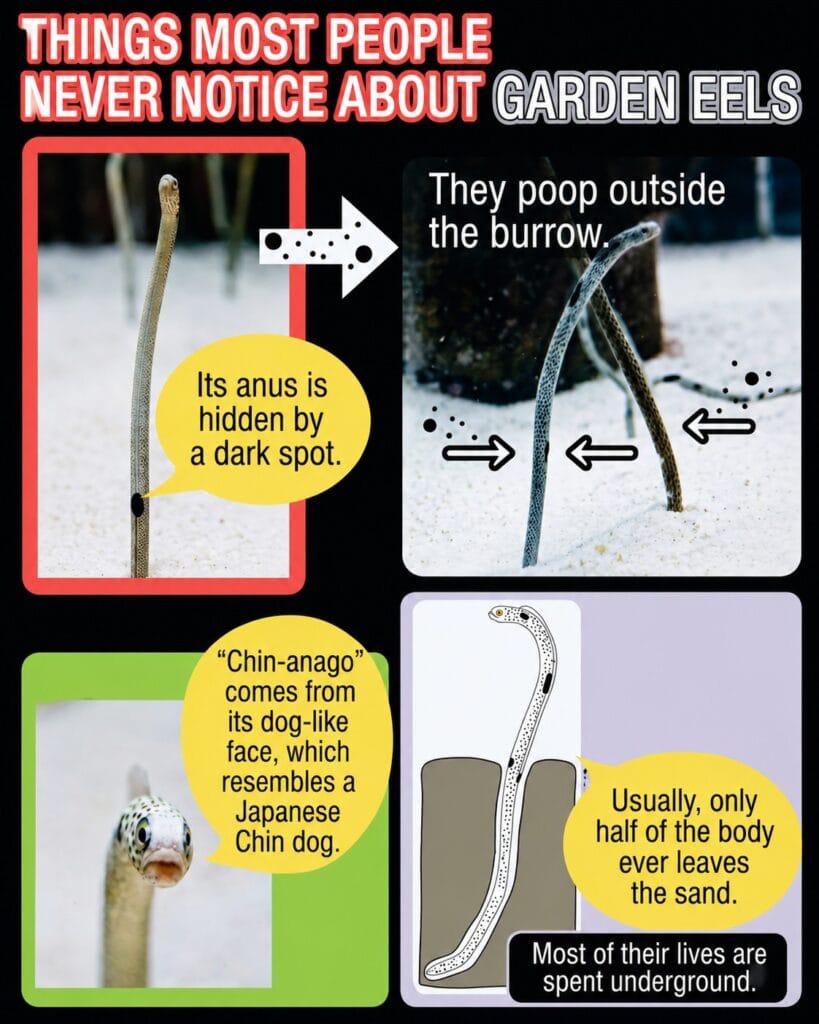
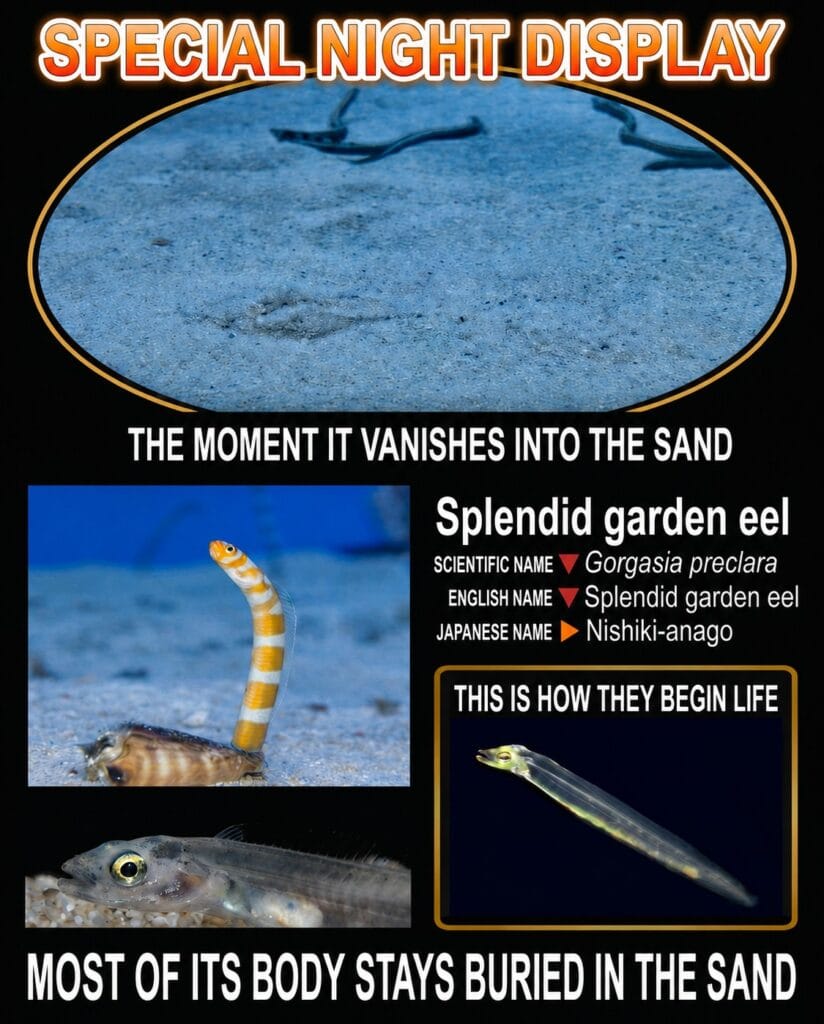
The aquarium display panel was cheerful about it. Bold graphics. Bright yellow speech bubbles. It explained that the anus of the garden eel is camouflaged by a dark spot on its body — because even waste must be expelled outside the burrow without revealing a weak point. It explained that the name Chin-anago comes from the face resembling a Japanese Chin dog.
People laughed at the poop diagram. I laughed too.
But the body cross-section drawing in the corner of that panel was the one that stayed with me. A thin white line showing the eel’s full length — and more than half of it shaded gray, below the sand line. Below the world. The label read: “Most of their lives are spent underground.”
That was not presented as tragedy. It was just a fact. A cheerful aquarium fact with a yellow bubble around it.
What Happens When You Get Too Close
A child pressed her hand flat against the aquarium glass.
The entire floor vanished.
Not one eel. Not a few near the glass. Every eel in the tank — dozens of them — disappeared simultaneously into the sand in under half a second. The white floor was suddenly empty, as if nothing had ever lived there.
This synchronized retreat is not coincidence — it spreads through the colony via pressure waves and light changes detected through their lateral line, a sensory system that reads vibrations in the water. One eel senses threat. The reaction spreads through the colony. The floor empties.
They reappeared slowly. First one head, then another, inching upward like they were testing the air. The child had already moved to the next tank. The eels had no way to know that.
The Night Display Nobody Talks About
The aquarium display panel in a darkened corner of the hall said: Special Night Display. It noted that garden eels spawn approximately two hours after the tank lights are dimmed. At this facility, spawning occurs mainly between May and November.
Two hours after the lights go out, they release eggs into the water column.
They remain inside their burrows, half-buried in the sand even during this moment. Upper bodies reaching toward each other in the dark — according to documentation from California Academy of Sciences and multiple marine research institutions, mating garden eels entwine their upper halves while their tails remain anchored in separate burrows. This can continue for hours. Neither one leaves.
The fertilized eggs float upward. They rise toward the surface on the current. The parents cannot follow. The parents cannot see where the eggs go.
Above the colony, in the open water column, predators are waiting. Most of the eggs never survive. The ones that make it drift for weeks as transparent larvae before they are large enough to descend and find sand of their own.
The parents release eggs into that. And return to position. And wait for morning current.
This Is What a Larva Looks Like
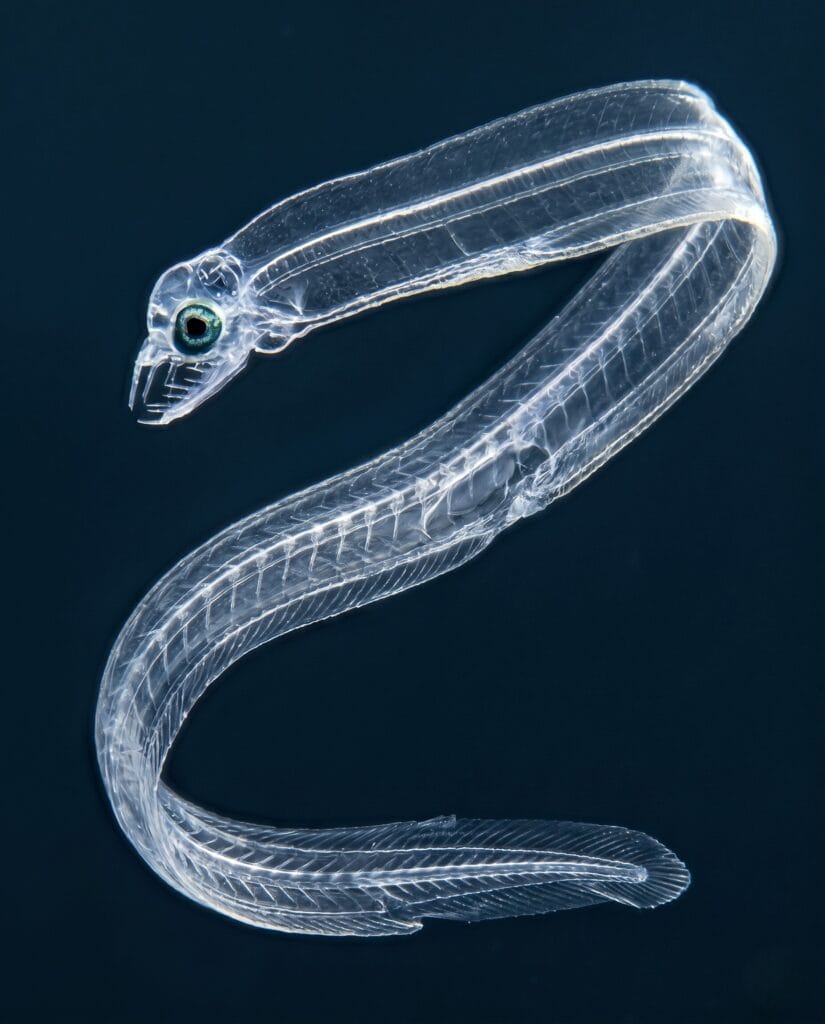
This is what they look like before settling into the sand — their bodies are entirely transparent. You can see the spine through the body. You can see the eye — one blue-green point — and the teeth already formed, waiting for a mouth that will eventually learn to intercept plankton. Nothing else is visible. They are almost not there.
They drift. They have no burrow, no colony, no fixed position. For weeks, sometimes months, they drift wherever the ocean carries them. Marine biologists tracking eel larvae found that for weeks, the larvae drift wherever the ocean pushes them.
And then one day they descend. They find sand. They drive their tails in. They secrete mucus. They build a tube.
After that, they do not leave.
Thirty-Five Years in One Hole
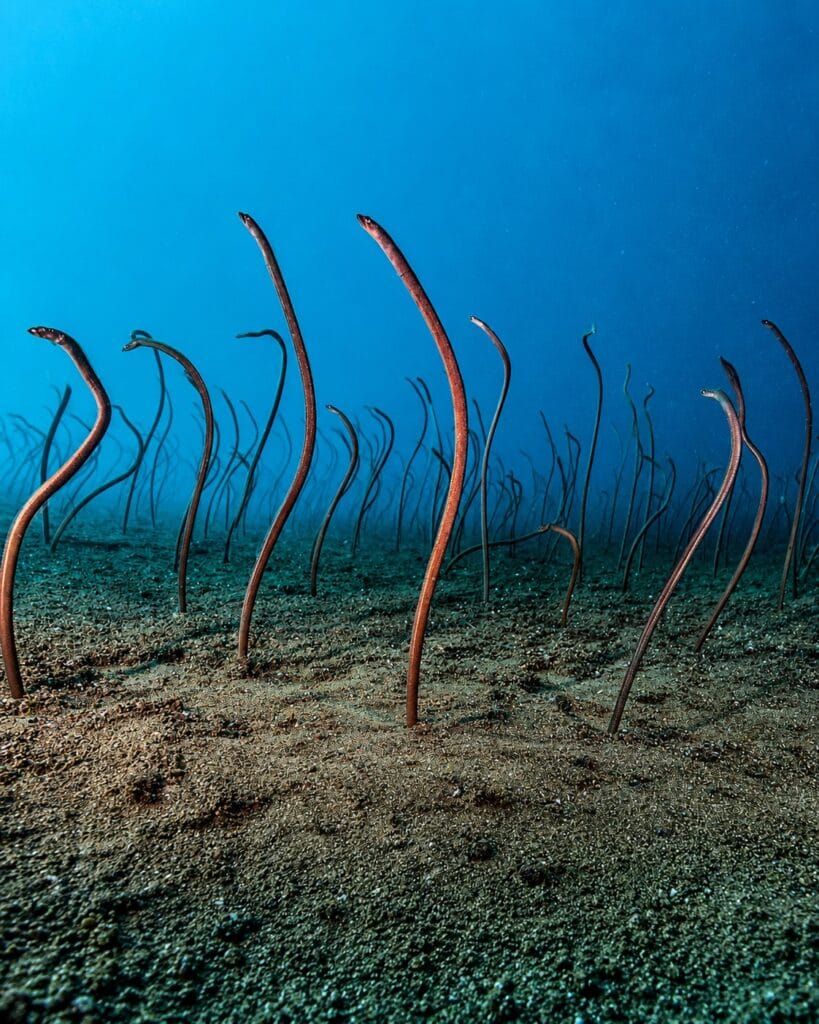
Garden eels in aquarium conditions have been documented living up to thirty-five years. In the wild, lifespan estimates vary, but the behavioral pattern does not. According to sedentary behavior studies cited in Marine Ecology Progress Series research on site-attached reef fish, adult garden eels — unless their habitat is destroyed — do not relocate. They remain in the same burrow. The same sand patch. For decades.
In thirty-five years, a garden eel may travel a total distance measurable in centimeters. Not kilometers. Centimeters. Its world ends where its body stops reaching.
That tiny radius becomes their entire world.
What this suggests — and it is worth sitting with — is that the garden eel did not end up trapped. It built the trap itself, with its own body fluid, on the first day it touched sand. And then it optimized for survival within that trap for the next three and a half decades.
Before You Call This Sad
Humans see something like this and immediately call it sad. The imagery pulls in that direction — the empty floor after the child touched the glass, the eggs disappearing into dark water, the decades in a single hole.
But that framing is a human import. Garden eels are among the most successful burrowing colonizers in the Indo-Pacific. They are found across a range stretching from the Red Sea to northwestern Australia to Japan. Their colonies can number in the thousands. They survived millions of years by doing almost nothing except holding position and waiting.
Maybe the terrifying part is how normal this starts to feel — watching them hold position against a current they did not choose, in a tube they built from their own body, waiting for food they cannot pursue.
Calling it sad tells you more about the observer than the eel.
Archive Notes
Why do garden eels always face the same direction?
They orient toward the prevailing current because that is the direction from which zooplankton arrives. The entire feeding strategy depends on passive interception — mouth open, body angled into the flow, waiting. When the current shifts, the colony shifts with it. They do not choose a direction. The water chooses for them.
Can a garden eel survive if removed from its burrow?
Removal is typically fatal under field conditions. The burrow provides thermal stability, predator cover, and positional anchor against current. Garden eels in aquarium settings require carefully maintained sandy substrate of sufficient depth — typically at least 30 centimeters — or they will fail to establish a stable burrow and decline rapidly. Stress-induced refusal to feed is the most common outcome in inadequate enclosures.
Do garden eels ever change sex?
Yes. In colonies where the male-to-female ratio drops below functional threshold, some female garden eels undergo sex reversal to maintain reproductive viability. This has been documented across multiple species in the subfamily Heterocongrinae and is interpreted as an adaptive mechanism to preserve colony-level breeding capacity without requiring individual relocation.
What You Now Know
A garden eel builds its own confinement on the first day it touches the seafloor — and then spends thirty-five years making that confinement as efficient as possible. It does not escape. It does not try. It perfects the inside of the hole.
The floor of that aquarium looked empty for about four seconds. Then the eels came back up, one by one, and resumed their position against the current. The child had already gone.
Tip For Readers
Garden eels are on permanent display at several major public aquariums in Japan, including facilities operated under the Japanese Association of Zoos and Aquariums (JAZA). The Okinawa Churaumi Aquarium maintains a mixed-species colony of Spotted and Splendid Garden Eels with documented nocturnal spawning displays during May through November.
Verified Sources
California Academy of Sciences — Creature Closeups: Spotted Garden Eel (Heteroconger hassi), behavioral documentation, 2023
Okinawa Churaumi Aquarium (affiliated with Japan Association of Zoos and Aquariums) — on-site interpretive display panels on Heteroconger hassi and Gorgasia preclara spawning behavior, 2026
Oceana Marine Life Encyclopedia — White-ring Garden Eel: broadcast spawning and burrow behavior documentation
Marine Ecology Progress Series — site-attachment and sedentary behavior research in reef-associated burrowing fish species
EBSCO Research Starters — Anatomy and Physiology: Garden Eel, behavioral and reproductive overview
Wikimedia Commons (CC0 / Public Domain) — leptocephalus larva photograph and open-ocean colony photograph, included for scientific reference
Original photography: VELLA TEAM — Okinawa aquarium colony, mating behavior, and interpretive display panels, May 2026
Image Credits:
Original photography by VELLA TEAM.
Additional reference materials from Wikimedia Commons.
Design elements assisted with AI tools.