
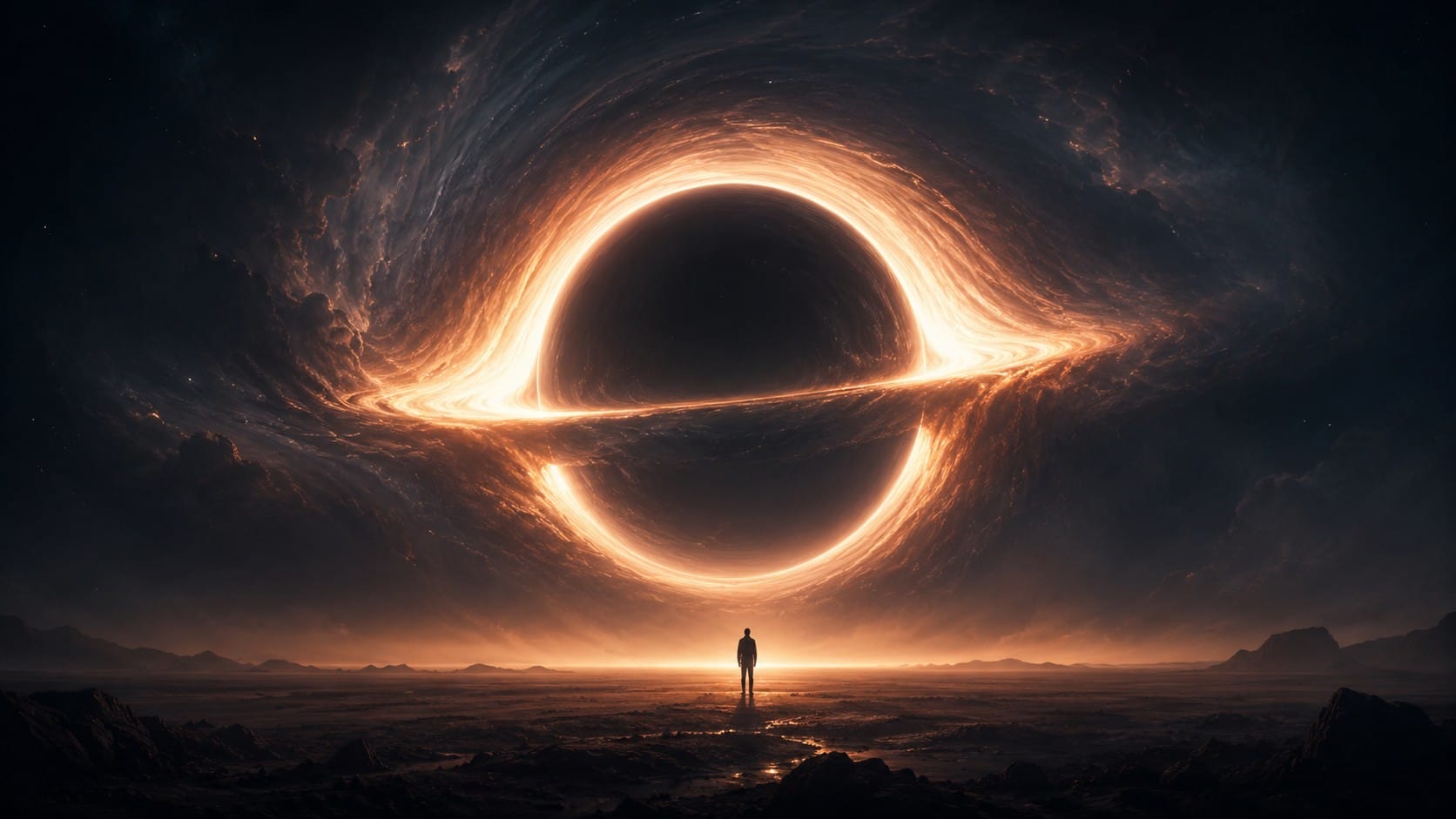
The universe had not finished building itself yet. There were no cities of stars, no spiral arms, no galaxies worth the name. And something enormous was already sitting in the dark, fully formed.
We like to think things happen in order. A house gets a foundation before it gets a roof. A galaxy, we were told, grows its stars first, gathers them into a shape, and only much later grows a black hole at its heart. That was the story we trusted. Then a telescope looked far enough back in time to test it.
The object now called UHZ1 sits 13.2 billion light-years away. We see it as it was when the universe was only about three percent of its current age. Just a few hundred million years after the Big Bang. Before most galaxies had even learned how to be galaxies. NASA’s Chandra X-ray Observatory and the James Webb Space Telescope found it together, and what they found did not fit the order we believed in.
A monster with no home
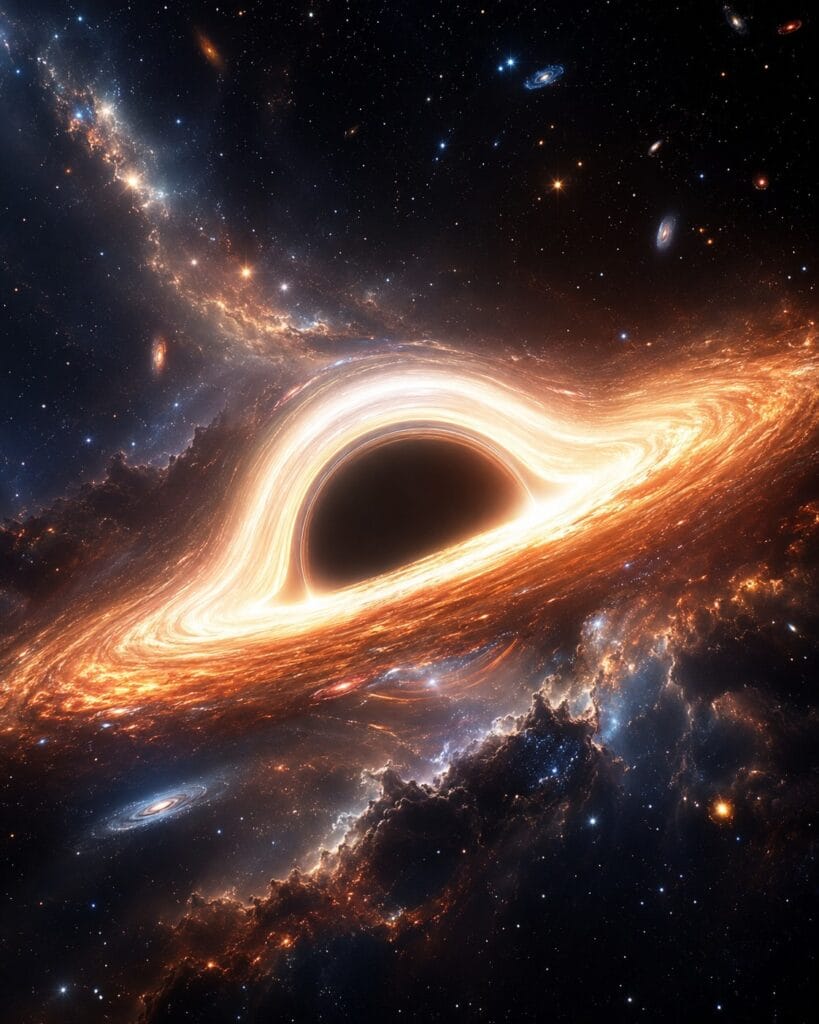
The strange part was not that a black hole existed so early. The strange part was the size of it, and what was missing around it.
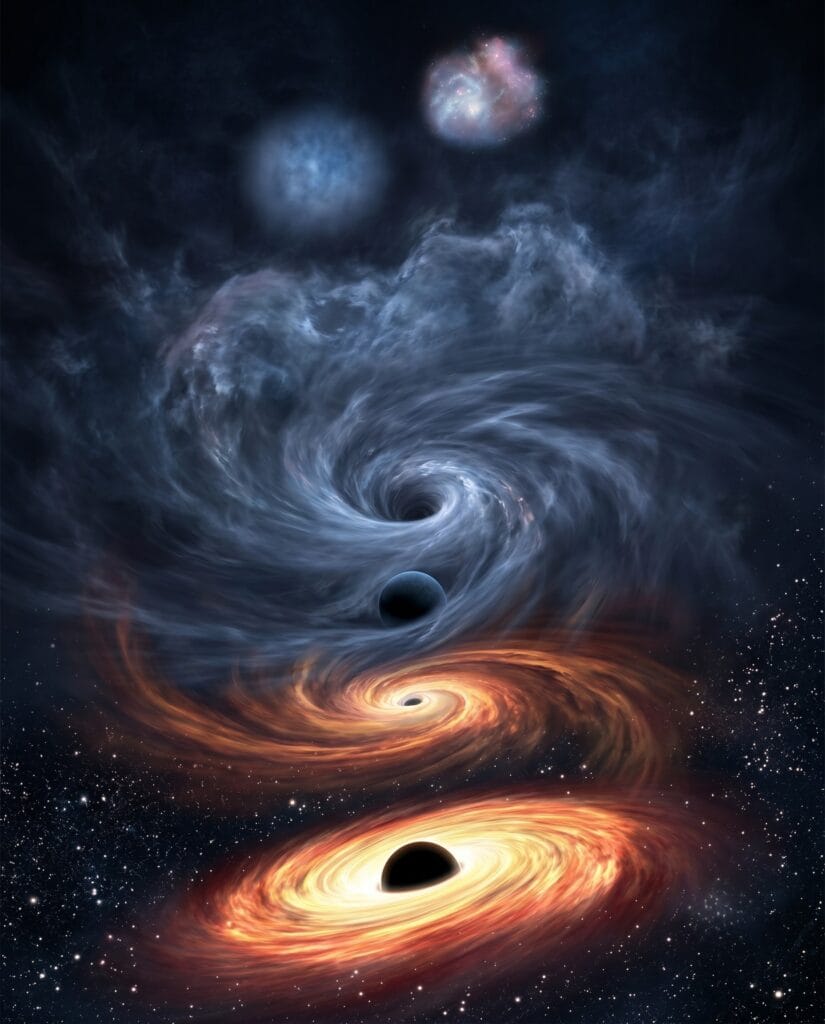
The host galaxy that should have been wrapped around UHZ1 was faint, small, barely there. The black hole, by contrast, looked far too heavy for its surroundings. It was like finding a child-sized house wrapped around a skyscraper. Astronomers studying the data interpreted it as a black hole that may have been born heavy, collapsing directly from a giant cloud of gas rather than growing slowly from a dead star.
There is a name for this idea. Some researchers call it a heavy seed. Instead of a single dying star collapsing into a modest black hole and then feeding for billions of years, a huge cloud of gas may have skipped the slow path entirely and collapsed straight into something enormous. If the scientists are right, UHZ1 is the closest thing we have to catching that process in the act, frozen in light that left it more than thirteen billion years ago.
In simple terms, the monster showed up before its house was finished. Possibly even before its galaxy had grown up around it.
Imagine a city that was never built
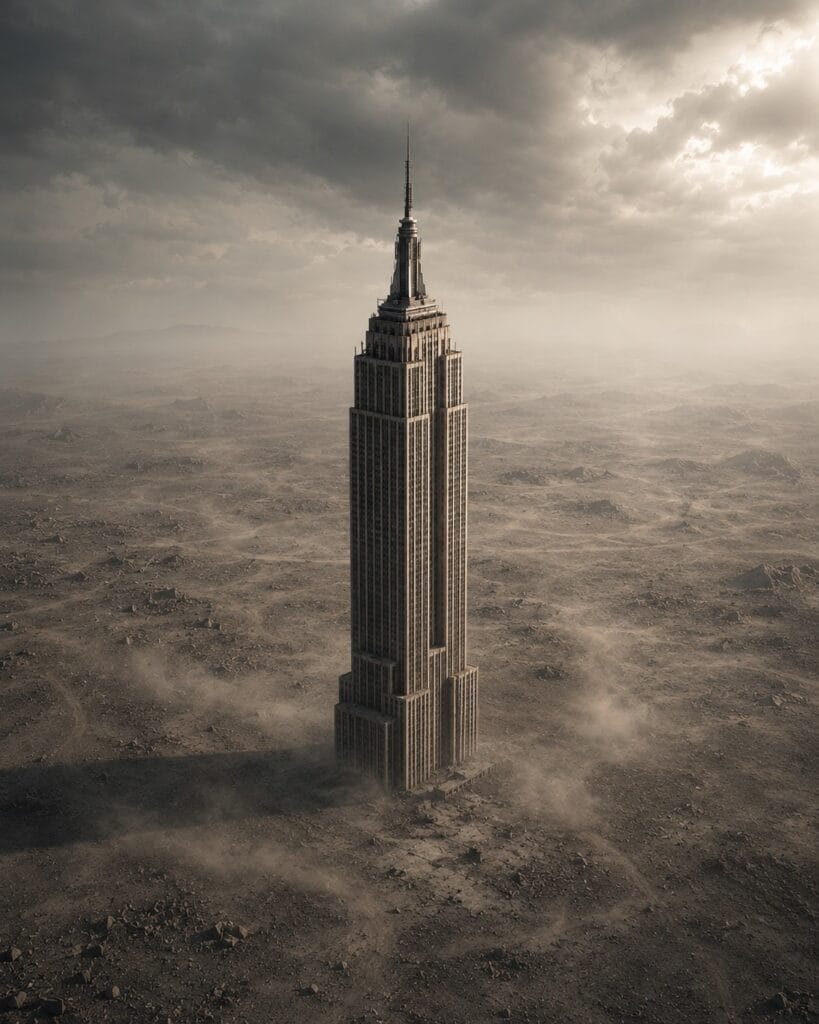
Picture stepping off a train into New York. There are no roads. No taxis. No lights, no crowds, no noise. And yet, standing alone in the middle of all that empty ground, is the Empire State Building, complete down to the last rivet.
Something about that picture feels wrong. It breaks the order of how things are supposed to grow. The skyline comes first, then the tower rises out of it. Not the other way around.
That is roughly what Webb and Chandra were looking at. The tower was there. The city was not. Researchers are still working through how a black hole could grow so massive so fast, and which came first, the black hole or the galaxy meant to hold it. Right now, few models can explain something this big appearing this early.
So if a black hole can break the order of creation, what could one do to a world like ours?
What if the Sun turned into a black hole tonight
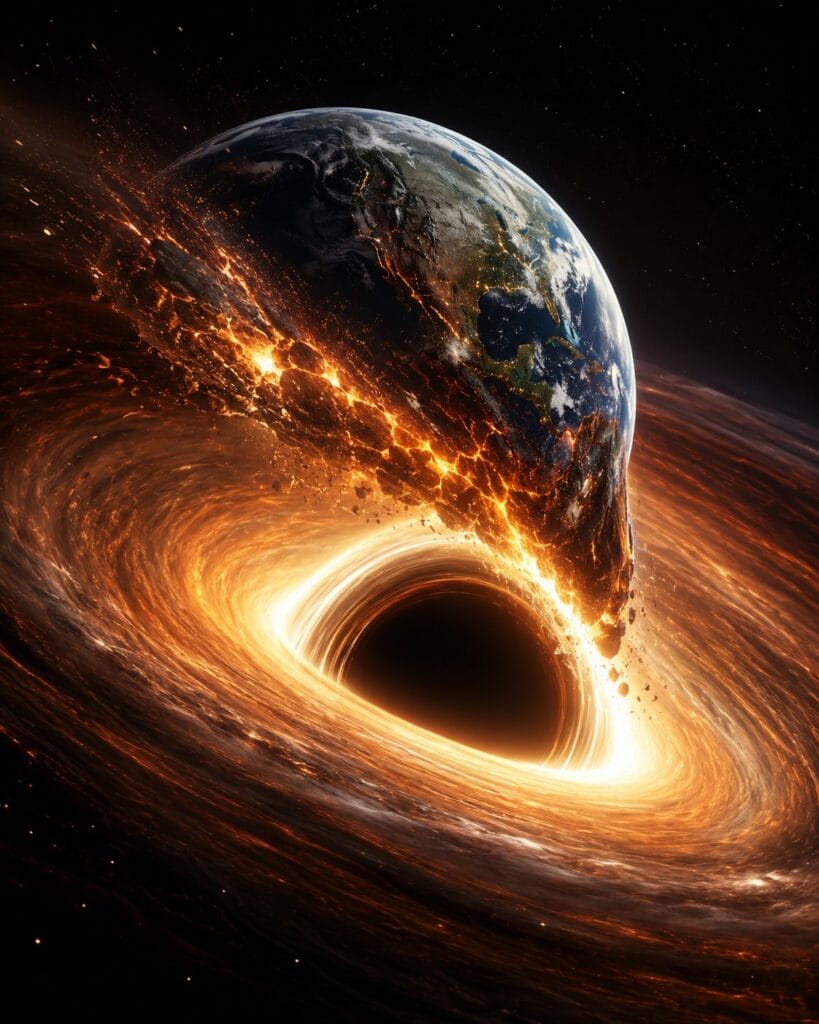
Many people assume the answer is instant. The Sun becomes a black hole, and Earth gets swallowed in a heartbeat. It is the kind of thing movies love. It is also wrong.
If the Sun were somehow compressed into a black hole, it would not become a cosmic drain that reaches out and grabs us. It would become a black sphere only about six kilometers across, smaller than the length of a city’s riverfront. Its mass would not change. And gravity depends on mass, not on how dark or small something looks.
So Earth would not fall in. It would keep orbiting exactly as before, on the same path, at the same speed. The cities would stand. The oceans would stay where they are. The mountains would not move. For about eight minutes, nothing at all would seem wrong.
Eight minutes. That is the part that stays with you. Eight minutes of normal life.
The eight minutes nobody would notice
Sunlight takes roughly eight minutes to cross the distance from the Sun to Earth. So if the Sun changed right now, we would not know right now. We would keep living inside the last light it sent us.
That light would be our final afternoon. When it ran out, the sky would simply go dark, and for the first time in human history there would be a night with no morning waiting at the end of it. No sunrise. No warning. Just a quiet that does not lift.
And nobody would feel it happen. Somewhere a child would still be walking home. Someone would be halfway through a sentence. A train would still be pulling into a station full of people checking the time. None of them would know that the warmth on their backs had already ended, eight minutes upstream, and was only now catching up.
The cold would come next. Within about a week, surface temperatures would fall below roughly minus seventeen degrees Celsius, and they would keep dropping. The oceans would start to freeze from the top down. Plants would fail. Earth itself, the rock and water of it, would survive for a very long time as a frozen, drifting world. Whether anything living survived with it is a much harder question.
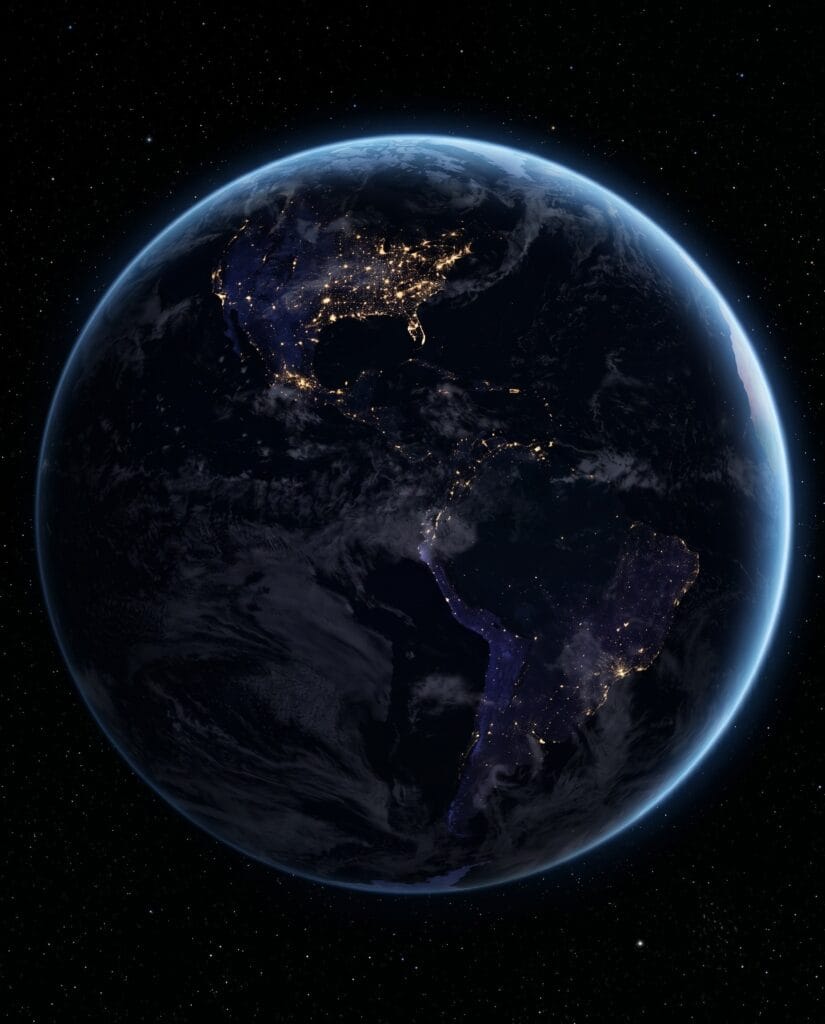
And this is the strange part. We have not seen a black hole reach out and take a planet. For a long time, we had not clearly seen a black hole at all.
A face we had already drawn
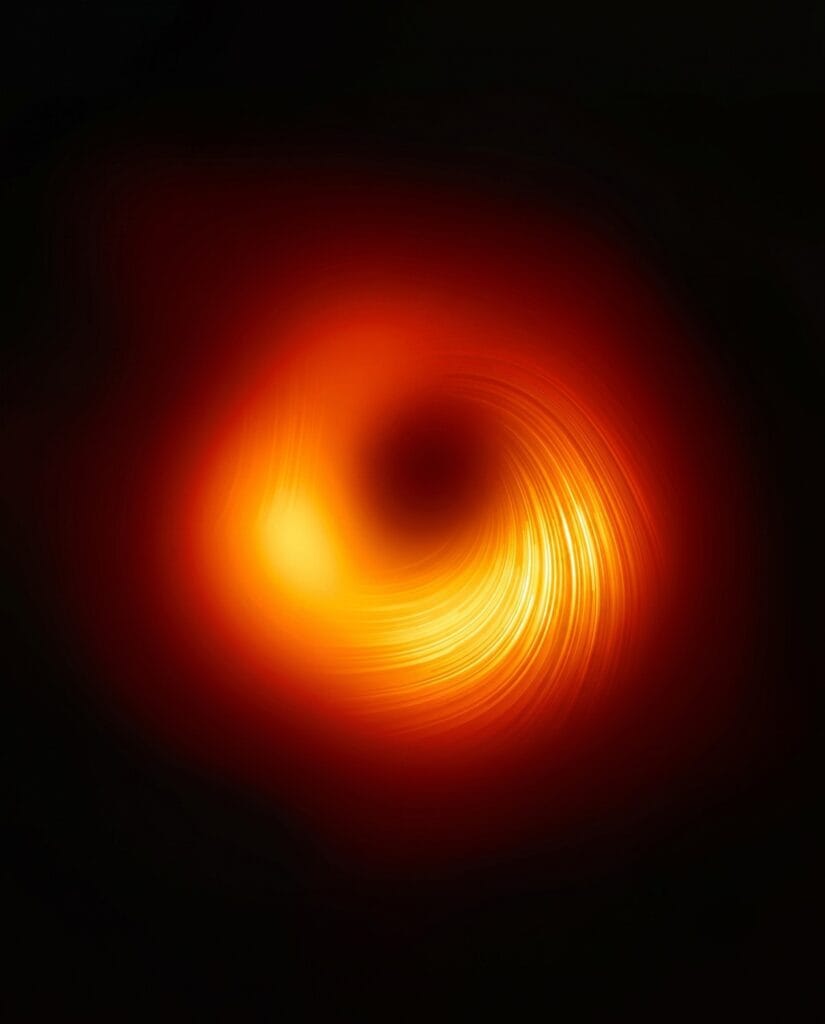
In 2019, that changed. For the first time, humanity looked directly at a black hole and saw its outline, a dark center ringed by a thin band of glowing light. The target sat in the galaxy M87, about 55 million light-years away.
To get there, scientists linked radio telescopes scattered across deserts, mountaintops, and ice fields into a single instrument as wide as the planet. They built, in effect, a camera the size of Earth, pointed it at a shadow tens of millions of light-years away, and waited.
The numbers behind that picture are almost funny. Over seven nights in April 2017, eight telescopes on different continents stared at M87 at the same moment, locked together by atomic clocks. They recorded so much raw data, around five petabytes, that no internet line on Earth could carry it. The hard drives, more than half a tonne of them, had to be loaded onto airplanes and physically flown to labs in Germany and the United States. One scientist summed it up by saying there is no internet that can beat a plane full of hard drives. Then it took close to two years to turn all of it into one round image. The light had crossed 55 million light-years to reach us. Turning it into a single picture, here on Earth, took two more years.
And the thing they captured is hard to hold in your head. That dark center is a shadow so wide that a beam of light, the fastest thing there is, would need roughly two and a half days just to cross it. The image looks small on a screen. The object behind it is bigger than our entire solar system.
For a hundred years, no one had seen such a thing. And yet, when the image arrived, it looked oddly familiar. A century earlier, a man with a pencil and a stack of paper had worked out, from pure mathematics, that this shadow should exist and what it should look like. His name was Einstein. A hundred-year-old equation had become a photograph. A prediction had become a picture. The paper grew old. The prediction did not.
Einstein left behind one more promise. And it took even longer to keep.
The sound of two monsters colliding
Back in 1916, Einstein argued that if two massive objects slammed together hard enough, they would shake the fabric of space itself, sending ripples outward like waves on a pond. He doubted anyone would measure something so faint.
In September 2015, we did. A detector on Earth registered a tremor that had been traveling for around 1.3 billion years. It came from two black holes spiraling into each other and merging into one. As they joined, spacetime rang like a struck bell, a single deep note fading into silence. A prediction made on paper in 1916 had at last been heard as a sound in 2015.
Ninety-nine years passed. A man scribbled an idea so faint he assumed it could not be tested. Two world wars, the entire space age, the birth of the computer. And then a machine sensitive enough to detect a shift far smaller than the width of an atom picks up the echo of an event that finished before our ancestors learned to farm. The waiting, in the end, was on our side, not the universe’s.
We did not see that collision. We felt it, through the trembling of space, long after the event itself was over.
But the strangest claims about these monsters do not come from the data at all. They come from the people who have spent their whole lives studying them.
The experts are more unsettled than you are
Start with the scariest idea, because it sounds like science fiction and is not. Stephen Hawking argued back in 1974 that a black hole is not perfectly black. Tiny amounts of energy leak from its edge, and over unimaginable stretches of time, that leak slowly drains it away. A black hole can die. Even the monster that eats everything eventually runs out of time.
Hawking took it one step further, and the line stuck. Black holes, he said, are not the eternal prisons we once thought. He even joked that if you ever feel trapped in one, you should not give up, because there may be a way out. He was talking about information, not about people, but the image is unforgettable.
Then it gets stranger. The physicist Carlo Rovelli has described what the inside of a black hole may actually be like, and it is nothing like a hole. From the outside it looks like a small dark sphere only kilometers across. Inside, Einstein’s equations suggest the space keeps stretching, like a funnel that widens the deeper you go. The volume hidden inside may be vastly larger than the tiny shell you see from out here.
And then there is the part that should make your skin crawl. Kip Thorne, who advised the film Interstellar and shared a Nobel Prize, points out that every black hole spins, because every star that made one was spinning first. A spinning black hole does not just pull things in. It grabs empty space itself and whips it around like a tornado, dragging the void along for the ride. At the very edge, to anyone watching from far away, time appears to slow to a complete stop.
And while the experts argue about what is inside, we keep missing the one closest to home.
The one at the center of everything
The most unsettling fact is not in the distant past. It is right now, above your head.
At the center of our own galaxy sits a supermassive black hole called Sagittarius A*. It holds the mass of roughly 4.3 million Suns, and it sits about 26,000 light-years away. You cannot see it. You cannot hear it. It makes no announcement. But it is always there, and our entire galaxy, including our Sun and our planet, slowly circles it.
It is there above the lights of New York. It is there above the rooftops of Seoul. It was there before any of us had a name for it, and it will be there long after. We are not watching the monster from a safe distance. We are already inside its orbit, turning around it, and we have been the whole time.
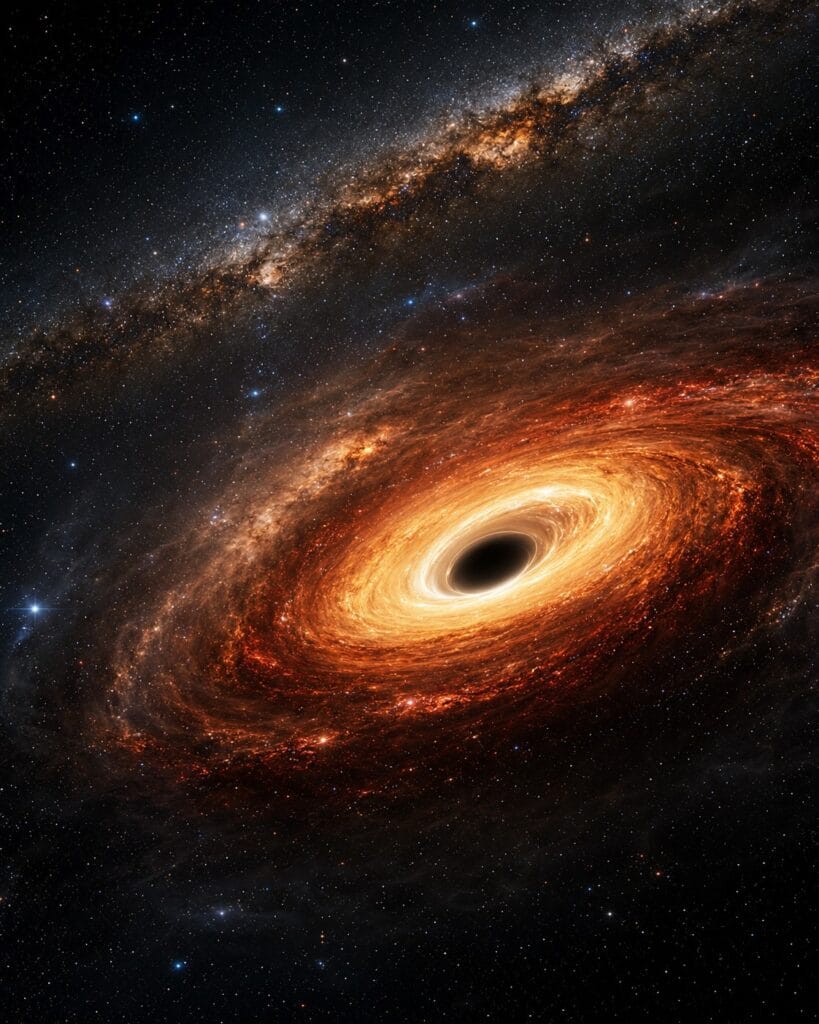
We arrived later than the stars. The galaxies came before us too. The monster never arrived. It was already there.
Before we leave
One last thing. The story is not over.
UHZ1 may not be exactly what we think it is. The signal is faint, and astronomers are still arguing about how to read it. The monster is real. The details are still being written.
And before anyone panics, our Sun is far too small to become a black hole. That part was only a thought experiment. The eight-minute night was never a prediction. It was a lesson in how gravity really works.
If the idea of a dead star leaving something behind stays with you, it is worth seeing what else the universe builds out of an ending. A collapsing star 5,000 light-years away left behind a glowing cloud shaped almost exactly like a human brain. And if what stays with you is how a single image can rewire the way we see everything, the first photograph of Earth seen from deep space did exactly that to an entire generation. Even our own solar system keeps its secrets close, which is why the famous shape on Pluto turned out to be nothing like the love letter people wanted it to be.
Archive Notes
How close is the nearest black hole to Earth?
The nearest one currently identified, named Gaia BH1, lies roughly 1,500 light-years away, paired with a Sun-like star. That is extremely close on a galactic scale, yet far too distant to pose any threat to Earth.
Why can we photograph M87’s black hole but not feel its gravity here?
Gravity weakens sharply with distance, so a black hole 55 million light-years away has no measurable pull on us. The 2019 image captured light from hot gas circling its edge, not its gravitational reach, which is why a planet-wide network of radio telescopes was needed to resolve it.
If the Sun became a black hole, how cold would Earth get?
Surface temperatures would fall below roughly minus seventeen degrees Celsius within about a week and continue dropping for months. The planet would survive as a frozen world, but its heat source would be gone within the same eight minutes it takes sunlight to reach us.
Verified Sources
Sources: NASA · JWST · Chandra · Event Horizon Telescope · ESO · LIGO · Stephen Hawking · Kip Thorne · Carlo Rovelli
Images: Editorial illustrations and visual concepts created by Vella Team for storytelling purposes, based on publicly documented astronomical observations.