
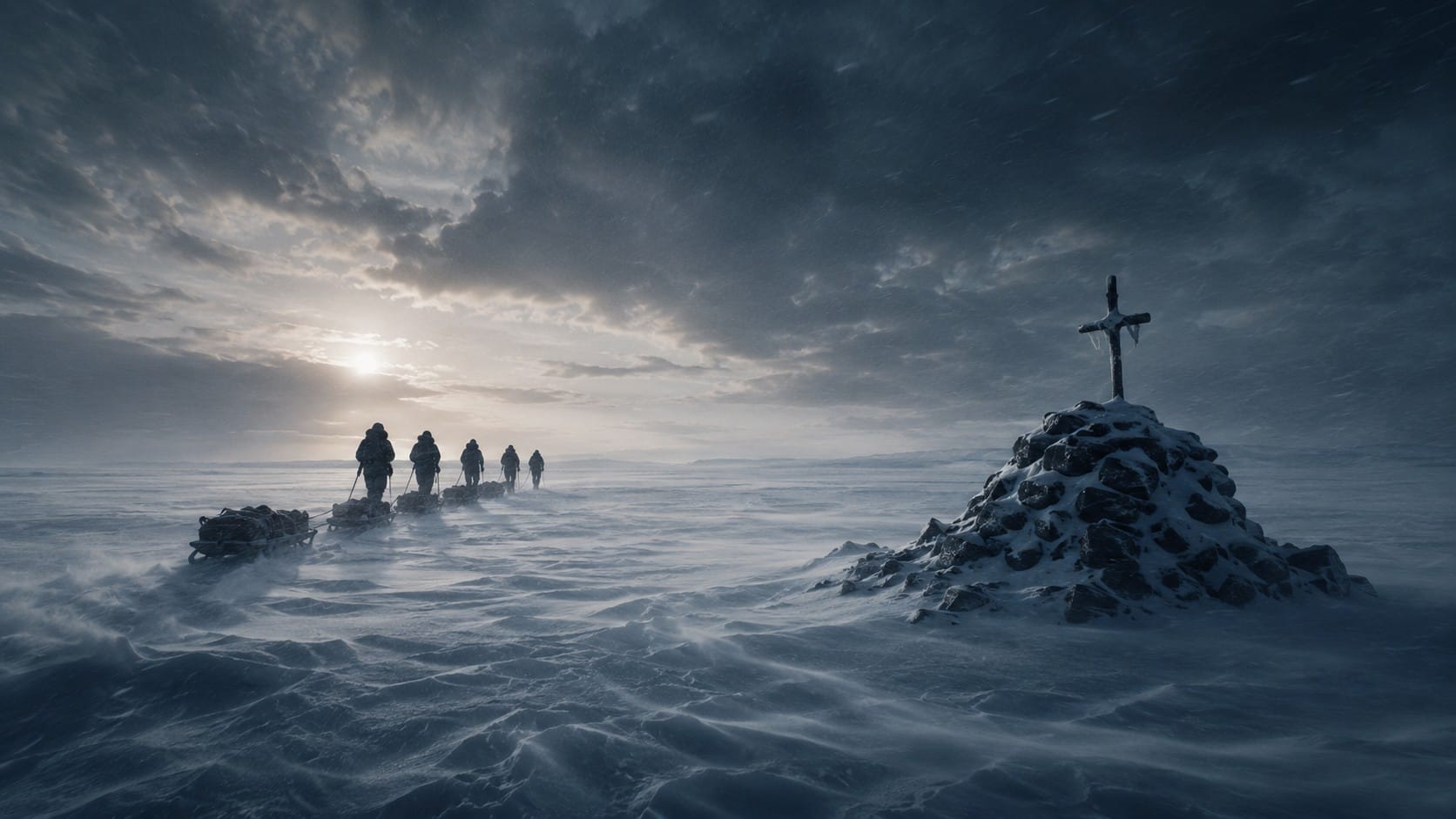
They reached the South Pole on January 17, 1912. Five men. Eight hundred miles of ice behind them. When they finally arrived at the bottom of the world, no one smiled.
Because the end of the earth already had a flag standing there. And it wasn’t theirs.
Roald Amundsen had been there first. Thirty-four days earlier. Scott’s team had starved and frozen their way across the ice, only to reach a place another man had already left. They would not make it home. What they left behind was written in pencil, by a man whose fingers were turning black with frostbite.
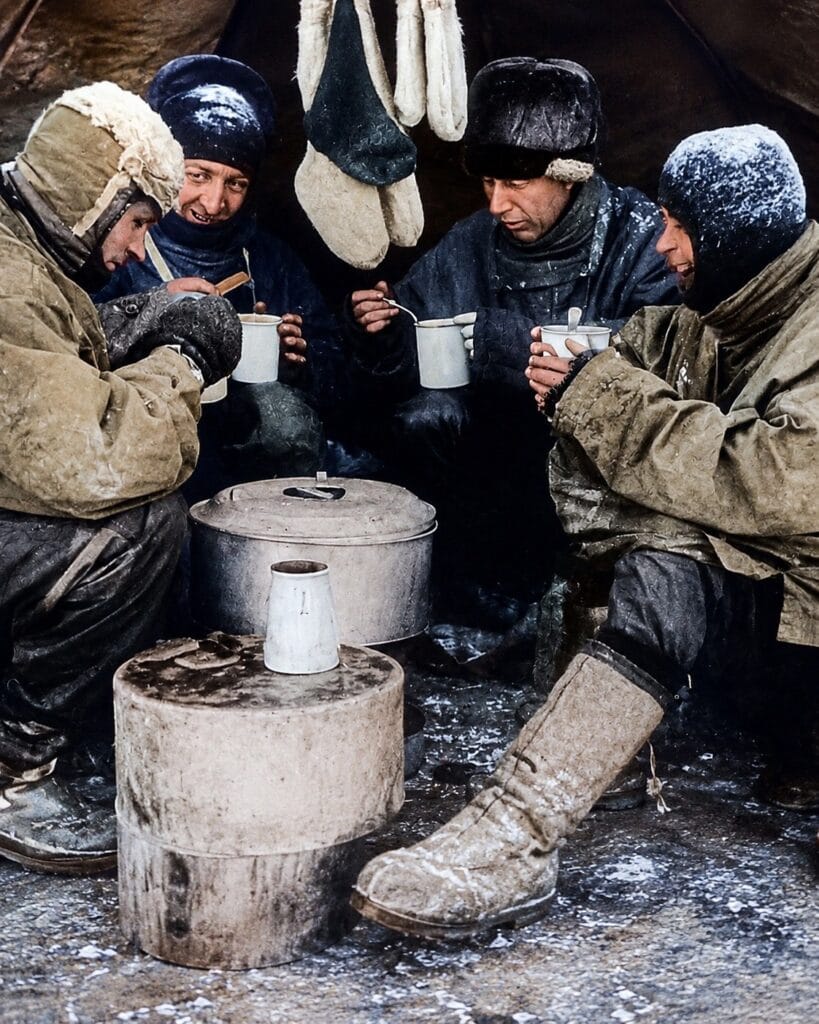
The Man Who Forced Himself to Be a Hero
Robert Falcon Scott was born in 1868 in Devonport, England — not into adventure, but into expectation. He was not a natural explorer. He was a sensitive boy from a failing family. He joined the Royal Navy because it offered the clearest future he could see.
He turned himself into someone else through sheer discipline. He studied harder than the men around him. He forced himself into discomfort repeatedly, because that was the only path he could see. His career advanced not because Antarctica called to him but because he answered every call that came, and one of them happened to be this.
In 1901, he led Britain’s first major Antarctic expedition in sixty years, reaching latitude 82 degrees 16 minutes south — a record at the time. The mission fell short of what the government and sponsors had hoped for, and Scott knew it. He understood his own failures with the same precision he used to understand everything else. That understanding became fuel.
By 1910, he had twenty thousand pounds from the government and the weight of the entire British Empire on his back. The crowds in New Zealand were enormous. The handshakes were firm. The champagne was cold. Nobody used the word “if.”
The Last Night That Felt Ordinary
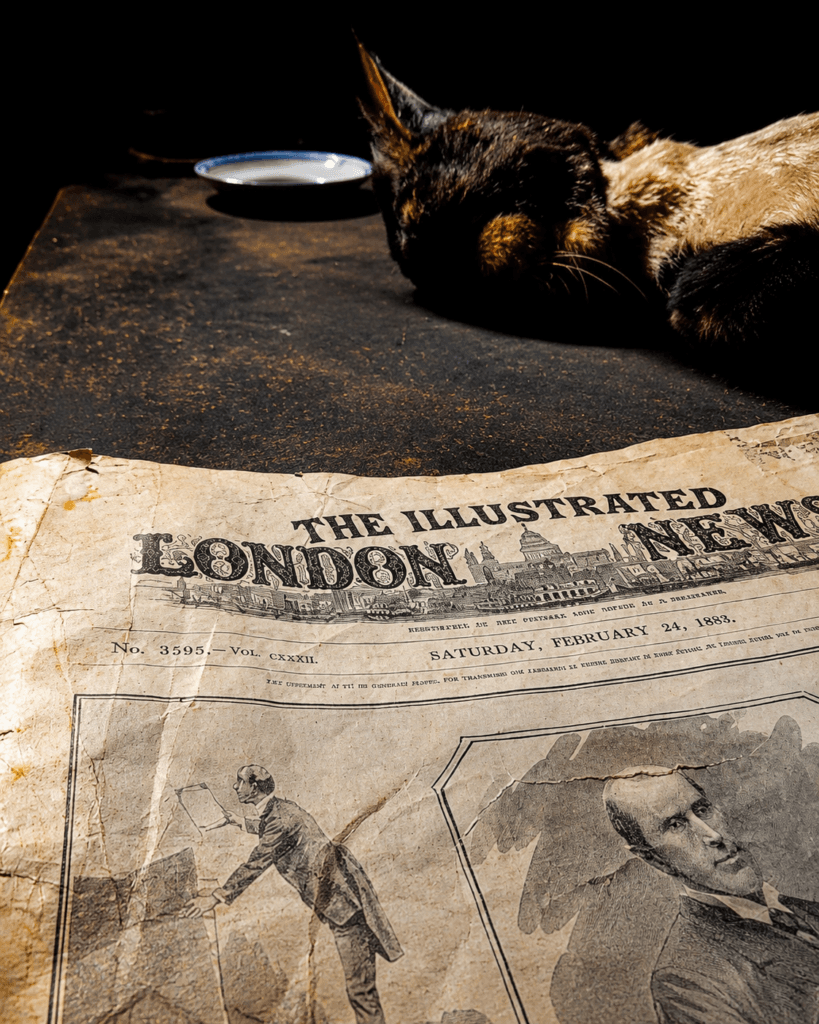
The hut at Cape Evans, 1911. The lamps are on. Someone is reading the Illustrated London News. The date on that newspaper is February 29, 1908 — three years old, and still the most recent news in the building.
Someone else is writing a letter home. A third man is arguing about something that doesn’t matter.
Outside, the temperature is forty degrees below zero. Inside, the warmth is almost normal.
This is how it looks before the cold takes everything. Not dramatic. Not electric. Just men trying to feel ordinary for a few more hours before they can’t anymore.
The Day the Support Party Turned Back
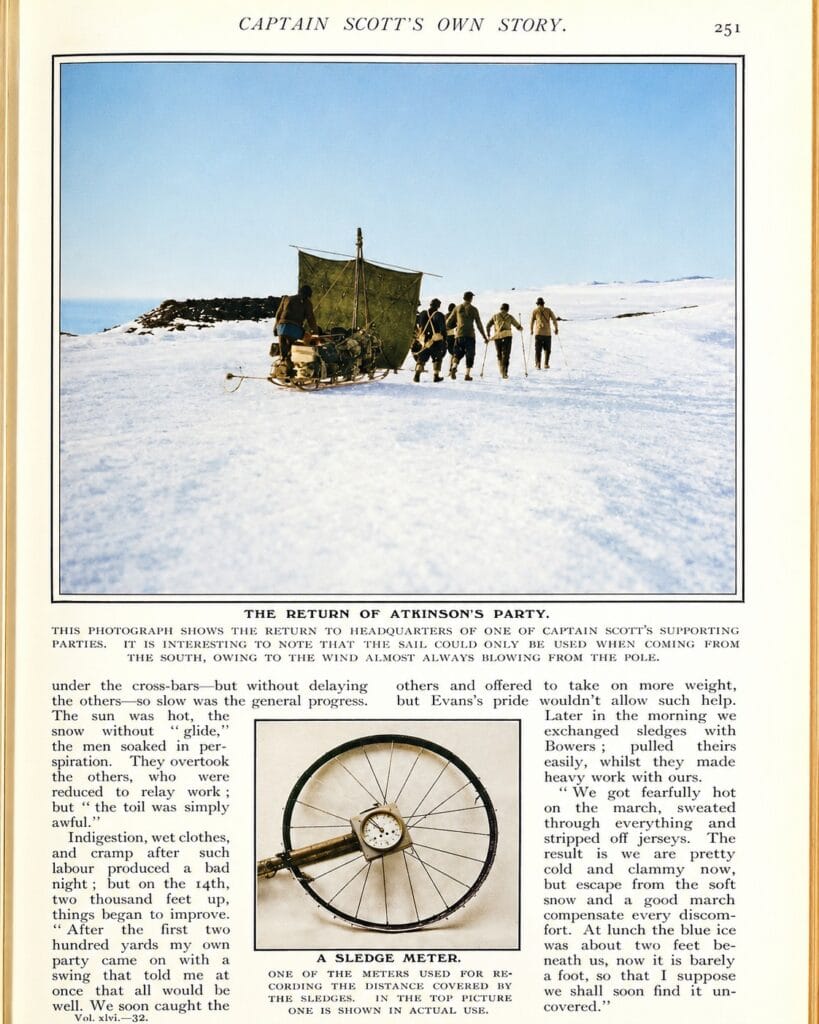
Look at the sledge in that upper photograph. There is a sail mounted on it. In Antarctica, the wind usually blows outward from the South Pole. That means the sail could only ever be used on the return journey — when the wind was behind you, pushing you home.
This is Atkinson’s party returning to base camp. These were Scott’s support team — they marched with the polar group as far as agreed, then turned back to wait.
The wind fills the sail. They are moving. They will make it home. Scott and his four men continued south without them.
The wheel in the lower photograph is a sledge meter. Mounted to the back of the sledge like a bicycle odometer, it counted every yard they moved. Every night in the tent, Scott pulled out his diary and wrote down the number.
Distance covered today. Distance remaining to the next depot. He never stopped writing down the numbers. It was his only way to feel that something could still be measured.
Those nightly numbers are why we know the final distance. In his last diary entry — written with a hand that could barely grip the pencil — Scott recorded that they were eleven miles from the supply depot when the blizzard made movement impossible. Not approximately eleven miles. Exactly eleven. The sledge meter told him so.
The Machine Failed. The Man Did Not.
The motor sledges broke down in the first few days. The engines seized at temperatures they had never been designed to handle. The ponies followed — one by one, unable to sustain the cold and the altitude. By the time the final five men were alone on the polar plateau, they were hauling their own equipment by hand.
The harness went across the chest and over both shoulders. You leaned forward, set your weight against it, and pulled. A fully loaded sledge weighed close to two hundred pounds. The polar plateau sits above nine thousand feet, where the air gives back less oxygen per breath than it should. Each mile cost more than a mile should cost.
Inside the tent, Scott’s diary reads like a cold autopsy report:
“The sun was hot, the snow without glide… the toil was simply awful.”
“We got fearfully hot on the march, sweated through everything and stripped off jerseys. The result is we are pretty cold and clammy now.”
In minus forty degrees, hauling sleds across the roof of the world, they were sweating. Generating so much body heat from pure exertion that they had to remove their outer layers.
Then the sweat cooled. Then the wet clothing froze against their skin. The same effort keeping them alive was slowly destroying them.
“Forestalled”: Beaten to the Edge of the World
They arrived at the South Pole on January 17, 1912. The sky was clear. Amundsen’s tent was standing in the middle of it, with a Norwegian flag above it, moving slowly in the wind.
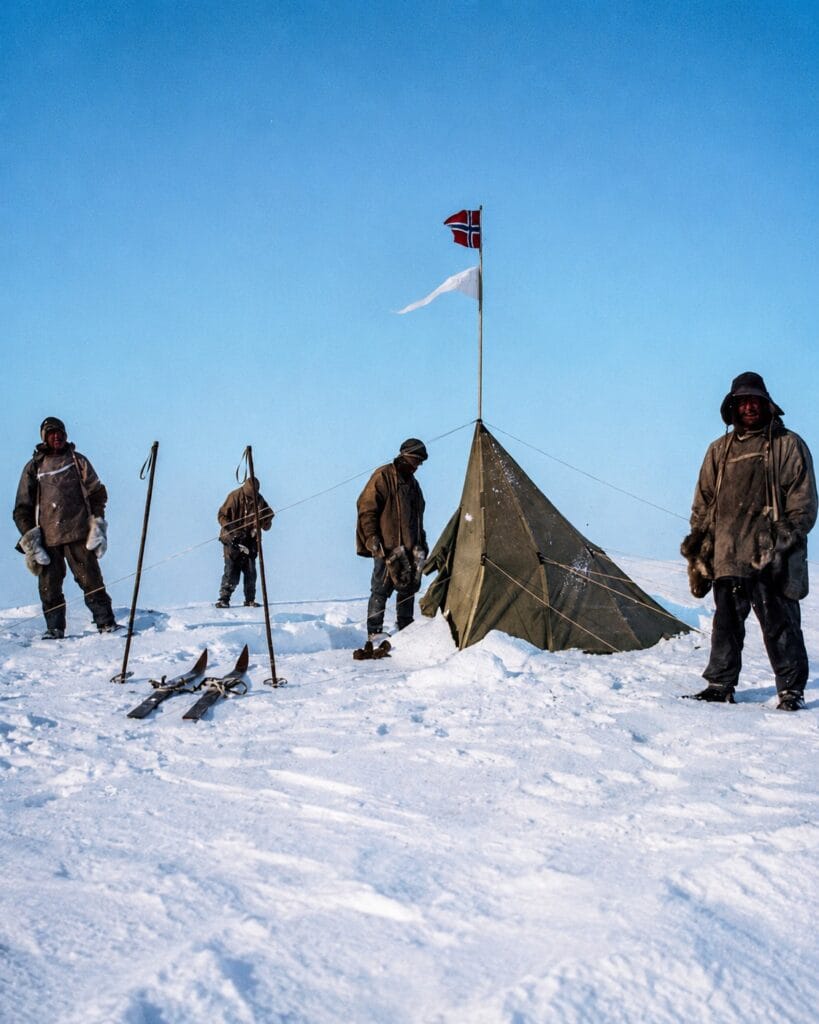
Inside the tent was a letter from Amundsen — addressed to the King of Norway, left there in case Amundsen died on the return journey. He was asking Scott’s team to deliver it for him. The greatest explorers of their generation had just been handed an errand by the man who beat them.
The following day, January 18, they raised their own flag anyway. Henry Bowers attached a long string to the camera shutter and pulled it from inside the frame, so all five men could be in the photograph.
That is how the photograph was made — by a dying man pulling a piece of string, standing in front of the tent of the man who beat him.
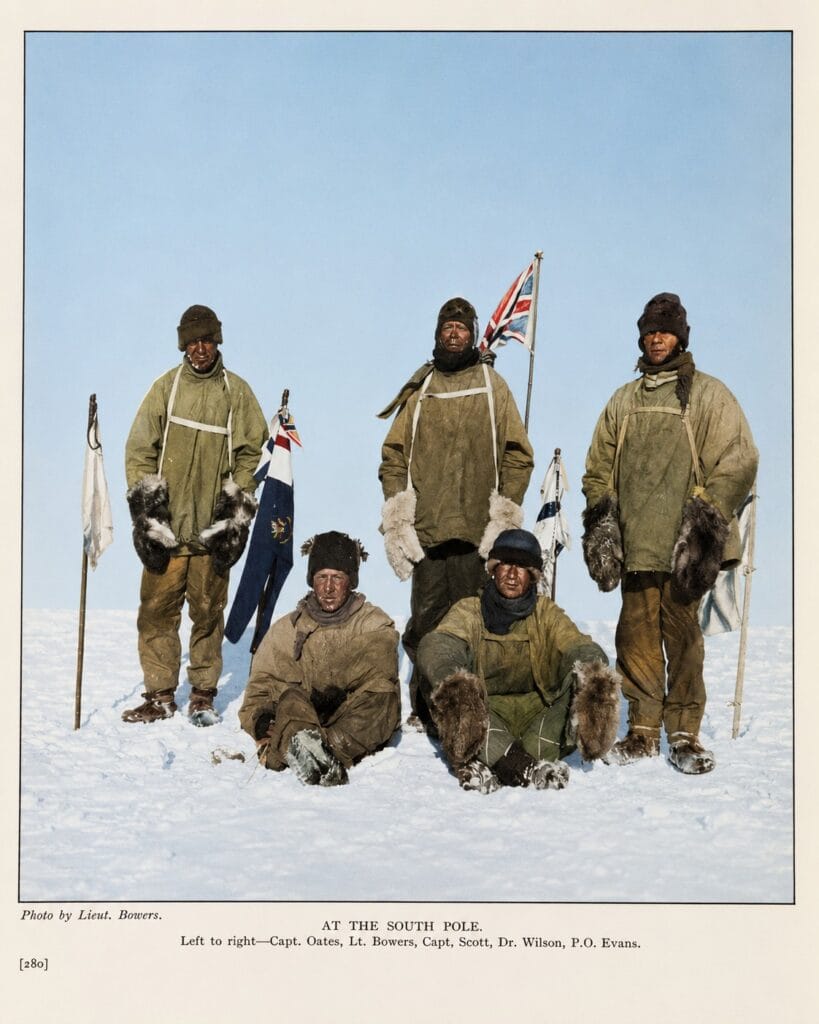
The Library of Congress catalogs this photograph under the word “Forestalled.” In English, it means to be beaten to something before you arrive — to find the door already closed, the seat already taken, the flag already planted.
Look at their faces. Not one of them is performing anything. There is no triumph, no forced smile, no remaining pride. They are simply standing there, in front of evidence of their own defeat, and holding still long enough for the shutter to close.
Scott had refused to use his sled dogs as a food source — killing the animals as you went, feeding the surviving dogs on the dead ones, arriving faster with nothing left behind you. Amundsen had done exactly this, without hesitation, and arrived thirty-three days earlier. Historians still argue whether it was a moral choice, a strategic mistake, or both. But it revealed who Scott really was: a man who refused to compromise his humanity just to win a race.
One Man Walked Out So The Others Could Live
The return journey killed them in order. Edgar Evans deteriorated first — frostbite, a fall, then a collapse that could not be reversed. He died on February 17, 1912, near the Beardmore Glacier. Four men continued.
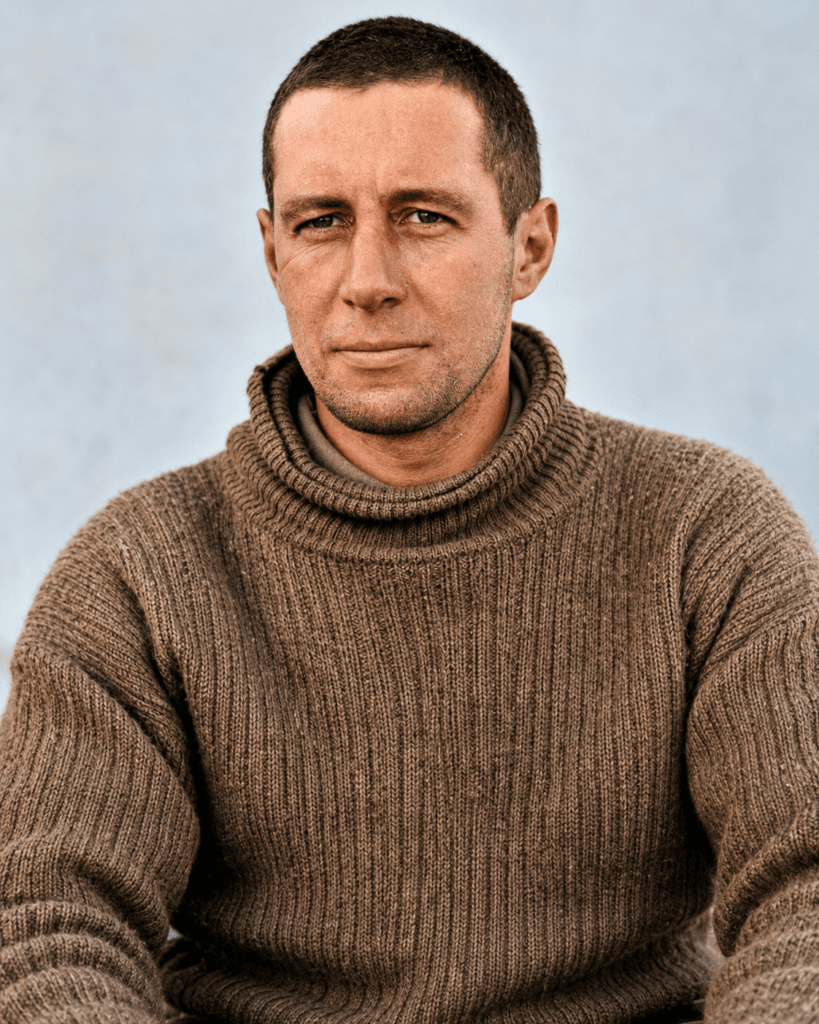
Lawrence Oates was thirty-two years old and an Army captain recruited for the expedition because of his experience with horses and his reputation for endurance without complaint. His feet had been deteriorating for weeks. He understood, with the same clarity Scott brought to everything, that he was slowing the group and that this was no longer a manageable problem.
On the morning of March 16 or 17 — Scott’s diary records the date with uncertainty — Oates said he was going outside. He left his coat behind. He made no grand speech. The temperature was minus forty degrees Celsius, with wind.
His words, as Scott recorded them: “I am just going outside and may be some time.”
He was not going outside. He was making room. Every calorie he would have eaten, every weight he was adding to the group’s burden — he was removing himself from the equation so the other three had a fractionally better chance. His body was never recovered.
Eleven Miles. His Last Sentence.
Scott, Wilson, and Bowers continued. The sledge meter kept counting. The supply depot at One Ton Camp was close — they could see it in the numbers.
Then a blizzard came that was not a normal blizzard. Wind speeds that made movement impossible. Temperatures that fell past forty below.
They had been in the tent for nine days when Scott picked up his pencil for the last time. His right hand was frostbitten enough that grip was a conscious effort. He did not use the pages to explain himself. He wrote letters — to the families of the men who had died, to the expedition’s backers, to the British public. He explained what went wrong, his frozen hand struggling to write, his tone remarkably calm.
At the end of the final document, he wrote: “For God’s sake look after our people.”
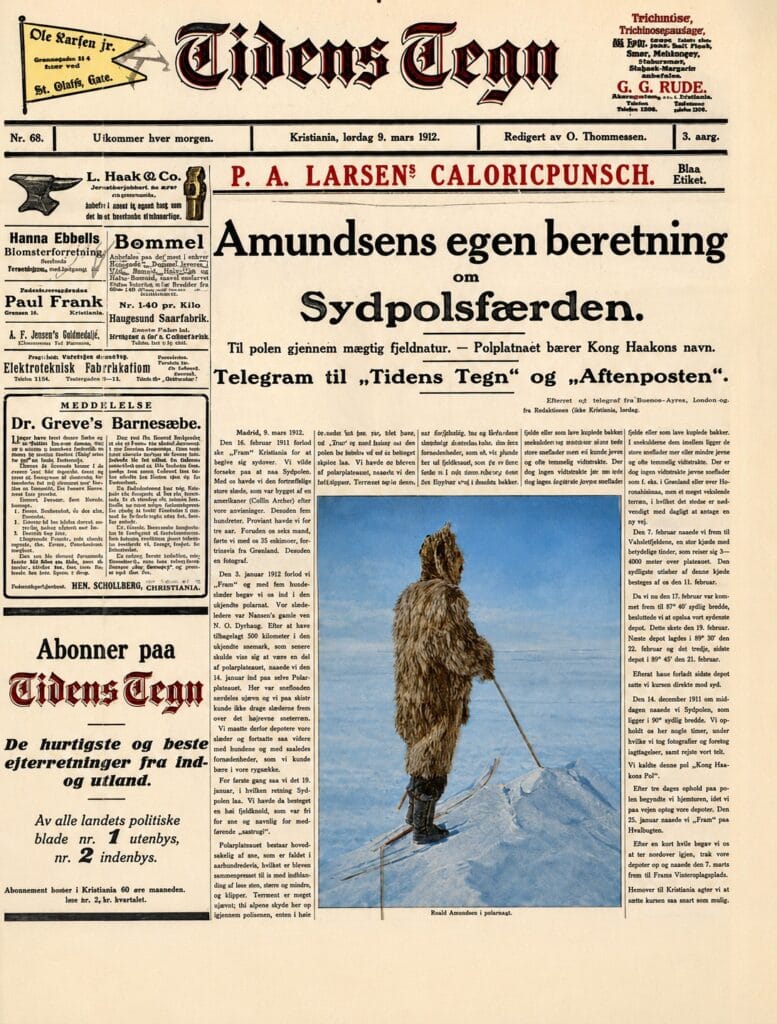
That same week, a newspaper in Oslo was selling out its print run. Tidens Tegn. March 9, 1912. Amundsen’s face on the front page.
The headline read: “Amundsen’s own account of the South Pole journey.” Church bells had rung across Norway. Congratulatory telegrams had arrived from the King of England. The world had a hero.
Scott did not know any of this. He could not have known. The tent walls were moving in the wind. The pencil in his hand was nearly still. Outside, it was forty degrees below zero, and the depot with food and fuel was eleven miles away.
It wasn’t a captain’s report. It was a dying husband begging his country to protect the widow and the son he would never see again. His last diary entry is dated March 29, 1912. The pencil stopped mid-sentence.
The 16 Kilograms of Rock
Before this becomes a story about heroism, there is another part worth remembering.
His critics would later blame him. They said he trusted untested motor sledges, chose ponies instead of dogs, and made fatal planning errors. One Ton Camp ended up eleven miles short of its intended position after a series of difficult decisions and worsening conditions. Those eleven miles became the exact distance between life and death.
He was a deeply disciplined man who made fatal choices in a place that allows zero room for error. Both things can be true at the same time. The second one makes the first one more human, not less.
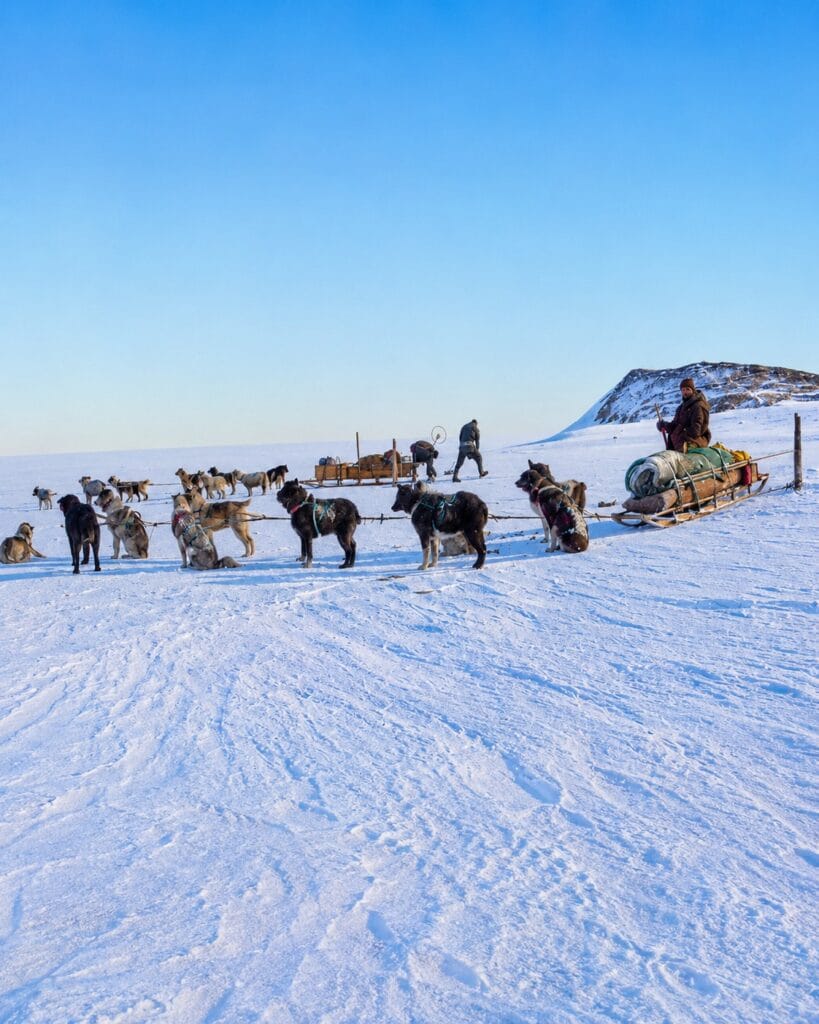
November 1, 1912. Eight months after Scott’s pencil stopped. The search party left Cape Evans to find them.
They knew the polar team was dead — the season had turned, two supply attempts had found no one, and the mathematics of food and distance had been calculated many times. They were not going to rescue. They were going to find.
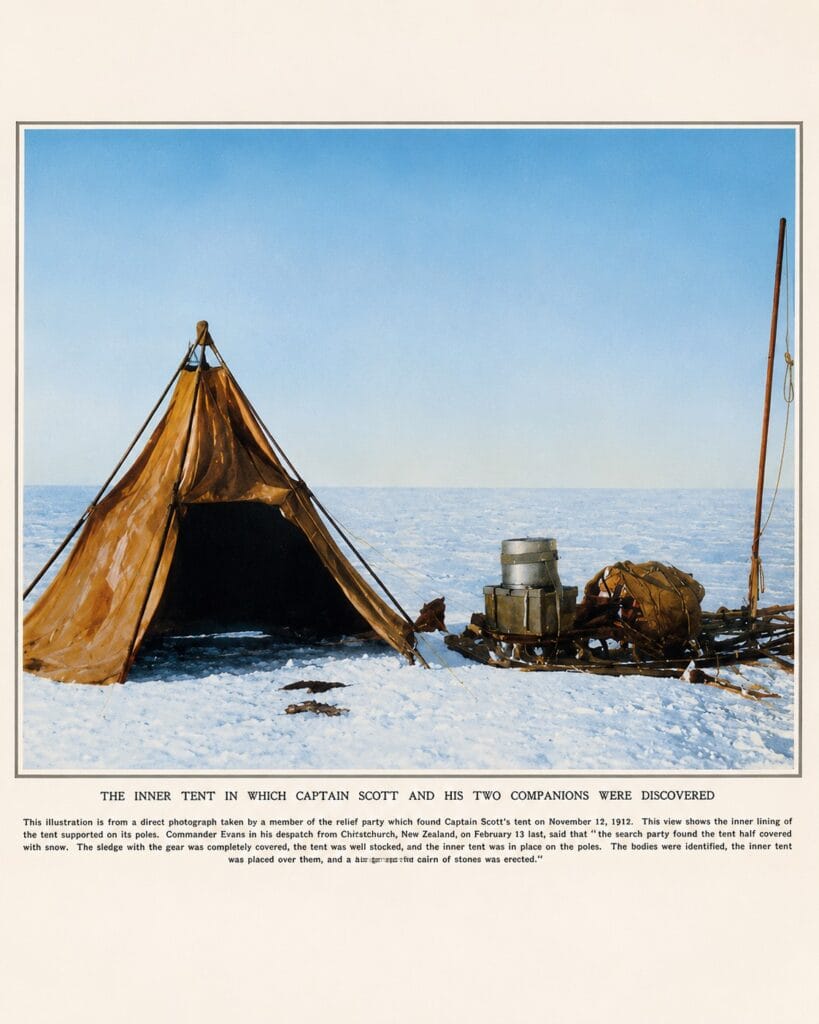
They found the tent on November 12, 1912. It was half-buried in snow, still held up by its poles. The sledge was beside it. On the sledge were thirty-five pounds of geological specimens — Glossopteris plant fossils that Scott’s team had hauled across hundreds of miles of ice when every extra pound was a pound that might kill them. They had not thrown the rocks away.
People remember Scott as the man who lost the race. That is not wrong. But those sixteen kilograms of rock tell a different story.
He was not only a captain trying to plant a flag. He was a scientist who kept his promise to science even as he was dying. The loss belongs to the race. The fossils belong to humanity.
Those fossils were later deposited at the Natural History Museum in London. The Glossopteris specimens became part of the evidence base for continental drift theory — the understanding that the world’s landmasses were once joined and have been separating for hundreds of millions of years. Scott’s men carried the proof of this, dying, across the ice of a continent that did not yet know what it was.
The search party did not move the bodies. They collapsed the tent over them, piled snow into a cairn above, and made a cross from skis. Then they left. The cairn has been moving slowly north on the Ross Ice Shelf ever since. In several centuries, it will reach the sea.
The Hut Is Still There
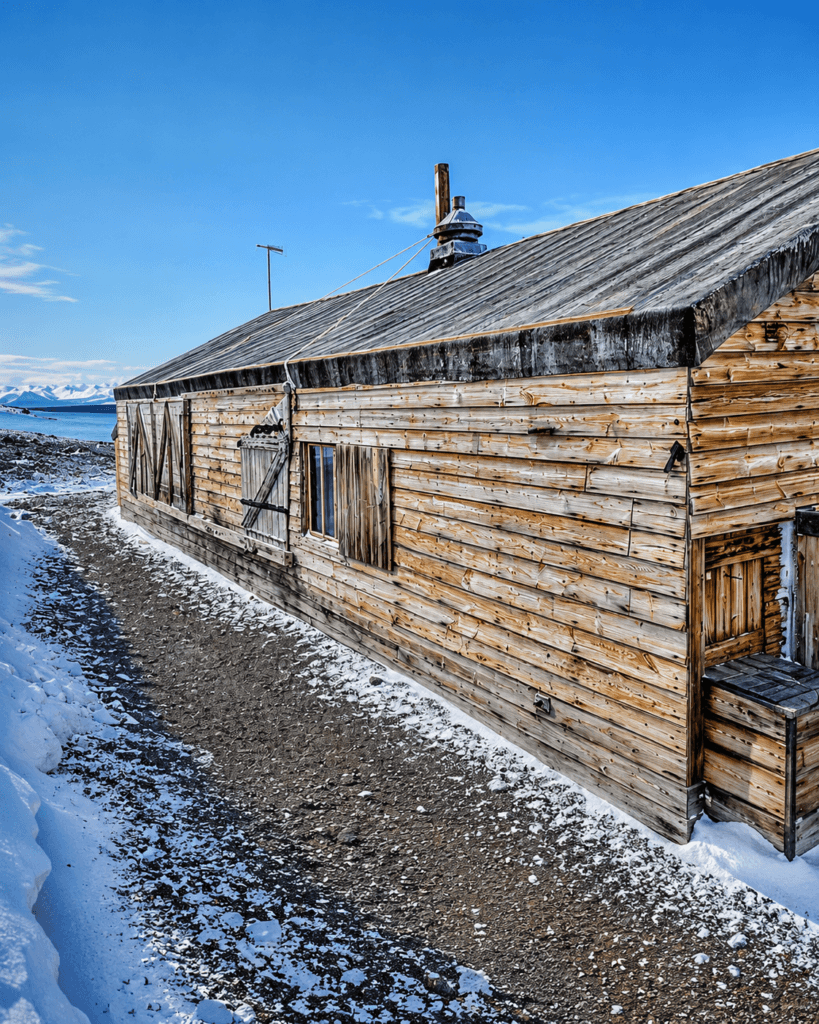
The Antarctic Heritage Trust of New Zealand has been maintaining the Cape Evans hut since the 1990s. The building is still intact. A tin of food on the shelf has not rotted. A newspaper on the table — an issue of the Illustrated London News dated February 29, 1908 — has not fully crumbled. The boots by the door retain the shape of the men who wore them.
The hut housed twenty-five men during the expedition’s first winter. It later sheltered survivors of Shackleton’s Ross Sea Party from 1915 to 1917. Three of those men died there as well. The structure has outlasted everyone who has ever depended on it.
Amundsen returned from the South Pole, was celebrated across Europe, gave lectures, wrote a book, and lived another eighteen years. Scott’s diary — recovered from a tent eight months after he died — was read by the King of England, published for the public, and is still in print. The man who won left a flag. The man who lost left a diary, a set of geological specimens that helped explain the planet, and a last sentence that reads less like a final entry and more like a letter that was never supposed to end.
Amundsen reached the Pole first. Scott never came home. Yet a century later, we still know his name.
Like the musicians who played on the sinking Titanic, Scott kept doing his job because it was the only thing he had left. He carried sixteen kilograms of rock across a dying landscape because science had asked him to. The same quiet stubbornness appears in the story of a mathematician who sent men to the moon from a desk where no one was supposed to listen to her.
Archive Notes
Why did Scott include a fifth man in the polar party at the last moment?
Scott’s original plan called for four men on the final polar push. At the last moment, he added Henry Bowers, creating a party of five. This altered the food and fuel calculations the entire supply chain had been built around — more men meant more consumption, and the depots had been stocked for four. Bowers was an exceptionally capable officer, and Scott’s reasoning was sound in isolation; but combined with the motor sledge failures and the underperformance of the ponies, the additional man tightened an already narrow margin.
What happened to the Glossopteris fossils Scott’s team carried?
The geological specimens — approximately thirty-five pounds of rock and fossil material collected near the Beardmore Glacier — were recovered with the bodies and sent to the Natural History Museum in London, where they remain. The Glossopteris flora, a fern-like plant from the Permian period, had been found across multiple southern continents, and its presence in Antarctic rock was later used as one of the supporting data points for the theory of continental drift, formalized in the twentieth century as plate tectonics.
What is “One Ton Camp” and why does its location matter?
One Ton Camp was the southernmost supply depot on Scott’s return route, stocked with food, fuel, and equipment. It was intended to be placed at 80 degrees south, but was positioned roughly eleven miles short of that point because the support ponies were in poor condition and the team stopped early. Scott’s party ran out of food and fuel eleven miles short of the camp. The coincidence of those two numbers — the shortfall in depot placement and the shortfall in survival distance — has been a central point of debate in the historical literature for over a century.
What You Now Know
Amundsen won the race. Scott won something slower and harder to name — the attention of every generation that has come after, not because he failed, but because of what he did with the remaining hours after he knew he was going to. A man who dies writing letters for other people’s families is doing something that has no category in athletic competition. It took a century for the rest of us to find the right word for it.
Tip For Readers
Scott’s complete diary and his “Message to the Public” are held at the Scott Polar Research Institute at the University of Cambridge, which maintains the world’s largest archive of polar exploration material. The British Library also holds digitized records from the expedition, accessible through its online collections portal.
Verified Sources
British Library (UK)
Scott Polar Research Institute, University of Cambridge
Library of Congress Prints & Photographs Division
Natural History Museum, London
Antarctic Heritage Trust (New Zealand)
Roland Huntford, Scott and Amundsen (1979)
Susan Solomon, The Coldest March (2001)
Apsley Cherry-Garrard, The Worst Journey in the World (1922)
Robert Falcon Scott, Scott’s Last Expedition (1913)
Tidens Tegn Historical Archives (1912)
Wikimedia Commons (Public Domain & Creative Commons Historical Images)