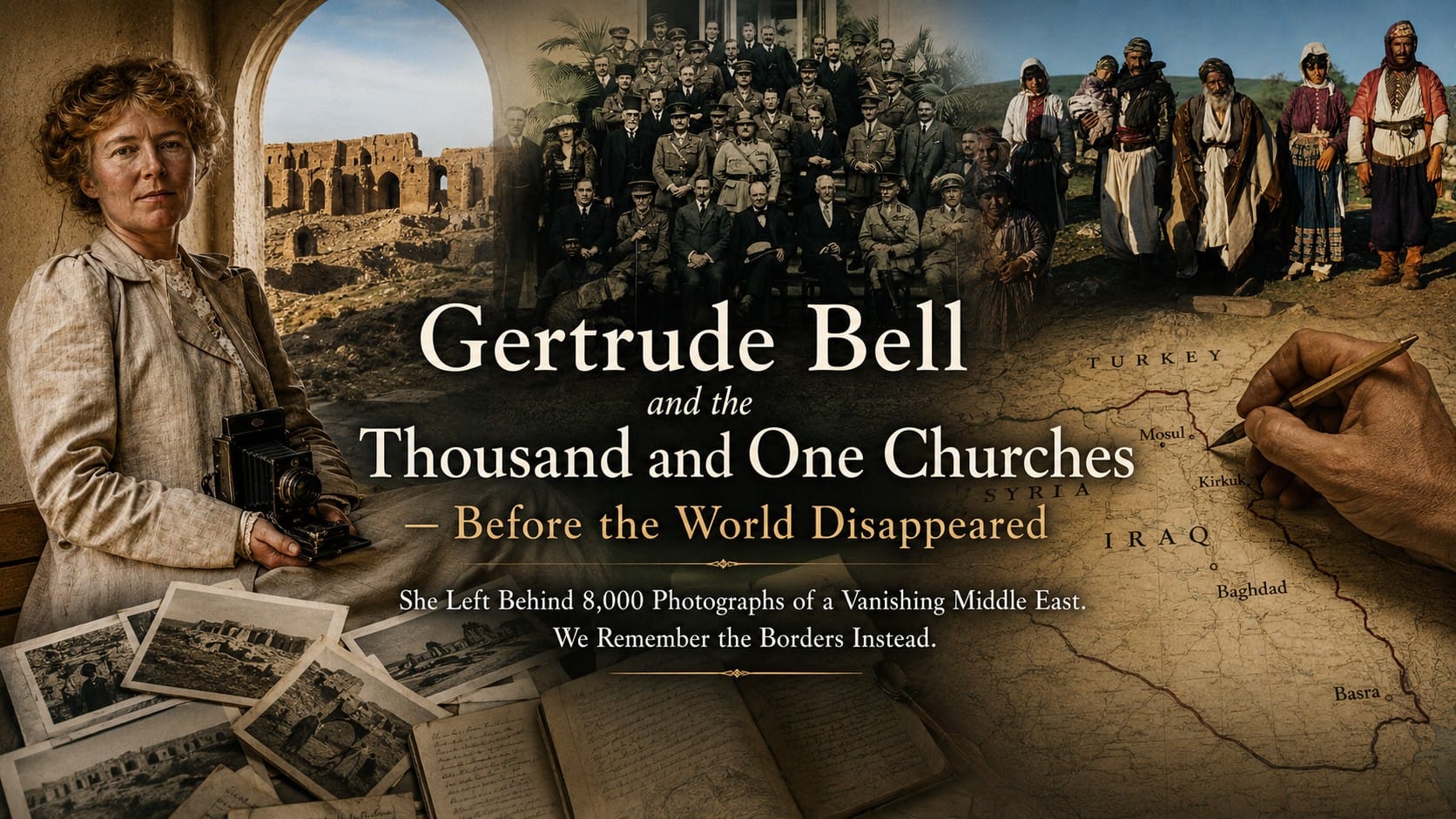
She Left Behind 8,000 Photographs of a Vanishing Middle East. We Remember the Borders Instead.
The world remembers Gertrude Bell one way. The woman who drew the borders of modern Iraq. The Queen of the Desert. The only woman in the room with Churchill and Lawrence. Her name is carved into textbooks, diplomatic records, and the long history of conflict in the Middle East.
But what she held onto her whole life wasn’t a border. It was a world that was disappearing.
On the morning of July 12, 1926, a servant knocked on her bedroom door in Baghdad. No answer. When the door opened, the Queen of the Desert was lying cold in her bed. A bottle of sleeping pills on the nightstand. She was 57 years old — two days before her 58th birthday. This year marks one hundred years since her death. All that remained in the room were the things she had spent her life collecting. Bundles of letters. Index cards for artifacts. And a camera.
Lawrence Got a Movie
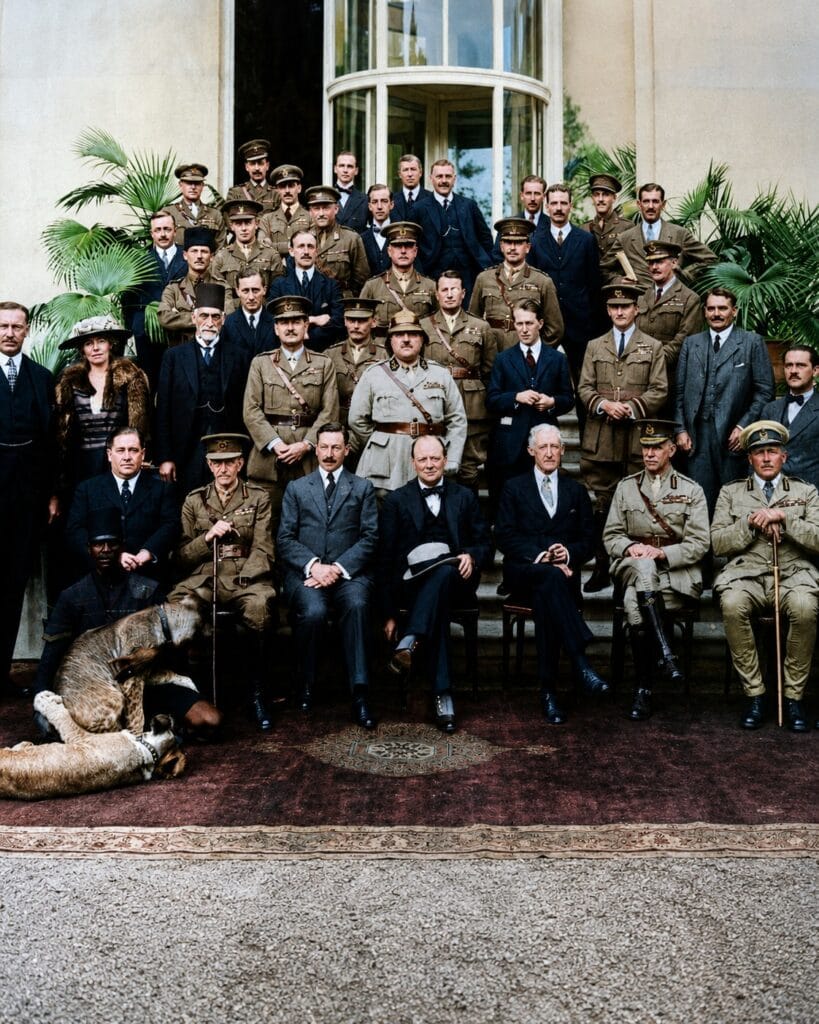
March 1921. Cairo, Egypt. Churchill called the meeting. Around 40 male delegates lined up on the steps. Two lion cubs from Somaliland lay on the floor in front. Second row, second from the left. One woman in a hat.
The Cairo Conference was where Britain decided to merge three regions — Basra, Baghdad, and Mosul — into what would become modern Iraq. Bell was at the center of it. The borders that followed from that meeting are still on the map today.
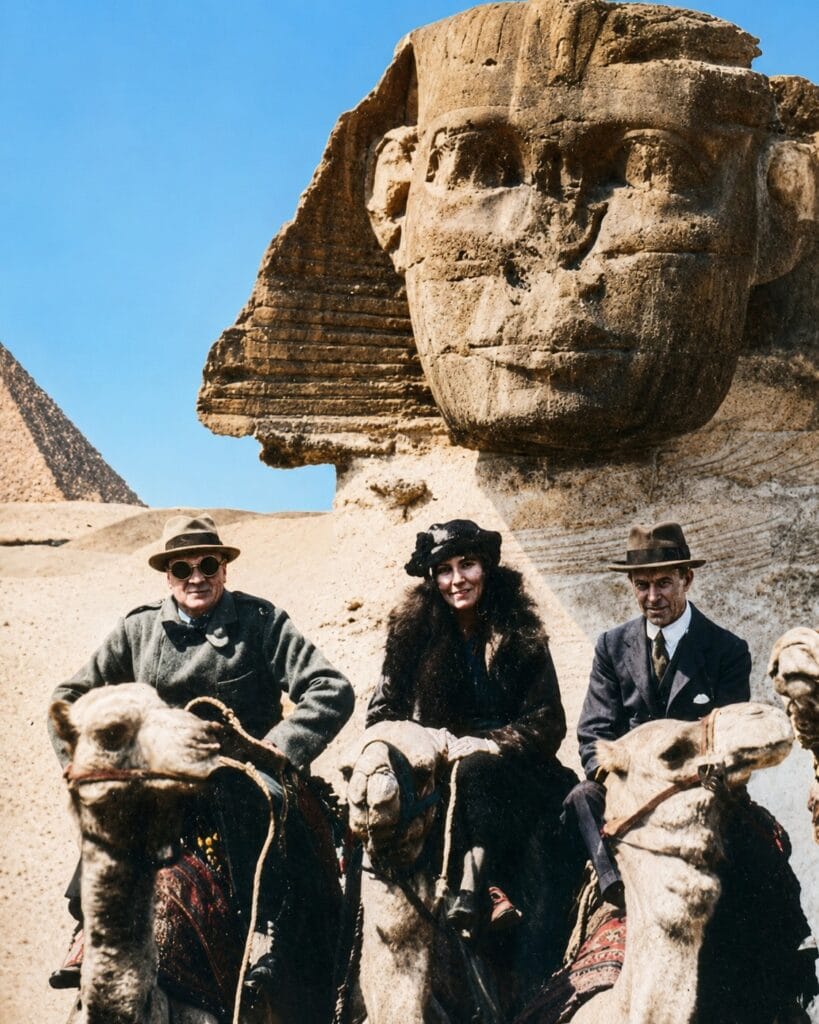
That same week, they rode camels in front of the Sphinx. Churchill on the left, Bell in the middle, Lawrence on the right. Churchill slid off his camel. His wife Clementine watched and said: “How the mighty have fallen.” Bell and Lawrence didn’t move. They had been crossing deserts for years.
T.E. Lawrence. In 1962, director David Lean turned his story into the film “Lawrence of Arabia.” Peter O’Toole in the lead. Seven Academy Awards. One of the greatest movies ever made. Lawrence and Bell first met in 1909 at an archaeological dig at Carchemish. Both had topped their class in Modern History at Oxford. Both spoke fluent Arabic. Both knew the desert.
In 1925, Lawrence sent out copies of his nearly finished manuscript — Revolt in the Desert — to a handful of people for feedback. Bell was one of them.
They had sat side by side on those camels. Lawrence got a movie. Bell left behind photographs of a world that was disappearing.
What She Actually Carried
A train station. Locals standing in a line. Kids, old men, women. In the middle, a woman in a dark coat holds a camera and looks down at it. White hat. That’s Bell.
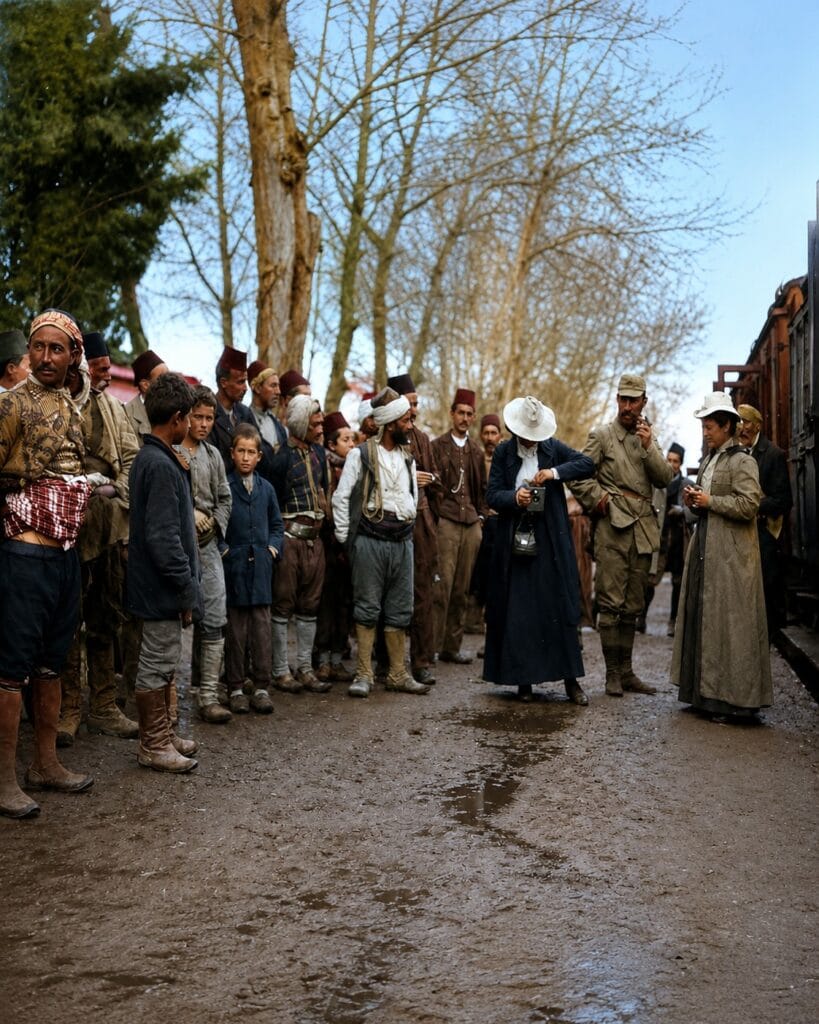
By 1901, Bell had taught herself photography — developing film, handling glass plates, doing it all herself. After that, every trip came with a camera. Tripod. Glass negatives. Chemicals. Transport. Storage. While other explorers handed their equipment off to someone else, Bell carried her own camera.
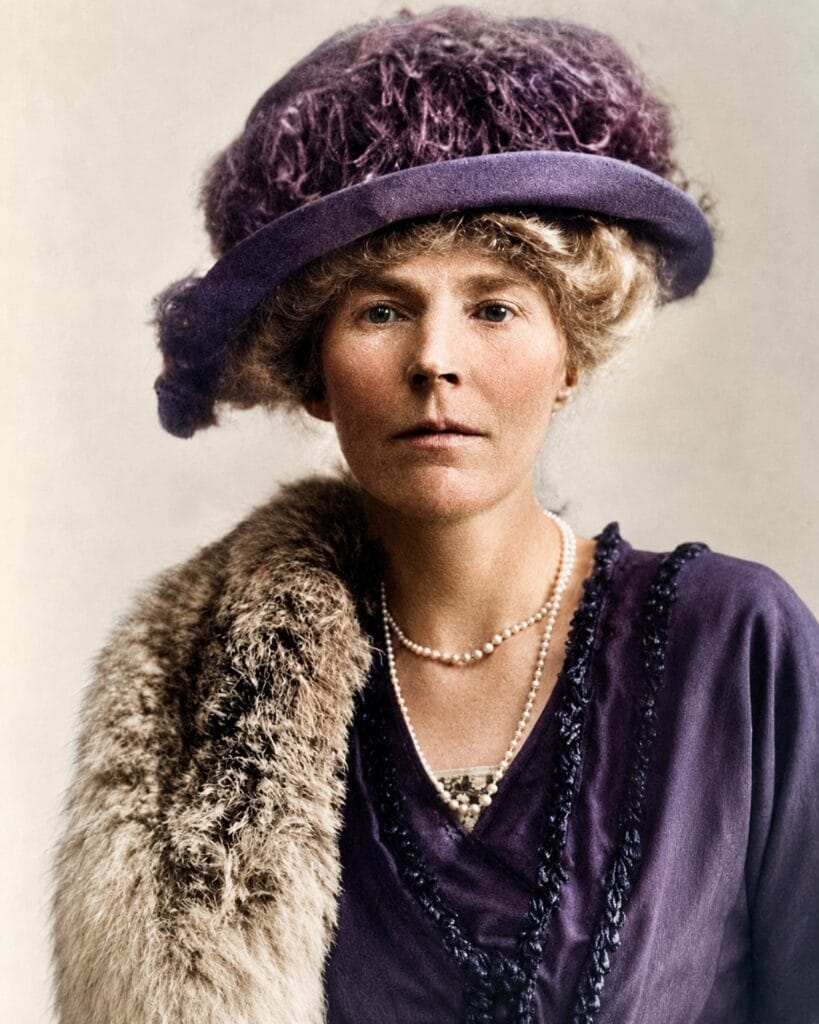
This woman — purple hat, pearl necklace, fur stole — sat down with tribal leaders across the Arab desert and talked. She spoke six languages fluently, including Arabic, Persian, and Turkish. She picked up a tripod and walked into the desert. Six major expeditions.
In 1905, she traveled from Jericho to Antioch — 1,500 miles. She hired a guide named Fattuh. He came on every expedition after that. Syria, Palestine, Arabia, Binbirkilise, Ukhaidir. Bell wrote his name in her diary. Without Fattuh, those desert crossings wouldn’t have been possible.
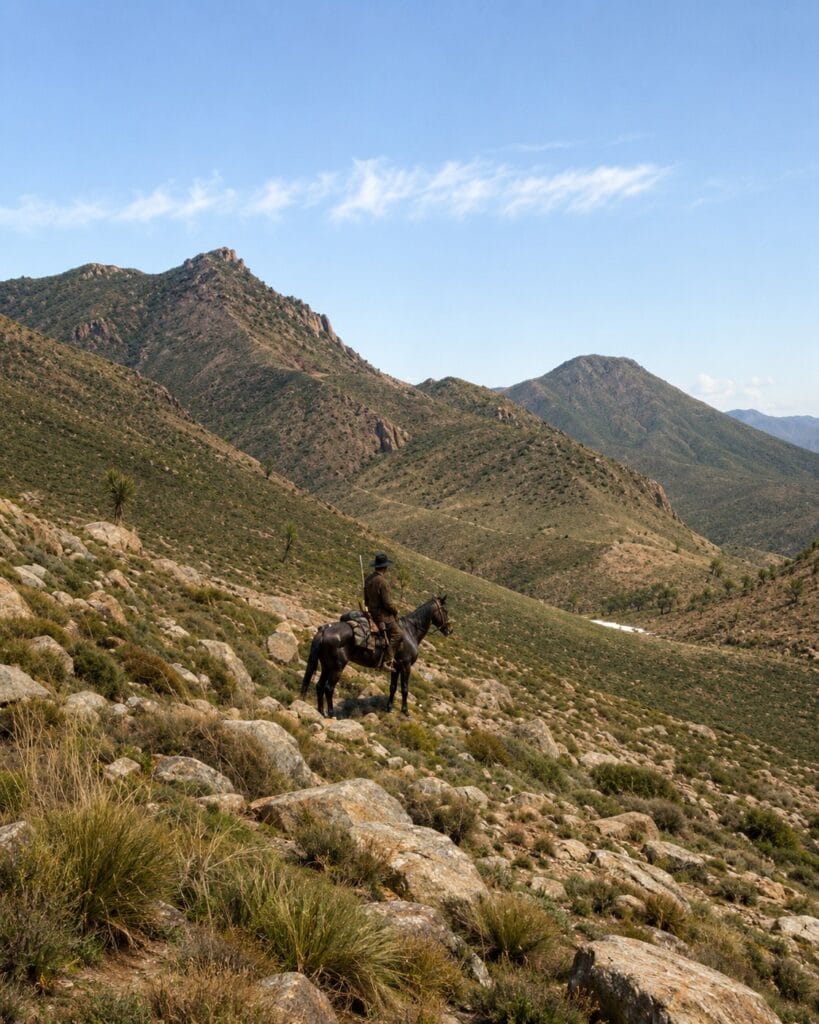
The photographs she took on that journey came out as a book in 1907 — Syria: The Desert and the Sown. For many readers, it was their first real look at the Arabian desert.
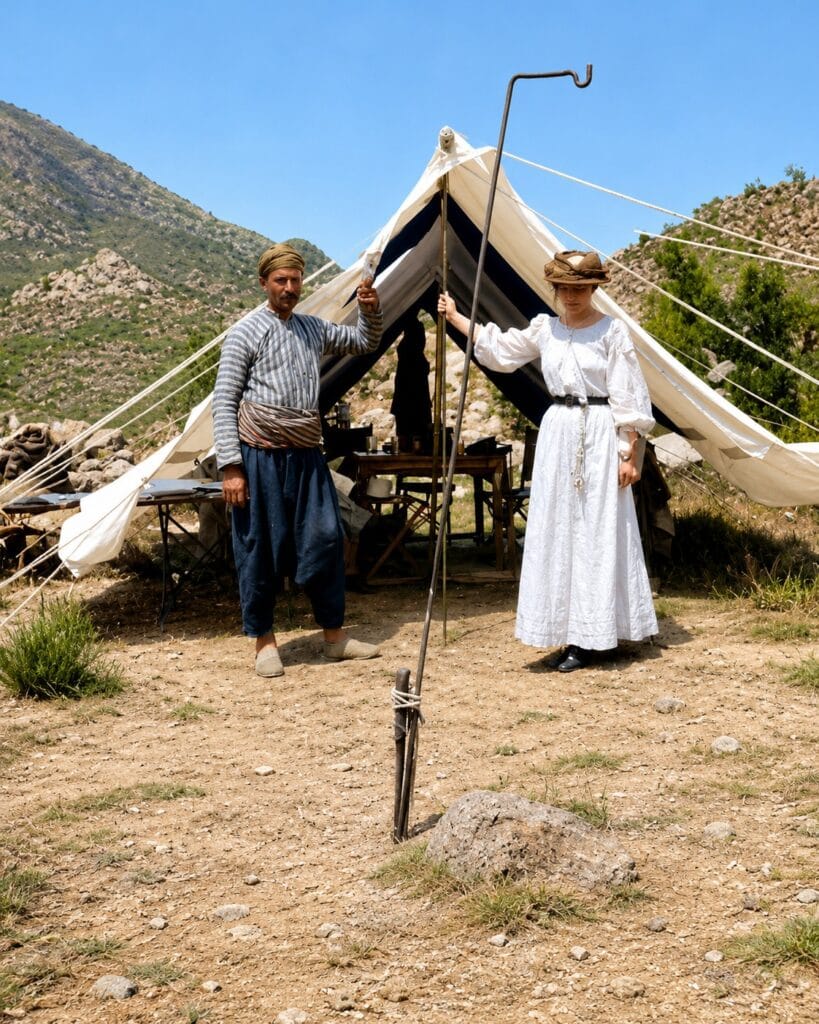
She’d set up the tripod in front of a ruin and frame it so you could see every brick. In front of Egyptian walls. Syrian rubble. Churches buried in Turkish mountains. About 7,000 to 8,000 photographs in total — and they’re still around today.
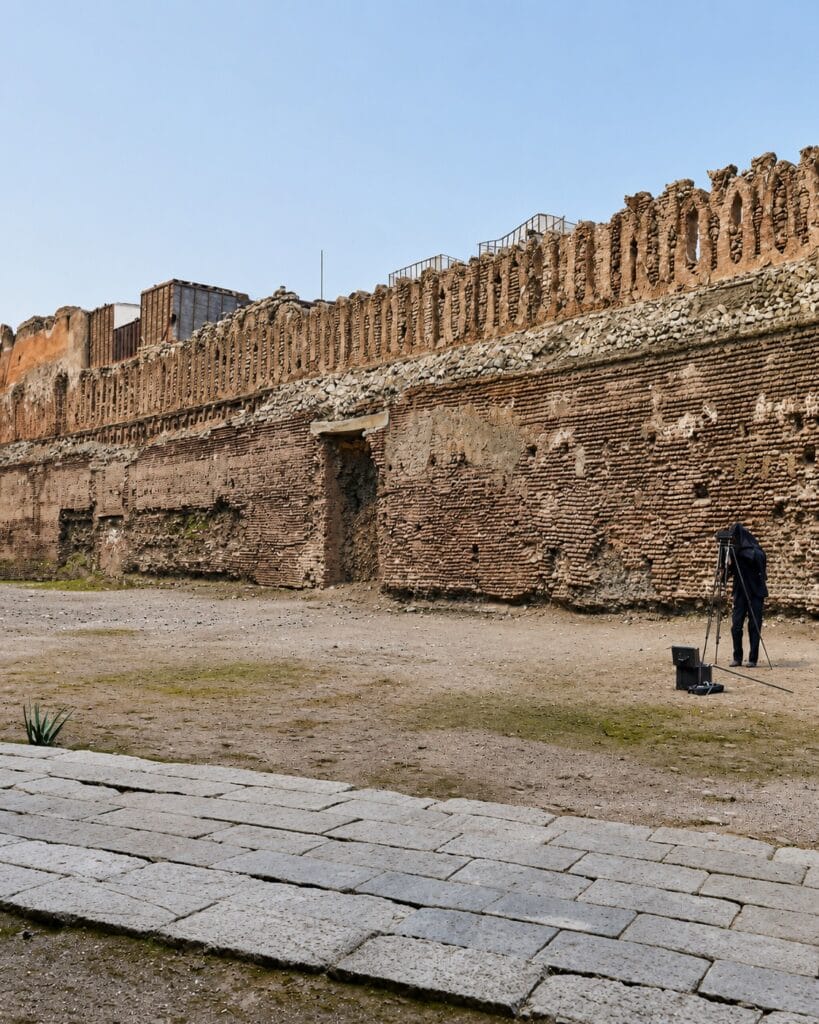
This Book Has to Get Done
The Karadağ volcanic region in Karaman, Turkey. This was a stone city deep in the mountains where Byzantine Christians had hidden from advancing Islamic forces. Churches scattered across the hillsides and into the villages. Not exactly 1,001 — it was a Turkish expression meaning “too many to count.” Binbirkilise. The Thousand Churches.
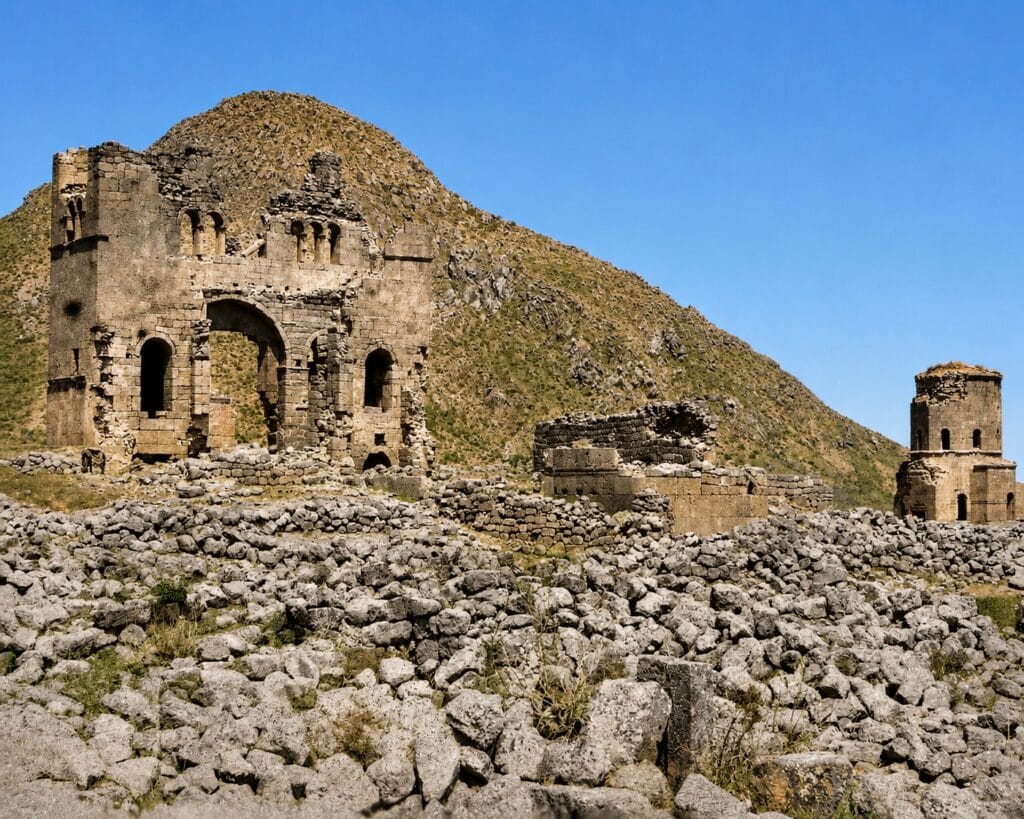
When Bell got there, locals were pulling apart the old churches to use the stones for new houses. Dozens disappearing every year. These buildings had been made entirely of stone — no timber in the region. That’s what had kept them standing for a thousand years. But once people started taking them apart, they were gone in a matter of months.
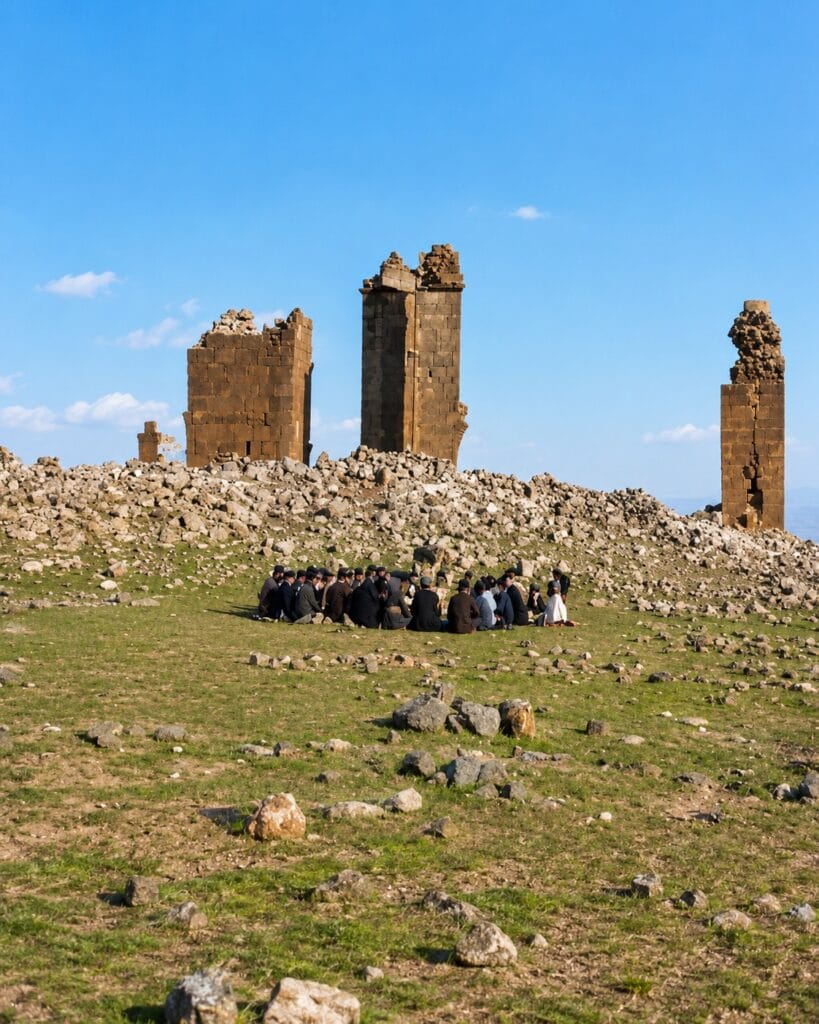
June 24, 1907. The Binbirkilise camp. Bell wrote a letter to her stepmother Florence.
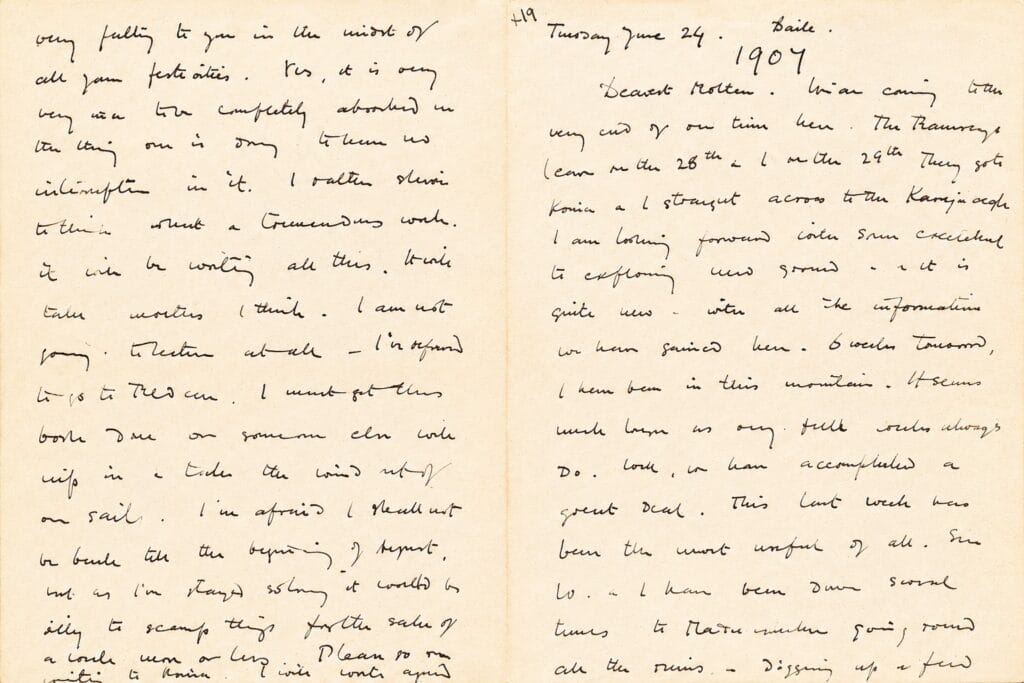
“Tomorrow will be six weeks since I arrived in this mountain.” She wrote: “I must get this book done or someone else will nip in and take the wind out of our sails.” Then this line: “It will be a very dull book, but I intend it to be magnificently illustrated.”
She turned down lecture requests. She turned down an invitation to Tehran. This book had to get done. That fear of being scooped would later turn out to be completely justified.
Bell clicked the shutter. Church number one. A basilica. Five arched windows running up each side of the nave. If she didn’t capture it now, it would be gone.
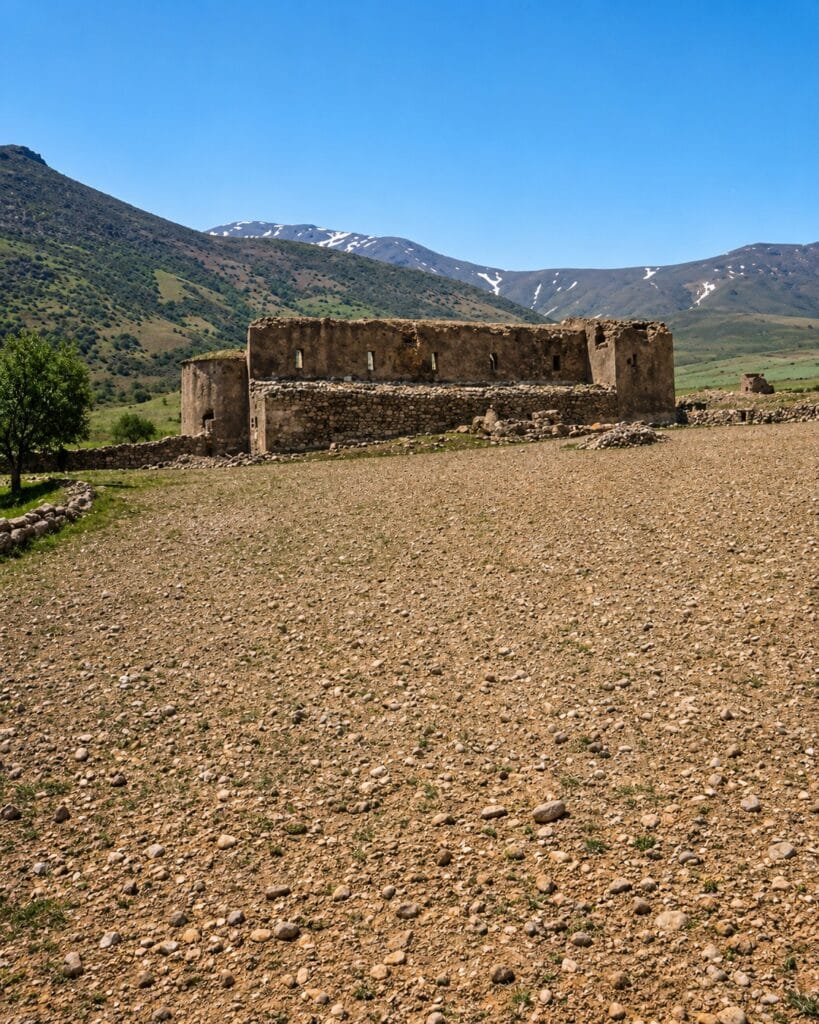
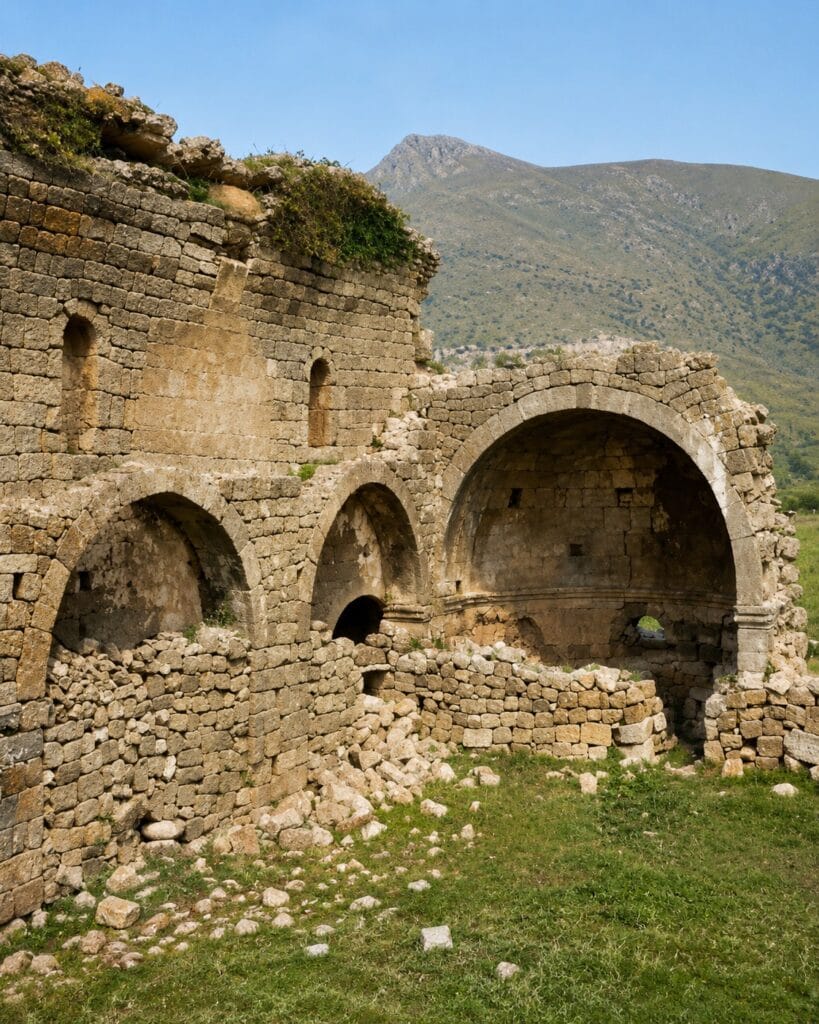
The same building — east side, looking toward the back wall. Three arches. Light coming through. When Bell came back just two years later, part of the building had already been torn apart and hauled away. The click of her shutter became one of the most important records these ruins ever had.
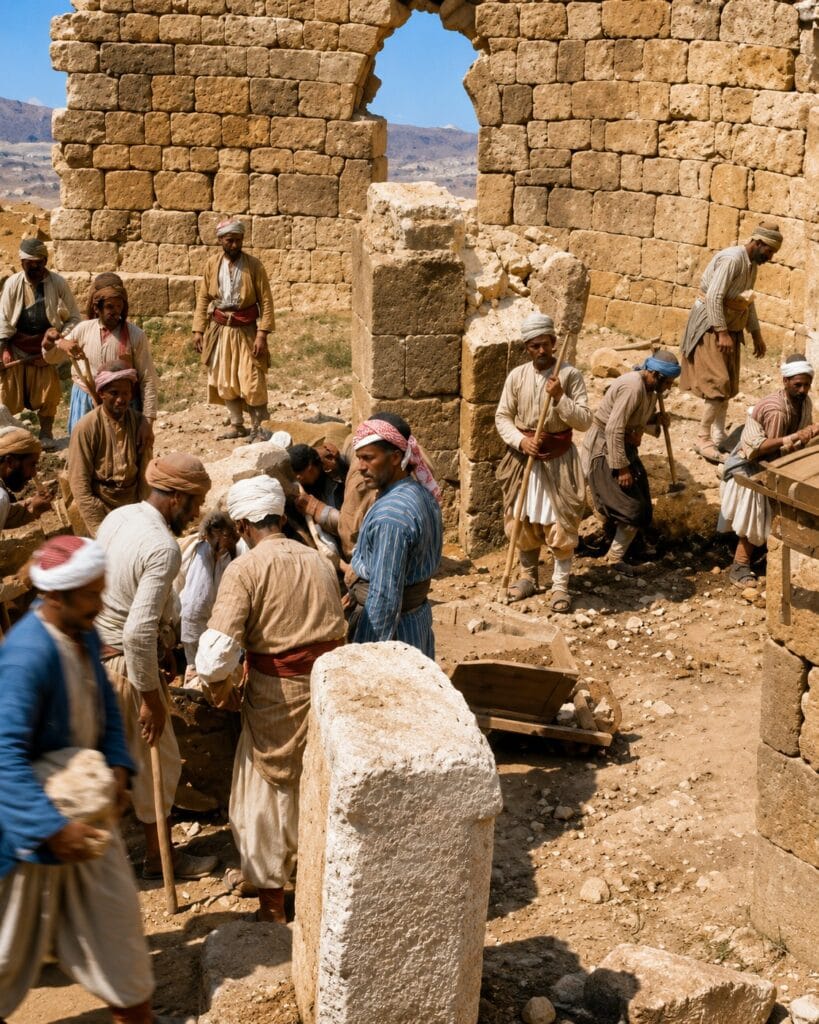
1907. Inside Church 10. The pier that once held up the arches. Local Turkish workers standing around it. Without them, none of this excavation would have happened. Bell didn’t treat them as background — she photographed them as part of the record.
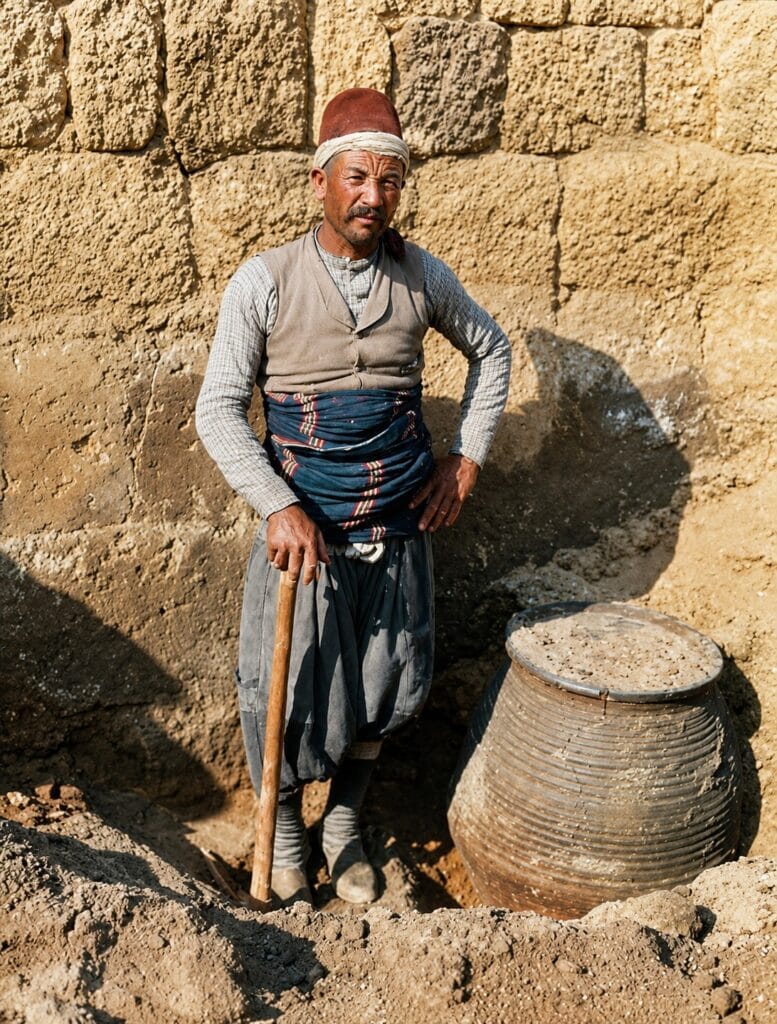
An unnamed Turkish worker. Standing next to a stone jar. Fez hat. Shovel. Bell’s caption reads: “Church 10 — Stone Jar, Possibly for Baking, and Turkish Workman.”
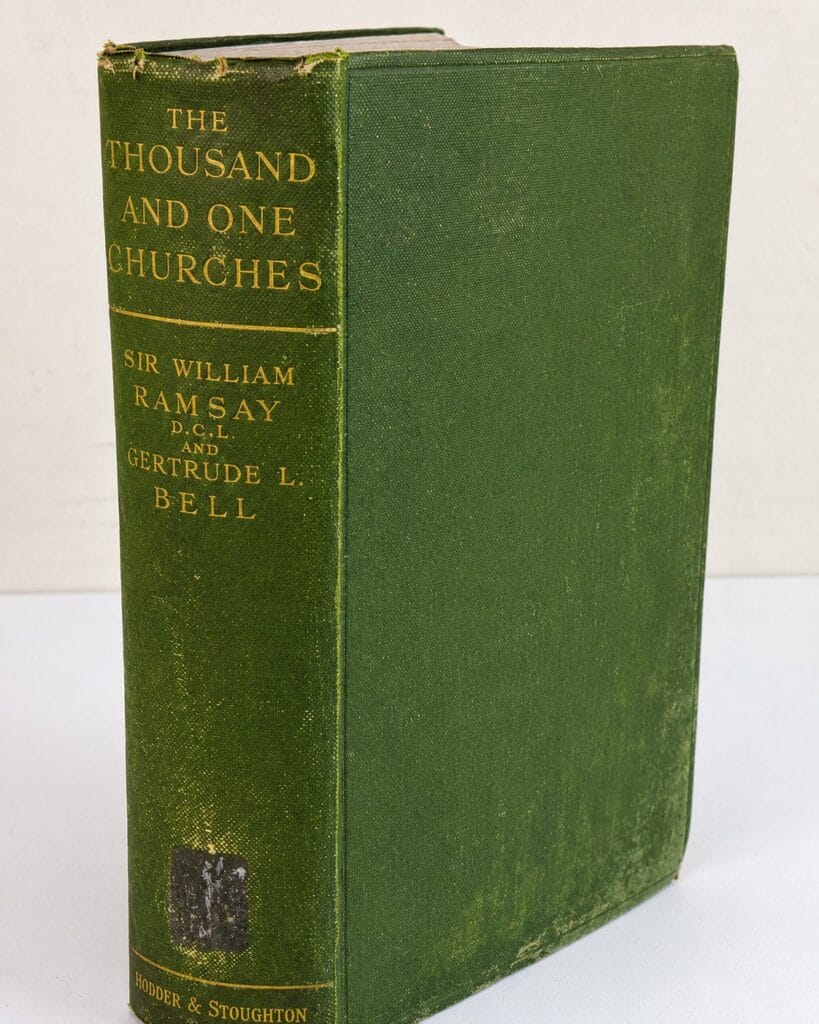
1909. The Thousand and One Churches. Green cloth cover. Gold lettering. Sir William Ramsay & Gertrude L. Bell. Still cited as an important reference in Byzantine architecture research today. That’s the book she said she’d fill with photographs.
The People She Photographed
Bell didn’t only photograph crumbling stone walls. She photographed the people living around them. A Bedouin warrior’s intense stare. A Yazidi family’s faces. Kurdish communities. Assyrian Christians. While most British officials saw the Middle East as a single bloc of “Arabs,” Bell knew these faces individually. She wrote their names and family histories in her diary.
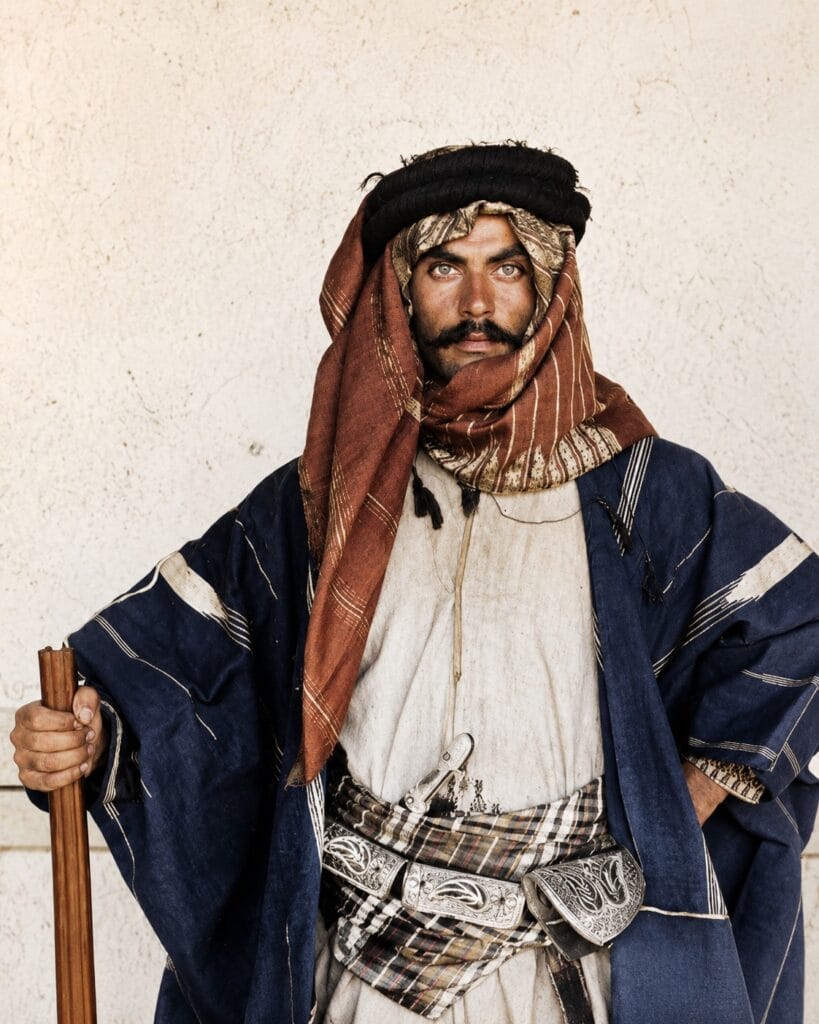
This man with the piercing eyes. A keffiyeh. An abaya. A dagger at his waist. Before Western powers came in and drew lines on a map, this desert was his. Bell didn’t treat him as an exotic subject to photograph. She sat across from him as one person to another. That was what got her deeper into the desert than anyone else.
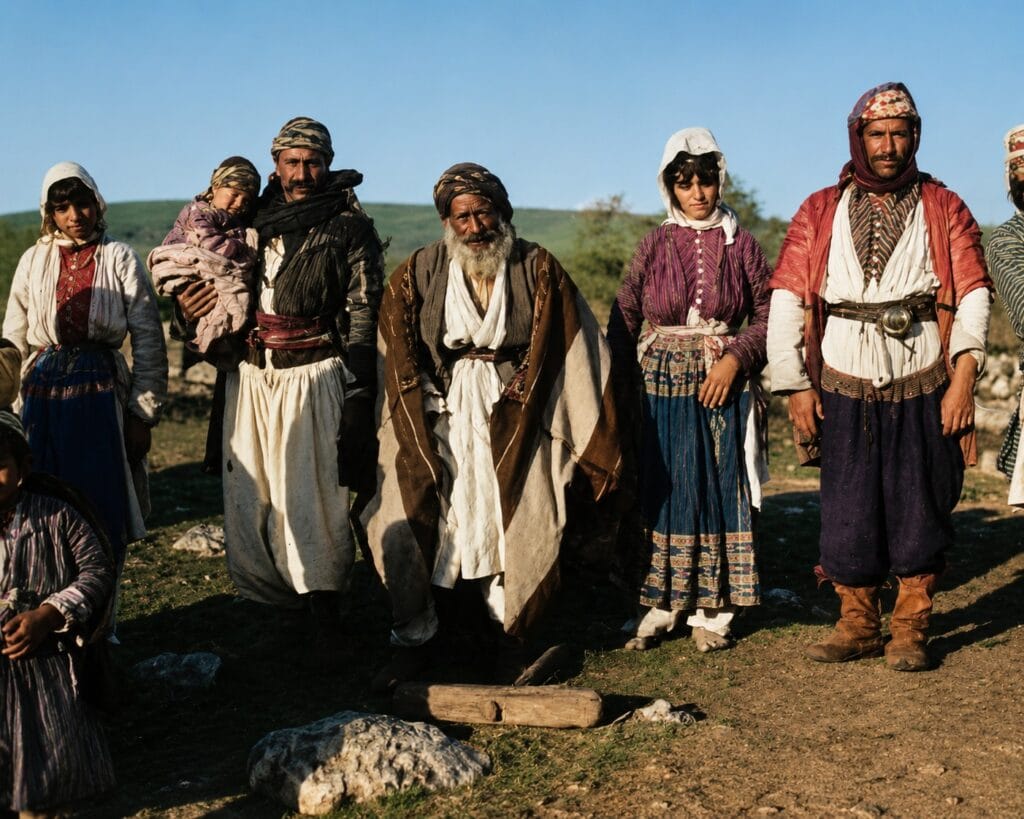
A man holding a baby. An old man. Women. Looking straight at the camera. Yazidis. Bell photographed their lives and wrote about the persecution they faced. But when she helped draw the border of Iraq, the northern oil-rich territories — including Yazidi lands — were folded inside. The people in this photo became “Iraqi” without ever being asked.
Ukhaidir — The Find That Backfired
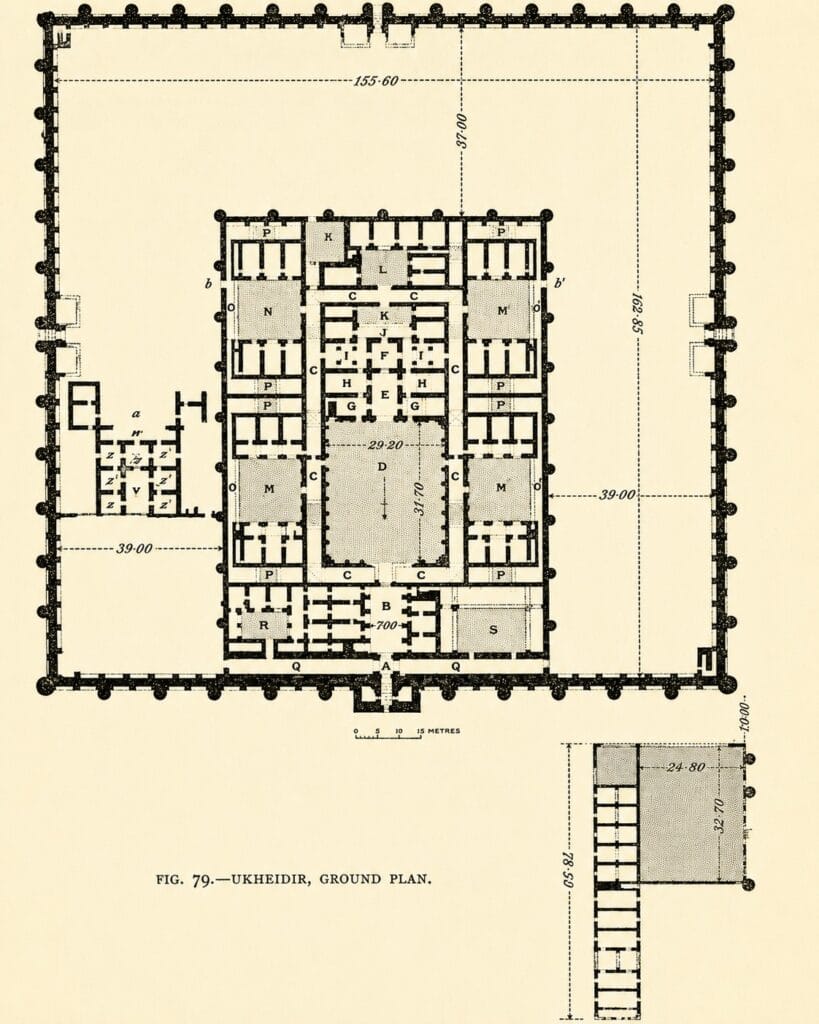
1909. Fattuh led the way. 120 miles from Baghdad. A palace in the middle of the desert. An 8th-century Islamic fortress that almost no Western researcher had reached. Bell measured it, photographed it, and drew up a floor plan. Every room. Every corridor. Every arch and dome. She wrote home: “This find will make my name as an archaeologist.”
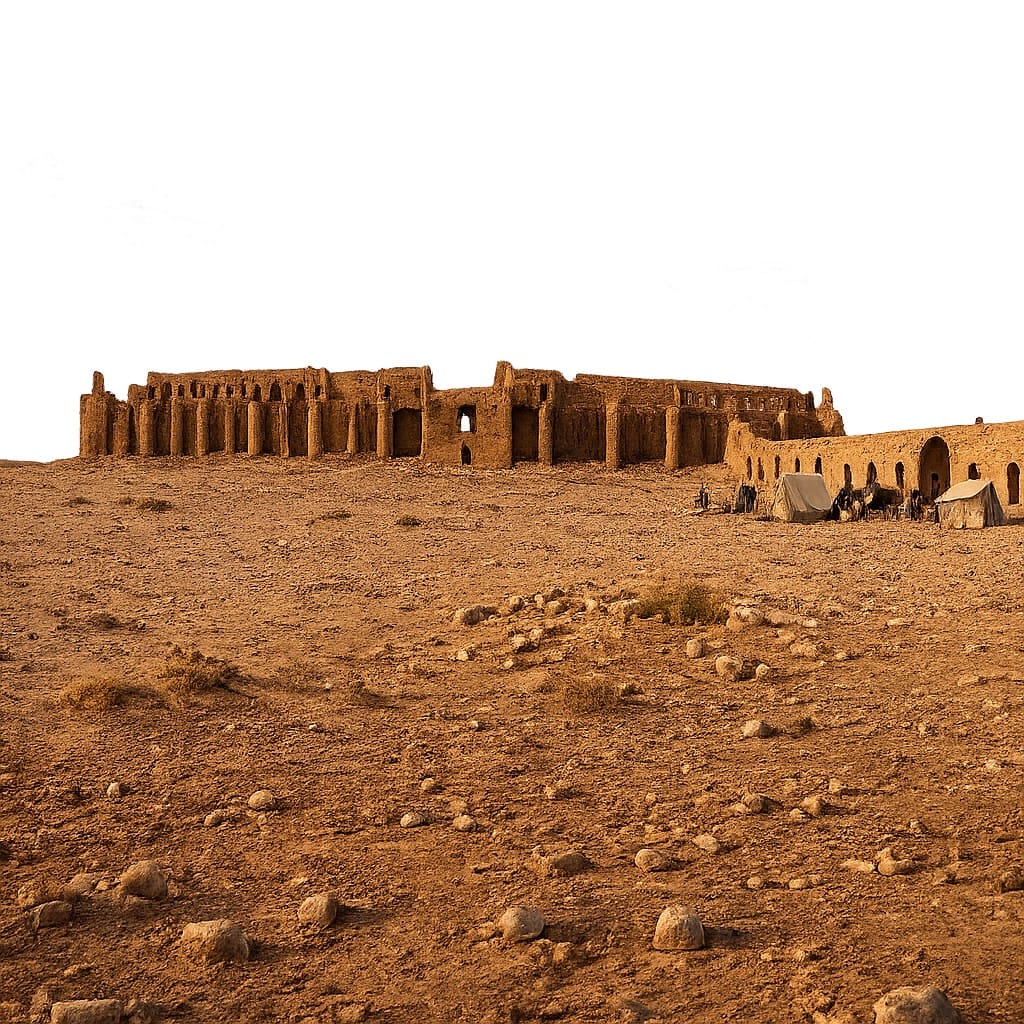
Excited, she stopped at Babylon and told a German archaeological team what she’d found. That was the mistake. They rushed straight to Ukhaidir and published their findings first — in 1912. Bell’s study came out in 1914. The fear she’d written about in that letter — “someone else will nip in and take the wind out of our sails” — had come true.
Still, her contribution held up. Bell did the foundational academic work on dating the palace and identifying the location of its mosque. The floor plan she drew at the site is still cited as a primary source in Islamic architectural research today.
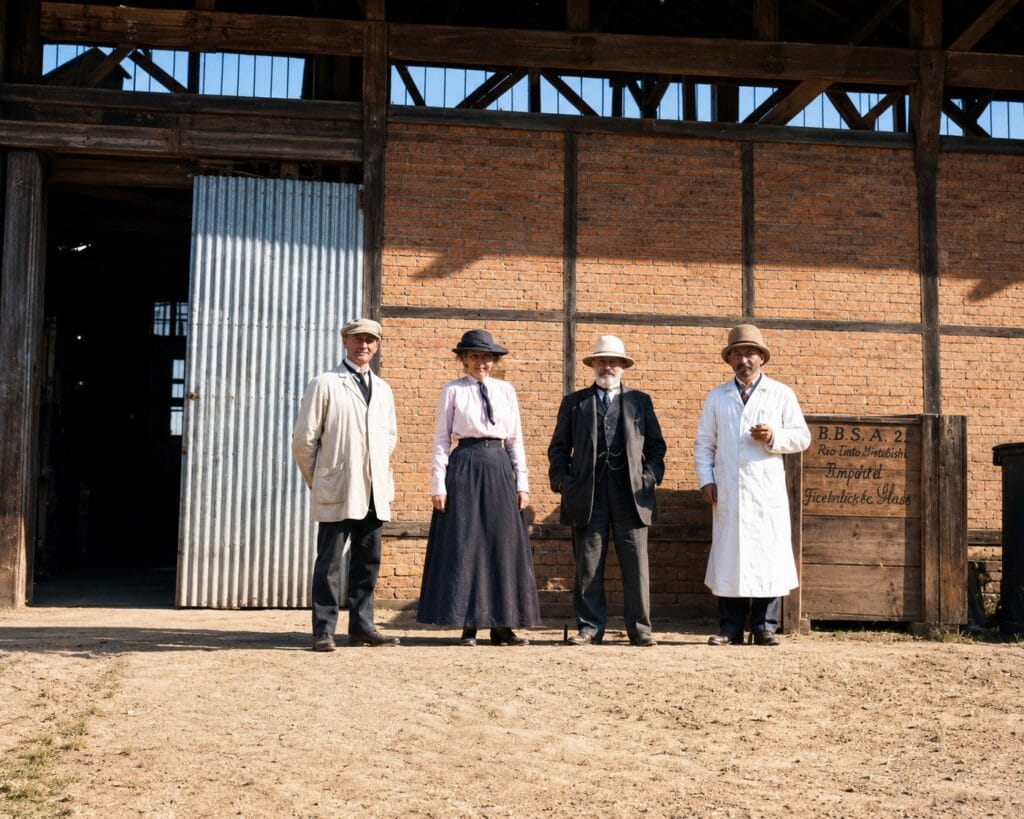
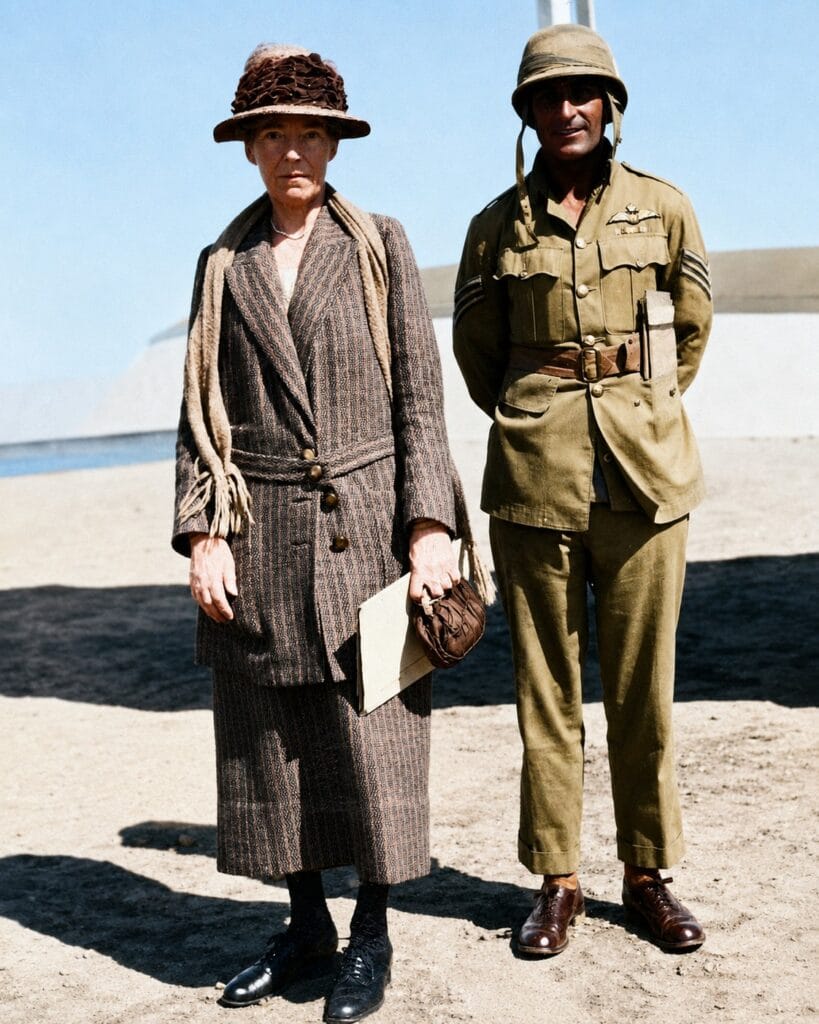
March 1914. Baghdad. Bell standing with German engineer Meissner Pasha at a railway construction site. Months before World War I. She was there. She documented it.
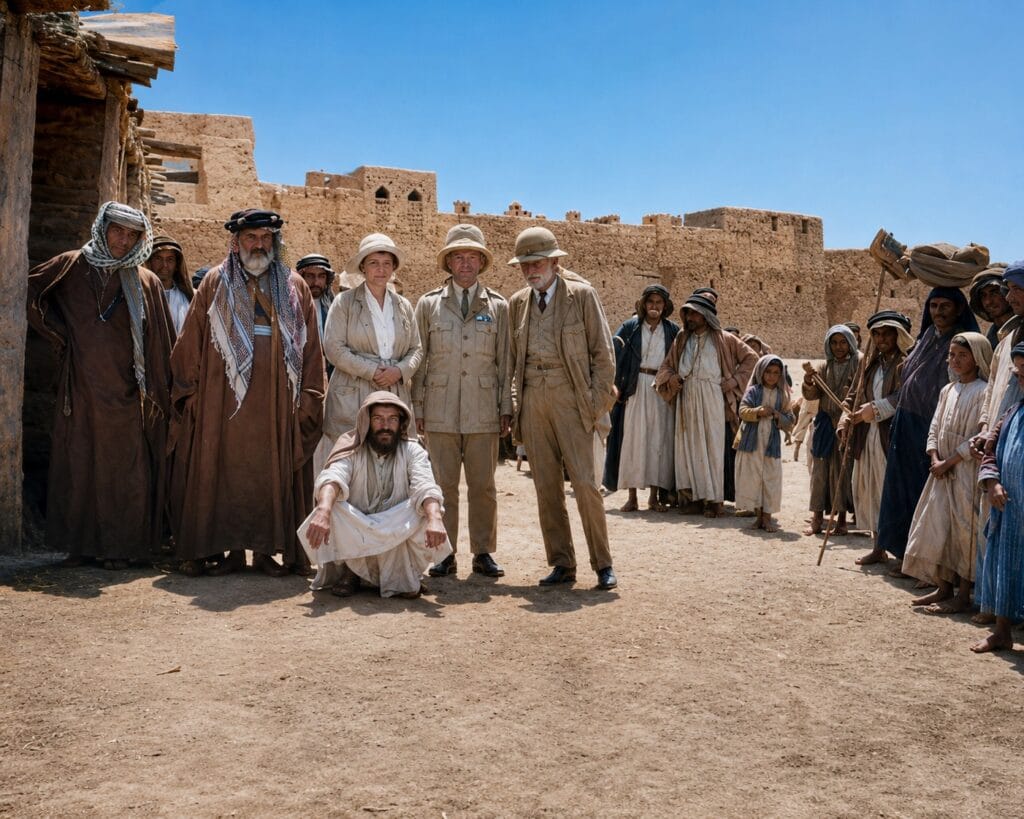
The Iraqi villages Bell walked through. Workers and locals. She went to places other British officials never bothered with — and she brought her camera every time.
The Lunch Where a Border Was Born
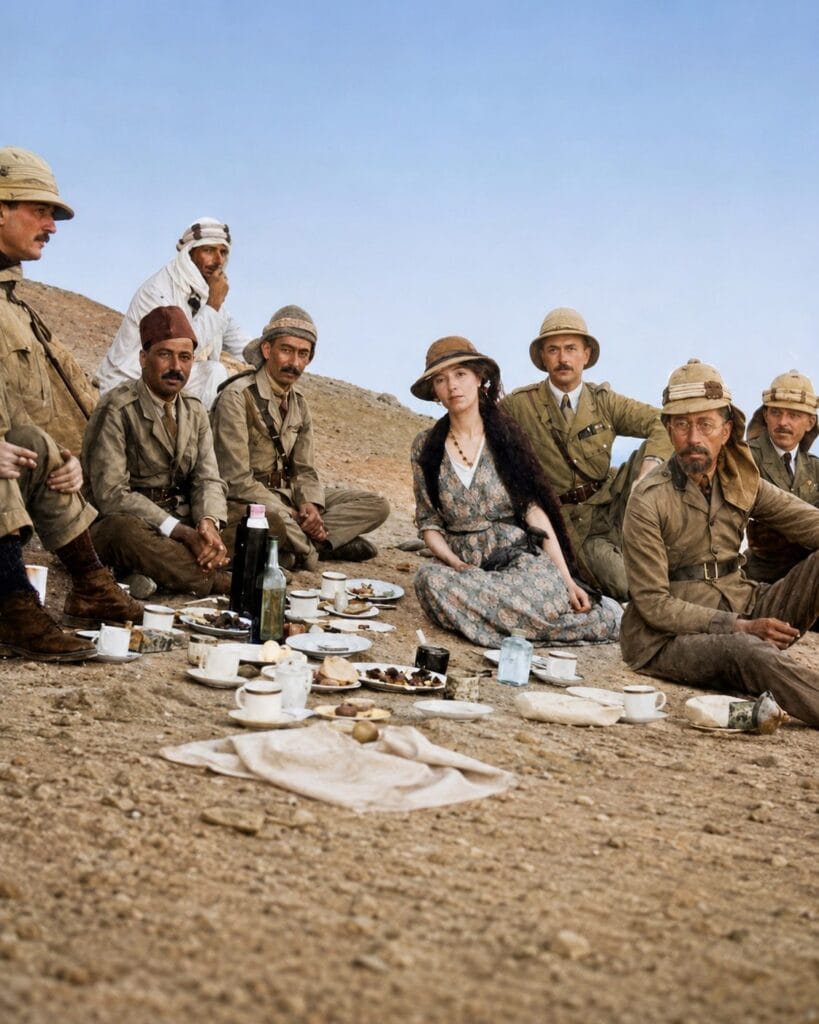
1921. Desert. A cloth on the ground. Tea. Plates of food. Bell in the middle. King Faisal I and Lawrence beside her. Sunnis, Shias, Kurds, Yazidis — all folded into one line on a map. Iraq was born.
King Faisal I. Sir Percy Cox. Bell. Faisal called her “Al-Khatun” — the Lady of the Court, the one who keeps her eyes and ears open at the palace. He asked for her advice every night. Bell was one of the key figures in building the Iraqi state.
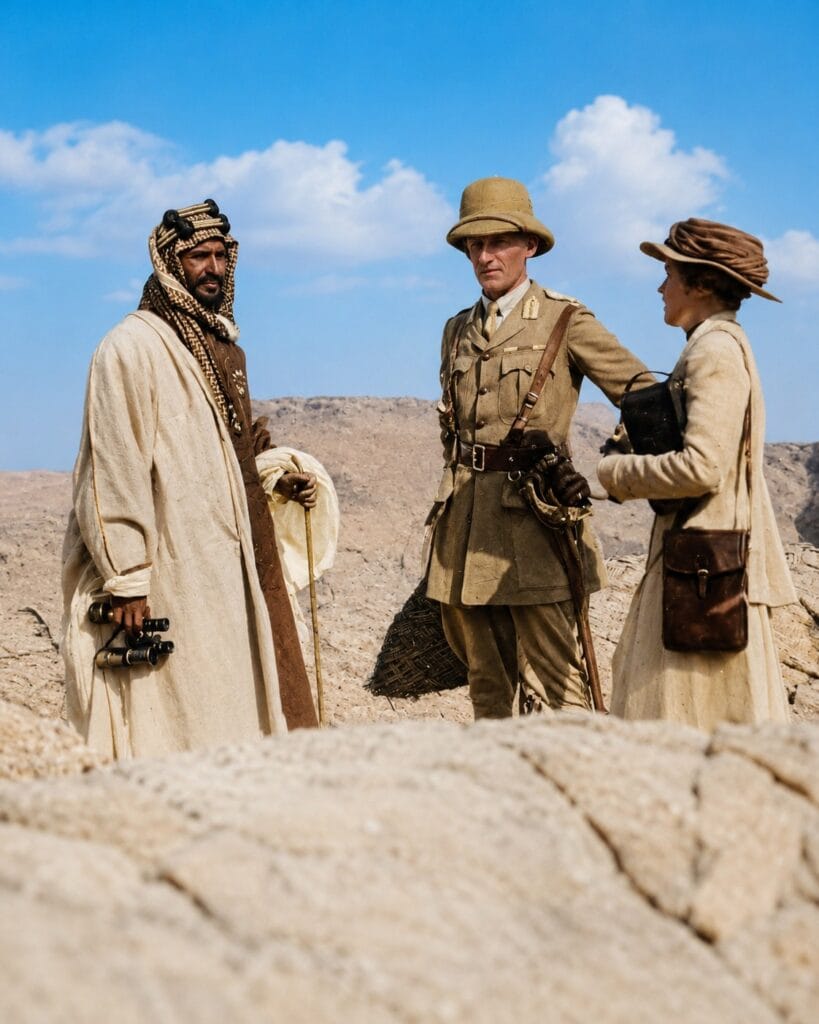
But once the Iraqi government was stable, it didn’t need her anymore. The new political class saw her input as interference. The British government felt the same way. Her influence faded fast. What was left: Honorary Director of Antiquities of Iraq.
From the Living World to the Dead One
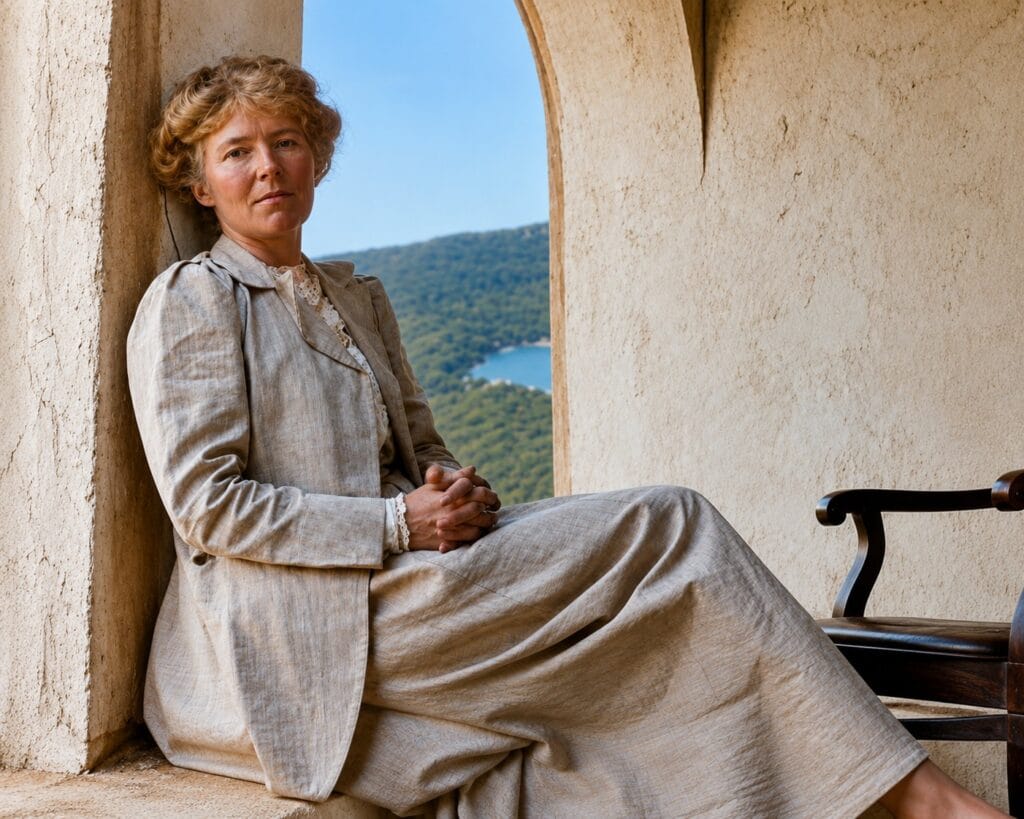
The woman sitting quietly in that arched doorway, hands folded in her lap — that’s Gertrude Bell in her final years in Baghdad. She worked from 5 a.m. to noon. After that, the heat made it impossible. Every day: cleaning dust off ancient artifacts and numbering them. That was the last year of the woman who helped design the borders of modern Iraq.
She’d been fighting for a museum building since 1923. Kept getting turned down. She lobbied Faisal. She took Iraqi aristocrats directly to the excavation site at Ur, spread out the artifacts in front of them — ancient gold, beads, carved stone friezes from Sumerian royal tombs, thousands of years old. By March 1926, she finally had a building. On June 14, she opened the first room. When it came time to divide the finds with the excavation teams, Bell didn’t budge. The most significant Sumerian stone carvings had to stay in Iraq. A month later, she was dead.
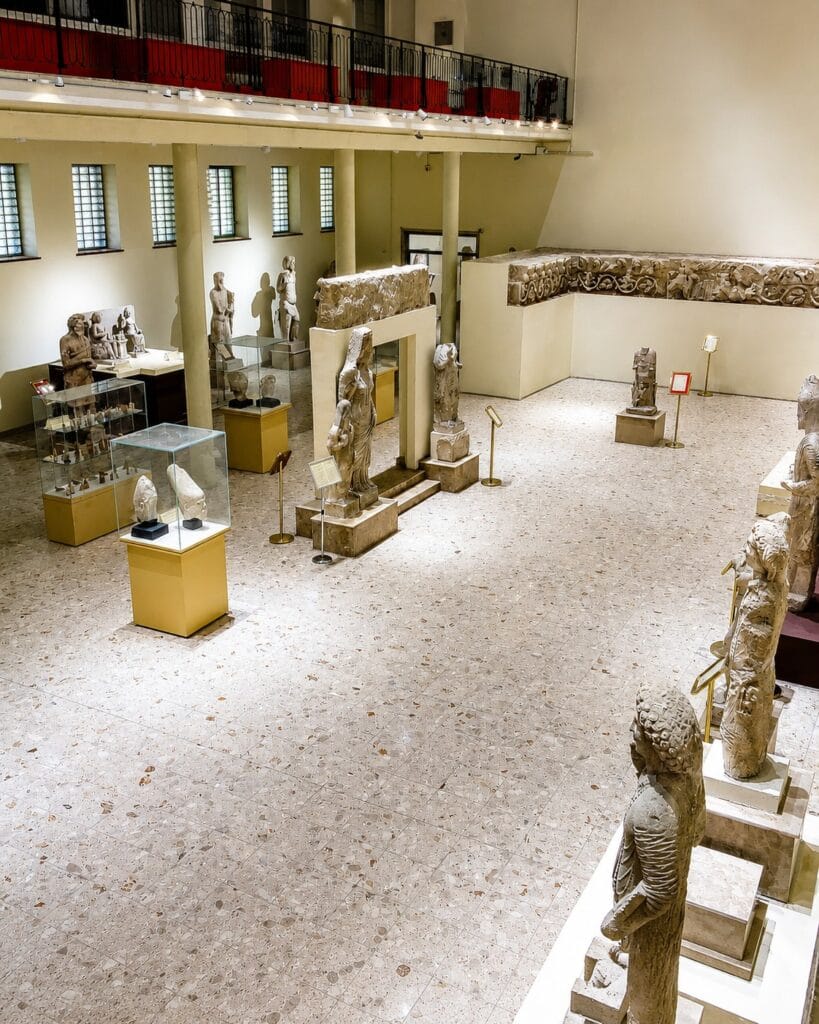
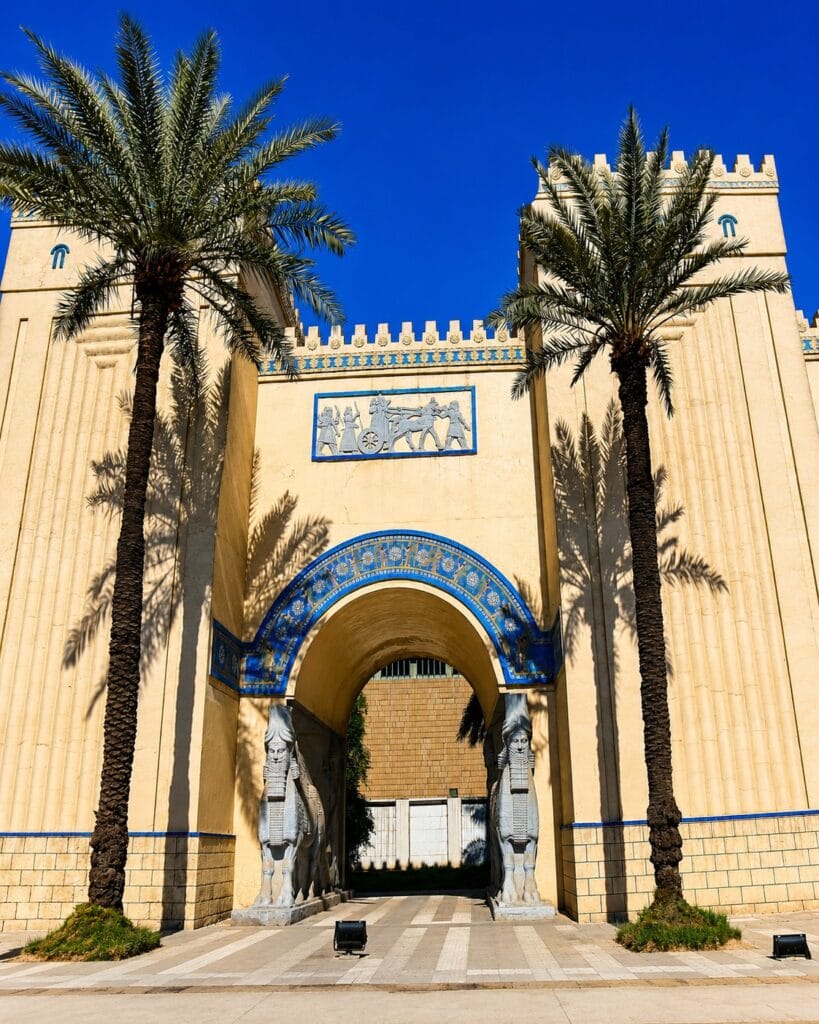
The museum exterior. Sumerian and Babylonian architectural details. Palm trees. This is Bell’s museum. She left £50,000 to it in her will. In 2003, around 15,000 artifacts were looted. A journalist covering the aftermath wrote: “It was completely wrecked. Papers going back to when Gertrude Bell founded the museum in the 1920s were scattered across the floor.”
Inside the museum: Bell’s bronze bust. A green plaque. English and Arabic. “The Arabs will always hold Gertrude Bell’s memory in reverence and affection. She created this museum in 1926. And through the heat of the summer, she worked and toiled until the day of her death on July 12, 1926.” King Faisal ordered the plaque installed. He also ordered that the main wing bear her name.
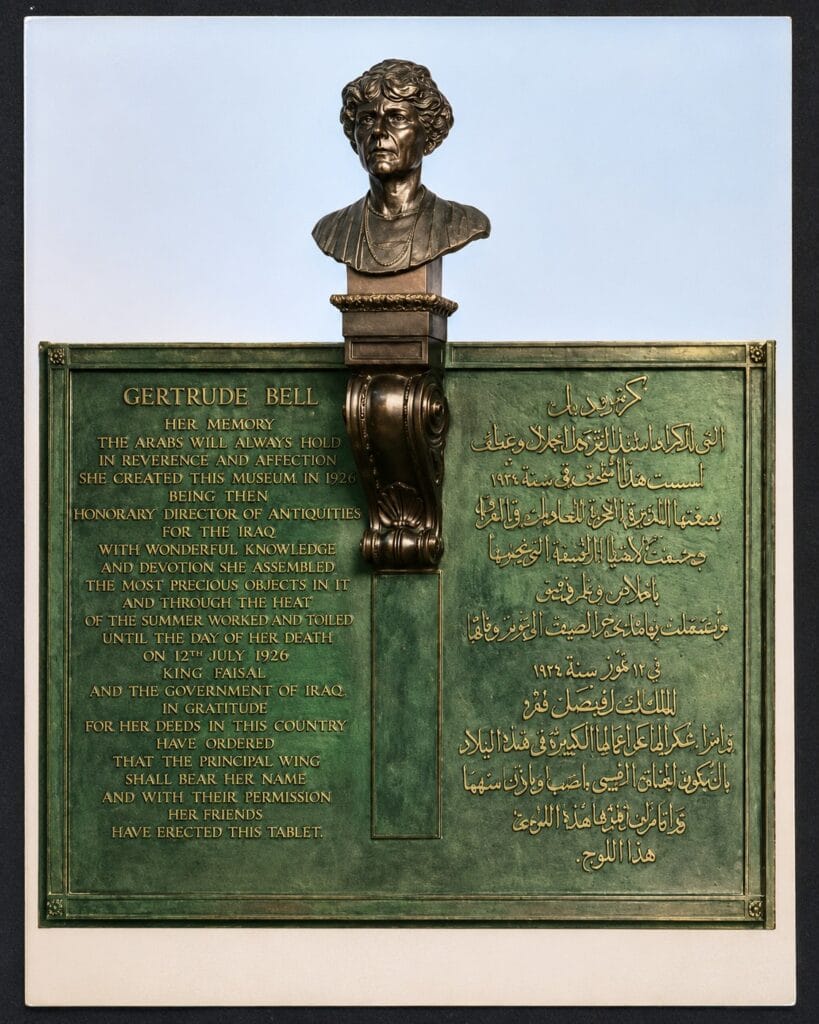
The same plaque — original black and white. The bust above the inscription. English on the left, Arabic on the right. Two languages saying the same thing.
Two Last Letters, and a Dog
June 24, 1925. To her father, Hugh Bell. Baghdad. Received: July 6, 1925.
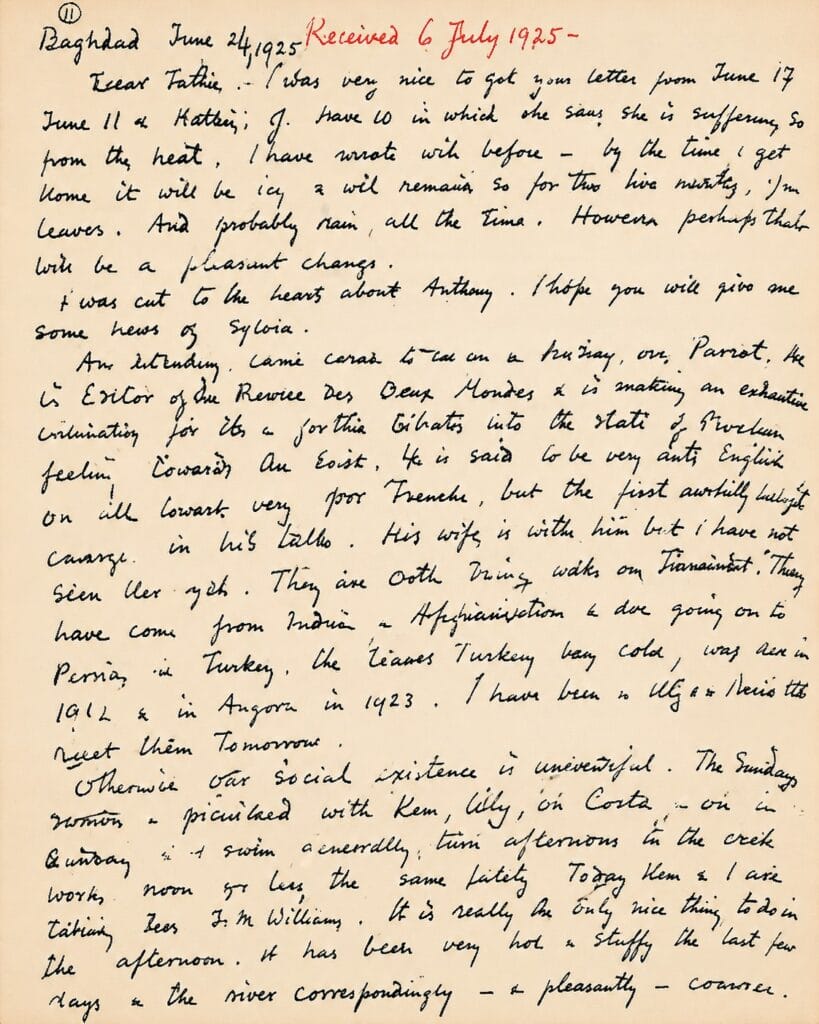
“I was cut to the heart about Anthony.” She wrote: “It has been very hot and stuffy the last few days.” A letter written one year before her death. Heat. Worry about family. Swimming. Lunch. Calm and ordinary. Then on July 7, 1926, she wrote her final letter — to her stepmother Florence.
“There is the lunch bell and I’m dreadfully in need of some iced soda water. Your very affectionate daughter, Gertrude.”
That same day, she sent a short note to her colleague Ken Cornwallis: “In case anything happens to me, please look after my dog Tundra.” Cornwallis later said he hadn’t understood the note — that he hadn’t felt well enough to read it carefully. This was Baghdad in the 1920s, where handwritten notes between colleagues were delivered the same day. Cornwallis was known to love dogs. In the end, Bell’s maid Marie took the dog back to Bell’s family in England.
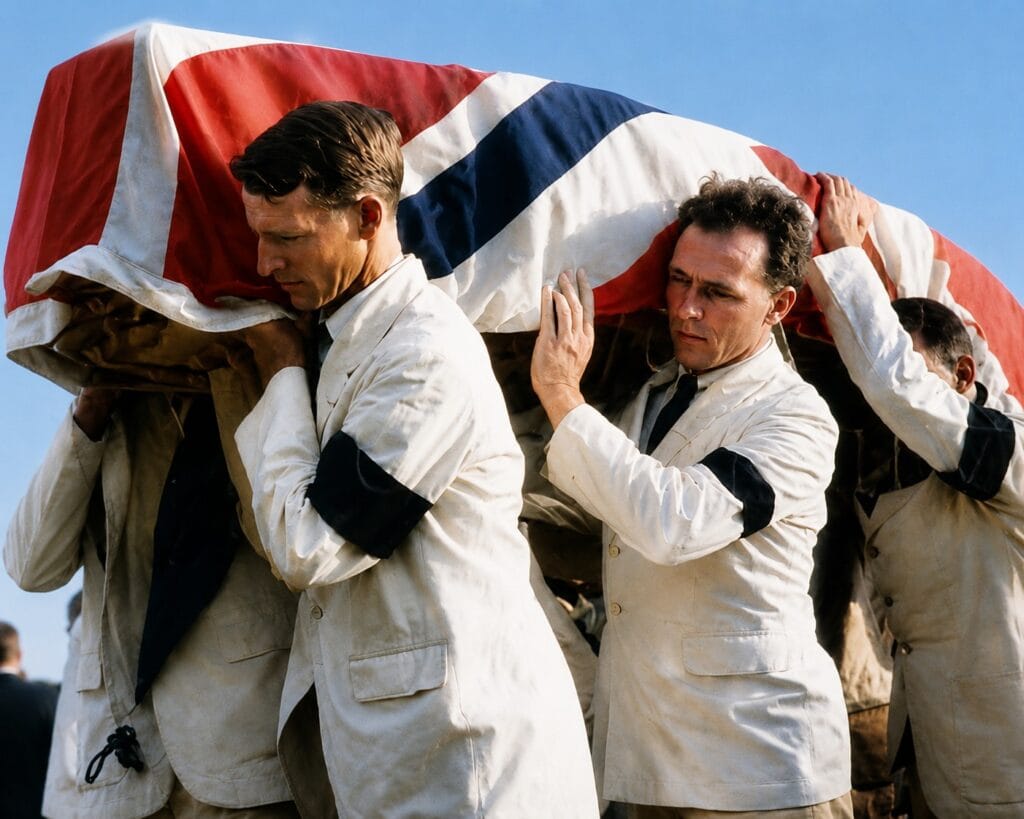
Five days later. The night of July 12, 1926. The bedroom door was locked from the inside. A bottle of sleeping pills called Dial. Found by a servant the next morning. King Faisal ordered a full military funeral. Baghdad in July — daytime temperatures over 45 degrees Celsius. In the Middle East at the time, local burial within 24 hours of death was standard practice. There was no way to preserve a body and transport it thousands of miles back to England. By the time the telegram reached Bell’s family in England, the funeral was already over.
1899. Christmas in Bethlehem. One more photograph Bell took. It’s sitting in the Newcastle University archive right now — one of 7,000 to 8,000. The full collection was added to UNESCO’s Memory of the World register in 2017. Researchers still use Bell’s photographs today to reconstruct sites that no longer exist.
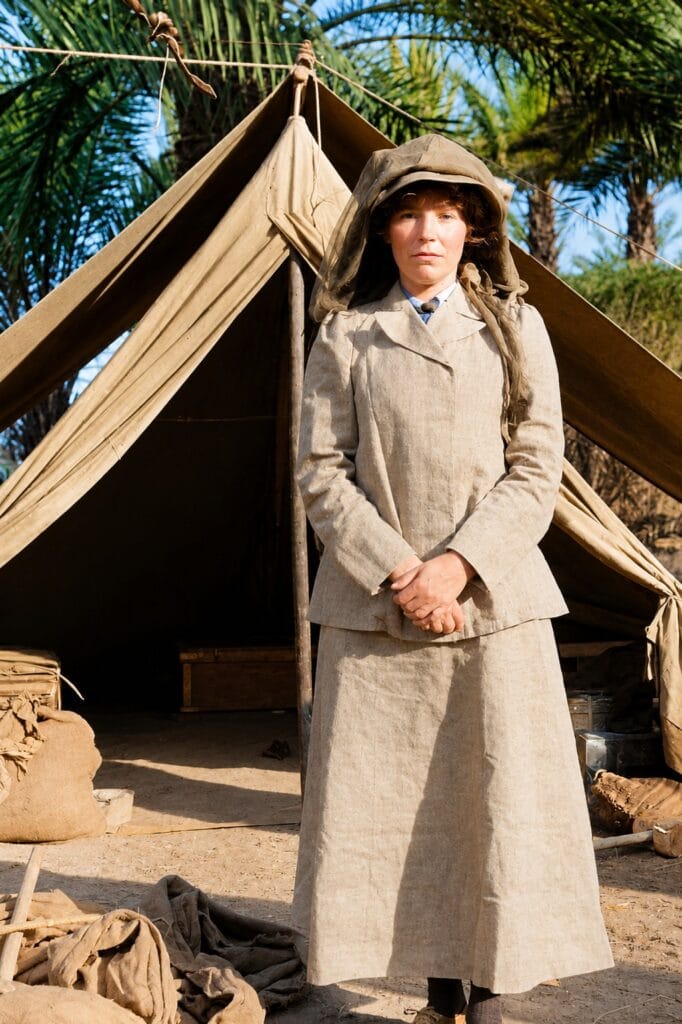
Here’s the Real Problem
How people see Bell today is complicated. The borders she helped draw — putting Sunnis, Shias, and Kurds inside the same line — have been blamed as the root cause of decades of conflict in the Middle East. Including Yazidi lands in Iraq is seen by many historians as a decision that left those communities dangerously exposed.
Bell knew the contradiction. She photographed Yazidi faces and wrote about their persecution in her diary — then drew the line anyway, inside the logic of empire. She opposed women’s suffrage in England while supporting Arab self-rule in the Middle East. She never fully belonged to either world. This article shows that the person who drew that line also spent her life taking thousands of photographs and writing 1,800 letters.
The borders stayed on the map. What she actually wanted to save was the world before they existed.
Archive Notes
Where can I find Bell’s photo archive today?
The full Gertrude Bell Archive is available for free at Newcastle University’s official site (gertrudebell.ncl.ac.uk) — around 7,000 to 8,000 photographs, roughly 1,800 letters, and her complete diaries. The collection was added to UNESCO’s Memory of the World register in 2017.
What exactly did Bell contribute to the study of Ukhaidir Palace?
Bell was among the first Western researchers to survey Al-Ukhaidir Palace in 1909. Her 1914 book, Palace and Mosque at Ukhaidir, provided the foundational academic work on dating the palace and identifying the location of its mosque. A German team published their account first in 1912, but Bell’s floor plans and photographs are still cited as primary sources in Islamic architectural research.
What happened to the Baghdad Museum after the 2003 looting?
Around 15,000 artifacts were stolen during the looting. The museum officially reopened in 2015. Journalist Andrew Lawler, who covered the aftermath, wrote that papers dating back to when Bell founded the museum in the 1920s were found scattered across the floor.
Bell wasn’t only trying to preserve churches. She was trying to save the faces of people crossing that desert, ruins that were being torn apart for building materials, and the quiet life of a worker standing next to a stone jar. She had the same obsessive need to hold onto things that were vanishing — just like Robert Falcon Scott, who kept writing in his diary as he was dying in Antarctica. And the way everything she built eventually pushed her out is something Mary Queen of Scots would have understood.
What You Now Know
When her political role was over, she was gradually forgotten. But the trail she left behind — trying to hold onto a vanishing Middle East — is so much larger than the grave. The borders stayed on the map. Bell left behind a record that will outlast them.
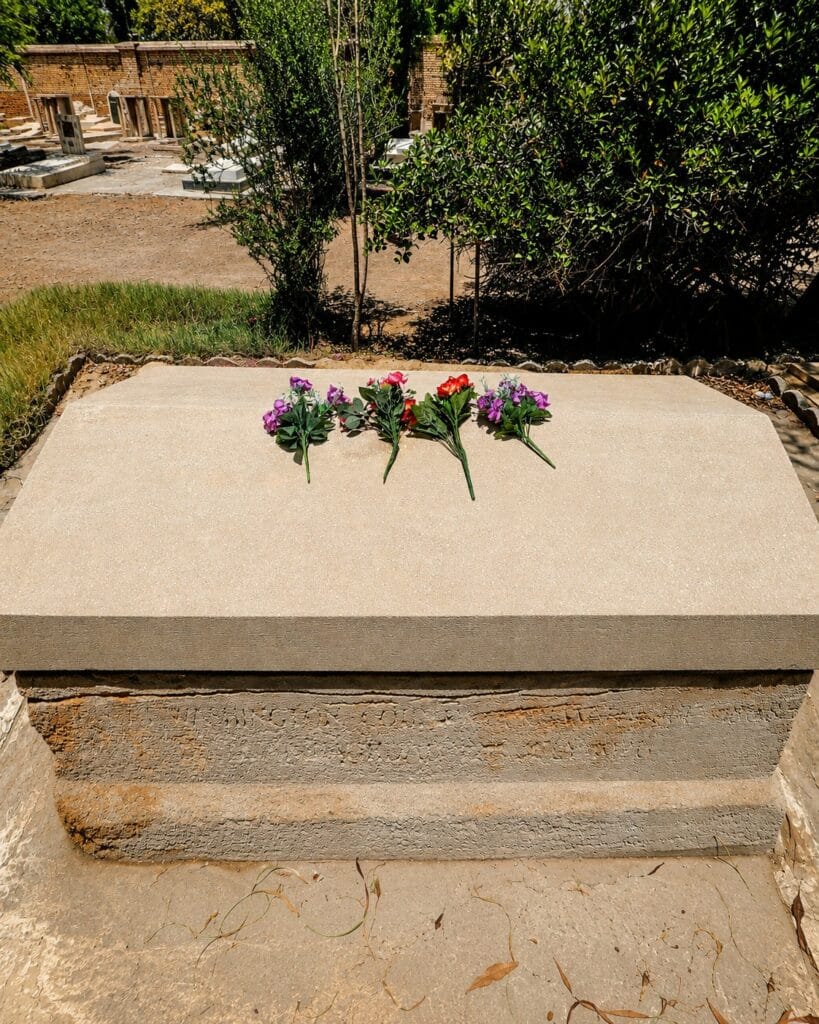
Tip For Readers
Bell’s photographs and letters are all available for free at the Gertrude Bell Archive at Newcastle University — a UNESCO Memory of the World collection.
Verified Sources
Newcastle University — Gertrude Bell Archive
UNESCO Memory of the World Register — Gertrude Bell Archive
Gertrude Bell & William M. Ramsay — The Thousand and One Churches (1909)
Gertrude Bell — Palace and Mosque at Ukhaidir: A Study in Early Mohammadan Architecture (1914)
Gertrude Bell — Syria: The Desert and the Sown (1907)
Florence Bell (ed.) — The Letters of Gertrude Bell (1927)
Georgina Howell — Gertrude Bell: Queen of the Desert, Shaper of Nations
Eleanor Scott Archaeology
Andrew Lawler — reporting on the Iraq Museum after the 2003 looting
Iraq Museum, Baghdad
Wikimedia Commons (Public Domain)
Historical photographs and archival materials were referenced from public-domain and institutional collections. Selected images have been editorially restored, colorized, or redesigned by Vella Team for visual storytelling. These editorial illustrations are intended for historical interpretation and are not presented as original archival photographs.