April 14, 1865.
Washington was finally breathing again. The war that had split the country in half for four years was almost over. The city was exhausted. The people were exhausted. And Abraham Lincoln was exhausted.
That night, he didn’t go out to give a speech. He wasn’t going to discuss the future of the nation. He just went to the theater. He wanted to sit somewhere — even for a few hours — as a person, not a president.
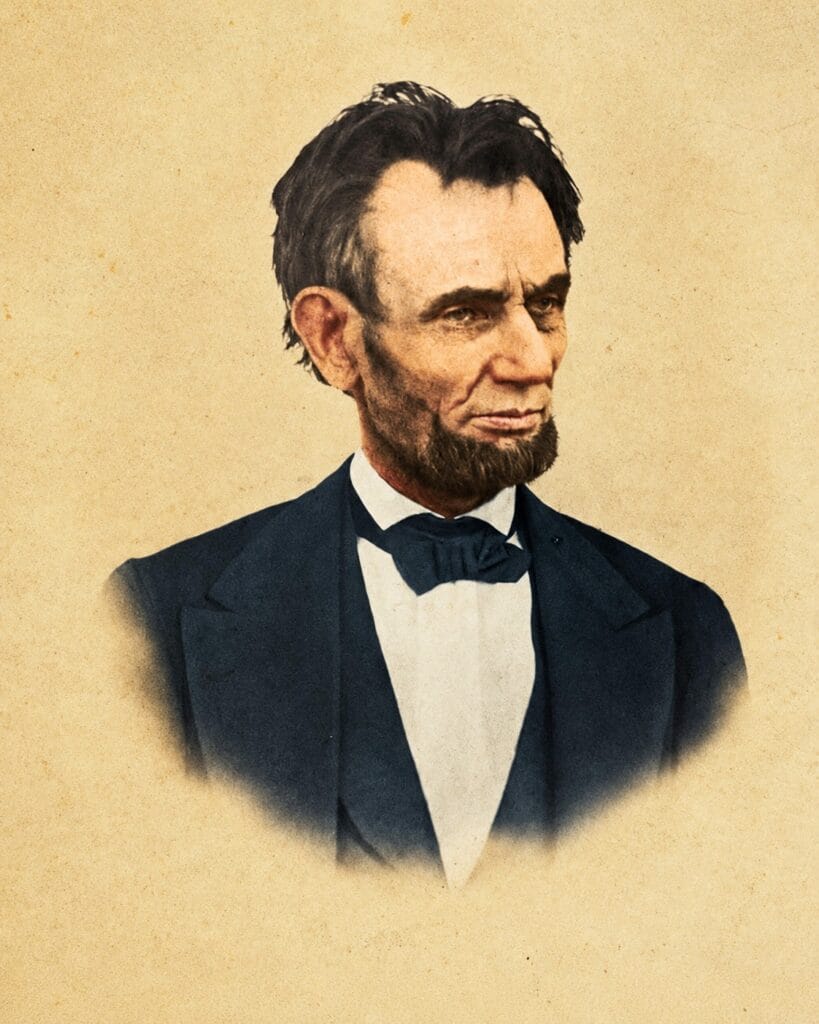
This photograph was taken forty-one days before he was killed. March 6, 1865.
It’s not the kind of portrait you see in history books. His hair isn’t combed. The lines around his eyes are deep. He’s standing on the White House’s south balcony because his youngest son, Tad, asked him to step outside for a moment. There’s nothing presidential about this image. This is a man who carried the weight of hundreds of thousands of deaths, who read letters from grieving families every night, who had been mocked and hated by large parts of the country for years — and who still showed up every morning.
When he arrived at the theater that evening, the audience rose to their feet and applauded. He waved. He settled into the red chair behind the curtained box. He was smiling. For the first time in four years, it looked real.
The Empty Chair
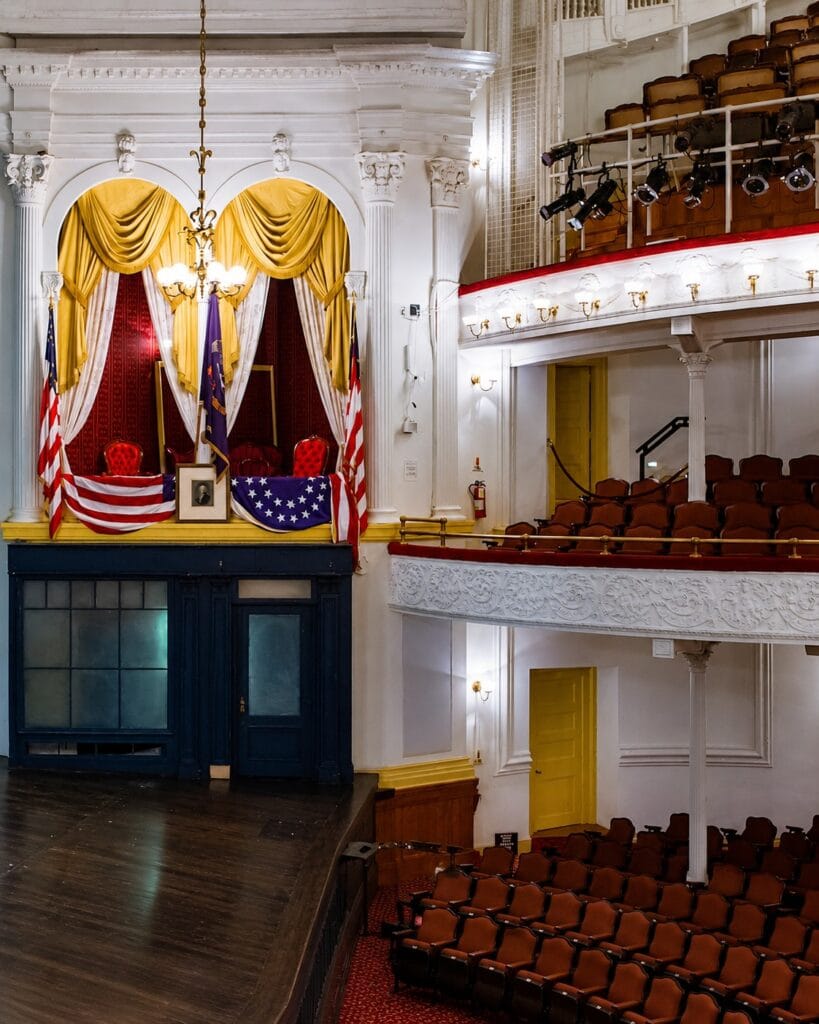
The chair is still there.
Red velvet. American flags. Gold curtains. And an empty seat that feels like whoever sat in it just stepped away for a second. Visitors stand in front of this space longer than anywhere else in the building. They take photos. Then they go quiet.
That night, there was laughter in this room. There were actors performing. There were people clapping. Nobody thought, even for a second, that American history was about to stop.
There was one gunshot. And it’s been echoing ever since.
THE PRESIDENT SHOT
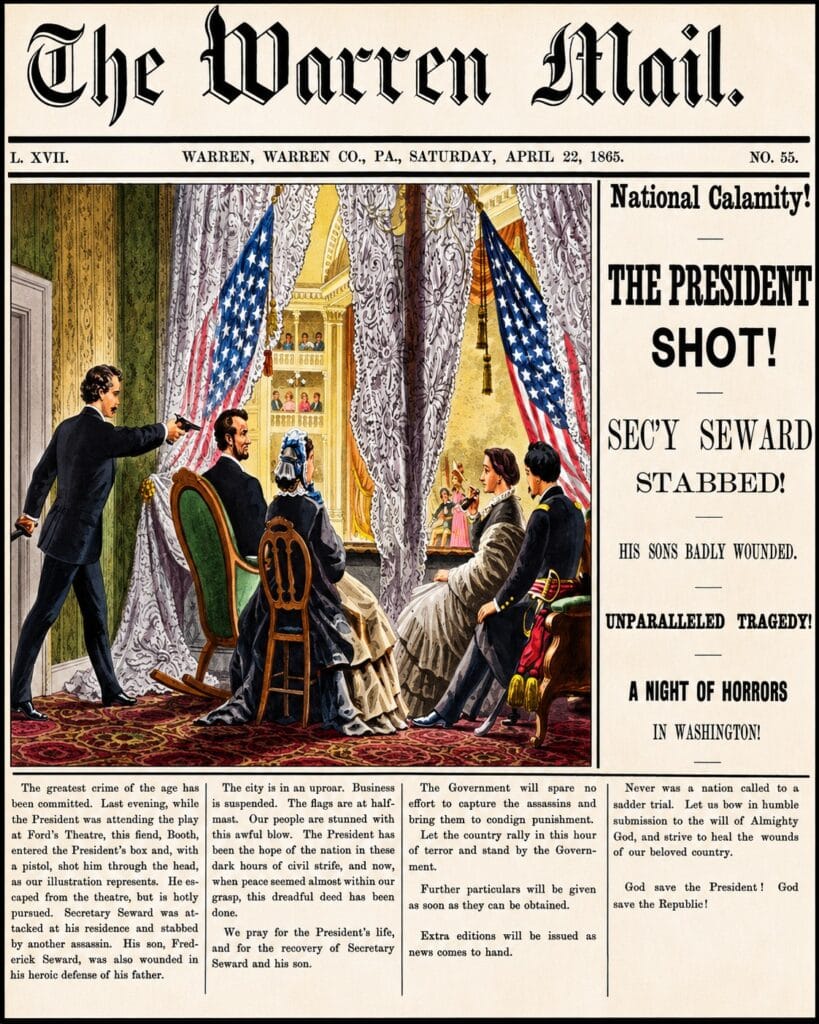
By the next morning, the front page of every newspaper in America carried the same three words.
“THE PRESIDENT SHOT.”
Lincoln didn’t make it through the night. He died the following morning. People wept in the streets. Flags were lowered. The country stopped. The man who had won the war and saved the nation fell at the exact moment victory was within reach.
Then someone started going through his pockets.
What They Found
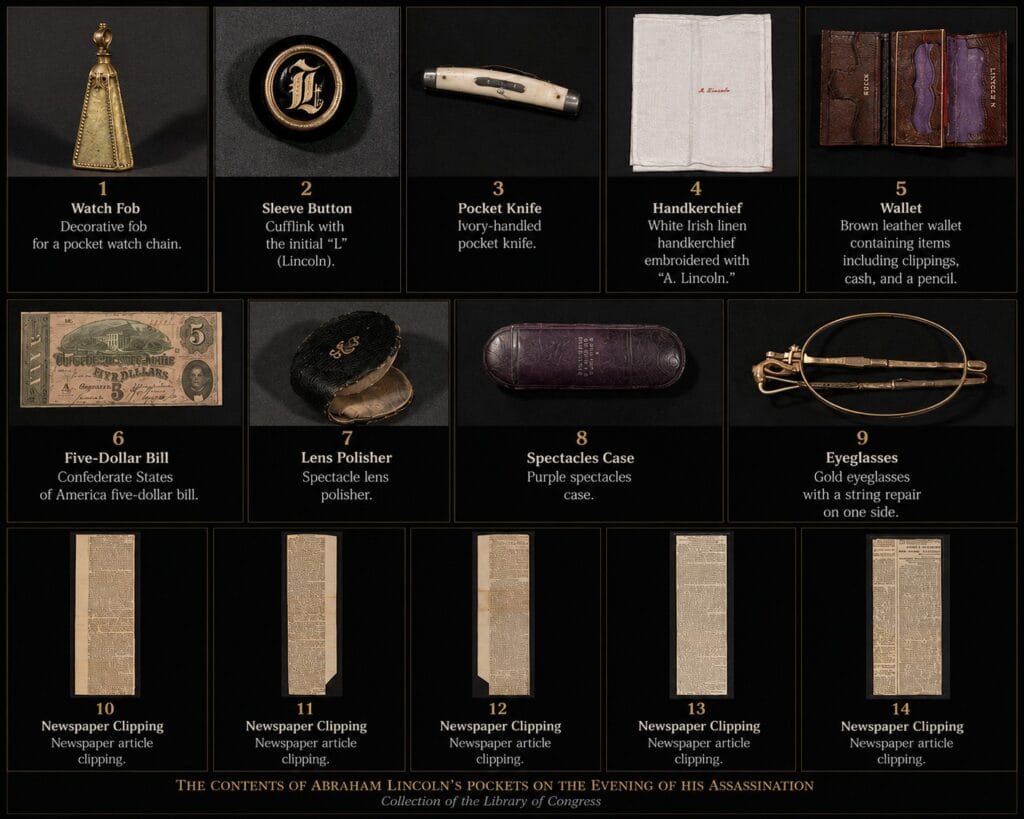
People were expecting state secrets. Important documents. Battle plans. Something that could move history. He was the president, after all.
Instead, they found this.
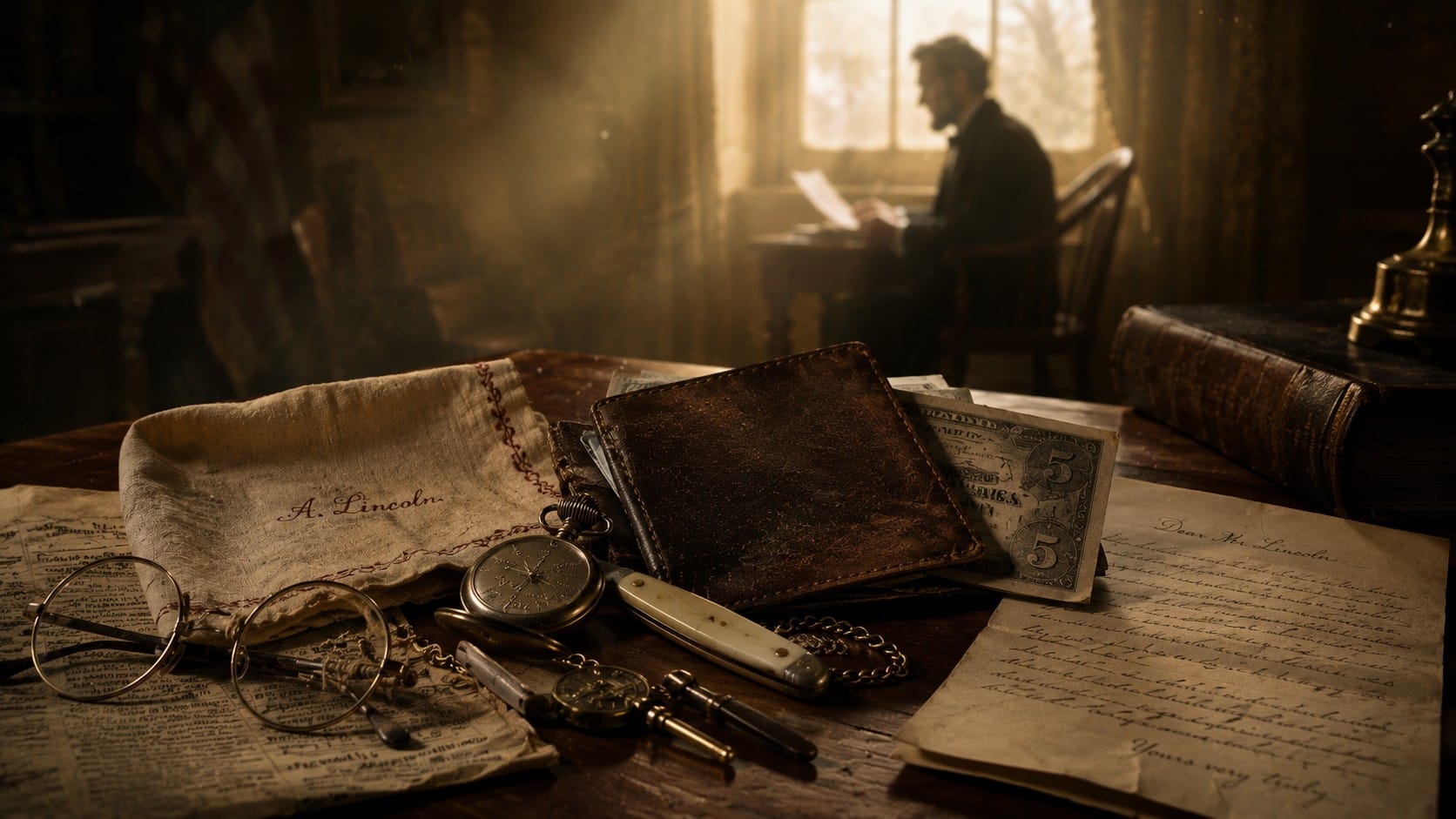
Two pairs of gold-rimmed glasses — one of them held together with a piece of string where the temple had broken. A glasses case. A lens polisher. A small ivory-handled pocketknife. A watch fob. A linen handkerchief embroidered with the letters “A. Lincoln” in red thread. A sleeve button. And a brown leather wallet.
It was surprisingly ordinary. One of the most recognizable men in America was carrying the same things you’d find in your grandfather’s jacket. Just one detail stood out: the glasses with the broken arm, held together with string. He could have bought new ones. He just didn’t bother.
The Knife That Belonged to the World’s Ugliest Man
Next to the wallet was a small ivory-handled pocketknife. An everyday object. But Lincoln had a story he loved to tell about a knife like this one.
Years earlier, when he was still a lawyer traveling by train, a stranger walked up to him and shoved a pocketknife into his hands. Confused, Lincoln asked what this was about. The stranger looked him dead in the eye and said:
“A few years back, a friend gave me this knife with one instruction — if I ever met someone uglier than me, I should hand it over. Sir, I believe I’ve finally found that person.”
Any other powerful man would have lost his temper. Lincoln laughed, took the knife, and pocketed it. He told this story for the rest of his life, using it to get a laugh out of anyone who’d listen — a story that proved, in his own words, just how ugly he was.
Whether that exact knife ended up in his pocket on the night he was shot, no one knows for certain. He owned several. But what it tells us is clear: this was a man who could take a joke at his own expense, laugh about it, and carry it with him wherever he went. A man who kept the knife, the worn-out newspaper clippings, and the enemy’s money all in the same pocket.
Zero Dollars, and a Bill From the Other Side
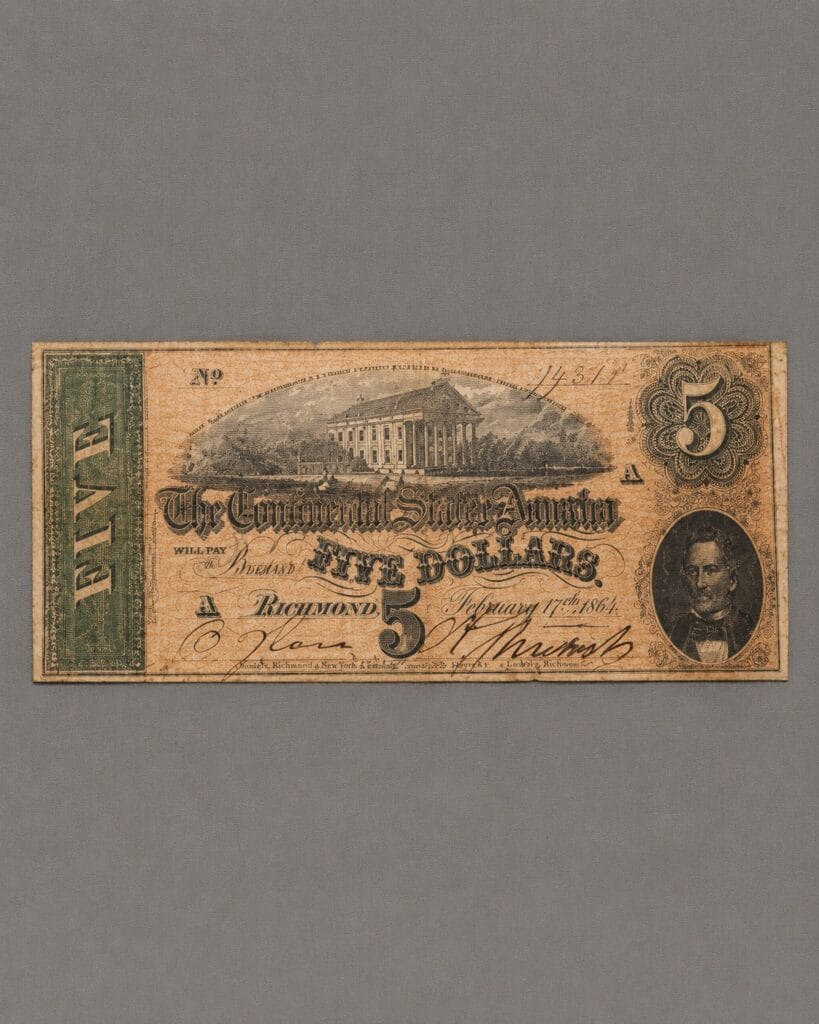
When they opened the wallet, people stopped again.
There was no American money inside. Not a single cent.
The man who had signed the Emancipation Proclamation — the commander-in-chief of the Union Army — had exactly zero dollars in his wallet the night he died. The only thing in there was a single five-dollar bill from the Confederate States of America, folded neatly next to the old newspaper clippings.
Confederate States of America. Issued in Richmond, February 17, 1864. The portrait in the lower corner was Christopher Memminger, the Confederate Secretary of the Treasury. Money from the side Lincoln had spent four years destroying.
So why did he have it? Ten days before the assassination, on April 4th, Lincoln did something that his security team thought was reckless: he walked through the streets of Richmond, Virginia — the fallen capital of the Confederacy — and looked around with his own eyes. According to historians, Lincoln most likely picked up this bill as a souvenir during that visit. A piece of paper from a collapsed country. Proof that the four worst years of his life were finally over.
Then, ten days later, he carried that bill into the theater. And the man who shot him was someone who had loved that collapsing country with everything he had.
The man who carried a souvenir from the defeated Confederacy was killed by someone who couldn’t accept that defeat. There’s no clean way to sit with that fact.
The Clipping He Kept Unfolding
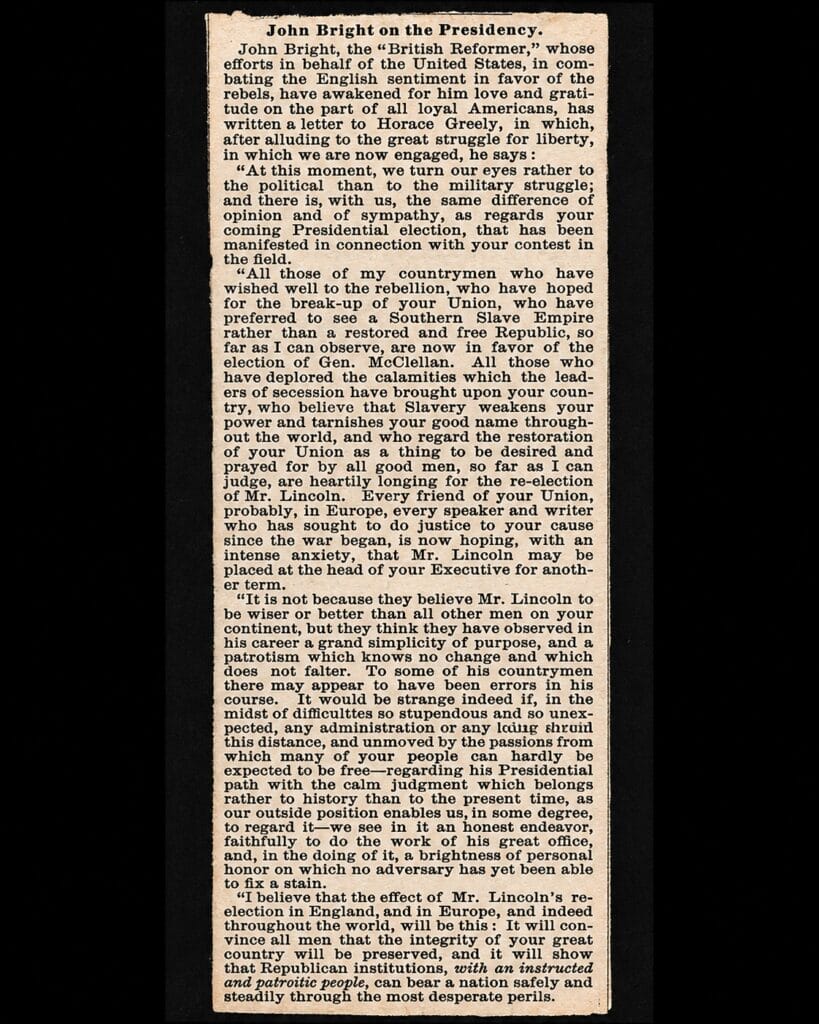
Inside the wallet were eight newspaper clippings. Folded so many times the paper had gone thin.
A curator at the Library of Congress once described them this way: “This isn’t about ego. This is evidence of a man who needed reassurance. His reelection was brutal. The war was eating him alive.”
One of the clippings was an article quoting a letter from John Bright — a British politician known as “the British Reformer” — who had publicly supported Lincoln when most of England sided against him. Bright had written to American journalist Horace Greeley, and someone had clipped out the part about Lincoln.
It read: “In his career, they have observed a grand simplicity of purpose, and a patriotism which knows no change and which does not falter. To some of his countrymen there may appear to have been errors in his course. It would be strange indeed if, in the midst of difficulties so stupendous and so unexpected, any administration or any leader had been free from error. Regarding his Presidential path — we see in it an honest endeavor, faithfully to do the work of his great office, and in the doing of it, a brightness of personal honor on which no adversary has yet been able to fix a stain.”
One sentence summed it all up: He wasn’t perfect. But his purpose was pure. And no one had managed to touch his integrity.
Lincoln folded this article and put it in his wallet. He took it out again and again until the paper nearly fell apart.
Here’s the thing you have to understand: Lincoln was one of the most openly mocked public figures in America. Editorial cartoonists drew him as a gorilla and an ape. Southern papers depicted him as the devil. Even Northern journalists called him a backwoods rube, a clumsy log-splitter with no business being in the White House. He was attacked by opponents, by the press, and sometimes by members of his own party. Every single day. For years.
And then one day, a British politician — someone on the other side of the ocean — actually saw him clearly. Lincoln couldn’t throw that away. He folded it. He kept it. He pulled it out when things got too heavy.
Even the President of the United States returned to the same newspaper clipping again and again. Not because he was weak. Because he was human. Because even the people carrying the biggest weight need someone to tell them they’re doing okay. Most of us do. We save the kind texts. We screenshot the compliments. We hold onto the one good thing someone said on a bad day. Lincoln did the same thing — and he was running a country through a civil war while he did it.
The Proof That He Had Won
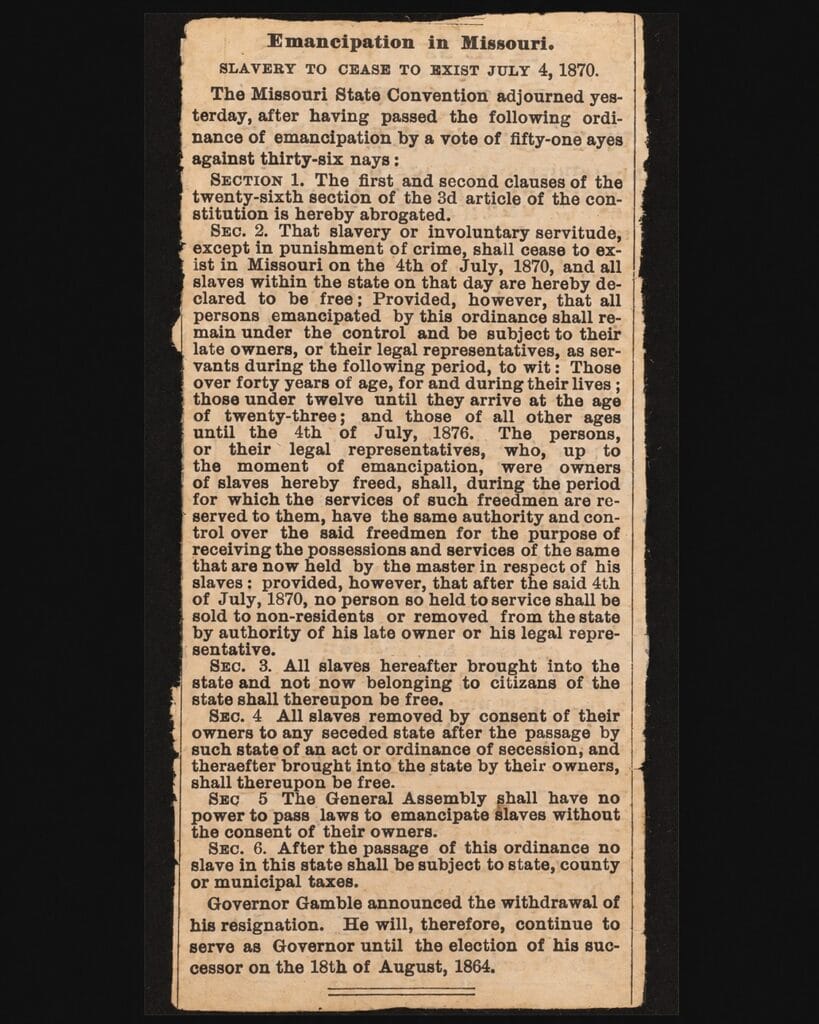
Another one of the eight clippings. This one wasn’t praise.
“Emancipation in Missouri. Slavery to Cease to Exist July 4, 1870.”
Missouri was a border state — technically on the Union side, but still holding onto slavery throughout the war. It was the state that gave Lincoln the most headaches. The pressure to compromise there was constant. And now Missouri had voted to abolish slavery. Fifty-one votes in favor. Thirty-six against. That vote, reduced to a few lines of newsprint, was folded up next to the praise article.
He carried both. The one that said he was right. And the one that proved it.
Think about what that means. Lincoln had been told, over and over, that he was wrong. That he was pushing too hard. That he needed to compromise. That abolition was too radical, too divisive, too much. He got up every morning and kept going anyway. And now here was the evidence — in black and white — that it had mattered. That it had worked. That the thing he had fought for his entire career had quietly become real.
He didn’t put this clipping in his wallet to show anyone. He put it there to remind himself. On the days when the weight was too much, he could reach in and feel that worn piece of paper and know: the fight was worth it. One of the things he seemed to value most wasn’t a medal or a certificate. It was a folded-up newspaper that told him he hadn’t been wrong.
The Secret Inside the Clock: A 144-Year-Old Message
Among the items in his pocket was a small watch fob — a decorative piece of gold-bearing quartz attached to a chain, reportedly a gift from California during the gold rush years. Lincoln wore it clipped to his pocket watch.
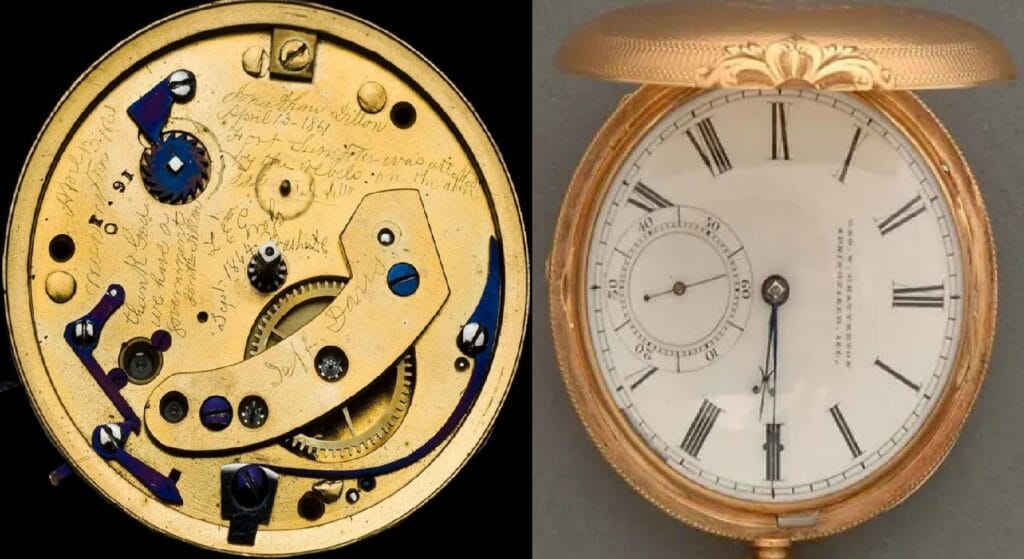
Inside that pocket watch, there was a secret. Lincoln never knew about it. For 144 years after his death, nobody knew.
April 13, 1861. A watchmaker named Jonathan Dillon was repairing Lincoln’s pocket watch in Washington D.C. While he worked, news came in from outside: Confederate forces had attacked Fort Sumter. The Civil War had just begun.
Dillon did something impulsive. He opened the face of the watch, and with a pin, scratched words into the brass plate inside.
“Jonathan Dillon, April 13-1861, Fort Sumter was attacked by the rebels. Thank God we have a government.”
Then he closed it back up. He never told anyone. He took the secret with him to his grave.
Lincoln carried that watch every single day of the war. He checked the time with it. He ran his fingers over the fob. But he never knew that inside the watch, tucked behind the gears, an ordinary repairman had left him a message. A message that had been beating alongside Lincoln’s heart through four years of war, through every impossible decision, through every morning he had to get up and face everything again — and he never got to read it.
The secret was discovered in 2009, when Dillon’s great-great-grandson contacted the Smithsonian Institution. Curators carefully opened the watch and found the inscription exactly where he said it would be. One hundred and forty-four years after it was written.
One of the loneliest men in America had a stranger’s encouragement hidden inside his watch the whole time. He just never knew.
The Stories That Would Have Been in His Pocket
The contents of Lincoln’s pockets tell part of the story. But to really know him, you have to look at what else he kept — not in his coat, but in his life. The letters he answered. The people he remembered. The moments he chose not to let go of.
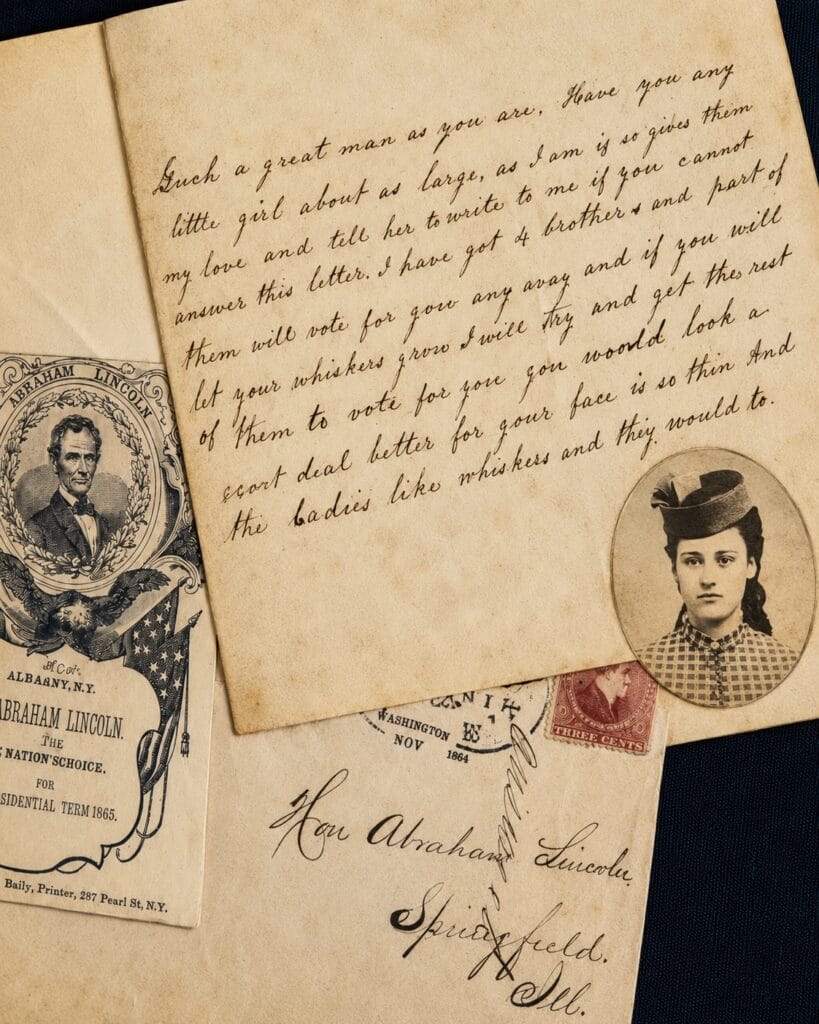
October 15, 1860. Grace Bedell, an eleven-year-old girl from Westfield, New York, wrote a letter to Abraham Lincoln — then a presidential candidate — and told him exactly what she thought.
“You would look a great deal better for your face is so thin. All the ladies like whiskers and they would tease their husbands to vote for you and then you would be President.”
There were thousands of letters coming in every day. Most politicians — most adults — wouldn’t give a letter like this a second glance. Lincoln wrote back himself.
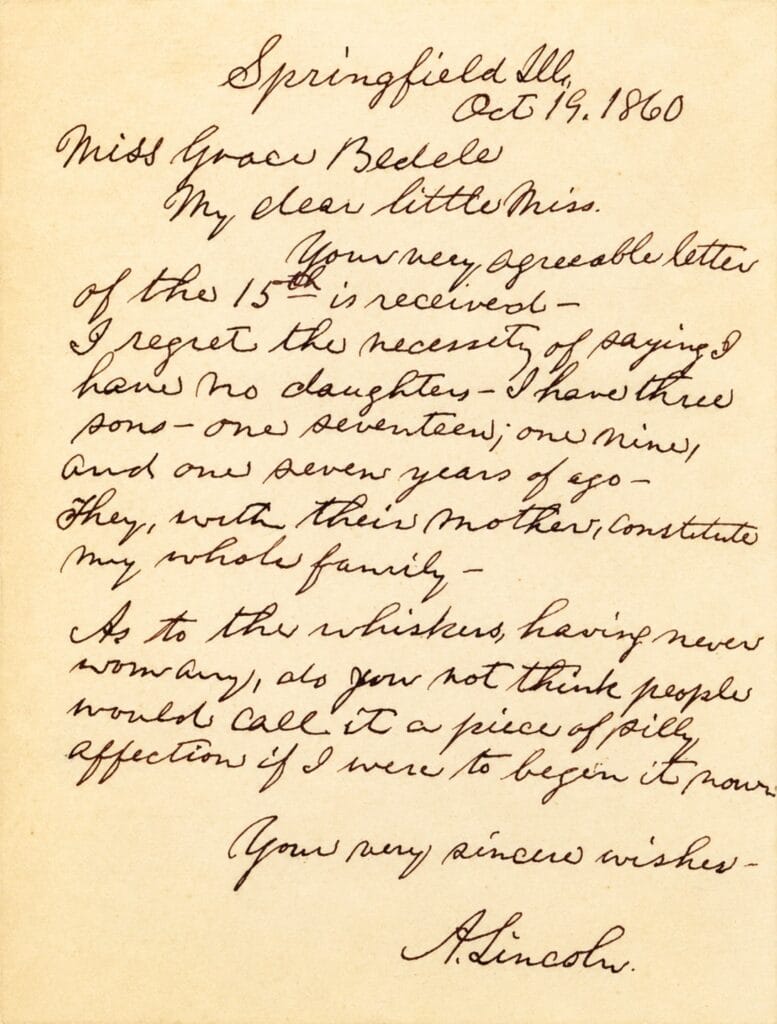
“My dear little Miss, I have no daughters — I have three sons, one seventeen, one nine, and one seven. They, with their mother, constitute my whole family. As to the whiskers, having never worn any, do you not think people would call it a piece of silly affection if I were to begin it now?”
A presidential candidate, writing back to an eleven-year-old, sheepishly asking if he’d look ridiculous. He threw in details about his sons and his wife. No authority. No distance. Just a man unsure of himself, talking to a kid.
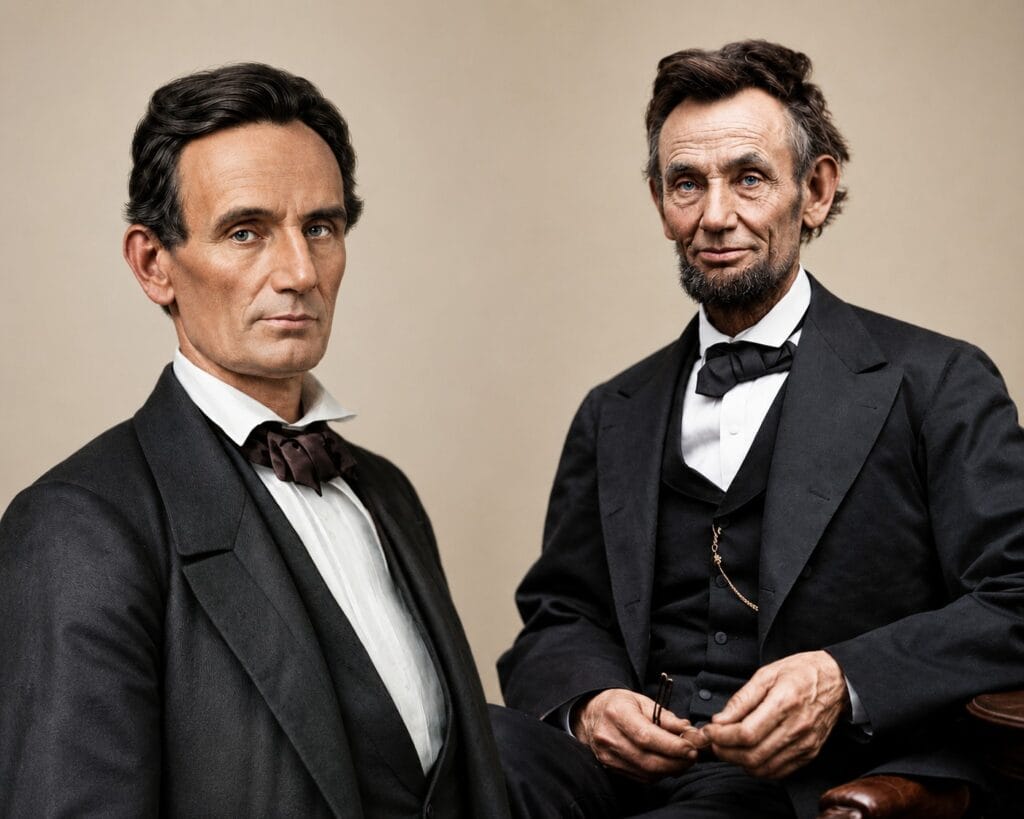
And then he grew the beard.
Consider what that actually took. At the time, Lincoln was constantly being ridiculed for his appearance. Newspapers printed cartoons of him as a gorilla. He was called grotesque, ungainly, unfit to be seen in public. Growing a beard out of nowhere — right in the middle of all that — could easily give the press more ammunition. He even wrote in his reply that people might think it was “silly affection.” He clearly thought about it. But he did it anyway. Because a little girl from Westfield had been worried about how thin his face looked, and that had stuck with him.
A month later, he won the election. With the beard. On March 4, 1861, he was inaugurated as the 16th President of the United States — beard and all.
On February 16, 1861, Lincoln’s inaugural train passed through Westfield, New York. He could have kept going — it was a small town, just another stop on a long journey. Instead, Lincoln stepped out onto the rear platform and called into the crowd.
“I have a correspondent in this place, a little girl. Her name is Grace Bedell. Is she here?”
Grace pushed through the crowd. She was twelve now. Lincoln stepped down from the platform, bent low toward her, and kissed her on the cheek.
“Grace,” he said. “Look at these whiskers. I let them grow for you.”
Grace froze. She had brought a bouquet of roses to give him, and she forgot to hand them over. She clutched the flowers, turned around, and ran all the way home. Years later, she described the moment: “It seemed to me as the president stooped to kiss me that he looked very kind, yes, and sad.”
Kind and sad. Already carrying something heavy, even then, on his way to a war he hadn’t started yet.
The face we picture when we think of Lincoln — the beard, the weathered eyes — started with one letter from an eleven-year-old who thought he looked too thin. And it was completed by a man who actually listened.
One of the Most Beautiful Letters Ever Written to a Grieving Mother
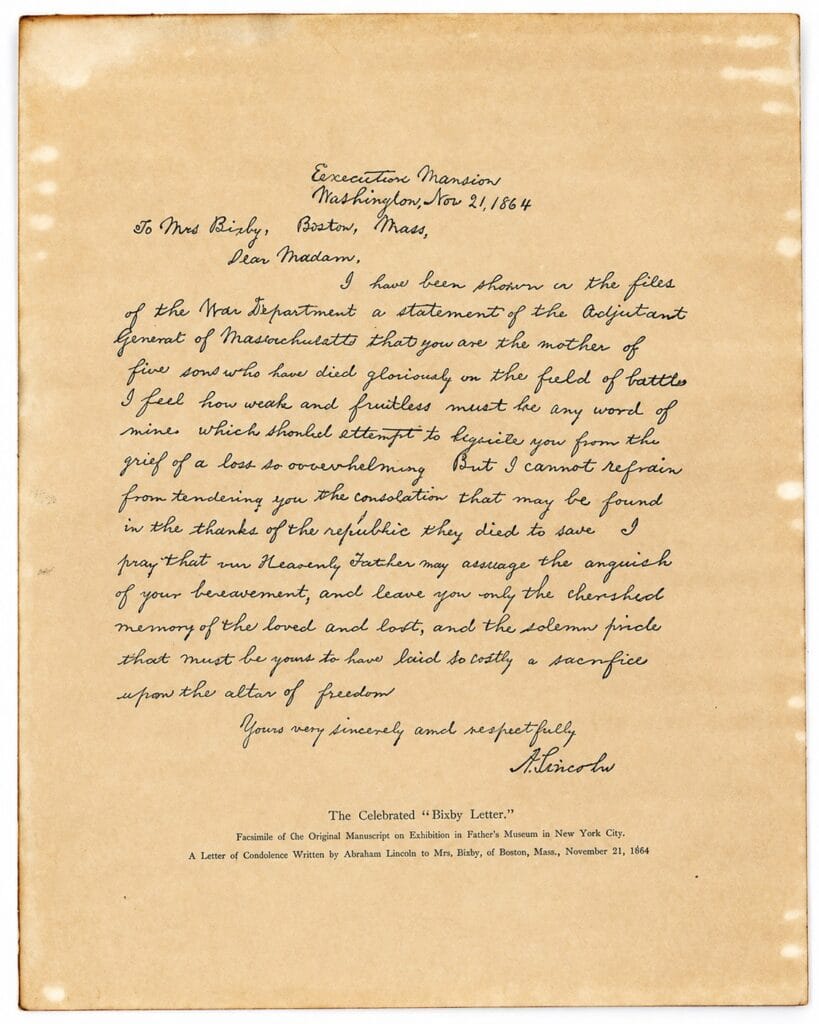
November 21, 1864. Lincoln wrote a letter to a woman in Boston named Mrs. Bixby. She had lost five sons in the war.
The letter is short. Remarkably short. And that’s exactly why it has survived 160 years.
“I feel how weak and fruitless must be any word of mine which should attempt to beguile you from the grief of a loss so overwhelming. But I cannot refrain from tendering you the consolation that may be found in the thanks of the Republic they died to save. I pray that our Heavenly Father may assuage the anguish of your bereavement, and leave you only the cherished memory of the loved and lost, and the solemn pride that must be yours to have laid so costly a sacrifice upon the altar of freedom.”
The most important sentence is the first one. He didn’t try to comfort her. He started by admitting that nothing he could say would actually help. A president, writing to a mother who had buried five sons, and his opening move was to acknowledge that his words were useless.
No grand speeches about sacrifice. No talk of national glory. Just: I know I can’t fix this. And I couldn’t stay silent anyway.
Many Lincoln historians place this letter alongside the Gettysburg Address as one of his finest pieces of writing. It’s still used as a reference point today — for leaders in crisis, for anyone searching for the right words when there aren’t any. But what makes it great isn’t the writing. It’s that the most powerful man in the country sat down and admitted, first, that he was powerless in front of one woman’s grief.
He signed it: A. Lincoln. The same way he signed his reply to a twelve-year-old girl about a beard.
What the Pocket Remembers
Those items are inside a glass case now, at the Library of Congress in Washington. Thousands of people walk past them every year.
Glasses held together with string. A handkerchief monogrammed “A. Lincoln.” A pocketknife. A Confederate five-dollar bill. Eight folded newspaper clippings worn thin from being opened and closed too many times.
Remarkably ordinary. And yet people stop in front of this case longer than anywhere else.
Not because these were a president’s things. Because these were a person’s things.
History turns presidents into monuments. It puts their faces on coins and their words in textbooks. But what brings Lincoln closest isn’t the speeches. It’s this: a man who saved old newspaper clippings when someone finally said something kind about him. A man who listened to an eleven-year-old girl and grew a beard. A man who went through four years of war with a stranger’s message hidden inside his watch and never got to read it. A man who wrote to a grieving mother and began by saying his words were useless.
The man who was shot that night was a president. But what was left in the glass case is something else entirely — someone who got lonely, who kept the kind things people said, and who stopped a train for a kid from Westfield.
History made him a giant. But his pockets stayed human.
Archive Notes
How many newspaper clippings were in Lincoln’s wallet?
The Library of Congress official record states “eight newspaper clippings.” The titles are: Emancipation in Missouri / The disaffection among the Southern soldiers / John Bright on the Presidency / President Lincoln / The message of the Governor of Missouri / A conscript’s epistle to Jeff. Davis / Sherman’s orders for his march, special field order no. 120 / The two platforms, Lincoln and Johnson. The items were passed to Lincoln’s son Robert Todd Lincoln after his death, and donated to the Library of Congress in 1937 by Lincoln’s granddaughter, Mary Lincoln Isham.
How was the secret inside the watch discovered?
In 2009, Jonathan Dillon’s great-great-grandson contacted the Smithsonian Institution and told them the story. Curators opened the watch and confirmed the inscription exactly where Dillon’s descendant said it would be. The watch is currently held at the Smithsonian’s National Museum of American History. The secret had remained hidden for 144 years.
What happened to Grace Bedell?
Grace Bedell later married and moved to Delphos, Kansas, where she spent most of her adult life. She died in 1936 at the age of eighty-seven. In 1999, the town of Westfield erected a bronze statue commemorating the moment she met Lincoln at the train station — the president bending down toward a twelve-year-old girl, keeping a promise he’d made to a letter.
If This Story Moved You
Lincoln’s pockets are a lot like what Robert Falcon Scott left behind in his tent in Antarctica — not trophies, not flags, but the quiet evidence of a human being who kept going when they had every reason to stop. The things that outlast us are never the grand gestures. They’re the folded pieces of paper. The broken glasses held together with string. The letter to a mother who already knew no words would be enough.
Verified Sources
Library of Congress — “The Contents of Abraham Lincoln’s Pockets on the Evening of his Assassination,” Alfred Whital Stern Collection of Lincolniana
Smithsonian Institution, National Museum of American History — Lincoln Pocket Watch Collection (Jonathan Dillon inscription, 2009)
Ford’s Theatre National Historic Site — National Park Service, Washington D.C.
Abraham Lincoln Online — Grace Bedell correspondence and Westfield meeting, February 16, 1861
Britannica — “Grace Bedell Meets Abraham Lincoln,” Today in History, February 16
National Park Service, Lincoln Home National Historic Site — Westfield, New York, Inaugural Journey
Donald, David Herbert, Lincoln, Simon and Schuster (1995)
Goodwin, Doris Kearns, Team of Rivals, Simon and Schuster (2005)