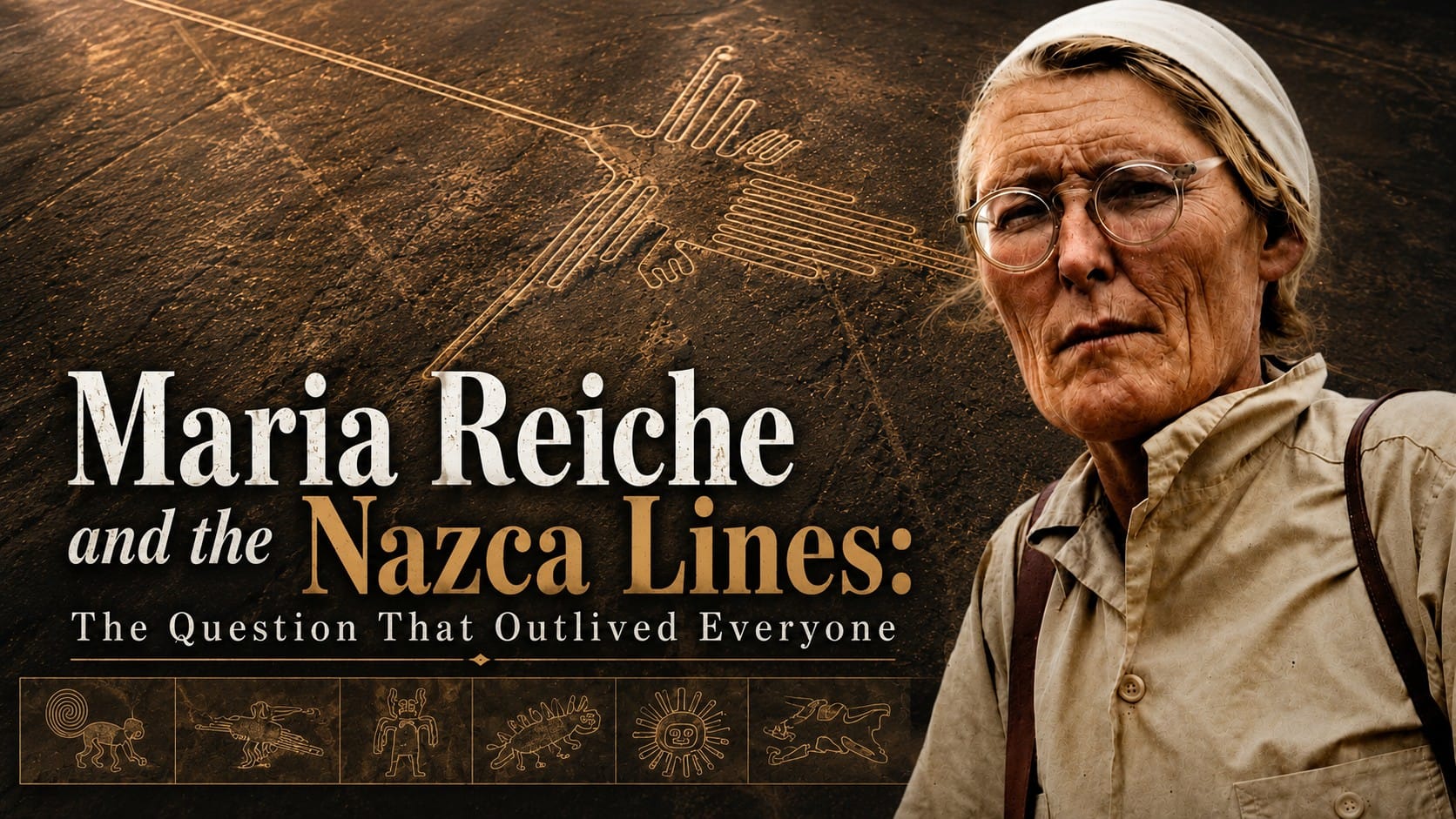
The lines aren’t a mystery because they’re hidden. They’re a mystery because they’re simply too huge for the human eye to process from the ground.
The Nazca Lines stretch across more than 450 square kilometers of desert in southern Peru. Every major design — the hummingbird, the monkey, the spider — is so vast that standing at its center gives you nothing. Only from above does the image begin to make sense. The people who made them never had that view. They worked blind, on a scale no single human eye could hold.
It took humans nearly a century to map out the edges of this ancient desert. Then, in 2024, researchers returned to the same desert with a new kind of tool — and found 303 figures that researchers had not previously identified. In just six months.
She Did Not Come to Find It. She Came to Keep It From Disappearing.
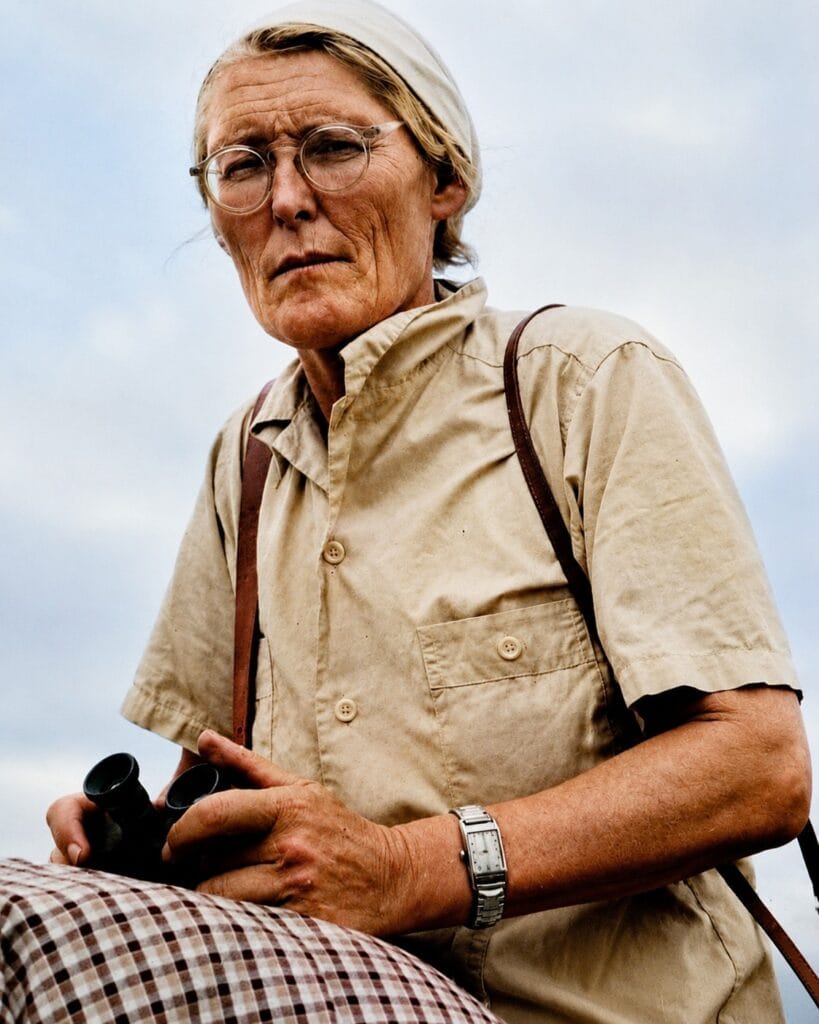
The face in that photograph belongs to a mathematician from Dresden, Germany. Her name was Maria Reiche. Born in 1903, she arrived in Peru in 1932 as a governess and found her life’s purpose in the desert. She was in her forties when she first stepped onto the pampa, gradually becoming convinced these massive lines weren’t just accidental scratches on the earth.
She is sometimes called the discoverer of Nazca. That title belongs to someone else — the Nasca people who created the lines between 200 BC and 650 AD. What Reiche discovered was something harder: that someone had to stay. Had to make sure the thing survived long enough to be understood.
By the 1970s, as the Smithsonian Institution documented, the Nazca Lines had become the second most important tourist destination in Peru. Reiche, then in her seventies, took up permanent residence in room 130 of the Hotel Nazca Lines. She continued lecturing on the lines from that room for twenty-five years, until she could no longer leave. She spent her final years in that same building, surrounded by the desert she refused to abandon.
She published her findings in a privately funded book, Mystery on the Desert, in 1949, when no institution would back the work. She lobbied the government to designate the pampa a protected national park. She fought every road proposal, every irrigation canal, every development project that threatened the lines. The Nazca Lines received UNESCO World Heritage status in 1994 — a result that did not happen without her.
From Above, It Was a Sentence. From the Ground, It Was Just a Desert.
The Nazca Pampa receives almost no rainfall. The slight stickiness of the gypsum-containing soil — a property Reiche documented carefully — is why the drawings have survived at all. In a wetter climate, they would have dissolved inside a generation. The desert preserved them the way amber preserves insects: quietly, for centuries.
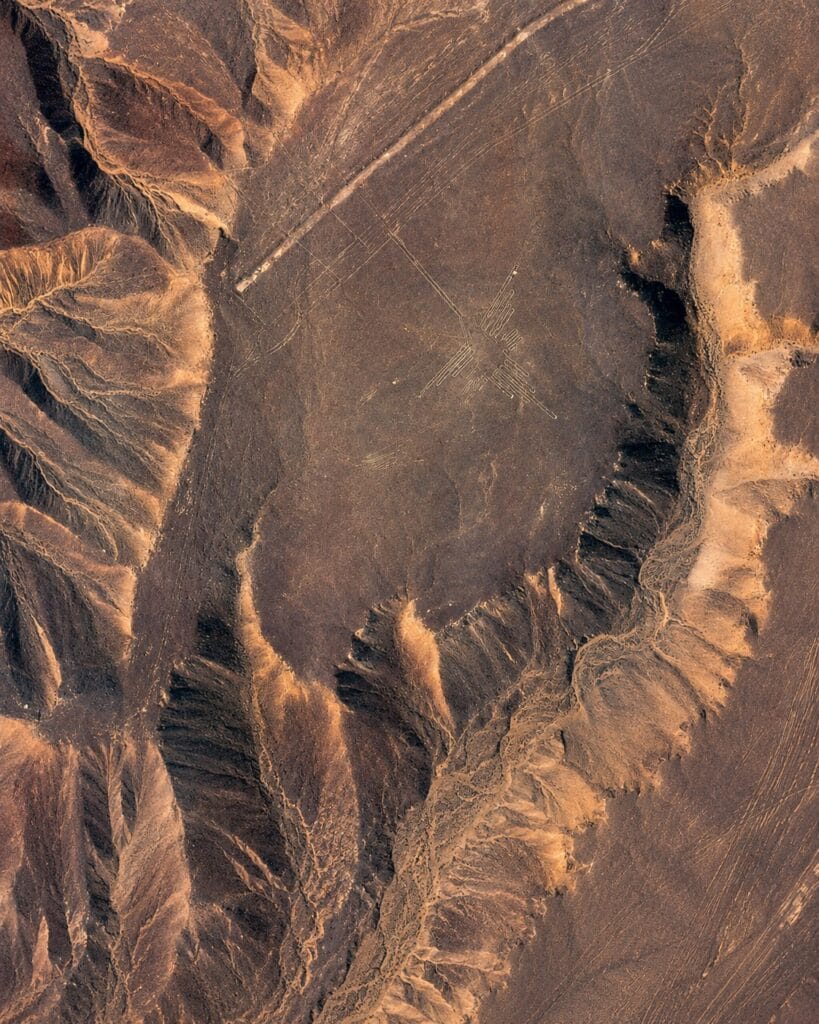
The ancient Nasca people made the geoglyphs by removing dark, iron-oxide-coated stones to expose the pale clay beneath. The contrast is subtle from the ground. It reads as a pale path crossing a dark field. From altitude, in the right light, it becomes a wing, a tail, a line that runs for kilometers without a single deviation.
Standing inside one of the large designs, a person has no idea what they are standing in. The shape exists only at height. The image only resolves itself at altitude — at a view the ancient Nasca never had.
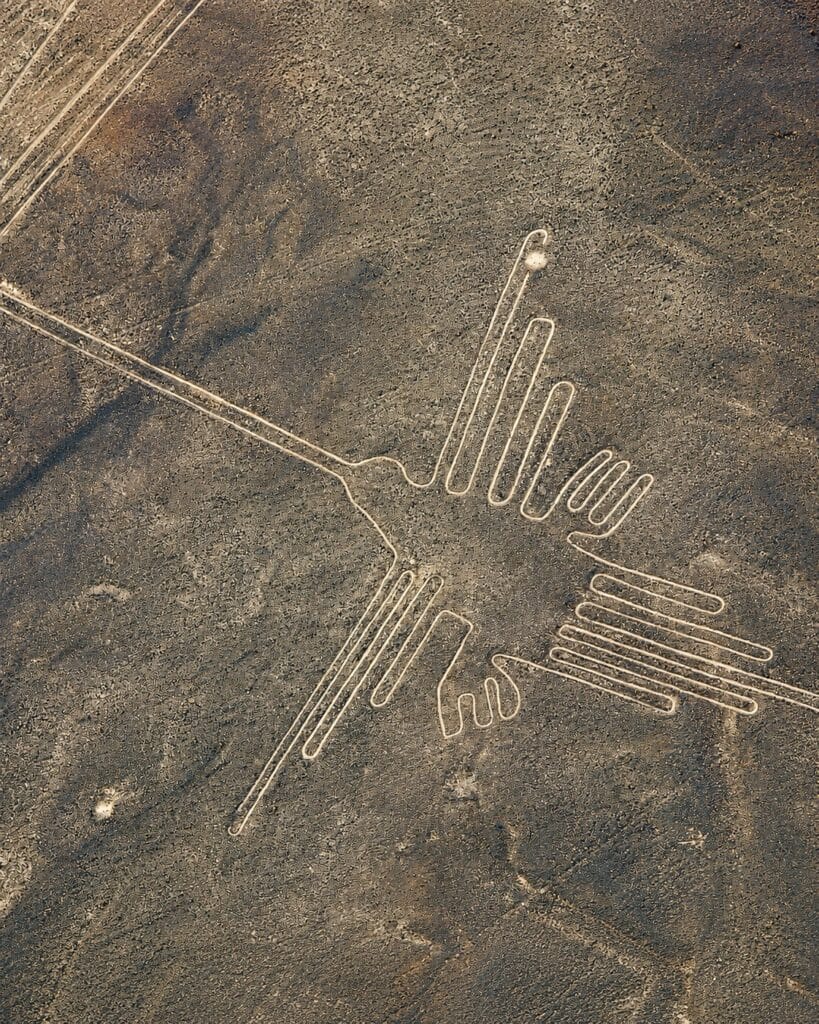
In the 1930s, commercial pilots began flying routes over southern Peru. The reports that came back were unsettling: the desert was full of giant drawings. A hummingbird stretching more than 90 meters. A condor. A spider.
A long-necked figure that no one has agreed on for eighty years. The question the pilots brought back has not been fully answered since.
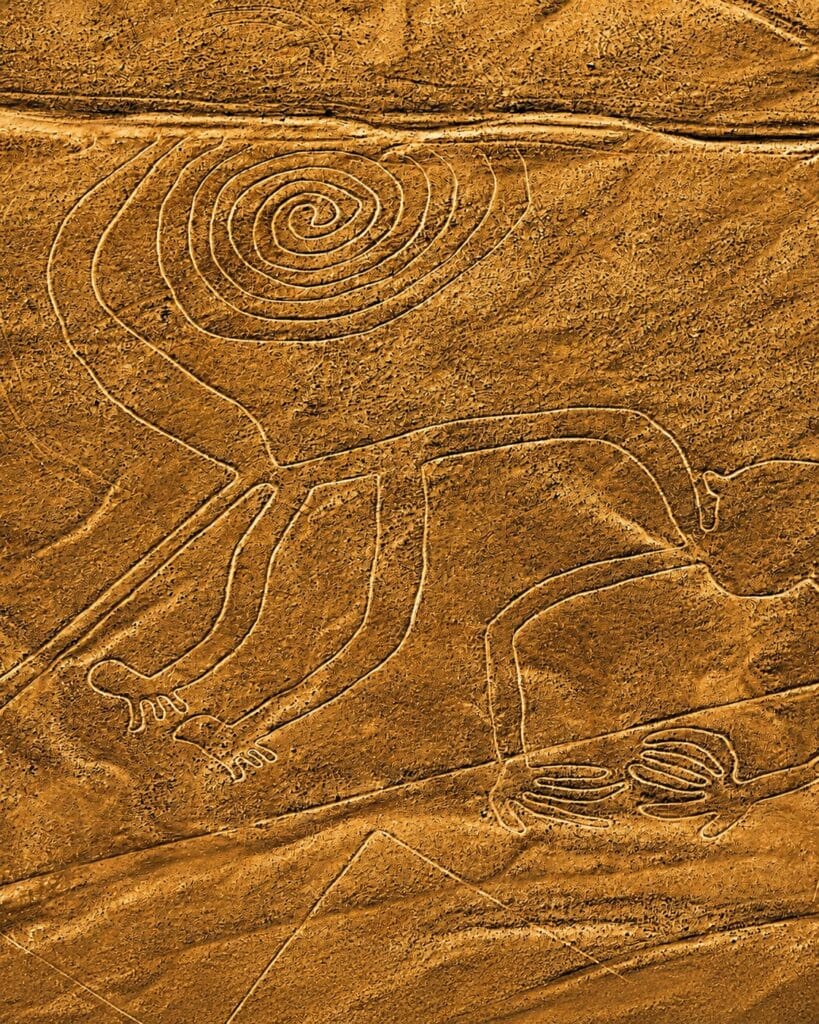
A monkey, scratched into a plateau, its spiral tail coiling in precise concentric rings. The monkey does not live in the Nazca Pampa. Neither does the orca, whose image appears elsewhere on the plain. The drawings seemed to be talking about a world far beyond the desert itself — the ocean, the jungle, creatures from places the Nasca people had never lived.
That is why the theories multiplied. Because the images invited them.
They Looked at the Sky for the Answer. The Sky Said Nothing Back.
On June 21, 1941 — the winter solstice in the southern hemisphere — Paul Kosok, an American historian from Long Island University, was standing at the end of a long straight line in the desert. He looked up as the sun went down. The sunset aligned with the line. He turned to Maria Reiche, who was with him, and told her what he thought he was seeing.
He called the Nazca pampa “the largest astronomy book in the world.” That phrase spread further than any field report could.
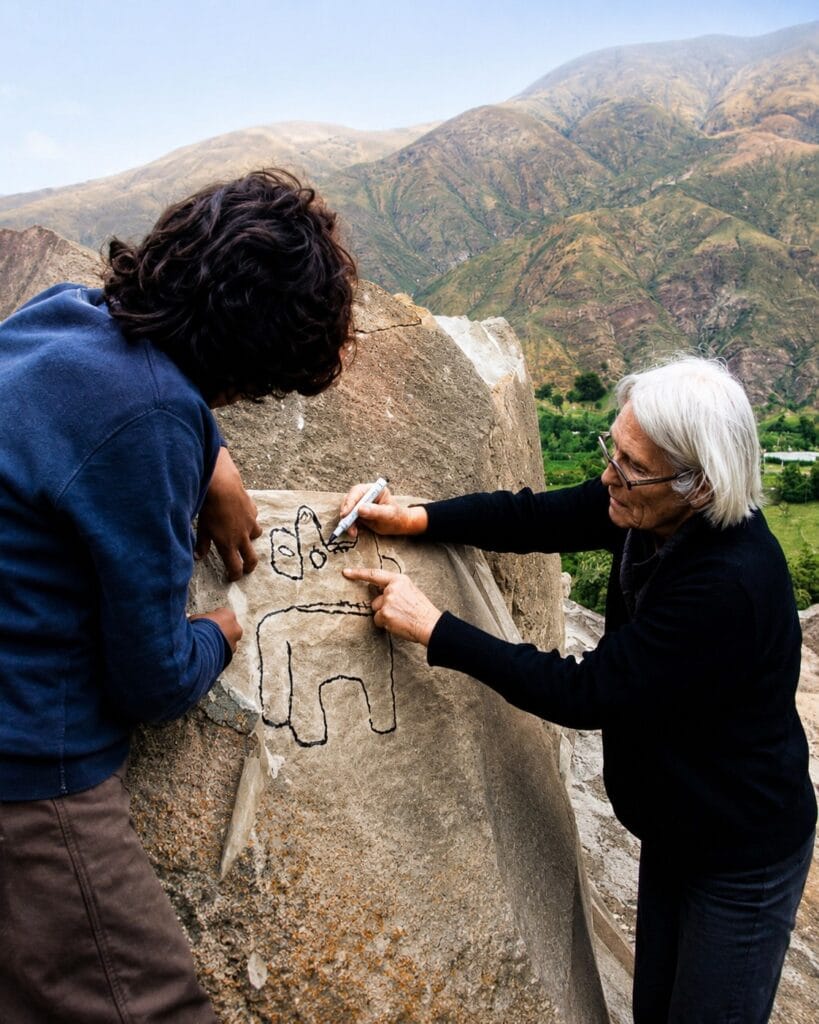
Reiche took the idea and put her mathematical training behind it for decades. She measured the alignments between lines and stars, solstices, cardinal directions. She mapped angles with a precision that only later researchers could fully evaluate. She believed the lines were a calendar written into the earth — and for a time, that was the most credible explanation anyone had.
The sky-calendar theory — though famous — couldn’t hold up under modern data analysis. Archaeoastronomer Anthony Aveni, working from systematic surveys of the alignments, found that the correspondence between Nazca lines and astronomical events was not meaningfully greater than random probability. The theory survived in popular culture long after the data had moved on.
The desert offered a different direction. Not up. Down. Along the ground. Near the paths people actually walked.
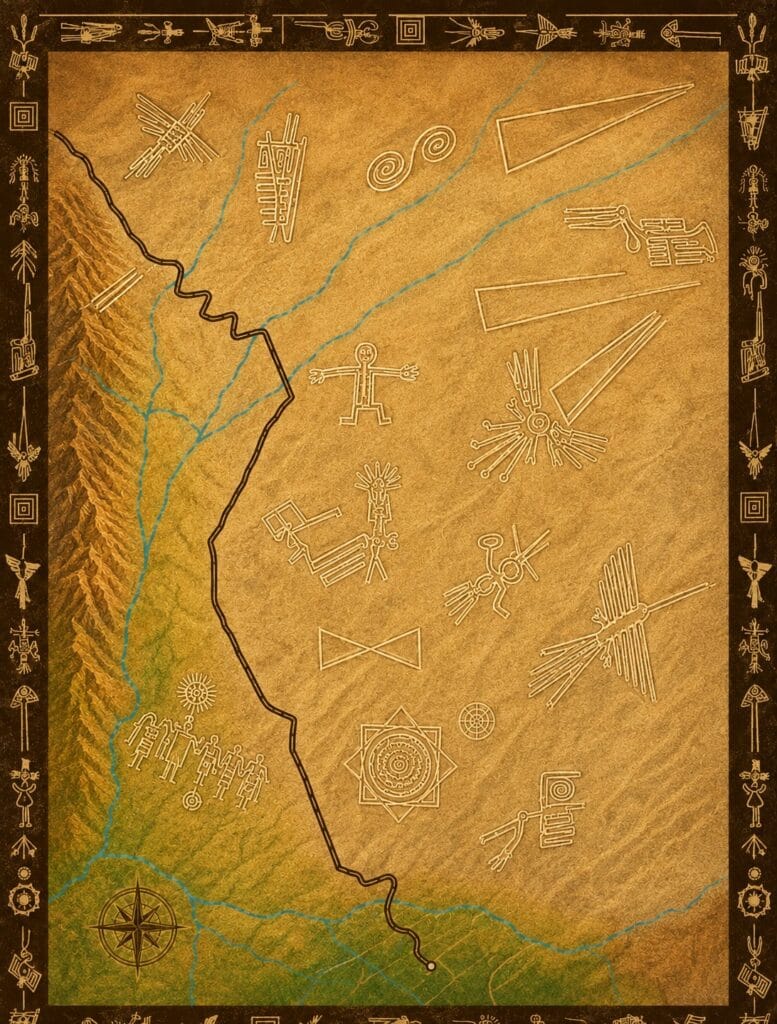
The map shows what they were working with. A region threaded by dry river channels. Ancient footpaths crossing the pampa in patterns. Geoglyphs clustering along those paths in ways that began to suggest something different.
Some of the drawings may have been intended for people walking through the desert, not for a view from above. That reframing changed everything. It arrived decades after the sky theories had already become legend.
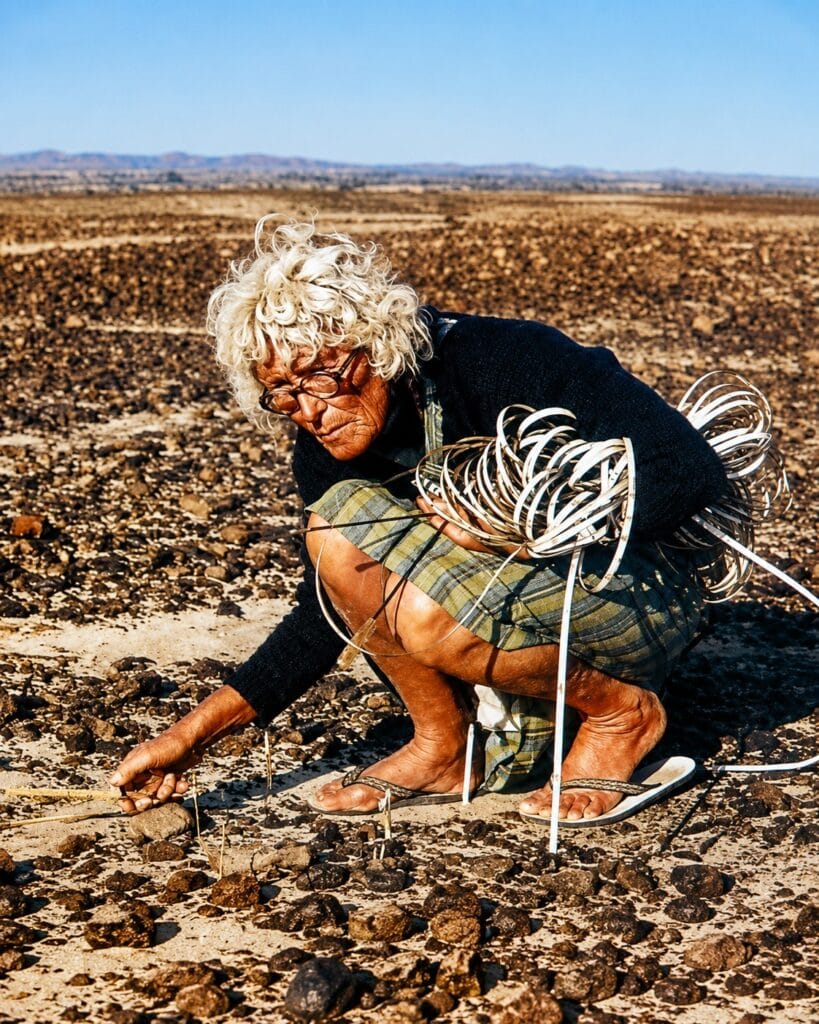
People in the Nazca region called her a witch. Not with hatred — with bewilderment. She crouched on the hot black gravel at midday, carrying ropes and measuring tape, sometimes a broom she used to clear loose pebbles before photographing.
She measured angles no one had asked her to measure. She was not looking for attention, or funding, or approval. She was not finding answers. She was making sure the questions stayed legible long enough for someone else to find them.
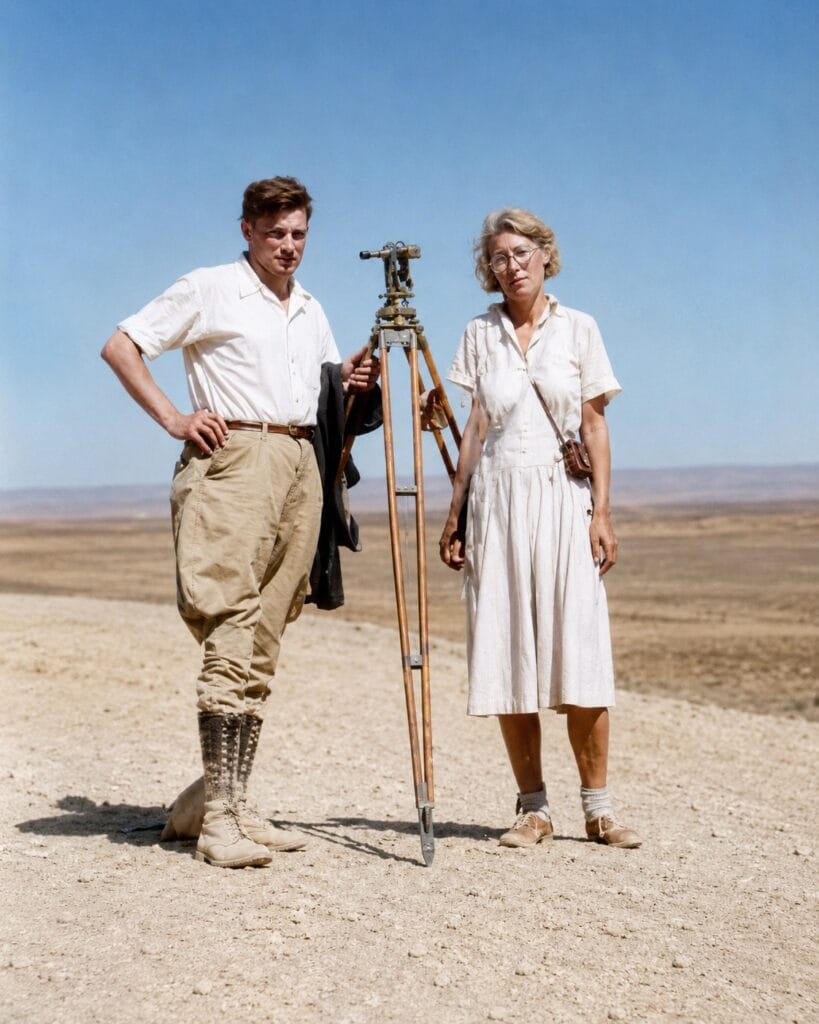
Two people. A surveying tripod. A flat horizon in all directions. Kosok brought the theory. Reiche brought the years.
They did not solve Nazca. They held it open. They were pushing human observation as far as it could go — and that was exactly the right thing to do with the time they had.
What Took Humans a Century, AI Helped Find in Six Months
By the time Masato Sakai, professor of cultural anthropology and Andean archaeology at Yamagata University, began his Nazca research in 2004, confirmed figurative geoglyphs numbered around 430. That represented close to a hundred years of aerial surveys, satellite imaging, field verification, and peer review. Four hundred and thirty. In a century.
In 2024, Sakai’s team — working with IBM Research — published a paper in the Proceedings of the National Academy of Sciences. They trained an AI model on high-resolution drone imagery of the entire Nazca region. The model learned to recognize faint traces associated with geoglyphs. It was also trained on what non-geoglyphs look like. Then the archaeologists went to the field.
In six months, the team confirmed 303 new figurative geoglyphs. According to Yamagata University’s official announcement, the rate of discovery increased sixteenfold compared to conventional survey methods. The total known figurative count rose from roughly 430 to more than 730 in a single field season.
Sakai told reporters in Lima that AI had helped remove one of the core biases in human field research — the tendency to look for large, spectacular figures while missing the smaller, fainter ones. “The use of AI in research has allowed us to map the distribution of geoglyphs in a faster and more precise way,” he said.
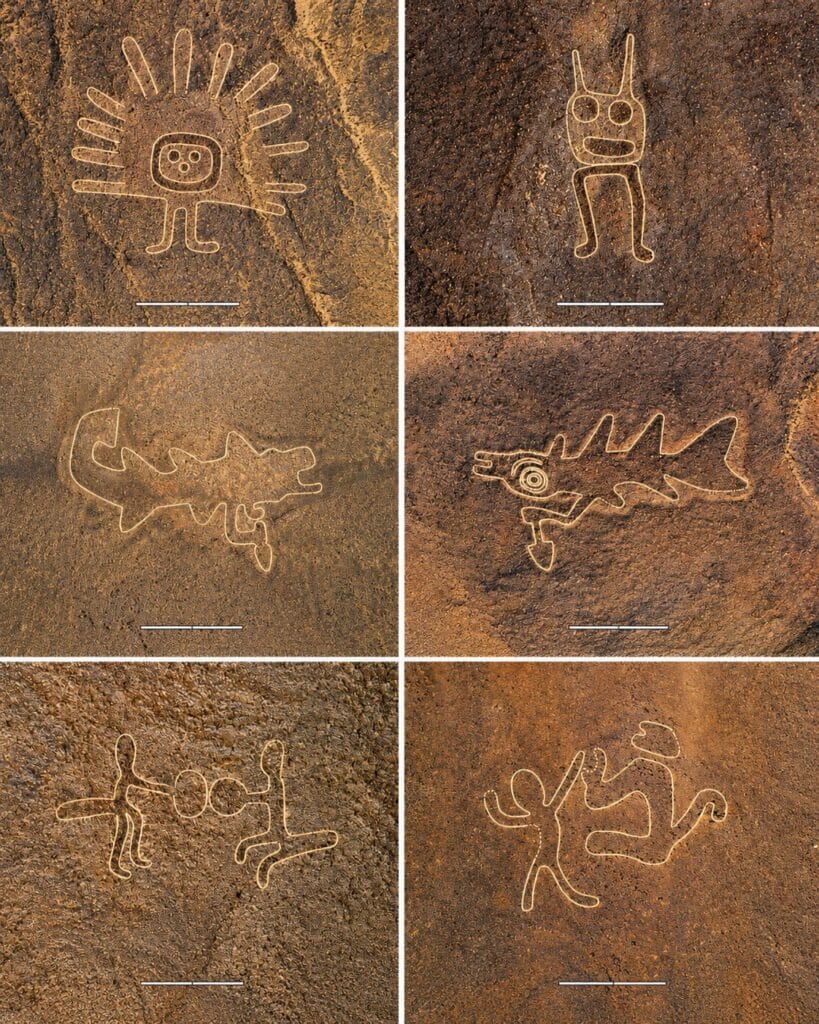
These new geoglyphs don’t look like the famous ones. No massive condor. No wide-winged hummingbird. The newly confirmed figures are mostly relief-type: small images made by arranging stones rather than clearing them.
Many are under ten meters. Some are five. They sit at the edge of ancient footpaths. Made to be seen while walking — not from a plane, not from a satellite, but from the ground by one person moving through the desert.
About 80 percent depict humanoid shapes, decapitated heads, or domesticated animals — particularly llamas — according to the PNAS paper. Perhaps not cosmic symbols. Perhaps not astronomical markers. Or perhaps only part of a much larger story that still has no last page.
Ordinary scenes. People. Animals. Life at ground level. The kind of thing you would draw for someone walking past, not for a god looking down.
Reiche spent fifty years on the same ground where these figures were hiding. She did not find them. But the archive she built became part of what made the AI search possible. One generation holds the question open. The next finds a new way to ask it.
Before You Call This a Solved Mystery, Read This Part First
The 303 new geoglyphs represent new data. They do not represent a conclusion. The AI model flagged approximately 1,309 candidate sites. Field teams confirmed 303. The remaining thousand-plus turned out to be geological features or erosion patterns — roughly a one-in-four confirmation rate.
The technology is a game-changer, but it’s not magic. It still needs human boots on the ground to double-check every single coordinate. The AI sped up the search. It did not replace the interpretation — which is still the hard part, the slow part, the part that does not accelerate.
There are also ongoing threats. The Yamagata University Institute of Nasca has published research on flash flood risk and urban expansion around the modern city of Nazca. Some newly identified geoglyphs are already damaged. The rate of discovery has increased. The rate of protection has not matched it.
What this raises is a question Reiche understood before any algorithm existed. Finding something and saving it are different problems. She solved the second one for fifty years so others could work on the first.
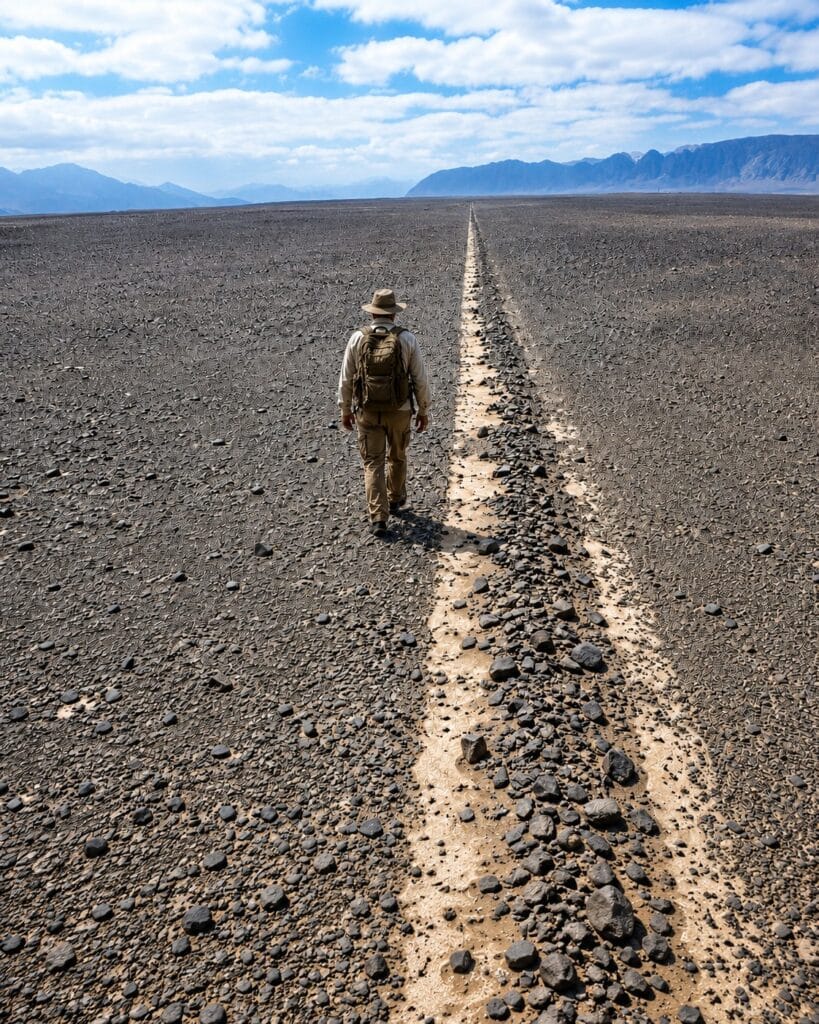
That figure walking away from the camera is not Maria Reiche. It is not Paul Kosok. It is not Masato Sakai.
It is the next person. The line runs ahead of them to the horizon. The desert is still holding whatever it has left to show.
Reiche held the questions open long enough for the AI to arrive. The AI opened more questions than it answered. And the next person will walk out into those questions the same way Reiche did — one step at a time, without knowing where the line ends.
Reiche’s story belongs to a particular kind of history — where one person’s refusal to stop is the only reason the record exists at all. That same refusal runs through the life of a mathematician who calculated the orbits that put men on the moon, working in a room where she was not supposed to matter. And it is the same refusal that kept a band playing on a sinking ship until the water took the instruments.
Archive Notes
What exactly was Paul Kosok’s astronomy theory, and why did it fall apart?
On June 21, 1941 — the southern hemisphere’s winter solstice — Kosok watched the sunset align precisely with one of the Nazca lines and declared the pampa “the largest astronomy book in the world.” Reiche spent decades verifying and extending the theory. Later analysis by archaeoastronomer Anthony Aveni found that the rate of astronomical alignment in the Nazca lines was not statistically significant — no greater than chance would suggest. The theory remains a landmark in the history of the site, but is no longer the primary framework used by researchers.
Where did Maria Reiche live, and what happened to her archive?
Reiche spent her final twenty-five years in room 130 of the Hotel Nazca Lines, where she continued to work and lecture until she could no longer do so. Her research house near the pampa, between Ica and Nasca in the district of San Pablo, has been preserved as the Casa-Museo María Reiche, containing her original tools, maps, and drawings. She died in 1998 and is buried beside her sister in the museum grounds. Her archive continues to inform Nazca research today.
Were the Nazca Lines ever proposed as extraterrestrial landing strips?
Erich von Däniken’s 1968 book Chariots of the Gods popularized the claim that the straight lines served as runways for spacecraft. Archaeologists and geologists have consistently found this interpretation unsupported: the pampa surface is soft and uneven, physically unsuitable as a landing surface, and the construction methods — wooden stakes, cord, basic geometric planning — have been documented at multiple sites by researchers working under Peru’s Ministerio de Cultura. The extraterrestrial hypothesis has no support in the physical or documentary record.
What You Now Know
Maria Reiche did not solve Nazca. She made sure Nazca stayed solvable. The question she kept alive for fifty years outlived her, outlived the theories built around it, and is still outliving every answer anyone has offered.
Maria Reiche is gone. Paul Kosok is gone. One day, Masato Sakai will be gone too.
The lines remain.
Tip For Readers
The full 2024 PNAS paper — Sakai et al., “AI-accelerated Nazca survey nearly doubles the number of known figurative geoglyphs and sheds light on their purpose” — is available through the Proceedings of the National Academy of Sciences. For the historical record, Maria Reiche’s Mystery on the Desert (1949, revised 1968) remains the foundational primary source from the field’s early decades.
Verified Sources
Sakai, M., Sakurai, A., Lu, S., Olano, J., Albrecht, C.M., Hamann, H.F., and Freitag, M. — “AI-accelerated Nazca survey nearly doubles the number of known figurative geoglyphs and sheds light on their purpose,” Proceedings of the National Academy of Sciences (PNAS), Vol. 121, No. 40, 2024
Yamagata University — Official announcement on the AI-assisted Nazca survey, September 24, 2024
UNESCO World Heritage Centre — Lines and Geoglyphs of Nasca and Palpa / Pampas de Jumana
Kosok, Paul — Life, Land and Water in Ancient Peru, 1965
Reiche, Maria — Mystery on the Desert, 1949 / revised edition 1968
Aveni, Anthony F. — Research on astronomical interpretations of the Nazca Lines
Smithsonian Magazine — Maria Reiche and the preservation of the Nazca Lines
National Geographic — Reporting and historical coverage of the Nazca Lines
Images 1, 2, 3, 4, 5, 7, 8, 10: Editorial images prepared by VELLA TEAM for educational and historical commentary.
Image 6: Original editorial map illustration by VELLA TEAM.
Image 9: Editorial illustration referencing findings reported by Sakai et al. (PNAS, 2024) and Yamagata University.