

Everyone assumed they knew what Pluto looked like. Cold. Gray. Beaten. A distant body of rock and ice at the edge of the solar system. When the International Astronomical Union reclassified it in 2006, the world’s attention quickly faded. For nine years, there were no new close observations. Then, in July 2015, a photograph arrived from 3.67 billion miles away — and it looked nothing like what scientists had expected.
The image showed a heart. Not a smudge. Not a vague suggestion. A large, clearly defined heart-shaped formation sitting at the center of a world that was supposed to be dead. The internet reacted quickly, as it often does when something unexpected appears — with jokes first, then emotion, then something closer to awe. But the scientists looking at the same photograph were asking an entirely different set of questions. The scientific reality behind the image is far more complex than the viral stories suggest.
On July 14, 2015, NASA’s New Horizons spacecraft completed a nine-and-a-half-year journey across the solar system and transmitted the first high-resolution images of Pluto’s surface. Among those images was a bright, nitrogen-ice-covered basin spanning roughly 1,000 kilometers across — formally designated Tombaugh Regio, informally called the Heart. What it actually represents is still being debated by planetary scientists today.

Enhanced-color image of Pluto captured by NASA’s New Horizons spacecraft, showing Tombaugh Regio — the bright, heart-shaped region on Pluto’s surface. The left side of the heart, known as Sputnik Planitia, is a large basin dominated by nitrogen ice, while the darker surrounding terrain contains complex organic materials called tholins. The contrast between these regions reflects differences in surface composition and geological history.
The Planet That Was Already Gone Before Anyone Said Goodbye
Pluto was discovered on February 18, 1930, by Clyde Tombaugh at Lowell Observatory in Flagstaff, Arizona. For seventy-six years it held the title of the solar system’s ninth planet. Then, on August 24, 2006, the International Astronomical Union voted to reclassify it as a “dwarf planet,” creating a new category that excluded any body unable to gravitationally dominate its orbital neighborhood. Surrounded by thousands of other icy objects in the Kuiper Belt, Pluto simply didn’t meet the new criteria.
The public reaction was unexpectedly emotional for a scientific reclassification. Children who had memorized nine planets suddenly had eight. The emotional attachment was real, and it set the stage for what happened when New Horizons arrived nine years later. The world was primed to project feelings onto whatever it found.
The heart shape appeared in the first approach images and spread across the internet within hours. But before examining what the internet made of it, consider what was actually transmitted: a spacecraft the size of a grand piano, traveling at 31,000 miles per hour, had just sent proof that Pluto was far more complex than scientists had previously thought. That gap — between the image arriving and the science being understood — allowed various rumors to take root.
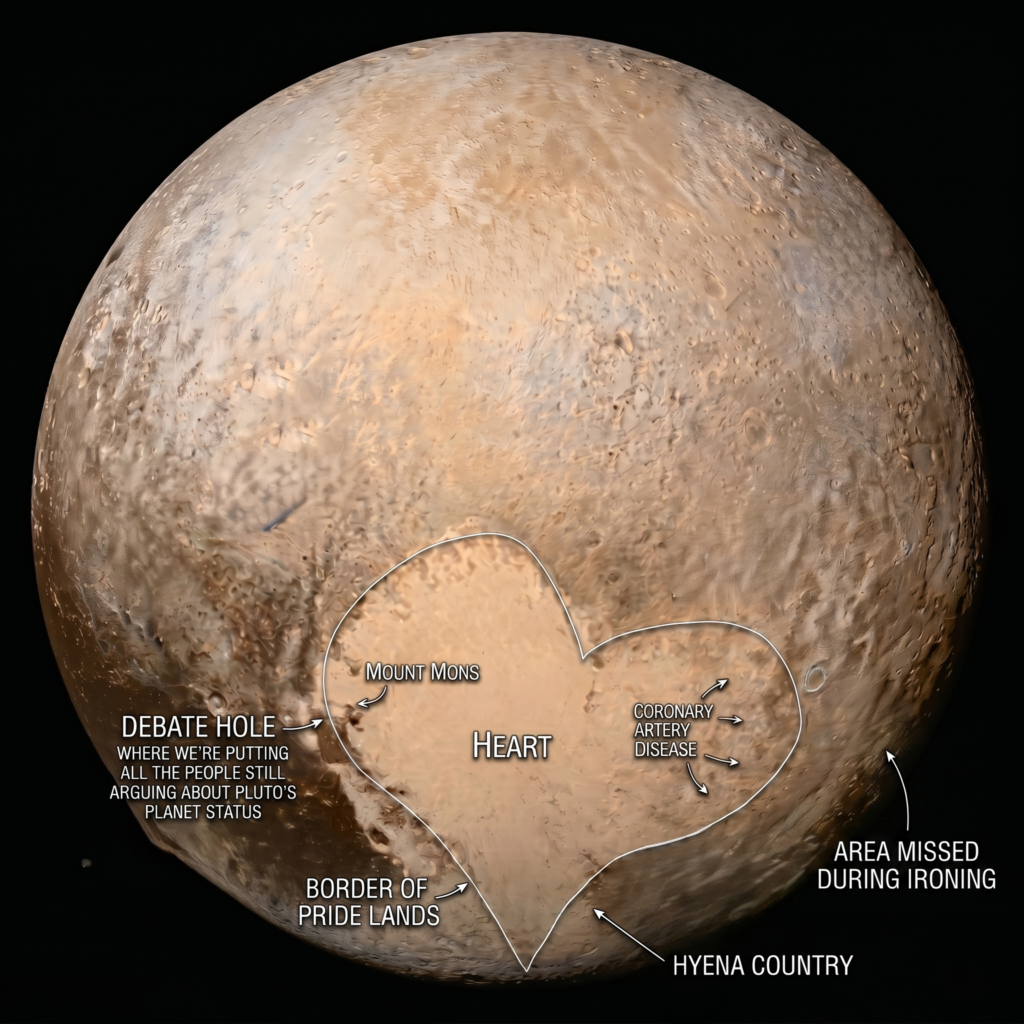
Widely shared internet edit of a New Horizons image of Pluto, highlighting the heart-shaped Tombaugh Regio with humorous and satirical labels. These annotations are not part of the original scientific data and were added for entertainment purposes.
What the Internet Decided It Meant
The story that spread first was sentimental. Pluto — demoted, humiliated, forgotten — had sent a love letter back to the civilization that rejected it. A small world, cast out of the planetary family, still carrying a heart for the species that named it. Social media filled with captions that anthropomorphized Pluto as a wounded but forgiving creature. This narrative resonated so deeply that it spread much faster than the actual scientific data.
A second wave built on the first, this time with humor. Someone with a sense of cartographic irony labeled the heart’s internal geography with names that had nothing to do with science. The left lobe became the “Debate Hole — where we’re putting all the people still arguing about Pluto’s planet status.” A ridge became “Mount Mons.” A darker region was labeled “Coronary Artery Disease.” The smooth lower basin, pressed against the rougher terrain surrounding it, was annotated as “Area Missed During Ironing.” A southern zone became “Hyena Country,” a reference to the Lion King geography of the Pride Lands. The image circulated as widely as the original photograph, perhaps more so.
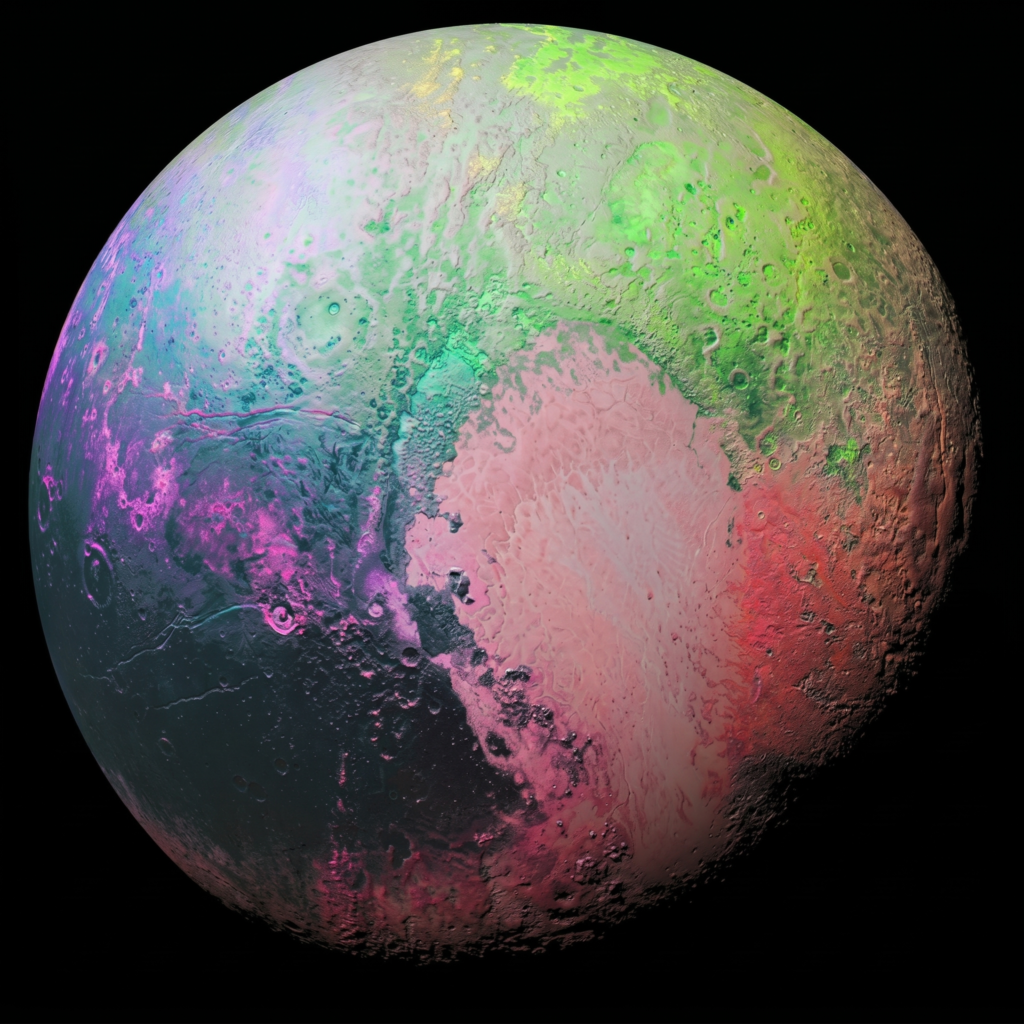
Edited false-color view of Pluto based on New Horizons data, highlighting the heart-shaped Tombaugh Regio. The labels and outlined regions are part of a widely circulated internet edit and are not part of the original scientific image.
A third rumor moved in a different direction. NASA’s enhanced-color images — processed to amplify compositional differences — made Pluto look alien enough that some observers concluded the heart could not be natural. The symmetry was too clean. A marker left by unknown intelligence, they said. These theories gained traction because they are difficult for the average observer to verify or debunk.
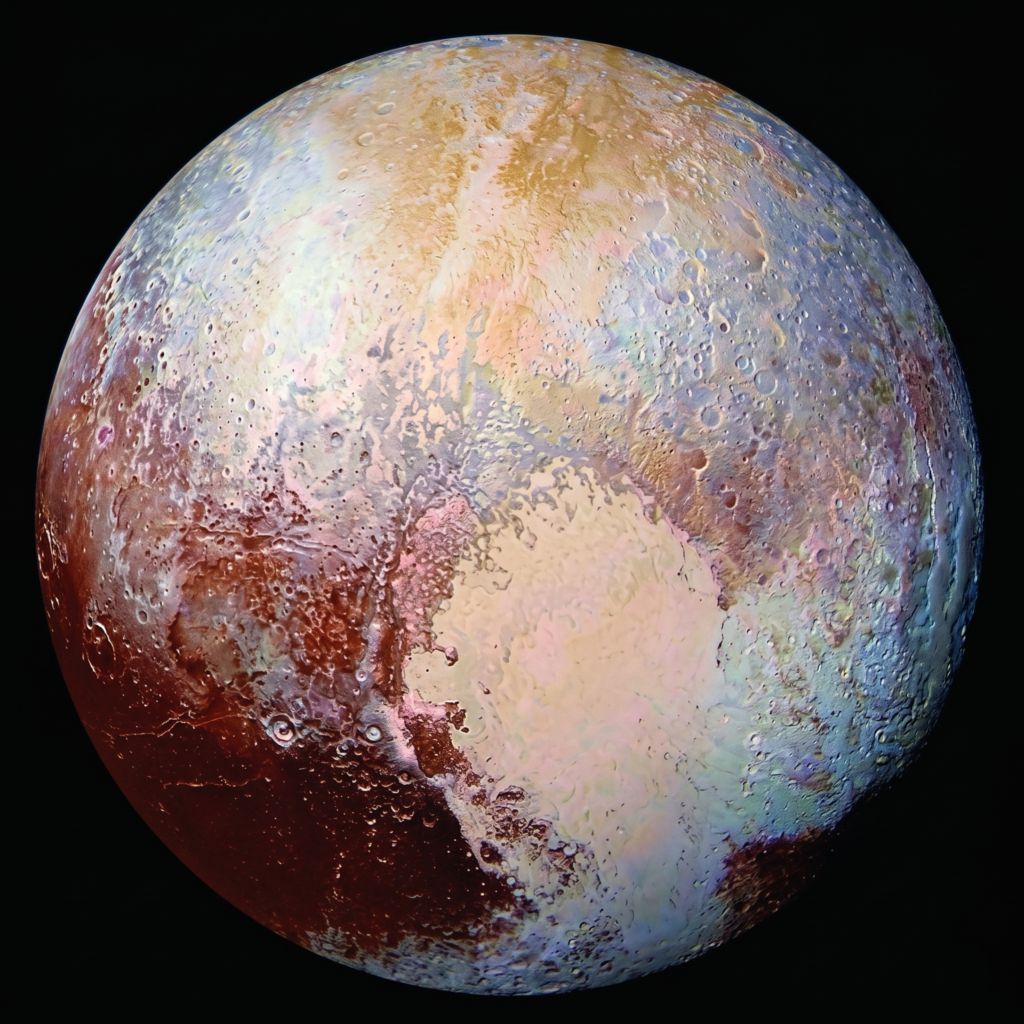
False-color view of Pluto from NASA’s New Horizons spacecraft, combining visible and infrared data from the Ralph/MVIC instrument. The bright, heart-shaped Tombaugh Regio at center is dominated by nitrogen ice, while darker surrounding regions contain complex organic materials (tholins). The enhanced colors are used to highlight differences in surface composition and geology.
The Heart Is Not a Symbol. It Is a Scar.
The scientific name for the heart’s left lobe is Sputnik Planitia. It is an impact basin. Research published in Nature in 2016 proposes that Sputnik Planitia formed when a body roughly 200 kilometers in diameter struck Pluto approximately four billion years ago, excavating a depression 900 kilometers wide and three to four kilometers deep. What filled the basin afterward is the most significant aspect of its formation.
Nitrogen, carbon monoxide, and methane ices migrated into the basin over geological time. Lower elevations on Pluto are slightly warmer, causing volatile ices to sublimate from surrounding heights and condense into the depression. The ice that accumulates reflects sunlight, keeping temperatures low enough to retain more ice — a self-reinforcing trap that has been filling itself for billions of years.
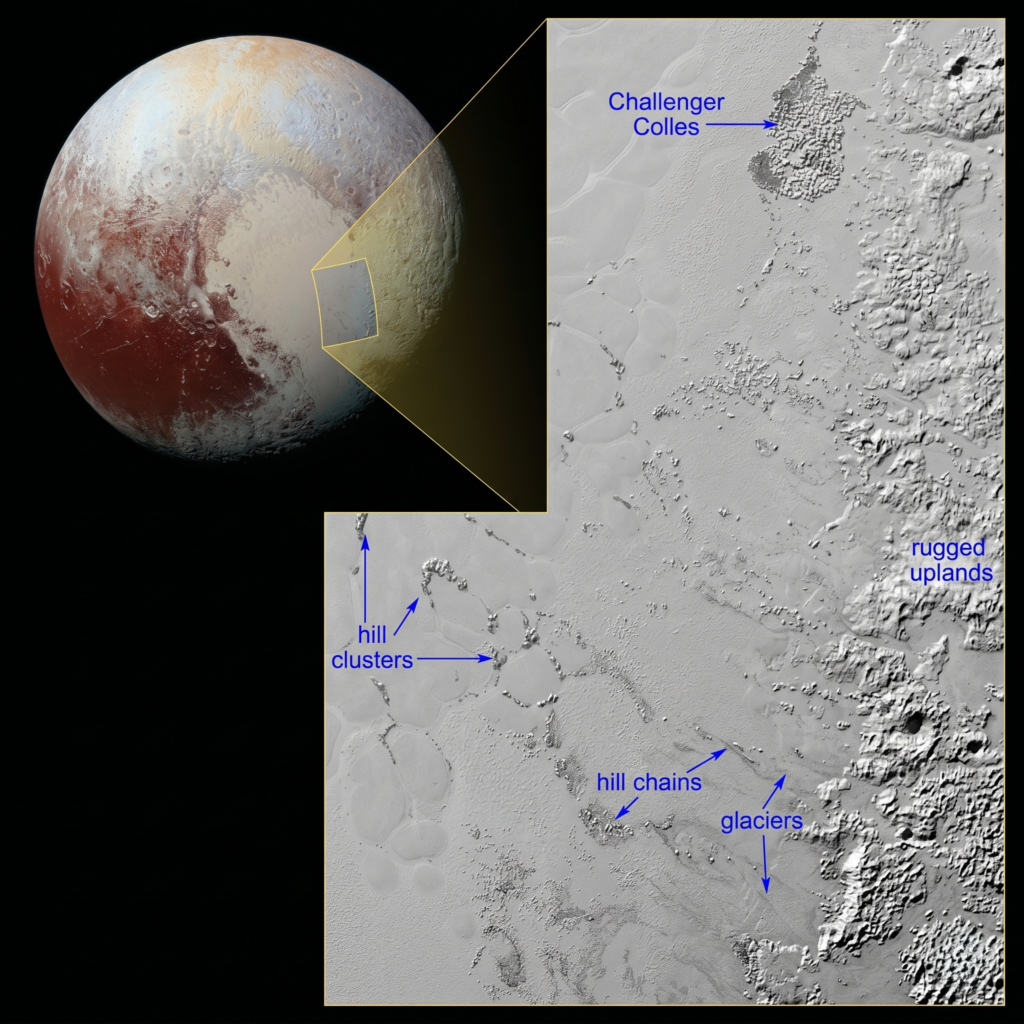
Pluto’s Tombaugh Regio with an inset zoom of Sputnik Planitia from NASA’s New Horizons mission. The annotated image highlights features such as hill clusters, hill chains, rugged uplands, and Challenger Colles. These features are composed of water-ice blocks within a nitrogen-ice plain.
The surface of Sputnik Planitia is geologically young — fewer than 10 million years old by crater count estimates, which on a 4.5-billion-year-old body is essentially brand new. The reason is convection. Nitrogen ice is heated from below — by residual internal heat, radiogenic decay, or possibly a subsurface ocean — and rises to the surface in slow churning cells roughly 20 to 40 kilometers across. Each cell spreads outward, cools, and sinks again at the cell boundaries, which appear as faint ridge lines in high-resolution imaging. The surface turns over. This is what ongoing geological activity looks like at the edge of the solar system.
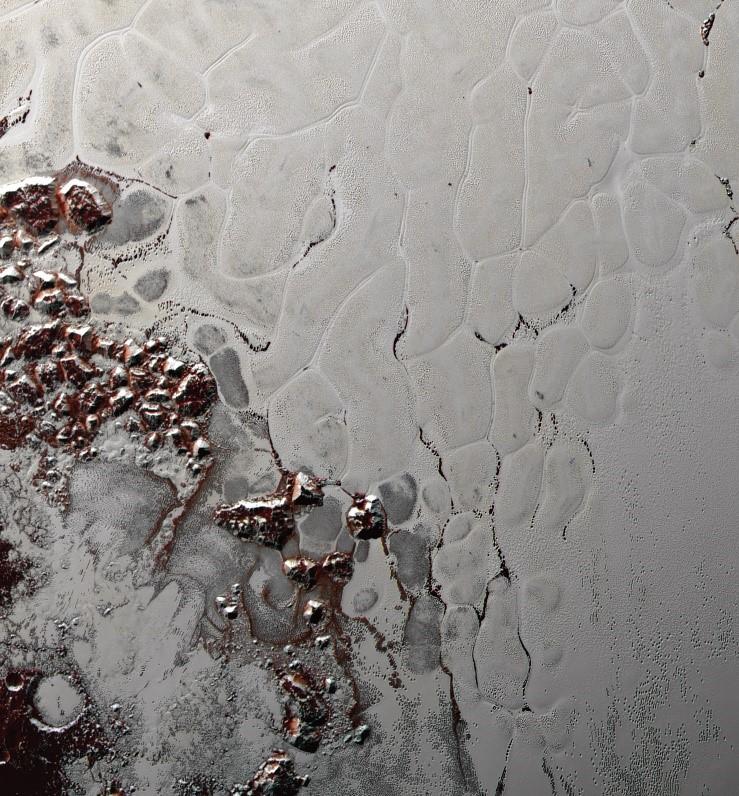
Close-up view of Sputnik Planitia on Pluto, captured by NASA’s New Horizons spacecraft. The image shows polygonal patterns on the nitrogen-ice surface and a boundary with darker, rugged water-ice terrain at left.
The Shape of the Heart Is Not an Accident — But Not for the Reason Anyone Thought
This is where the science becomes more complex. Sputnik Planitia is not centered randomly on Pluto’s surface. It sits almost exactly opposite Charon — Pluto’s largest moon — in the tidal lock position. Charon and Pluto are mutually tidally locked: both worlds keep the same face toward each other at all times, the way Earth’s moon keeps its near side perpetually facing us. The tidal bulge raised by Charon on Pluto points directly toward Charon. Sputnik Planitia is located almost precisely at the antipodal point — the spot farthest from Charon.
This alignment is statistically improbable enough that planetary scientists have proposed a specific mechanism. When the ancient impact basin filled with nitrogen ice, that accumulated mass gradually affected Pluto’s rotational dynamics. On a tidally locked body, a significant mass concentration migrates over geological time until it reaches the tidal axis or its antipode. This massive accumulation of ice likely caused the dwarf planet to shift its orientation over geological time. Not as a message. As mechanics.
What this reveals is how limited pre-flyby models were. Few models anticipated convective ice cells or this level of surface complexity. The possibility that Pluto’s own geology could have influenced its orientation was also not widely considered. These differences became clear only after direct observations from New Horizons.
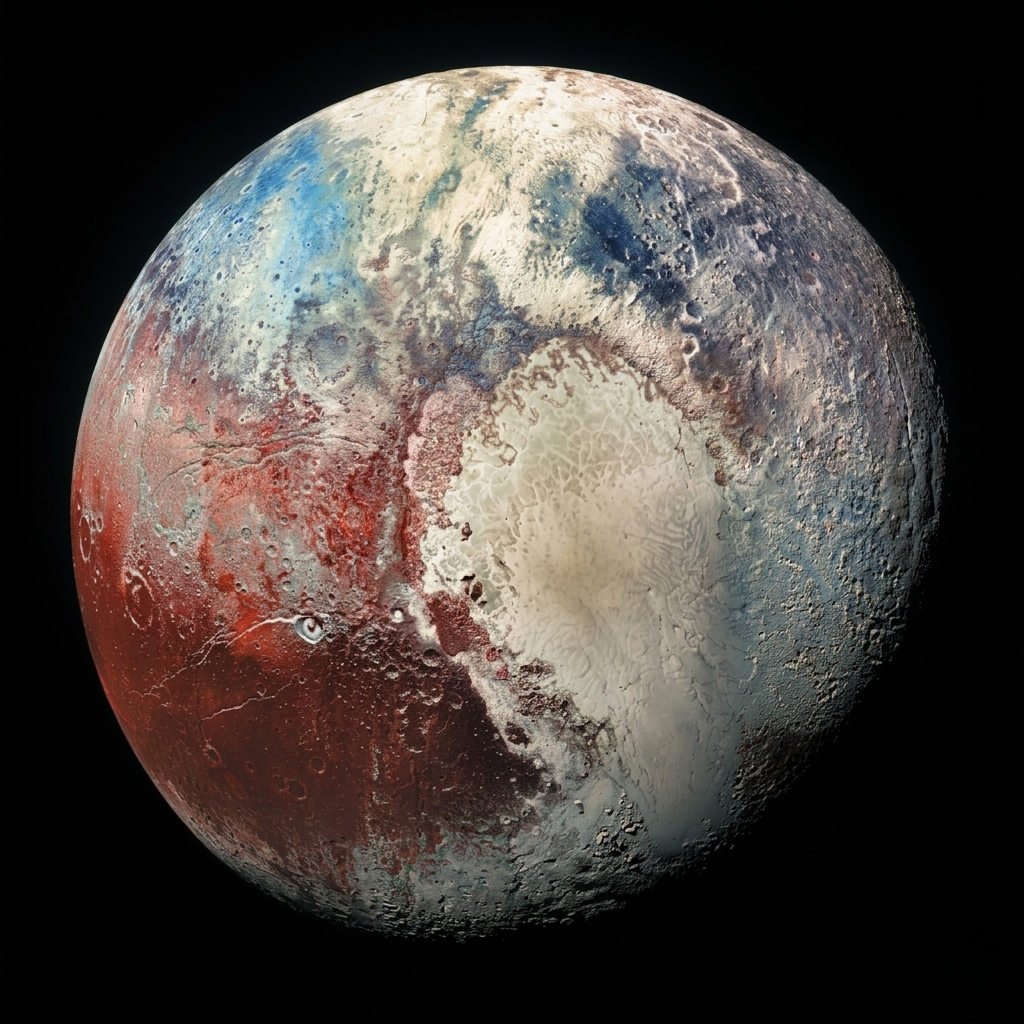
Enhanced-color global view of Pluto from NASA’s New Horizons spacecraft. The bright, heart-shaped Tombaugh Regio is dominated by nitrogen ice, while darker surrounding regions contain complex organic materials.
The Case Against Taking the Heart at Face Value
The subsurface ocean hypothesis requires careful handling. The evidence is indirect: fracture patterns consistent with volume change, the gravitational anomaly of Sputnik Planitia’s position, and thermal modeling showing a liquid layer is plausible. But New Horizons was a flyby mission. No seismometer. No drill. The data exists; the confirmation does not.
The love-letter narrative relies on a simplified view of Pluto. The actual science still involves uncertainty. Pluto might have a subsurface ocean. It might not. The heart might have reoriented the planet, or the convection might be driven by residual heat alone. These are not settled questions; treating the heart as a mere symbol overlooks the ongoing scientific debate.
The risk is not just intellectual — it changes how people understand reality. Emotionally compelling narratives crowd out uncertainty. The story of Pluto’s love letter felt complete in 2015. It was not complete. It is still not complete.
Frequently Asked Questions
Q. What exactly is Tombaugh Regio, and why does it look like a heart?
A. Tombaugh Regio is a large bright region on Pluto’s surface named after Clyde Tombaugh, the astronomer who discovered Pluto in 1930. The heart shape results from the combination of two distinct features: Sputnik Planitia, a nitrogen-ice-filled impact basin forming the left lobe, and a separate highland region forming the right. The left lobe’s exceptional brightness comes from its continuously refreshed nitrogen ice surface, which reflects far more sunlight than the surrounding tholin-darkened terrain. The shape is a coincidence of geology and viewing angle, not a designed feature.
Q. Is there really a possibility of liquid water beneath Pluto’s surface?
A. Research published in Nature in 2016 and subsequent studies have proposed that a subsurface liquid water ocean may exist beneath Pluto’s water-ice crust, maintained by radiogenic heat from the rocky core. The evidence is indirect: surface fracture patterns consistent with volume changes, the gravitational anomaly of Sputnik Planitia’s position, and thermal modeling showing that a liquid layer is plausible over geological timescales. However, New Horizons carried no instruments capable of directly detecting a subsurface ocean, so the hypothesis remains scientifically compelling but unconfirmed as of 2026.
Q. Could New Horizons have photographed more of Pluto’s surface if it had slowed down?
A. Slowing New Horizons to enter Pluto orbit would have required carrying hundreds of times more fuel than the mission’s weight budget allowed, making an orbiter mission with 1990s–2000s propulsion technology effectively impossible. The flyby design was a deliberate tradeoff: sacrifice orbital science for the ability to actually reach Pluto within a human-relevant timeframe. A dedicated Pluto orbiter mission remains under study at NASA’s Planetary Science Division, but no mission has been formally approved as of 2026.
What You Now Know
The heart-shaped region on Pluto is not symbolic, but geological. It records an ancient impact basin, billions of years of ice accumulation, and ongoing convective processes within nitrogen ice. It may also be linked to a subsurface ocean hypothesis that has not been directly confirmed. Rather than a visual coincidence, this structure reflects how Pluto’s surface and interior have evolved over time, including the possibility that the redistribution of mass influenced the planet’s orientation. These features reveal a complex and dynamic world, far beyond what early interpretations suggested.
Tip For Readers
NASA’s full archive of New Horizons images, including raw and processed data from the Pluto flyby, is publicly available through the NASA/JPL Photojournal and the New Horizons mission page. The Southwest Research Institute also maintains a dedicated science archive where peer-reviewed results from the flyby data continue to be published.
Verified Sources
Image Sources:
NASA / Johns Hopkins University Applied Physics Laboratory / Southwest Research Institute — New Horizons Pluto Image Archive (2015)
NASA Planetary Data System (PDS) — New Horizons Ralph/MVIC Data Sets
NASA Image and Video Library — Pluto Global and Surface Imagery
NASA New Horizons Science Team / Johns Hopkins University Applied Physics Laboratory — New Horizons Pluto Flyby Results and Initial Data Release, 2015
University of California Santa Cruz, Earth and Planetary Sciences — Reorientation of Sputnik Planitia Implies a Subsurface Ocean on Pluto, Nature, 2016
NASA Planetary Science Division — New Horizons Mission Overview and Science Objectives, 2015
Southwest Research Institute, New Horizons Principal Investigator Office — Geology and Geophysics Investigation Results: Pluto System, 2016
University of Arizona, Lunar and Planetary Laboratory — Thermal and Compositional Constraints on the Interior Structure of Pluto, Nature Astronomy, 2017