
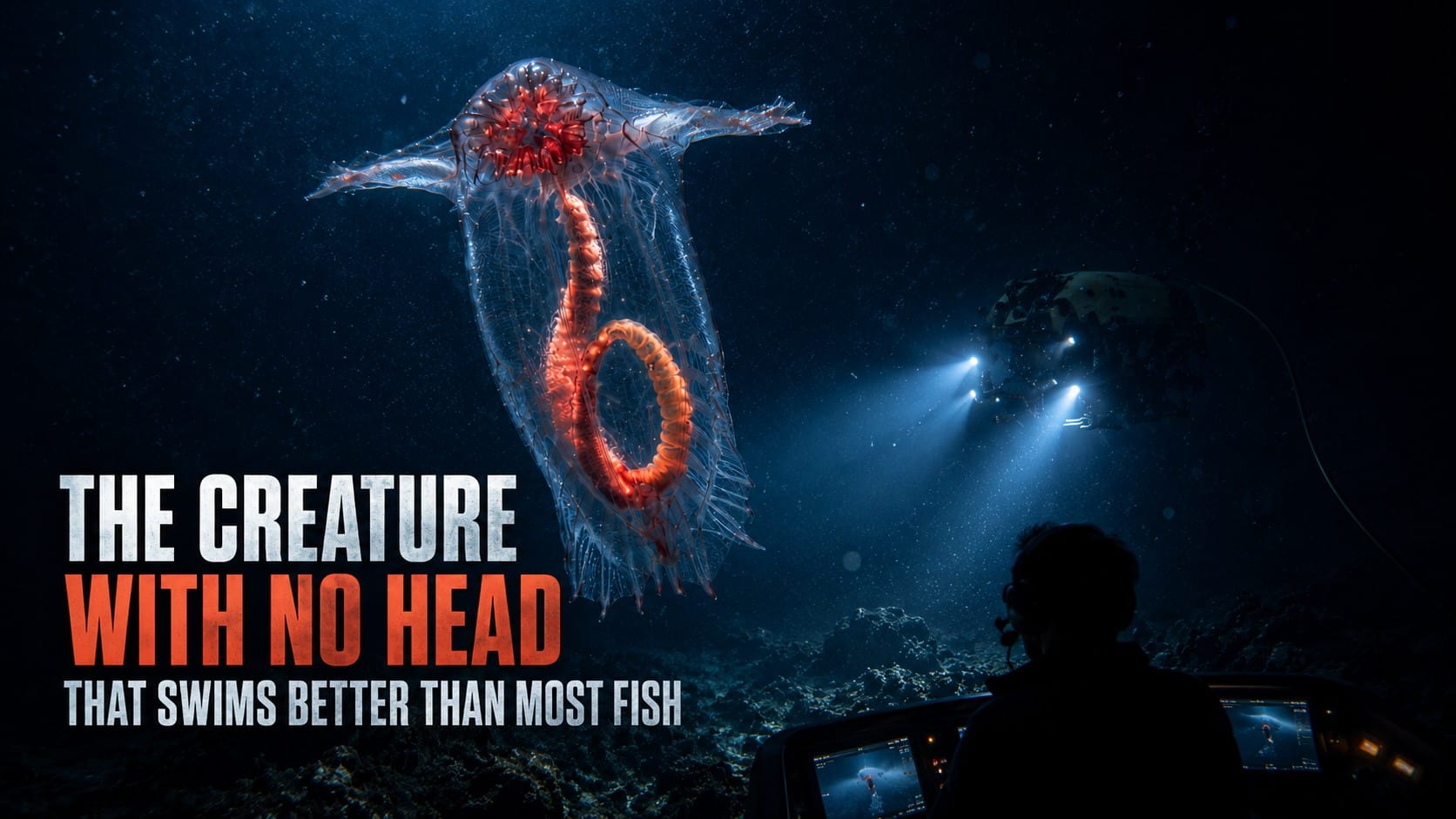
You think you know what a sea cucumber is. A creature that slowly drags itself along the ocean floor, appearing passive and barely alive. This animal behaves in a way that contradicts those assumptions.
When ROV pilots first encountered it in the deep sea, they didn’t reach for a field guide. They reached for a nickname. The body looked like a plucked chicken — headless, wet, and strangely unsettling. They nicknamed it the Headless Chicken Monster, a name that became more widely known than its scientific designation.
The scientific name is Enypniastes eximia. It is a sea cucumber — a member of the same echinoderm family as starfish and sea urchins. NOAA Ocean Exploration documented it during the 2017 Gulf of Mexico expedition, when ROV Deep Discoverer approached and the animal responded not by hiding, but by lifting off the seafloor and swimming.
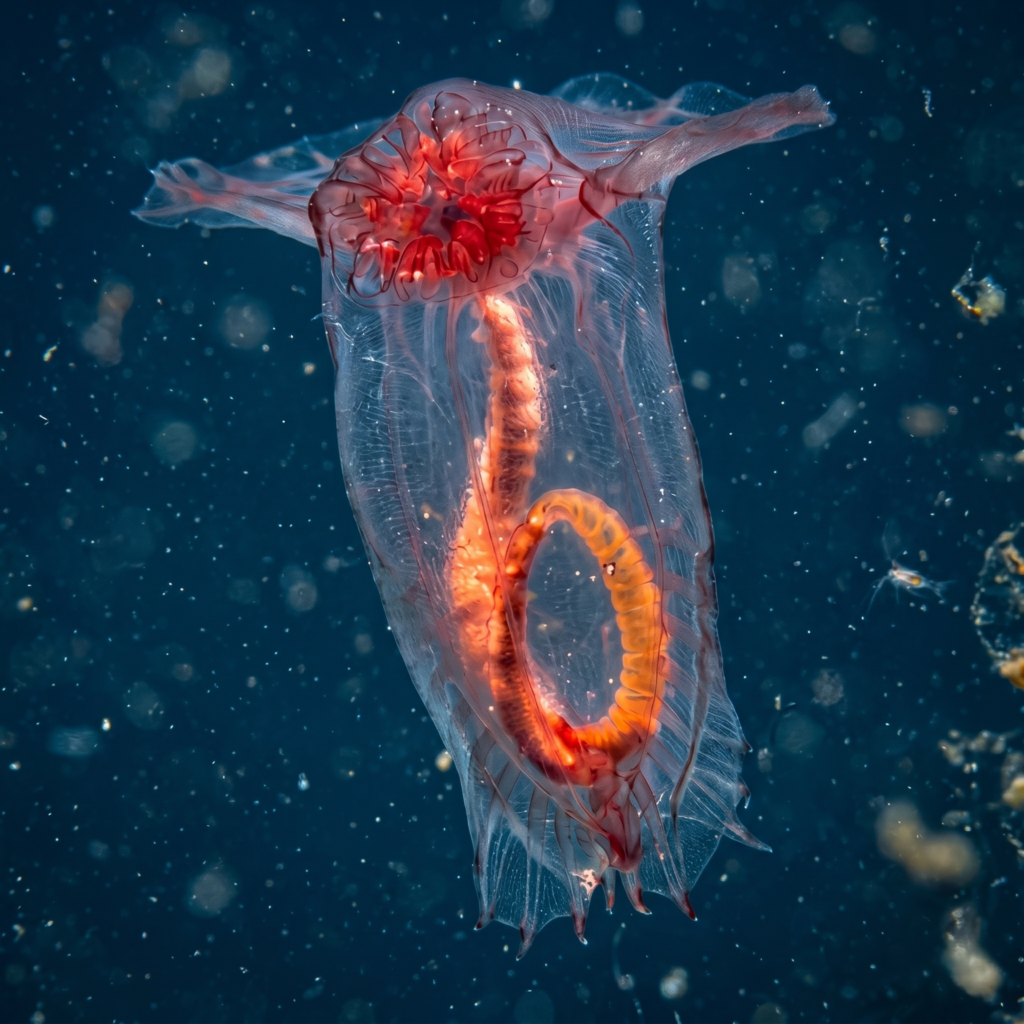
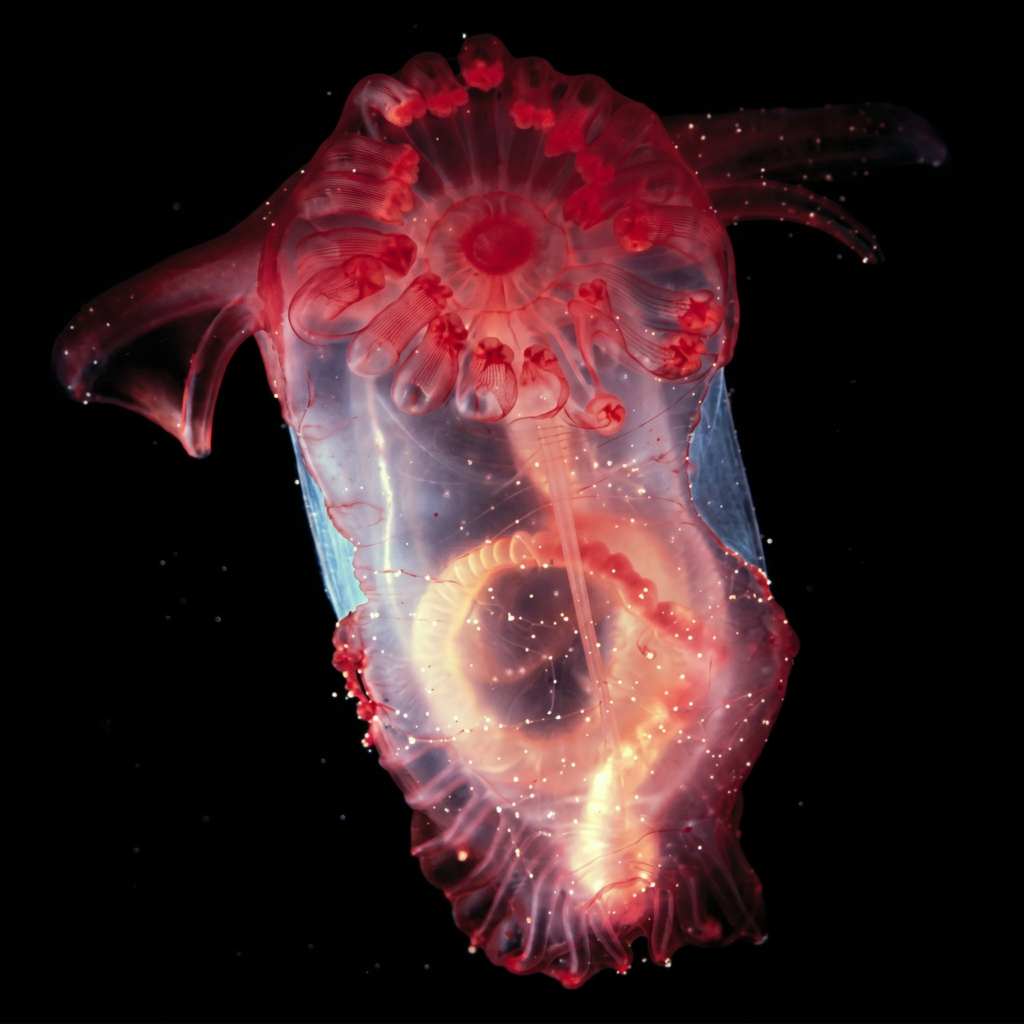
Enypniastes eximia in open water, body fully translucent — the red feeding tentacle cluster at top, the coiled orange digestive loop, and the vascular network running through clear skin are all visible without any dissection. This is what the ROV pilots actually saw when they invented the nickname.
A Sea Cucumber That Chose to Swim
While most echinoderms — sea urchins, starfish, brittle stars — stay on the bottom, scraping rock or inching across sand, even other sea cucumbers, when threatened, can only drift briefly before settling back down. Enypniastes eximia made a different evolutionary choice. Swimming is not just an escape response — it is a regular behavior. NOAA researchers describe it as spending significant portions of its life in the water column rather than on the seafloor, using rhythmic muscular contractions of its body wall flaps to generate forward thrust.
Think of those flaps as the difference between a rowboat and a manta ray. Most sea cucumbers move like the rowboat — dragging, deliberate, dependent on contact with something solid. Enypniastes moves more like a ray, undulating through the water by using its entire body for movement. There is no rigid skeleton. No fin bones. Just muscle coordinated through a nervous system that has no centralized brain. The entire body functions as its primary means of locomotion.
What this really reveals is a survival strategy built entirely on contrast. The seafloor is predictable, and predictable means detectable. Moving into open water, where predators have fewer reference points, may reduce the risk of being found. This is not random. It appears to follow a consistent pattern — even without a centralized brain.
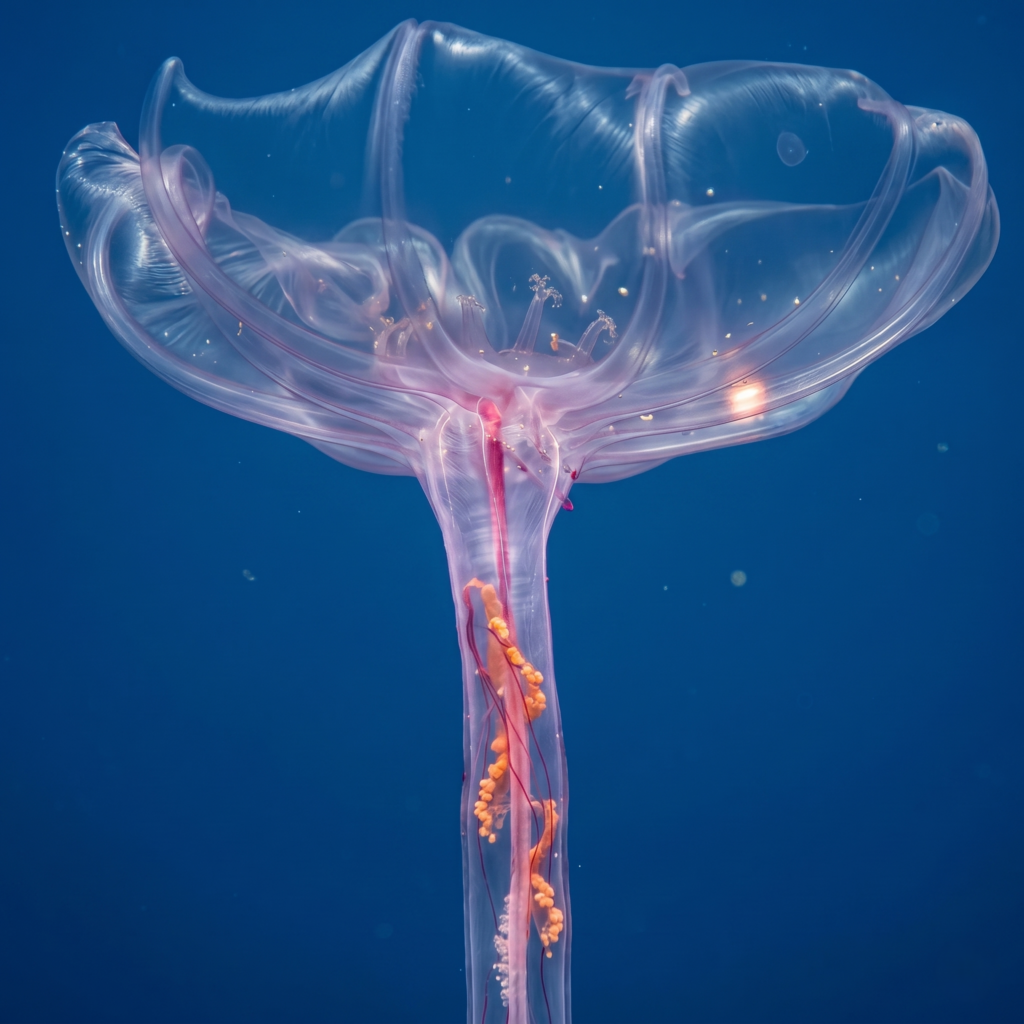
Umbrella-like full extension with lateral flaps clearly spread wide — the translucent canopy reveals the pink internal column and orange organ clusters beneath, captured from directly below the swimming animal.
The Body That Shows Everything and Explains Nothing
There is something unsettling about an animal you can see through. Enypniastes eximia has semi-transparent skin, which means that when the ROV lights hit it at the right angle, the entire internal anatomy becomes visible without dissection. The circular digestive tract. The feeding tentacles folded near what would be called a mouth. The vascular structures running in red lines through clear tissue.
For the ROV pilots, this transparency produced the wrong kind of recognition. It looked less like a living animal and more like something removed from one. That is where the nickname came from — not from the animal’s behavior, but from the way it looked under artificial light at 2,500 meters. It appeared as a headless creature floating in the deep sea, where few animals venture.
The same transparency that made it look disturbing is almost certainly functional. In a lightless environment, bioluminescence is the primary visual threat. An animal that reflects or redirects light rather than absorbing it may be harder to track in the dark. The transparency is unlikely to be accidental. It is likely an evolutionary adaptation developed over millions of years.
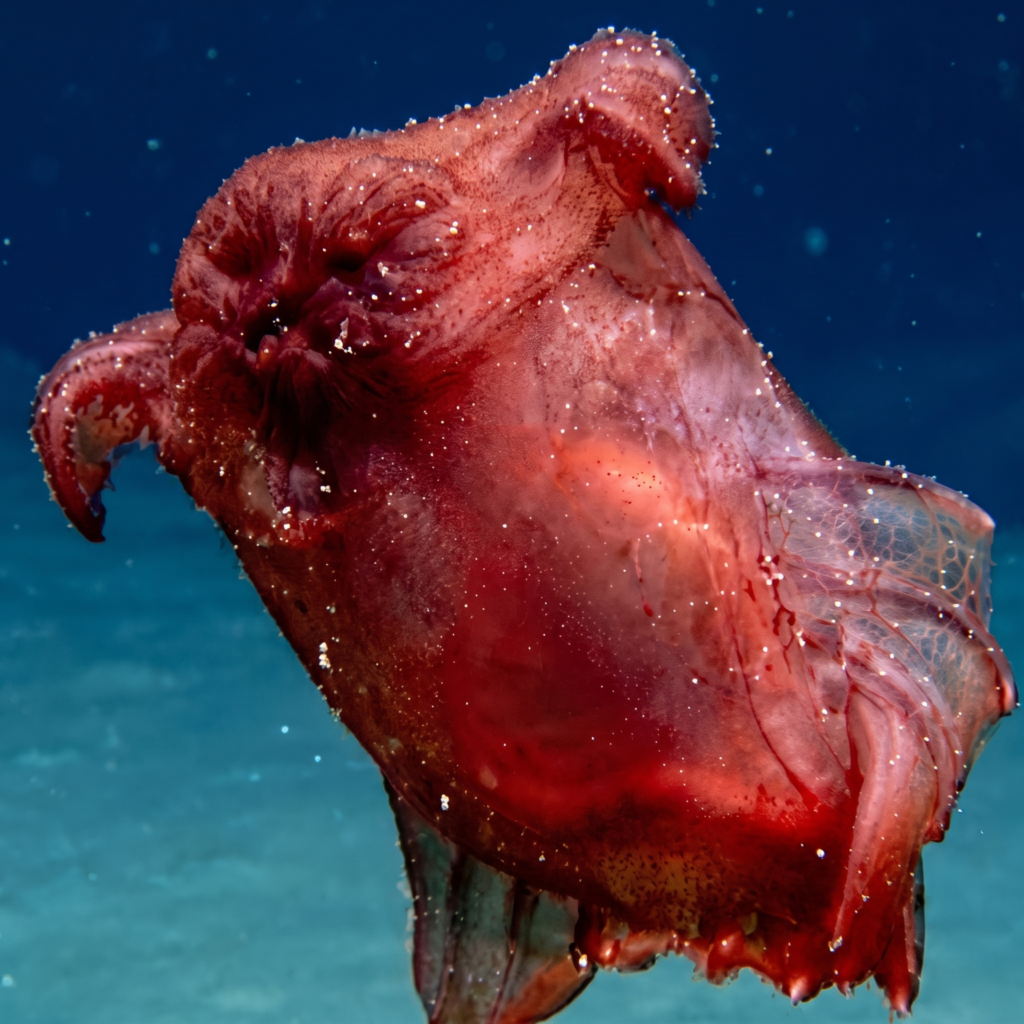
A collapsed, folded body with the texture of plucked tissue — dark red, opaque, with curled appendages and no visible head region. This is the image that earned the nickname. It does not look like an animal. It looks like something taken apart.
What It Actually Eats, and How
For all the drama of its swimming, Enypniastes eximia is not a predator. It eats marine snow — the slow, continuous fall of organic particles from the surface layers of the ocean. Dead algae. Fecal pellets. Decomposing fragments of organisms from hundreds of meters above. In the deep sea, this material is the base of almost everything. It is the only energy source arriving from outside, and it lands on the seafloor in a thin, diffuse layer that requires patience and surface contact to harvest.
When it feeds, the animal descends. The flaps retract. The body flattens. The feeding tentacles — arranged in a ring around the oral opening — extend and sweep the sediment, collecting marine snow along with the thin bacterial film that coats every grain of deep-sea substrate. Then it rises again. The cycle between swimming and feeding is not random; it may correspond to periods when surface productivity is higher and more material is falling, though the precise triggers are still being studied by NOAA-affiliated researchers.
This raises an important question: an animal with no brain, no eyes, and no centralized nervous system is nonetheless timing its vertical movements against the productivity of ocean layers it cannot see, sense by any obvious mechanism, or reach. Whatever internal signal drives that behavior, it works well enough to have survived across millions of years of ocean change.
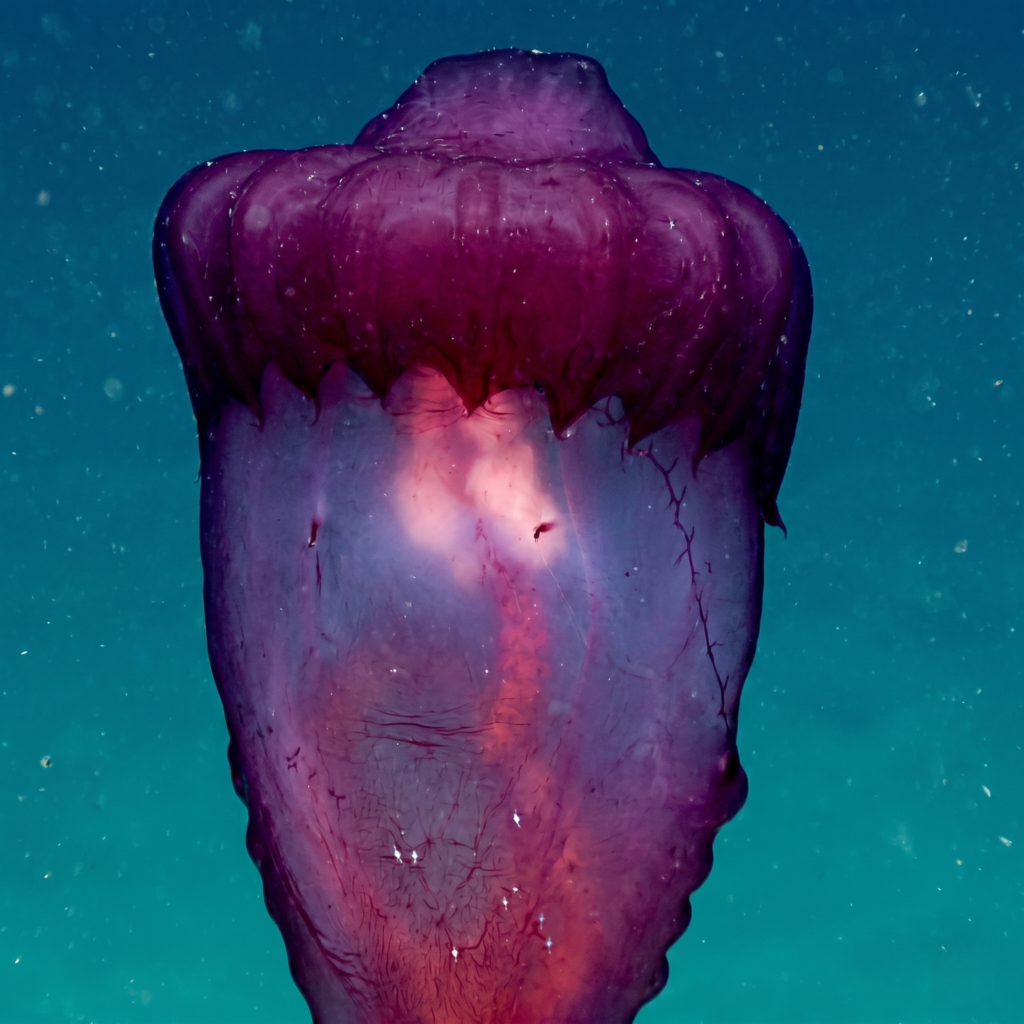
A purple-pigmented specimen in contracted swimming posture against a teal background — the body is compact, opaque, and almost architectural in shape, showing none of the transparency of the previous images. Individual color variation within Enypniastes eximia ranges from near-transparent to deep violet.
Why the Name “Headless Chicken Monster” Is More Accurate Than It Sounds
The nickname is a joke, but it is a precise one. The animal genuinely lacks what most people mean when they say “head.” There is no distinct cephalic structure — no defined anterior region containing a brain, sensory organs, or facial features. The feeding end and the trailing end are differentiated, but not in any way that registers as a face. The ROV pilots were not wrong about what they saw. They were just missing the context that would have made it less alarming.
Enypniastes eximia also goes by a second nickname that says something different about the same animal: the Spanish dancer. That name comes from the movement — the slow, rhythmic, almost theatrical undulation of the body wall during swimming, which looks less like escape behavior and more like performance. Both names are accurate. The same animal that looks like discarded poultry from one angle looks like choreography from another.
It also has a cousin worth mentioning. The species belongs to the class Holothuroidea — the sea cucumbers — which sits within the phylum Echinodermata alongside sea urchins, brittle stars, and the common starfish recognizable in every tide pool. The Headless Chicken Monster and the starfish your child picks up on a California beach share a body plan ancestor. Evolution separated them into forms that now look completely different.
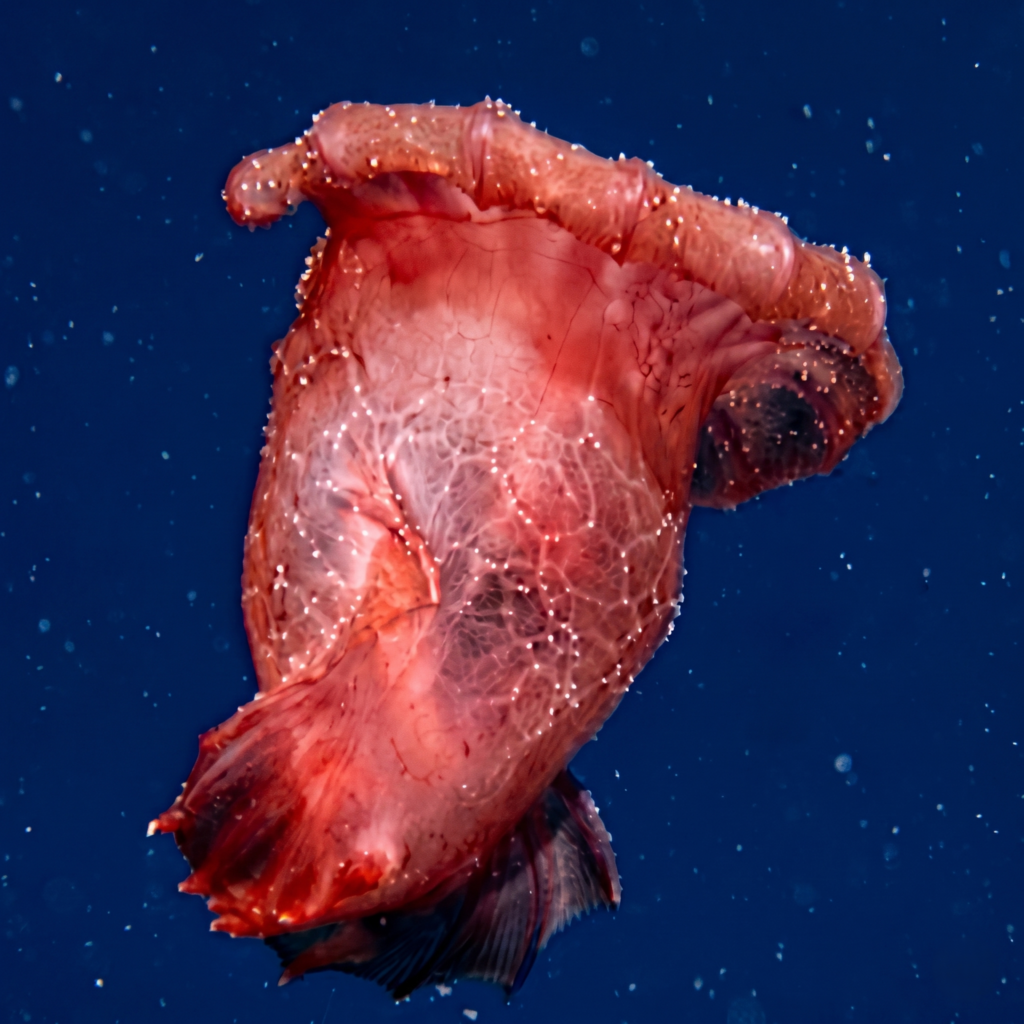
The most poultry-like morphology in this series — irregular surface covered in white papillae, curved upper appendages, and a trailing lower section that resembles a carcass more than a living animal. The white speckled texture across the body is the papillae that cover the skin surface.
No Eyes. No Brain. Still Moving.
It swims. Without eyes to navigate by.
It changes direction — without a brain to process decisions.
It leaves the seafloor, rises through the water column, and returns to feed. Without any centralized nervous system that science has identified as capable of that kind of behavioral sequencing.
Enypniastes eximia has a diffuse nerve net — the same basic neural architecture found in sea stars and sea urchins. There is no brain. No spinal cord. No identified structure analogous to what vertebrates use for spatial orientation or directional decision-making. And yet the animal executes a vertical migration pattern that implies some form of timing, some sensitivity to environmental gradient, some mechanism for distinguishing up from down and floor from water column.
This raises a question that current research has not resolved: what exactly is doing the navigating? The honest answer, according to the available literature, is that we do not fully know.
Two Names, One Animal, Zero Consensus on What to Call It
The scientific community settled on Enypniastes eximia. The ROV community settled on the Headless Chicken Monster. Neither name captures what the animal actually does — moving through the deep ocean with a level of efficiency comparable to some fish. The “Spanish dancer” nickname, given by researchers who watched the swimming motion rather than the resting form, may be the most honest of the three. There is something rhythmic about it. Deliberate and unhurried. The animal shows no clear response to the presence of observers.
That ease — behavioral or otherwise — may reflect the reality that Enypniastes eximia has very few known predators at the depths it inhabits. Deep-sea predation data is sparse, and the animal’s primary response when approached by an ROV is to swim away at a pace that exceeds what most benthic organisms can manage. Whether it is actually fast enough to escape biological predators, rather than just slow robots, remains an open question that the available footage cannot answer.
Against a black background, the full internal anatomy is visible at its clearest — the circular digestive loop glowing orange-red at center, the crown of feeding tentacles at top, and the lateral wing extensions mid-body, all seen through skin that is effectively transparent under direct light.
The Limits of What We Actually Know
NOAA footage from the 2017 Gulf of Mexico expedition remains among the clearest documentation of this species in open water. But “clearest documentation” in deep-sea biology is a low bar. ROV surveys cover limited areas in limited time windows. The animal has been observed across multiple ocean basins — Atlantic, Pacific, Southern Ocean — but population size, lifespan, reproductive behavior, and the full range of depth tolerance are still described in approximations.
The transparency hypothesis — that clear skin offers some predator-avoidance advantage in bioluminescent environments — is plausible and widely cited, but it has not been tested experimentally. The feeding-cycle hypothesis connecting vertical migration to surface productivity is inferred from behavioral observation, not measured directly. This is not a limitation of science, but a reflection of how difficult deep-sea research actually is. Sending a robot to 2,500 meters costs more than most laboratory studies run in a decade.
The risk of treating the Headless Chicken Monster as a solved curiosity — something understood once it has a name and a YouTube clip — is that it shuts down curiosity before the real questions are asked. The nickname does not explain the animal. It only makes it more confusing.
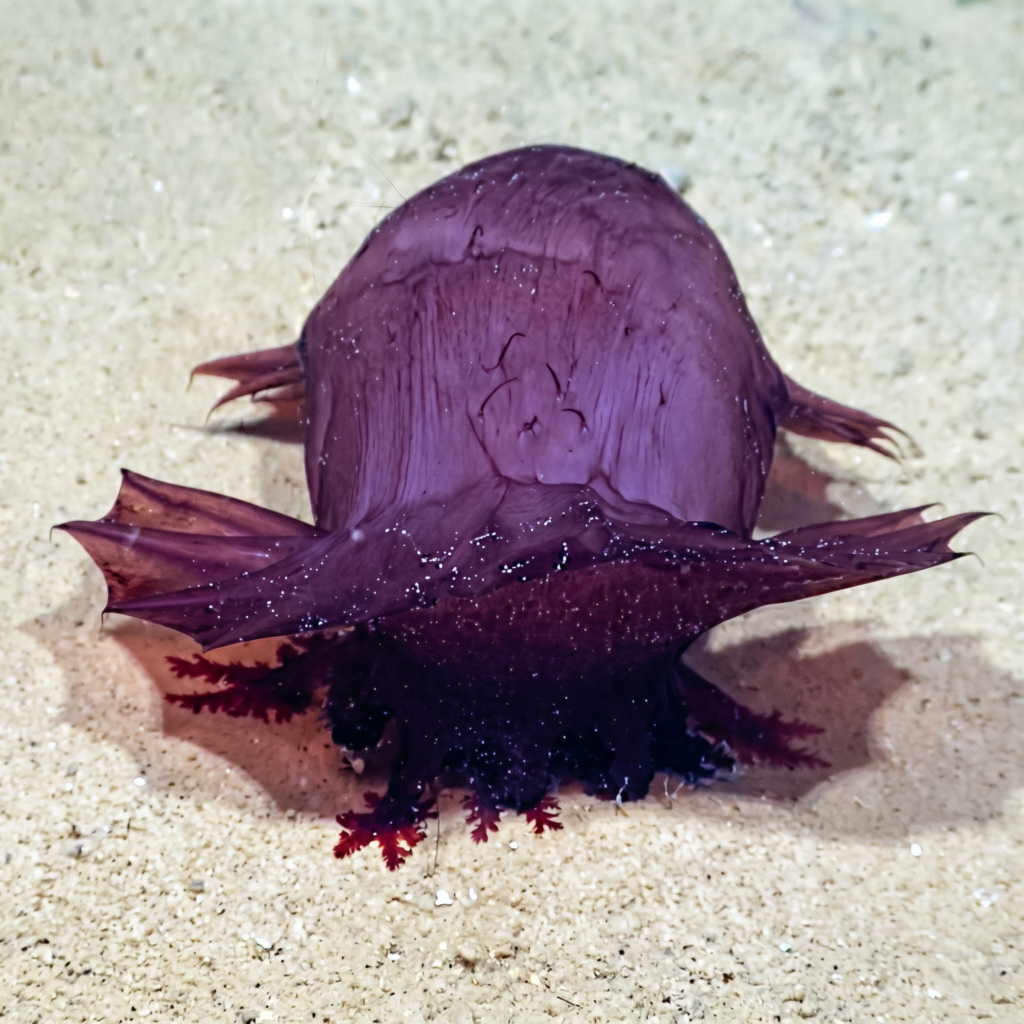
The same species on the seafloor in feeding posture — body flattened and spread wide against sandy substrate, feeding tentacles extended downward into sediment. Here, the animal remains still, gathering marine snow from the ocean floor.
Frequently Asked Questions
Q. Where does the Headless Chicken Monster actually live?
A. Enypniastes eximia has been documented in deep ocean environments across multiple basins, including the Gulf of Mexico, the Atlantic, and waters near Antarctica. It typically inhabits depths ranging from roughly 100 meters to more than 2,500 meters. NOAA Ocean Exploration’s 2017 Gulf of Mexico survey produced some of the most widely circulated footage of the species in open-water swimming behavior.
Q. Is the Headless Chicken Monster dangerous?
A. No. Enypniastes eximia is a deposit feeder that consumes organic particles from deep-sea sediment and the water column. It has no predatory behavior, no venom, and no defensive structures that pose any risk to humans. Its alarming appearance results from its translucent skin and internal organ visibility, not from any aggressive biology.
Q. Why can you see through its body?
A. The semi-transparent body wall of Enypniastes eximia is likely an adaptation to the deep-sea environment, though the precise evolutionary function is still studied. One hypothesis suggests that transparency reduces the animal’s visibility to bioluminescent predators in an otherwise lightless environment. The internal organs — particularly the digestive loop and vascular tissue — are visible as red and orange structures through the clear outer skin.
What You Now Know
An animal with no head, no brain, no eyes, and no bones has been swimming the deep ocean for millions of years, timing its vertical migrations, harvesting marine snow, and confusing every ROV pilot who has ever encountered it. The name “monster” was chosen by people who had only seen shallow water. The deep ocean had a different answer ready.
Tip For Readers
NOAA Ocean Exploration maintains a public archive of deep-sea expedition footage, including the original 2017 Gulf of Mexico documentation of Enypniastes eximia. The official species overview and video are available directly through NOAA Ocean Exploration.
Verified Sources
NOAA Ocean Exploration — Gulf of Mexico 2017 Expedition: ROV Deep Discoverer Observations
NOAA Ocean Exploration — Ocean Fact: What Is a Headless Chicken Monster
Smithsonian National Museum of Natural History — Department of Invertebrate Zoology, Holothuroidea Species Records, 2023
Schmidt Ocean Institute — Deep-Sea Echinoderm Behavioral Observations, Southern Ocean, 2020
Image sources: NOAA Ocean Exploration (Gulf of Mexico 2017 expedition footage and still images), U.S. Government work (public domain)