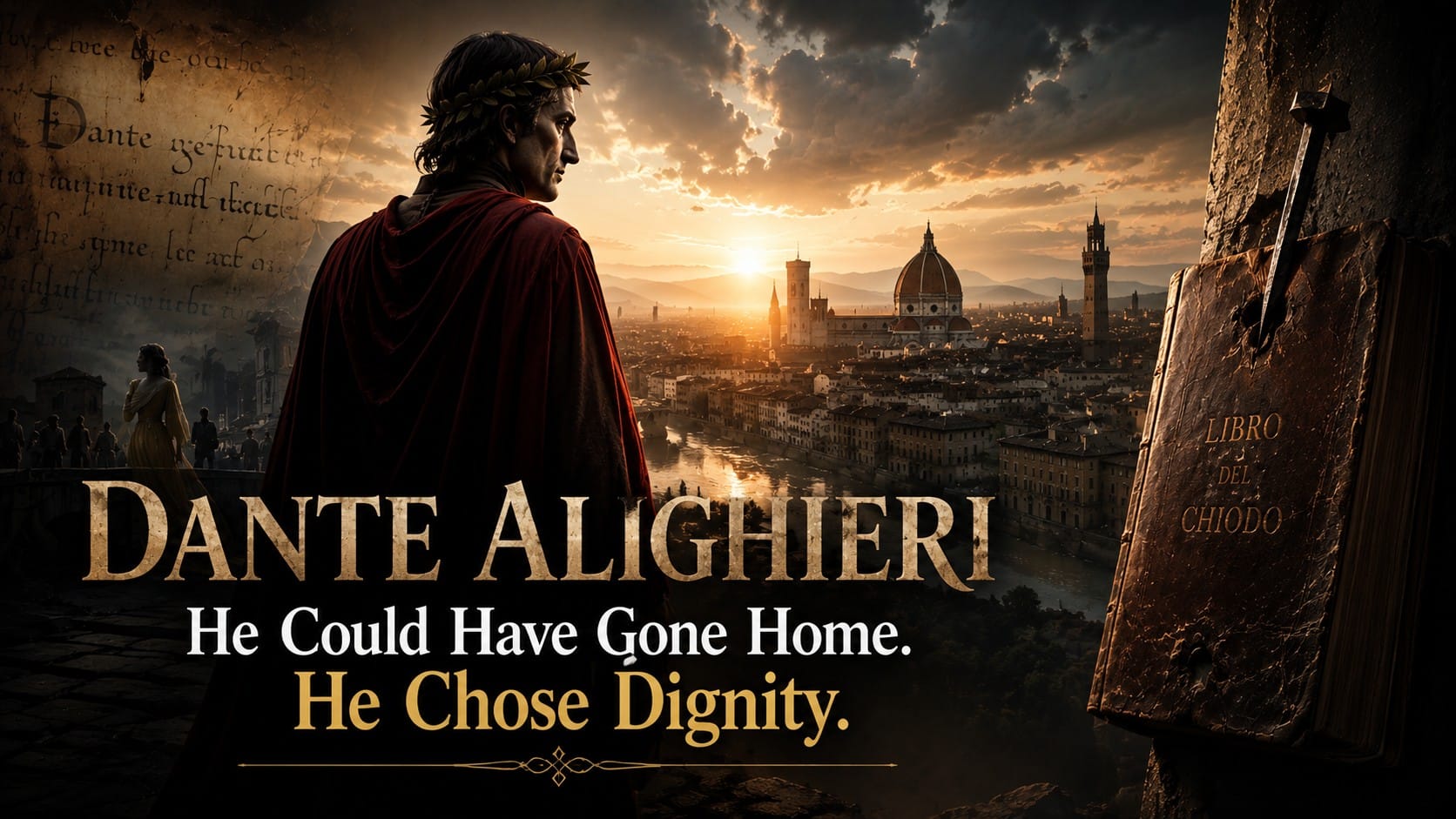
On March 10, 1302, a clerk in Florence stood up and read out a verdict. The man on trial was thirty-seven years old. The charge: stealing public money. The sentence: death by fire. If he ever set foot in Florence again, he’d be burned alive.
He wasn’t a thief. A few months earlier, he’d been one of the top officials in Florence. He’d volunteered to go to Rome as a diplomat, to protect his own city. While he was there negotiating with the Pope, the door back home was quietly closing behind him.
Today, people know him as the guy who wrote the Divine Comedy. But in 1302, he wasn’t a poet yet. He was just a man who’d lost his house, his money, his job, and his good name. His name was Dante Alighieri.
A Name on a Contract
Deep in the Vatican archives sits a beat-up piece of parchment from late-13th-century Florence — a boring old legal document. The edges are worn ragged, the ink has gone brown, but one name is still legible: Dante. Not poetry. A contract, a sworn statement.
When this document was written, Florence was split down the middle — the Black faction backing the Pope’s political power, and the White faction pushing for the city to run its own affairs. Dante was on the White side, and he wasn’t just some poet on the sidelines. He signed contracts. He sat on committees. In rooms full of candlelight and arguing voices, he had opinions about where his city was headed, and he said them out loud.
People like to picture him as some lonely genius scribbling verses in isolation. But the first place his name shows up isn’t a book of poems — it’s paperwork like this. A guy with ink-stained fingers, reading contract clauses line by line, worrying about his city’s future. That was Dante at thirty-seven, before anyone sentenced him to burn.
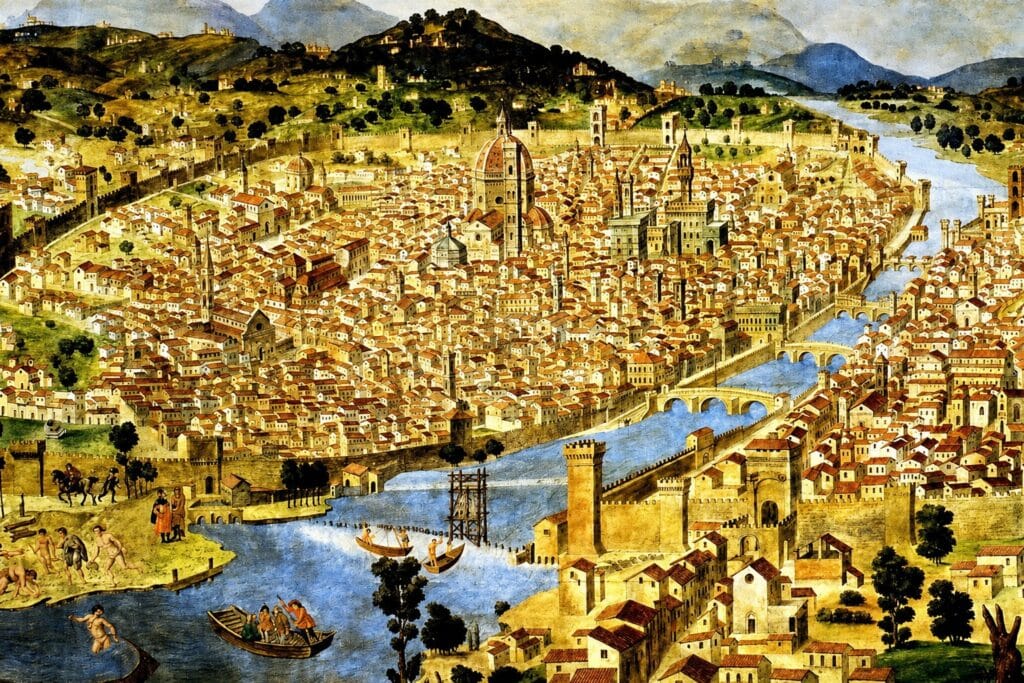
This is roughly what the city looked like from up above when he walked home through the narrow streets after a long meeting. Red rooftops packed in tight along the river. He looked at all of it and figured he belonged there. No doubts.
The City Turned Its Back
In 1301, the French king’s brother, Charles of Valois, was trying to march into Florence under the excuse of “keeping the peace.” The White faction needed to stop him, so Dante went to Rome on the city’s behalf. He had one job: talk the Pope into keeping the French army out.
Pope Boniface VIII agreed to meet with him. The meetings kept going, and Dante couldn’t leave Rome. It looked like negotiations were still in progress. Back in Florence, something else was happening.
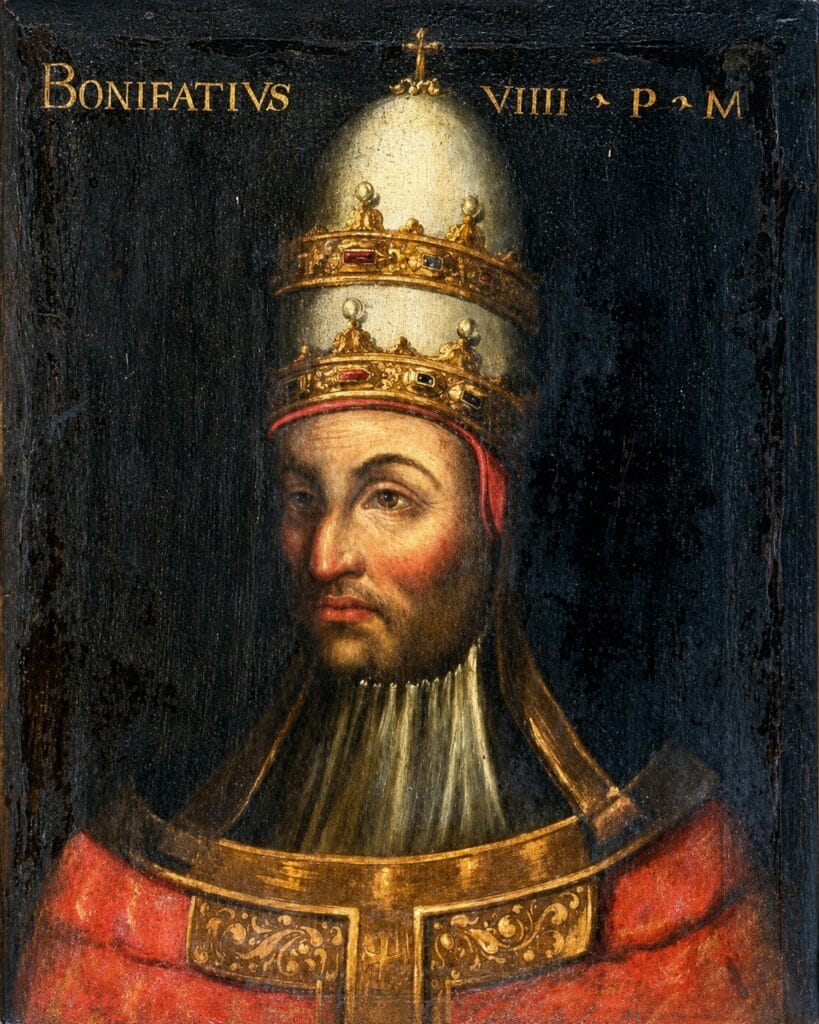
While Dante sat around in Rome, the French army and the Black faction back in Florence started moving together. The talks kept dragging on, but by then the city’s fate had already been decided somewhere else entirely.
In November 1301, the Black faction seized Florence by force. Dante was still stuck in Rome. The man who’d left to protect his city ended up watching it slip away from a place he couldn’t do a thing about.
Along with the verdict came the seizure of his property — his house in Florence now belonged to the state. Dante heard the news from somewhere outside the city walls, and he never crossed his own doorstep again. Just months before, he’d been one of the highest officials in Florence. Now his name wasn’t on the list of people who ran the city. It was on the list of people the city had thrown out.
Nailed to the Book
In the basement of Florence’s town hall, one book hung from a single nail on the wall of the records room. The leather cover had gone dark red-brown from age and damp, and right in the center sat a heavy iron nail. People called it the Book of the Nail.
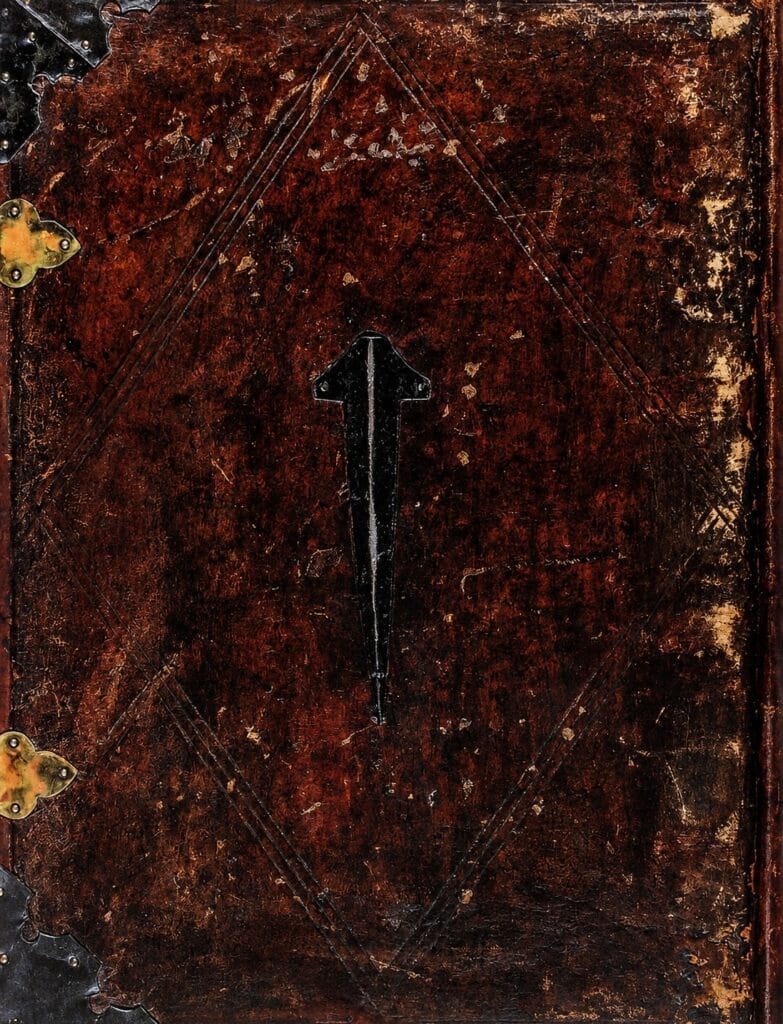
On January 27, 1302, a clerk’s quill scratched across the parchment, writing out the first verdict. Dante Alighieri — guilty of embezzlement and illegal profit. A fine, and exile. Dante heard the news in Rome. He never showed up in court. He couldn’t admit to a crime he hadn’t committed.
When he still didn’t show up, a second verdict went into the same book on March 10. This time there was no fine attached. The clerk wrote the last line: if Dante Alighieri ever sets foot in Florentine territory again, he burns.
She Never Looked Back
Long before politics and exile tore his life apart, there was one person Dante could never stop thinking about.
Around 1290, on the Ponte Vecchio in Florence. Young Dante, dressed in green, stood across the street watching a woman walk by. Beatrice, in a pale yellow dress, was chatting with her friends as she passed. They were on the same bridge. Her eyes never once landed on him.
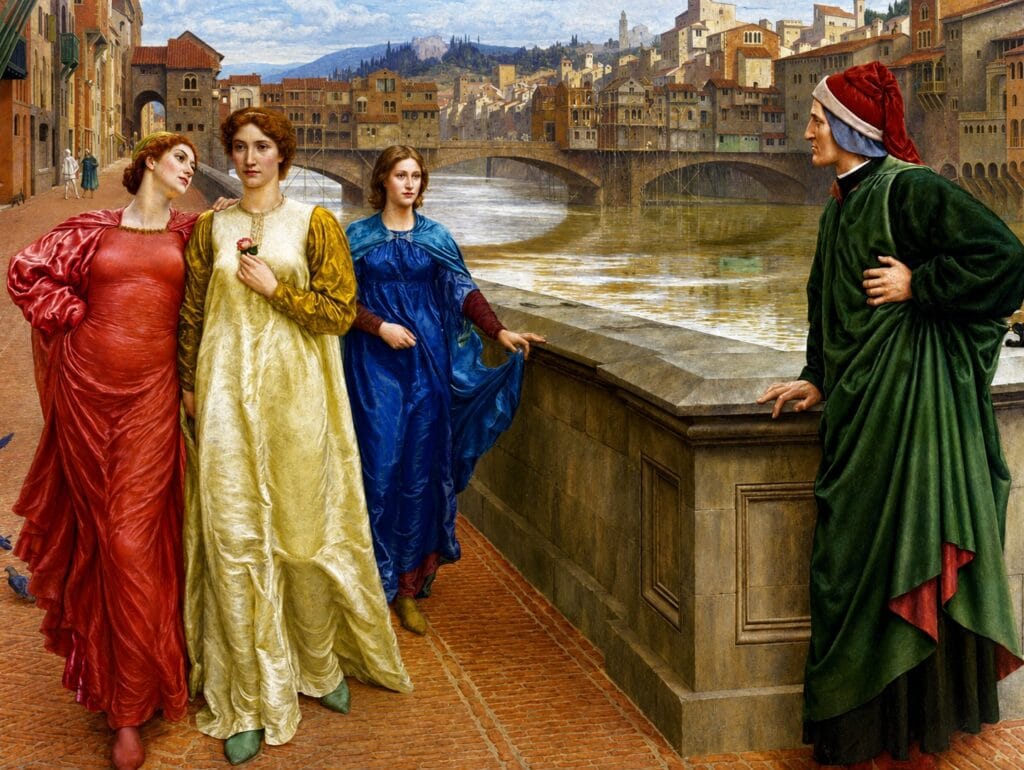
It lasted a few seconds. For Dante, it never really ended.
Long after she’d passed, he was still standing there on the bridge. Everyone else had already gone home. He just kept staring in the direction she’d disappeared.
Real life never gave him a way to be with her. So he put her somewhere no one could ever take her from him again — inside his own writing.
Somebody Else’s Stairs
After Florence sentenced him to death, plenty of powerful people wanted nothing to do with Dante. Taking him in meant picking a fight with Florence. Then the Scala family of Verona opened their door. The young ruler, Cangrande della Scala, gave Dante a place to stay — no strings attached.
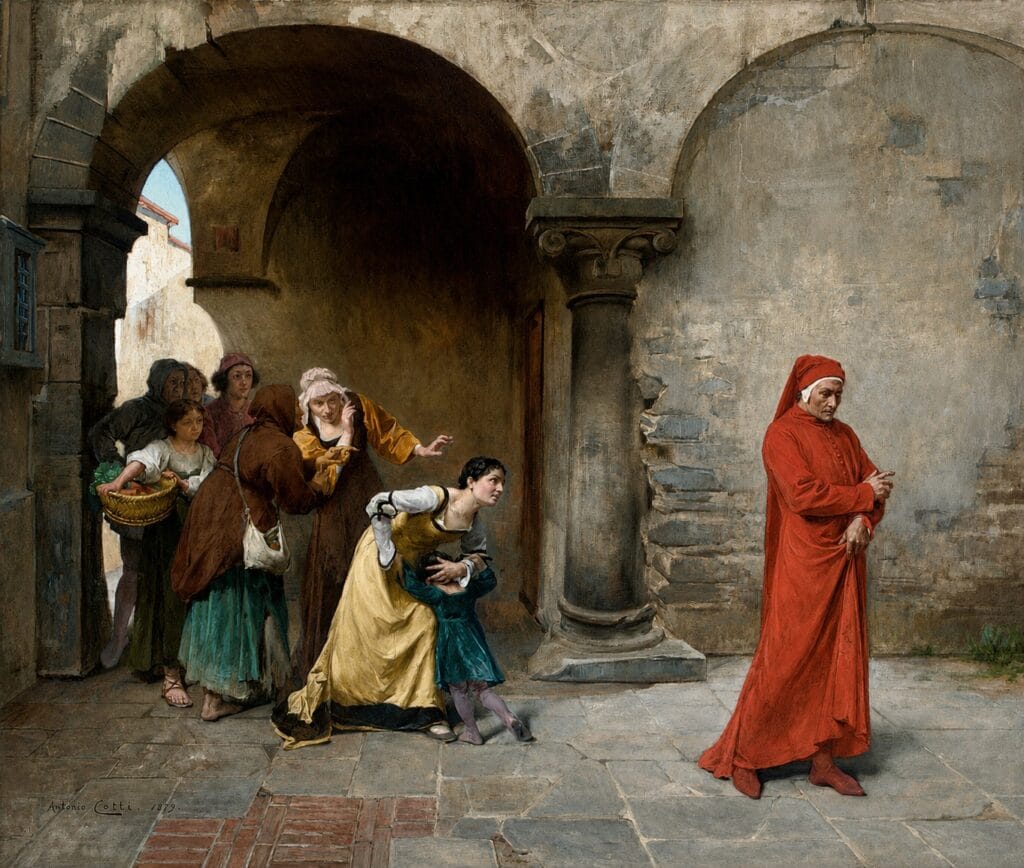
He never made it back to Florence. Not once, for the rest of his life. He spent his days bouncing between other people’s houses — Verona, Lucca, Ravenna — and somehow nineteen years went by like that. He was never the owner of any of these places. Later he wrote about how bitter someone else’s bread tastes, and how hard it is to climb someone else’s stairs.
During the day, he wrote official letters and handled diplomatic business for the people who’d taken him in. At night, he picked up the same pen and wrote something completely different. Not a plea to go home someday. It was turning into the last thing a man who’d never go home would leave behind for the world.
The Man Who Turned Down a Pardon
On slow afternoons with nowhere to be, he’d sit alone on the steps of some church. When evening came, he’d head to the Biblioteca Capitolare in Verona. By candlelight, he’d open Boethius’s Consolation of Philosophy. The world had called him a criminal, but that book kept telling him how to stay human anyway. He read those pages over and over.
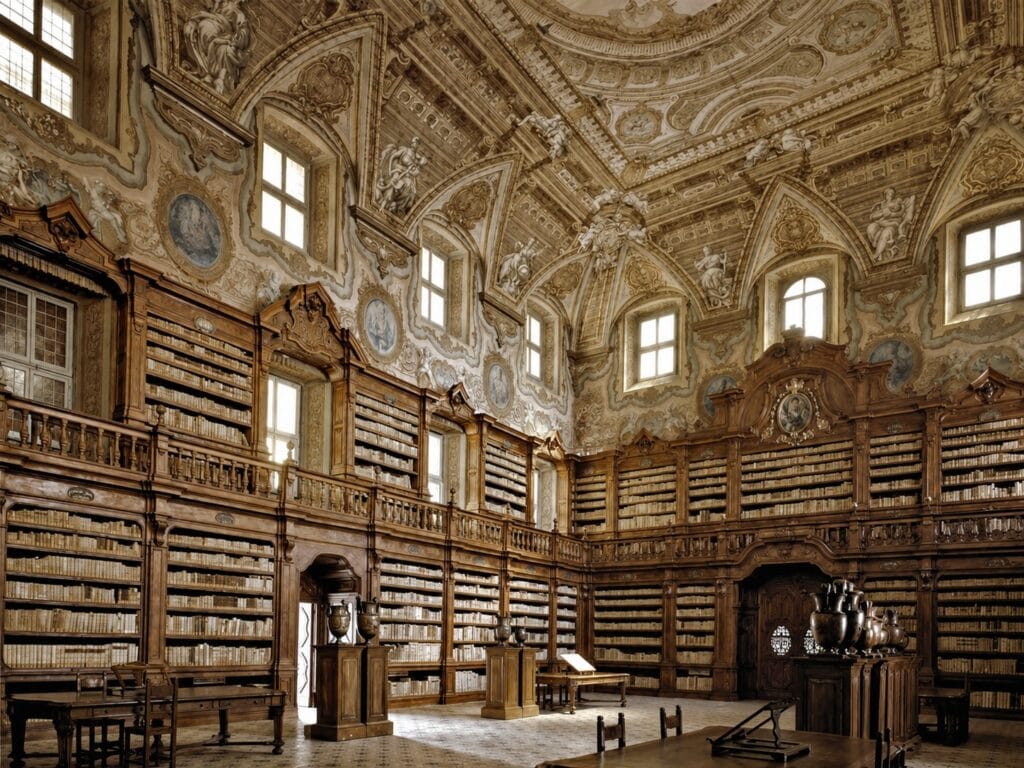
In 1315, Florence finally offered him a way back. Admit the crime, pay the fine, and walk through the streets in ashes for everyone to see — do that, and he could come home. For someone who’d been drifting for over a decade, it was the kind of offer you’d think nobody could turn down.
But Dante wrote a letter to a friend instead. He said he couldn’t confess to something he hadn’t done. For an innocent man, walking home dressed like a criminal wasn’t a homecoming — it was surrender. He wrote that wherever he stood, he could still look up at the sun and the stars, and search for the truth. That was enough.
He didn’t lose Florence because the door was never open. The door was right there — all he had to do was kneel. He never did. That day, Dante picked dignity over home. And seven hundred years later, that choice is still the reason people remember his name.
He Ditched Latin for the First Line
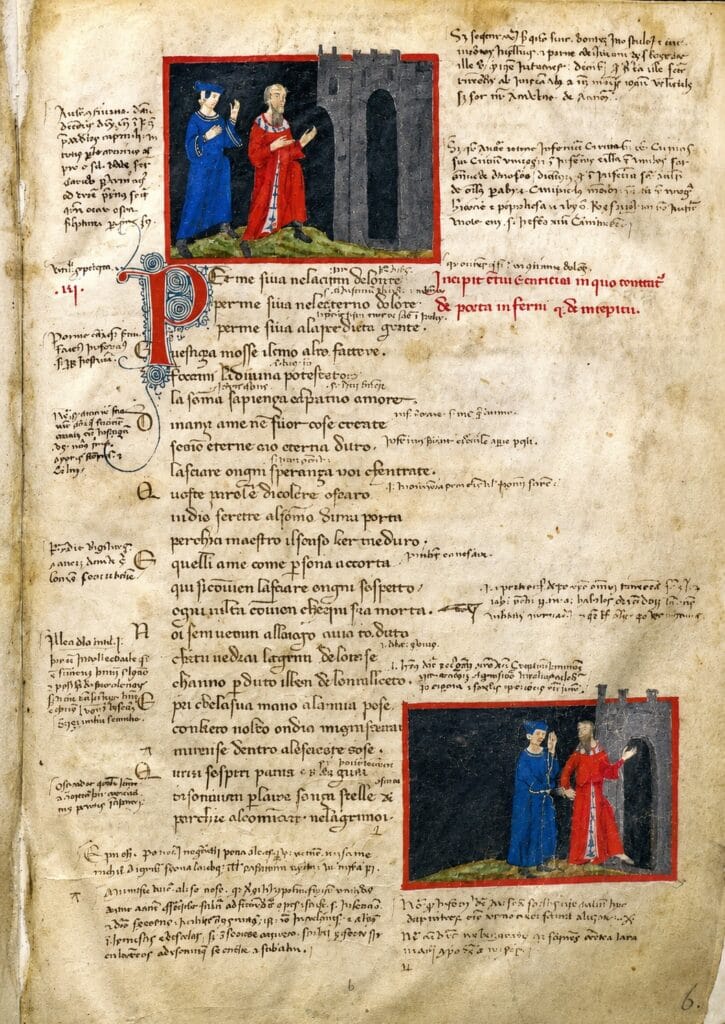
Under a line of red heading text, one sentence quietly begins. This is the opening page of an early manuscript of the Divine Comedy, now held at the Library of Congress. “Midway through the journey of our life, I found myself in a dark wood.” That first line, the one so many people still know today, wasn’t written in Latin. It was written in the everyday language of Tuscany.
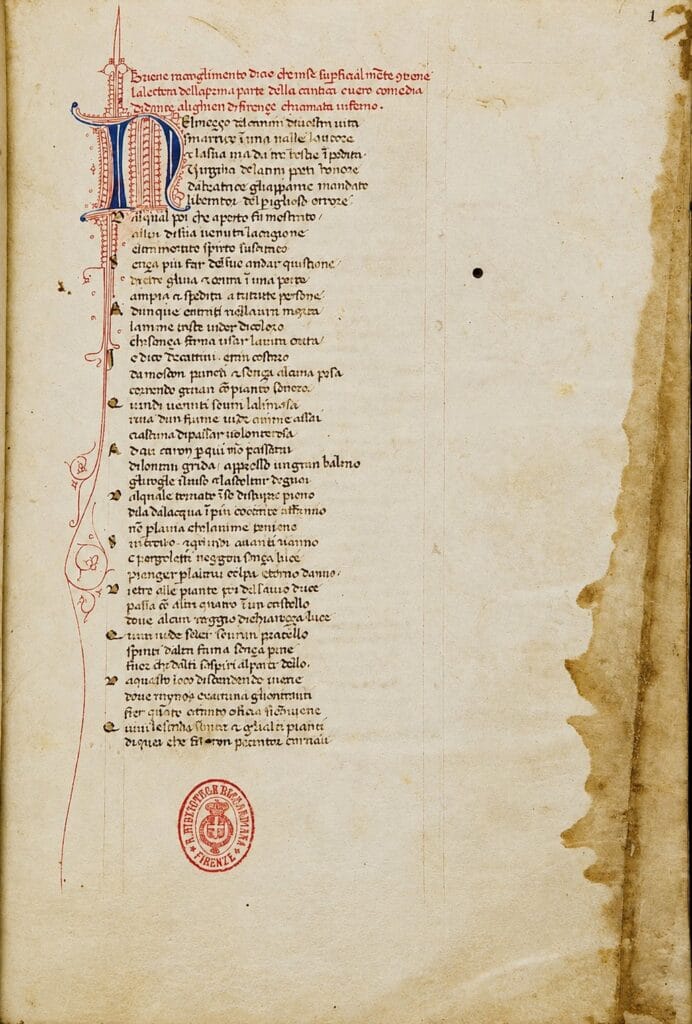
Back then, scholarship and religion belonged to Latin. It was the language of priests, scholars, and people with power. Dante wrote the Divine Comedy in the language people actually used in the streets and markets of Tuscany — the same language spoken by ordinary people from the city that had thrown him out.
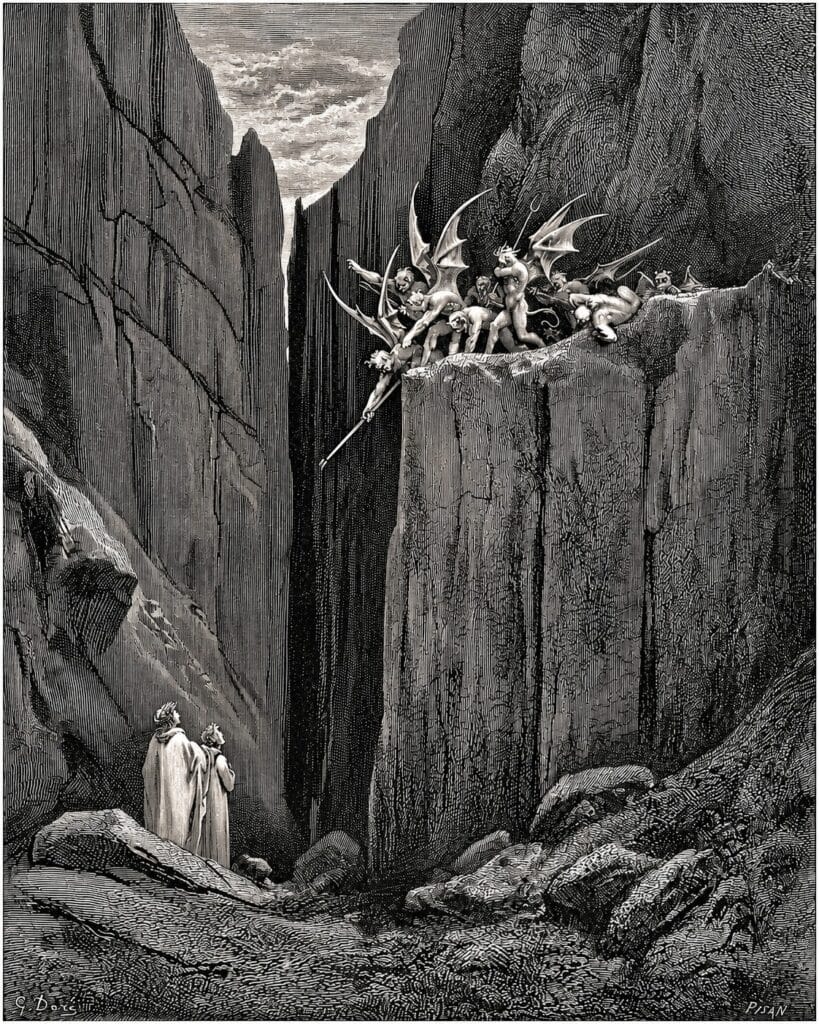
His home country nailed his name into a book as a criminal. He answered in the language his people actually spoke. That single opening line, written by an exile, crossed borders and centuries, and it’s still one of the most-read lines in literature today.
He Put a Living Pope in Hell
In 1302, the pope who’d trapped Dante in Rome and helped destroy his life — Boniface VIII — was still sitting at the top of the Church, still very much alive. As long as he was breathing, nobody on earth could judge him.
Nobody except Dante.
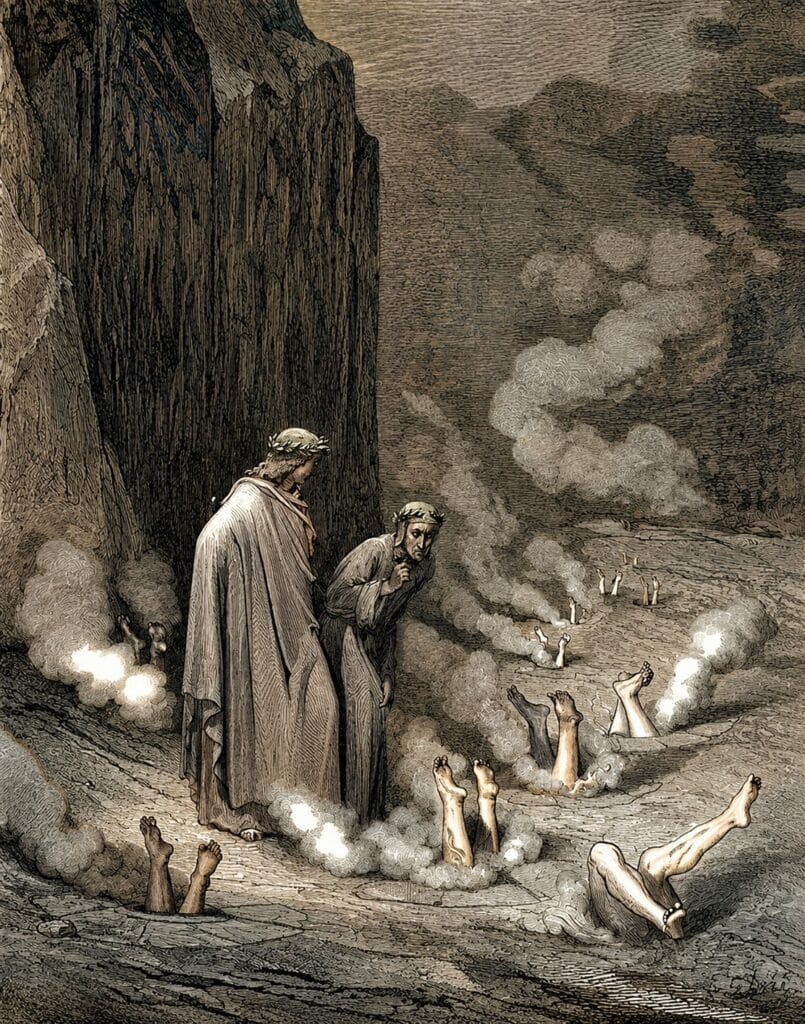
In Canto XIX of Inferno, Dante and Virgil reach a stretch of rocky pits that never seems to end. Here, people who’d sold Church offices for money were shoved headfirst into the ground, flames licking at the soles of their feet, which were the only part of them still sticking out.
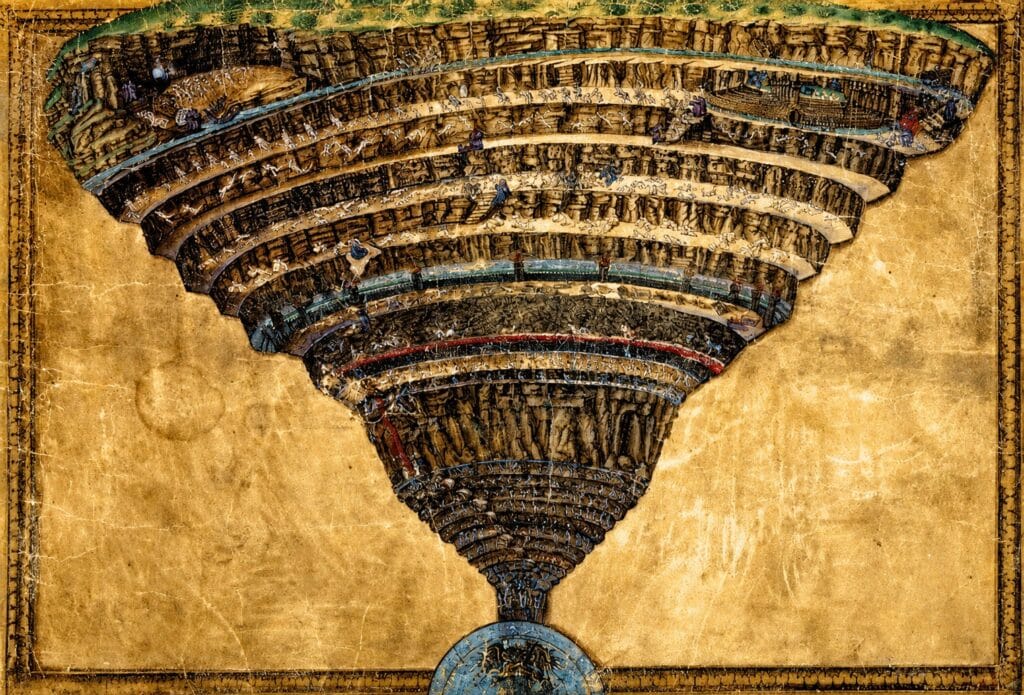
Dante’s Hell wasn’t just some chaotic fire pit. It was a carefully built structure — nine rings, narrowing like a funnel, sinking deeper and deeper based on how bad the sin was, all the way down to the center of the earth. The corrupt clergymen were stuck in the eighth ring, not far from the very bottom.
The man stuck in that pit was Pope Nicholas III. He looked up, saw Dante, and got confused — he figured the next pope in line to join him down here had finally shown up. The name he was waiting to hear was Boniface VIII.
The man who’d kept Dante stuck in Rome and let his home country slam the door behind him — Dante had already picked out his spot in Hell, while the guy was still alive and breathing.
“Se’ tu già costì ritto, Bonifazio?”
“Already here, Boniface?”
It’s a strange thing to say about someone who’s still alive. But for Dante, the verdict wasn’t waiting on death. It was already final.
The rage behind those lines wasn’t simple payback. It wasn’t that he hated one man — it’s that he’d watched, up close, the faith and justice he’d believed in his whole life get sold off for money and power. In Dante’s book, not even a pope got a pass on that.
But even that cold, unforgiving stare had a limit.
But Love Made Him Cry
The same man who’d sentenced a living pope to Hell — the thing that actually broke him down inside that Hell was a woman’s voice.
In Canto V of Inferno, Dante and Virgil head down into a place stripped of all light. A violent wind never lets up. Souls slam into each other, cry out, and get swept back into the dark. People who’d let desire run their lives while they were alive now spend eternity being tossed around a storm that never lands anywhere.
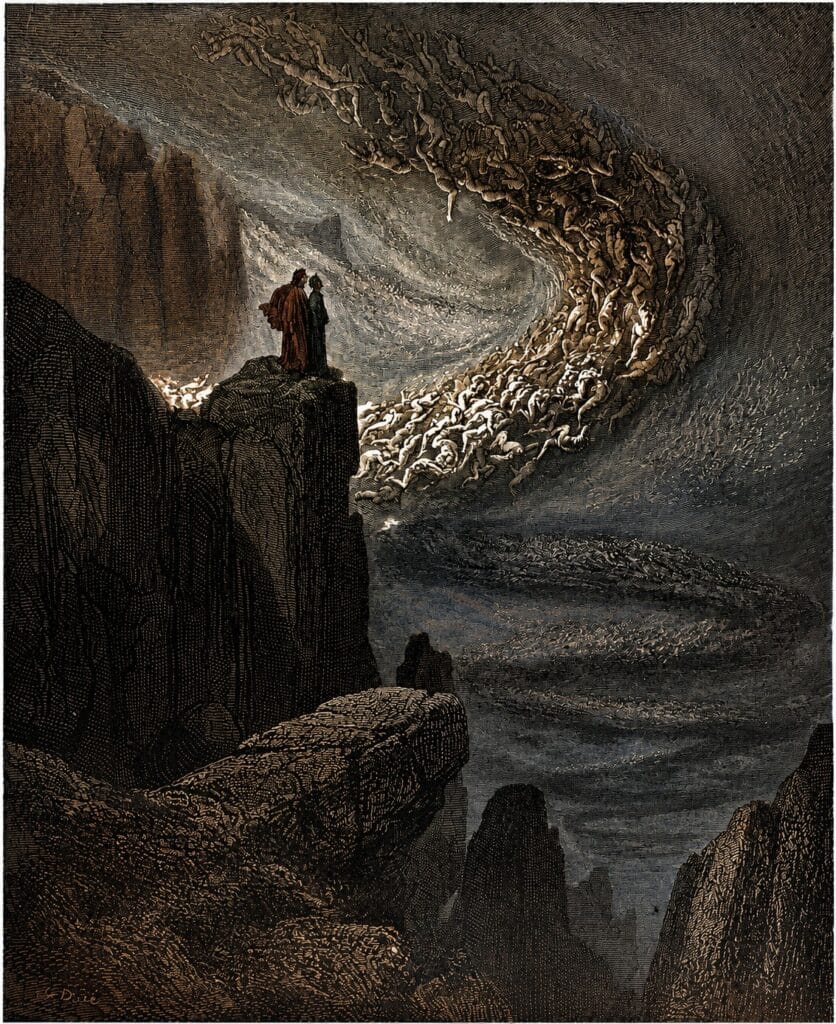
Out of all those souls, two of them never got separated. No matter how hard the wind blew, one never let go of the other. Francesca and Paolo.
Dante called out to them. Francesca spoke. Paolo just stood next to her, crying, saying nothing.
“Amor, ch’al cor gentil ratto s’apprende…”
“Love took hold of a gentle heart so fast.”
She told him how it started. Love had caught Paolo first, and then it wouldn’t let go of her either.
“Amor, ch’a nullo amato amar perdona…”
“Love gives no one who is loved the choice not to love back.”
For Francesca, love wasn’t something that had faded away. Not even death, not even Hell, had put an end to it. She looked over at Paolo, still crying beside her, and said:
“Amor condusse noi ad una morte.”
“Love led the two of us to a single death.”
Love.
Love.
Love.
She said the same word three times. First, the love that brought them together. Then, the love that made it impossible to walk away from each other. And finally, the love that dragged them both to their deaths.
Dante lowered his head.
He already knew where they were. Their love hadn’t saved them. This was Hell, and they were souls under judgment. Even so, Dante couldn’t just wave them off as sinners and move on.
He asked Francesca a question. When did it start? At what point did the two of you realize how you felt?
Francesca went back to a happy afternoon.
“Nessun maggior dolore
che ricordarsi del tempo felice
ne la miseria.”
“There is no greater pain than remembering happy times in the middle of misery.”
Then she walked him through the last moment they’d shared, before everything fell apart.
“Noi leggiavamo un giorno per diletto
di Lancialotto, come amor lo strinse;
soli eravamo e sanza alcun sospetto.”
“One day, for fun, we were reading about Lancelot, and how love gripped him. We were alone, without a hint of suspicion.”
They hadn’t met to sin. They were just sitting side by side with a book between them. In the story, the knight Lancelot was in love with Queen Guinevere. As they read the same lines, they kept glancing at each other, and every time, the color drained from their faces.
But they went back to the page.
Then came the moment where Lancelot finally kissed the woman he loved.
Right then, Paolo looked at Francesca.
“Questi, che mai da me non fia diviso,
la bocca mi basciò tutto tremante.”
“This man, who will never leave my side, kissed my mouth, trembling all over.”
One of them was telling the story. The other was still crying beside her.
Francesca didn’t say anything more after that. Not the moment they got caught. Not the moment they were killed. Not the moment they fell into this storm. None of it.
She only left him with the moment the book closed.
“Galeotto fu ‘l libro e chi lo scrisse:
quel giorno più non vi leggemmo avante.”
“That book, and the man who wrote it, brought us together. That day, we read no further.”
Francesca’s voice stopped.
Paolo was still crying.
The storm was already coming back for them.
Dante was a man who’d sent a living pope straight to Hell. He never hesitated to call sin what it was, never backed off a fight even against real power. But watching a woman recall the happiest day of her life while describing her own death, with a man beside her who couldn’t say a single word through his tears — he couldn’t stand there as a judge anymore.
The pity hit him so hard his vision blurred. His legs gave out. The moment Francesca stopped speaking, Dante’s body went down with her.
“E caddi come corpo morto cade.”
“And I fell, the way a dead body falls.”
Ravenna, A Father Again
Near the end of his exile, Dante settled into the household of Guido da Polenta in Ravenna. His sons Pietro and Jacopo, and his daughter Antonia, showed up there one by one. He never got to be with his wife Gemma, still back in Florence — but after years apart, his children were finally back at his side.
In a small room, the manuscript of the Divine Comedy sat on his desk. Instead of just handing it over, Dante read the lines out loud himself and explained them one at a time. Pietro and Jacopo learned the work sitting right next to him, and years later, they became the first people to bring his writing to the world. His daughter Antonia entered a convent and lived under the name “Beatrice” — the same name he’d carried through his work his whole life.
When he pushed open the door that evening, the first voices he heard were his children’s. Guido da Polenta had also put him back to work as a diplomat, and by day, Dante handled the job. But in the evening, none of that mattered. For that one evening, he wasn’t a poet or an exile. He was just a father.
Reaching the Stars
At the top of Purgatory, Dante met Beatrice again. Back in Florence, the two of them had barely crossed paths a handful of times. Now they were walking a road nobody could ever pull them apart from.
For the first time since his exile began, Dante no longer felt like a man searching for someone. She was already there.
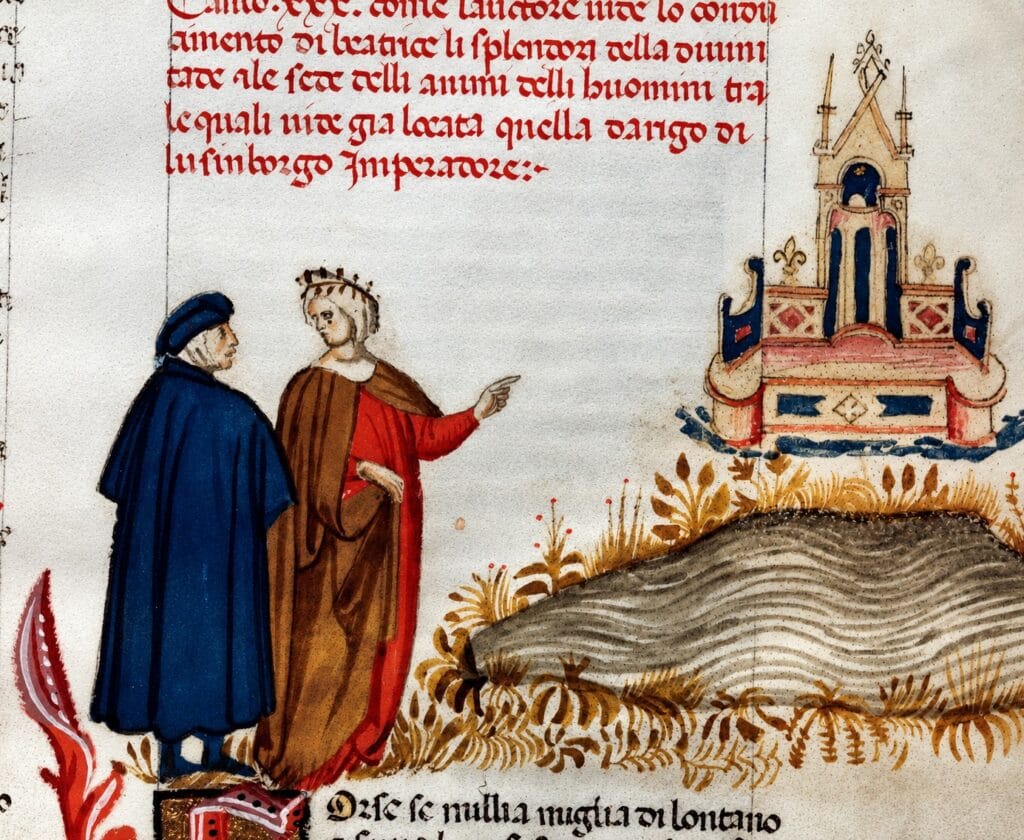
In an endless field of light, the saints formed a giant rose. Before he took in any of that light, Dante looked at the one thing standing right next to him — Beatrice.
She wasn’t the girl who’d once walked past without a glance. The name he could never quite reach on the streets of Florence had been waiting for him quietly, right at the finish line of his whole journey.
Dante didn’t say a word. One hello in his youth had turned into a lifetime of love, a love that never got the chance to happen back then — and now, at the very end of his road, the two of them were finally standing side by side.
He slowly lifted his eyes. And looked out at more stars, more light, than he could ever count.
Dragged Off by a Beast’s Tail
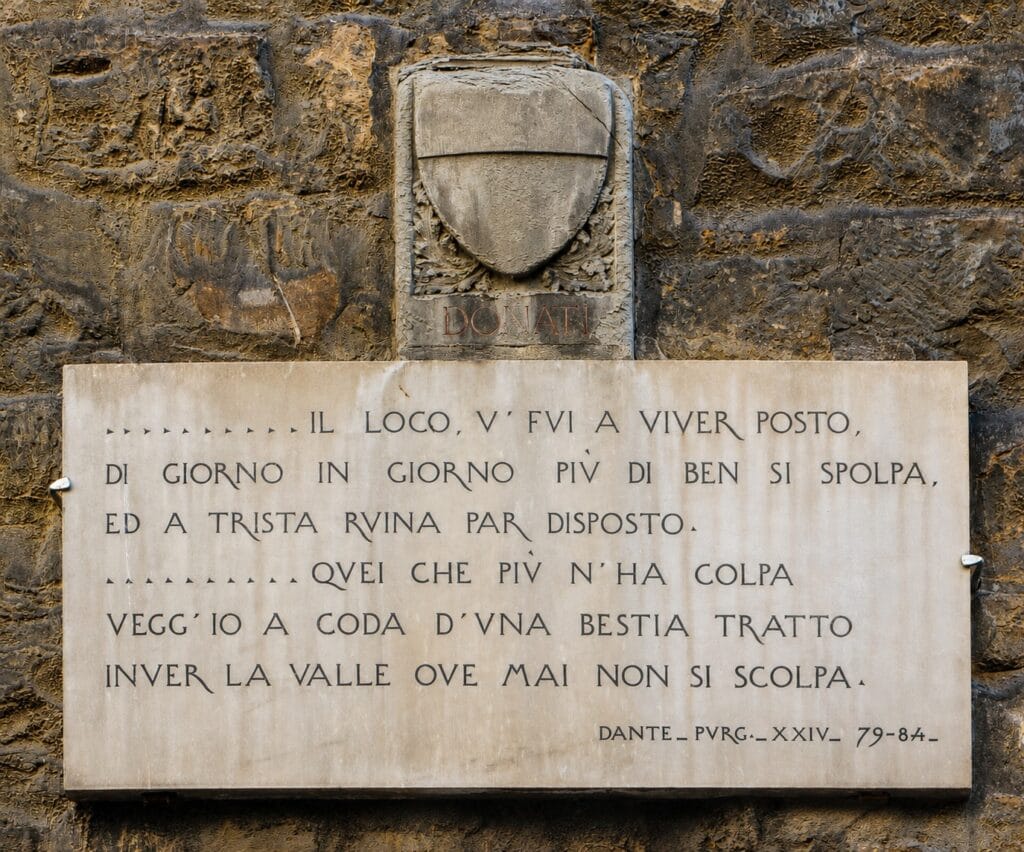
In 1308, the man who’d destroyed Dante’s life — Corso Donati, the top power in the Black faction — got his own ending. Caught up in a power struggle and branded a traitor, he tried to flee on horseback and his foot got caught in the stirrup. The horse dragged him through the streets. He was caught and killed near the Church of San Salvi.
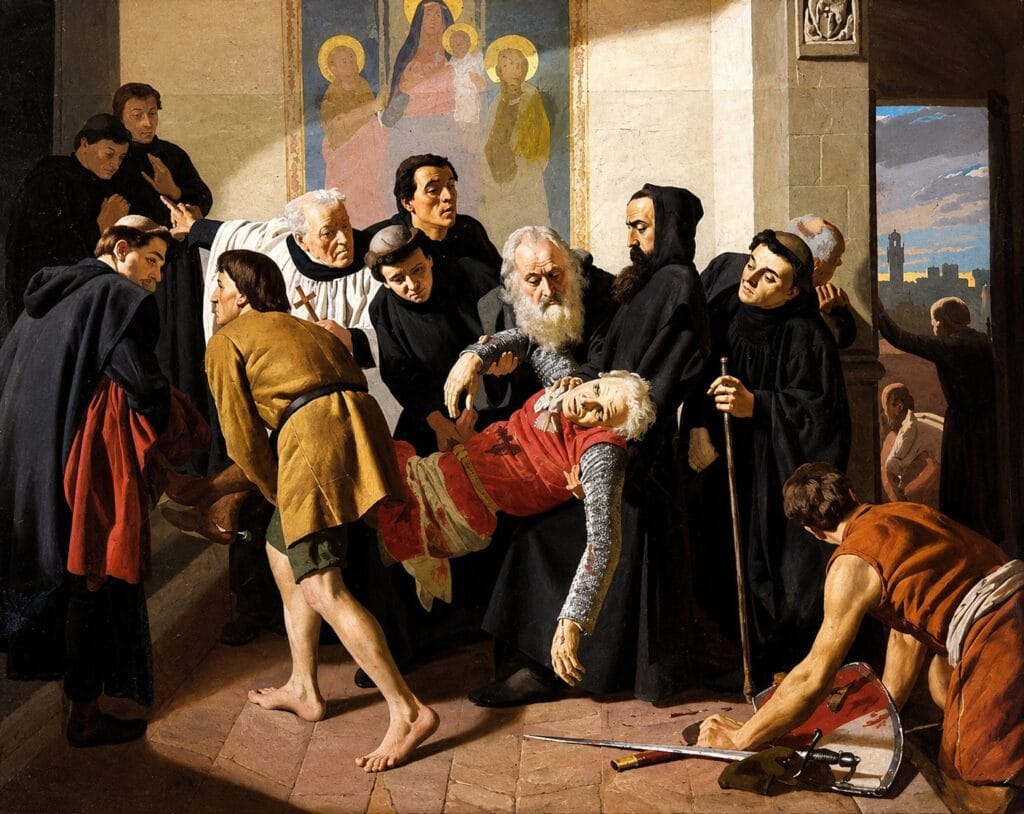
Years earlier, Dante had already written this moment into Purgatorio.
“e trassel un dì l’animal ch’ha la coda…”
“and one day the beast with the tail will drag him off.”
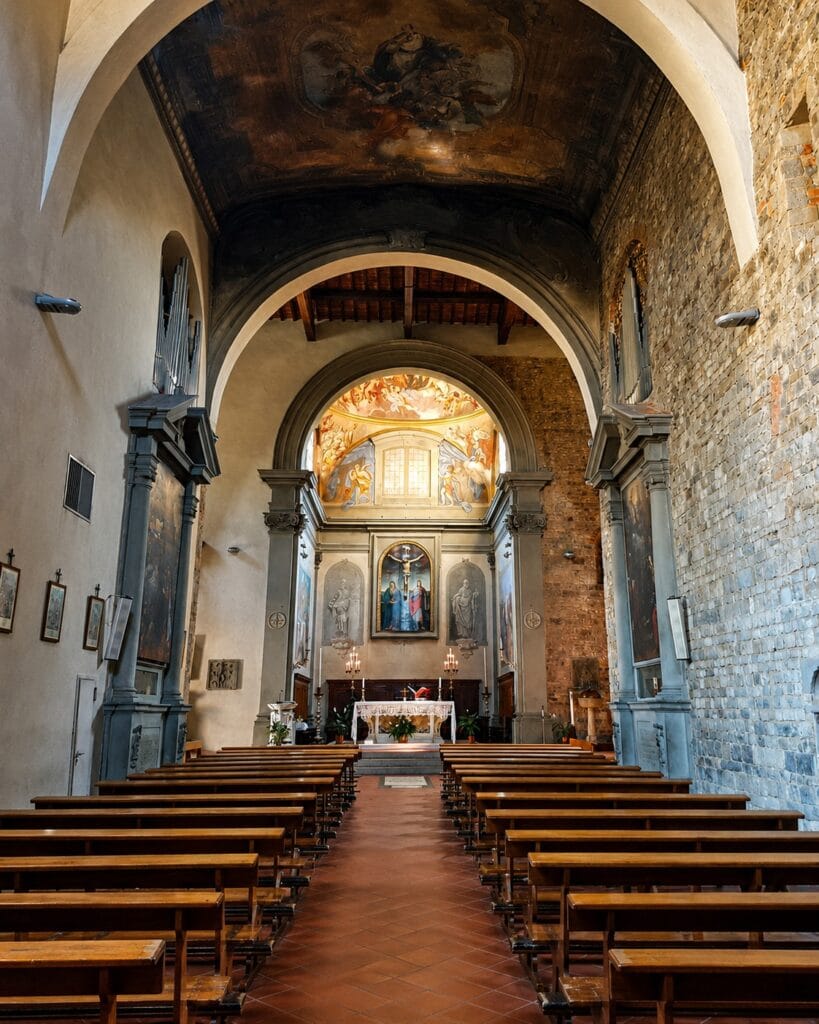
Stand outside the Church of San Michele a San Salvi on the edge of Florence, and you’re standing right where Corso Donati took his last breath. And on the wall of that church, the exact lines Dante wrote in Purgatorio are still carved there today.
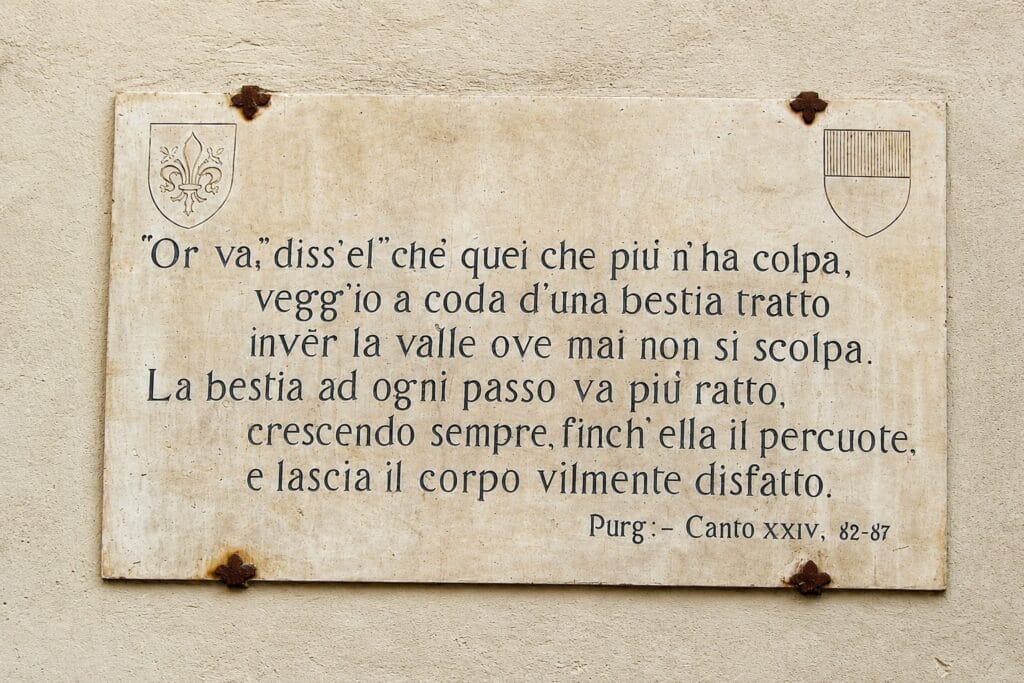
Those same lines show up again, carved into the Donati family tower back in Florence. Dante’s wife, Gemma, his friend Forese, and his enemy Corso — all of them belonged to that same family. Dante never wrote Corso’s name. But the words he left behind are still sitting there today, on the tower where Corso’s own family once lived.
Bones in a Foreign Land
On September 14, 1321, Dante died in Ravenna, never having set foot in Florence again. His body was buried next to the Church of San Francesco.
Years later, Florence finally asked for him back. But the Franciscan monks in Ravenna weren’t about to let that happen — they hid his coffin inside a wall. His bones stayed hidden from the world for centuries, until someone finally found them again in 1865.
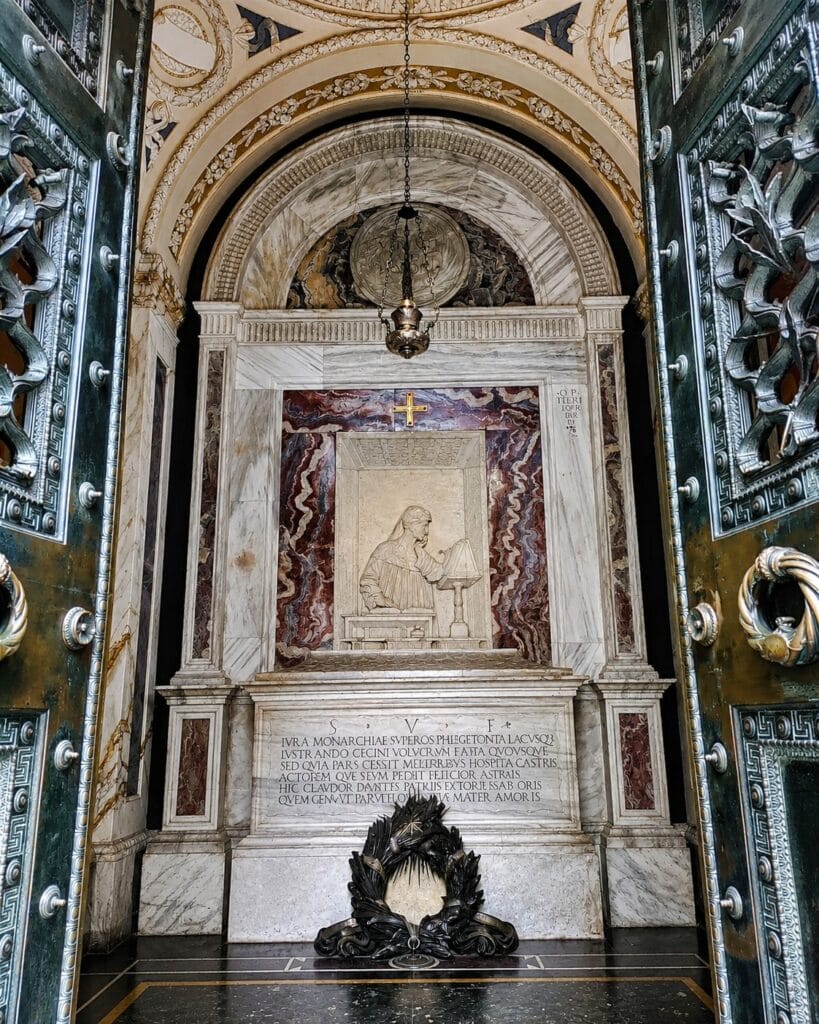
An old Latin inscription still sits on the wall of his tomb.
“Hic claudor Dantes patriis extorris ab oris.”
“Here lies Dante, shut away from his homeland.”
“Parvi Florentia mater amoris.”
“The mother who gave him too little love was Florence.”
Dante never made it back to Florence. Even after death, his bones never left Ravenna. He’s still resting in a foreign land today.
Florence Finally Took Him Back
One hundred sixty-three years after they exiled him, in 1465, Florence commissioned a painting for the inside of the Duomo. In it, painted by Domenico di Michelino, Dante stands in a laurel crown, holding the Divine Comedy, facing his own city once again.
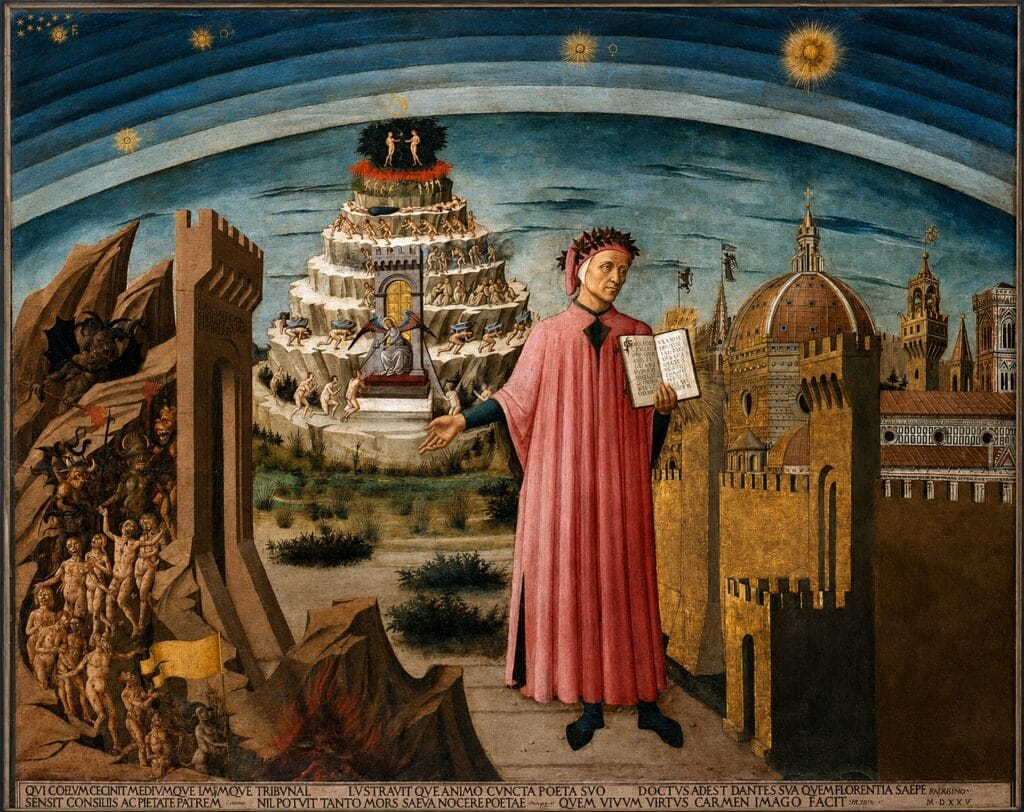
To his left, Hell. Behind him, the mountain of Purgatory. Above, Heaven. And right beside him, Florence, with the Duomo’s dome rising over it all. The city that never let him back in while he was alive gave him a spot at its very center two hundred years later.
The Dante in this painting isn’t a wanderer anymore. He’s holding the Divine Comedy in one hand, and reaching toward the city he loved his whole life with the other. Long after he was gone, the city never forgot his voice — and eventually, it gave him a place in its most sacred building.
“L’amor che move il sole e l’altre stelle.”
“The love that moves the sun and the other stars.”
Dante never made it back to Florence. His grave is still in Ravenna to this day. But his words came home, and now, holding his own book, he’s standing face-to-face with his city again.
People still walk past this painting inside the Duomo today. What they’re looking at isn’t just some exile from centuries ago. It’s a man who, after all that time, finally got to stand across from his own city again.
Archive Notes
What did Dante actually look like?
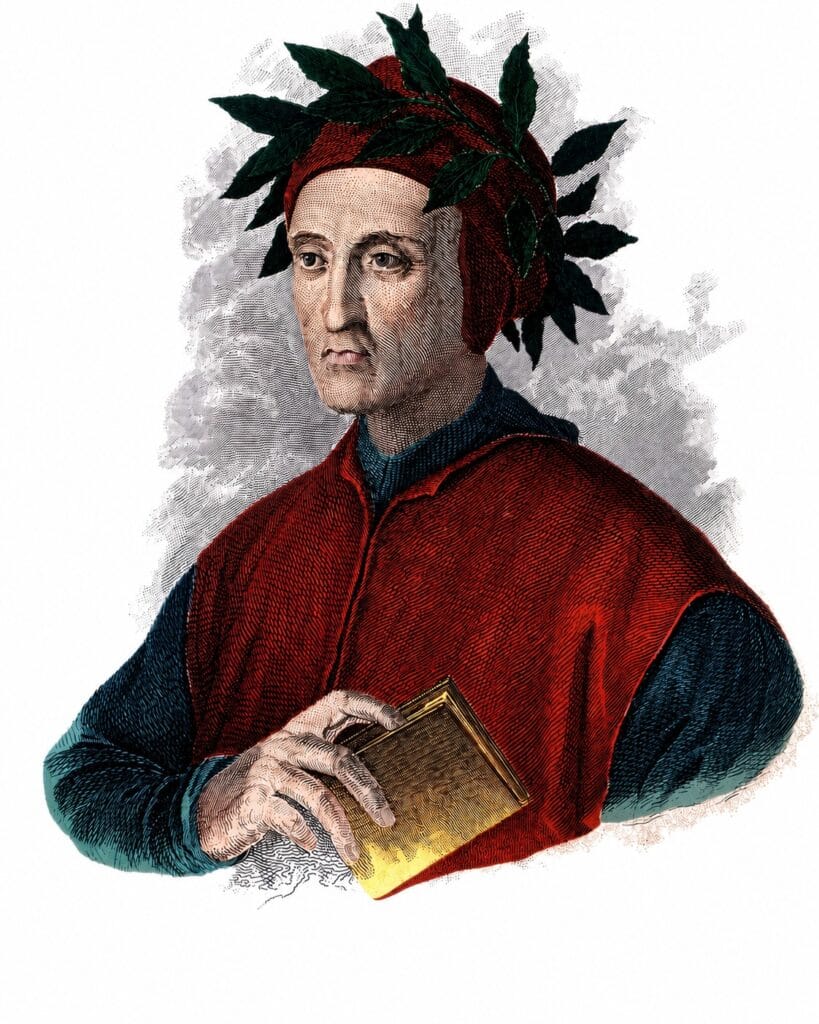
No portrait from his lifetime survives. The face people picture today comes from portraits and sculptures made decades, even centuries, after he died. Ravenna has an object said to be Dante’s death mask, but historians still debate whether it was really made right after his death.
Why do people call Dante “the father of the Italian language”?
Regional dialects existed in Italy before Dante. But he wrote the Divine Comedy in Tuscan instead of Latin, and that choice ended up shaping modern Italian more than almost any other single work. The standard Italian taught in schools today traces back to that tradition.
Did Dante actually call it “The Divine Comedy”?
No. Dante’s own title was simply Commedia — Comedy. The name we use today, Divina Commedia, got added by Renaissance scholars about two hundred years later, as a way of honoring him.
Reading about Dante, you might also think of Gustave Eiffel. One man rebuilt himself through his pen after being cast out of his own country. The other rebuilt his name through a tower the world had laughed at. Neither one, while they were alive, had any idea how they’d be remembered.
And if you want to meet someone else the world only understood after it was too late, there’s Vincent van Gogh. He died having sold just one painting in his entire life. Today he’s one of the most beloved painters on earth. All three of these lives looked completely different. But time never managed to erase what any of them really meant.
What You Now Know
Most people know Dante as the guy who dreamed up Hell. But before he ever wrote a word of it, he’d already spent nineteen years climbing other people’s stairs, living the life of an exile.
He never went home. His words did.
Tip For Readers
If you want to trace Dante’s footsteps, start at the fresco inside the Duomo in Florence. From there, head to the plaque at the Church of San Michele a San Salvi, where a line from Purgatorio meets the actual place it describes. End your trip in Ravenna. That’s where Dante still lies today, in the city he never got to leave behind for home.
Verified Sources
Archivio di Stato di Firenze — Libro del Chiodo and exile records
Archivio Apostolico Vaticano — Historical archival collections
Società Dantesca Italiana — Dante Online
Biblioteca Capitolare di Verona — Manuscript collections
Comune di Ravenna — Dante Alighieri Tomb and historical records
Library of Congress — Divine Comedy manuscript collections
Giovanni Boccaccio — Trattatello in laude di Dante
Historical images sourced from public-domain archives, museum collections, and open-access collections, including Wikimedia Commons.
Some historical images have been digitally restored or editorially arranged by FramedTruth for documentary storytelling. Such edits are intended only to improve historical readability and do not alter the underlying historical evidence.