Tag: nasa

  • The Empty Man Who Orbited Earth

    The Empty Man Who Orbited Earth

    The first time people saw the photograph, they all said the same thing.

    Someone is drifting away.

    Black space. Blue Earth curving at the edge. And a figure — helmet, arms, legs — tumbling slowly into nothing, growing smaller with every second. No tether. No rescue. Just a human shape, alone, drifting away from the only human outpost for hundreds of kilometers.

    But zoom in as far as you want. There is no face.

    Because there never was one.

    On February 3, 2006, the International Space Station released an object that defied common sense — a discarded Russian spacesuit, stuffed with dirty laundry, broadcasting children’s voices into space at 17,500 miles per hour.

    It Was Supposed to Be Garbage

    The suit had a name before it had a mission. Orlan-M number 14. It arrived at the ISS on September 16, 2001, aboard the Russian docking module Pirs. Over the next four years, six different astronauts wore it into the vacuum of space. NASA astronaut Mike Finke was the last. By 2004, Orlan-M 14 had logged more than 20 hours of extravehicular activity and reached the end of its operational life.

    The problem with Russian spacesuits is logistical. The Soyuz capsule that ferries cosmonauts home cannot fit a bulky EVA suit. So old Orlans stay in space. Before this, they were simply stuffed into spent cargo ships and burned up on reentry — a quiet end for equipment that had once kept people alive in space.

    Sergey Samburov had a different idea.

    Samburov, leading a group of Russian researchers at the Moscow State Technical University’s ARISS team, asked a question nobody had seriously considered before: what if the suit didn’t have to die? What if, before it burned, it could do something useful — something that had never been done?

    What if you turned a spacesuit into a satellite?

    The Crew That Sent It
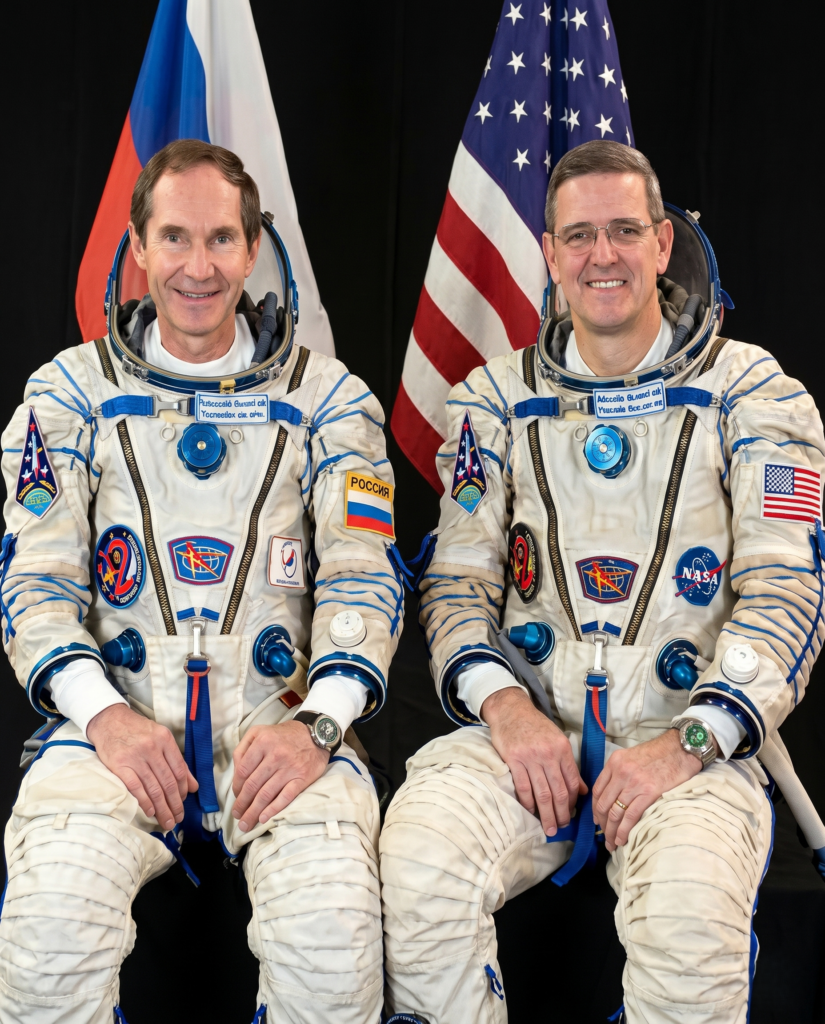
    The men assigned to carry out the mission were Expedition 12 Commander Bill McArthur — a retired U.S. Army colonel from rural North Carolina with four spaceflights and more than 9,000 hours in the air — and Russian flight engineer Valery Tokarev, a colonel in the Russian Air Force who had flown to the ISS aboard a Space Shuttle in 1999.

    They had been living together on the station since October 3, 2005. Six months alone at 350 kilometers altitude. Two people trying to keep a fragile station alive above a sleeping planet, troubleshooting systems, performing experiments, doing the slow unglamorous work that nobody on the ground ever sees.

    The SuitSat deployment was not the primary purpose of their February 3 spacewalk. It was listed as one of several tasks — almost as an afterthought. Move a crane adapter. Retrieve an experiment. Oh, and throw a spacesuit into space.

    Nobody outside the amateur radio community expected it to become one of the defining moments of the mission.

    What They Built Inside It
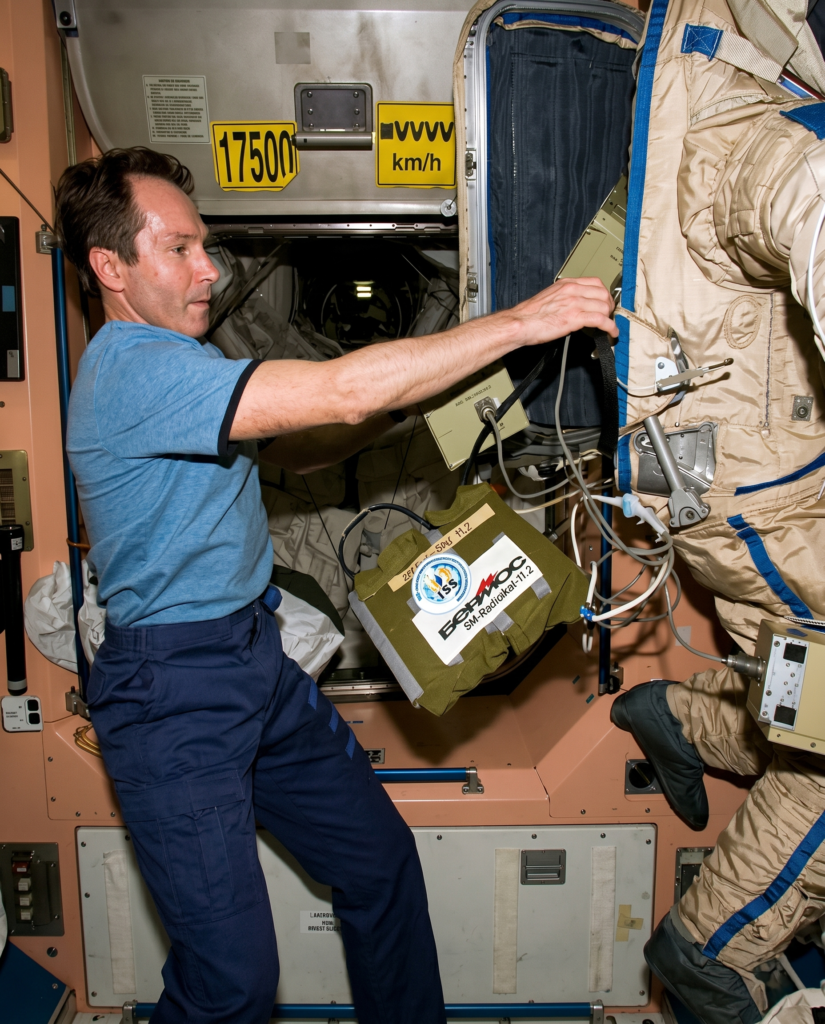
    The engineering was improvised. That is not criticism. It is simply what happened.

    The components arrived at the ISS on a Progress resupply ship in September 2005. Three batteries. A radio transmitter. Internal sensors to measure temperature and battery voltage. An antenna, assembled from parts scavenged on the station. A control box, labeled SM-RadioSkaF, bolted to the suit’s helmet.

    Then came the problem of weight and balance. The ARISS engineers calculated the suit’s spin dynamics — how it would tumble once released — and determined that the arms and legs needed to be filled to stabilize rotation. They asked the crew to stuff the suit with dirty laundry.

    This is how one of the most unusual satellites of the early ISS era came together: a six-year-old spacesuit, packed with old clothes, wired to a handbuilt transmitter, carrying a CD with images and signatures from over 300 schools worldwide, programmed to broadcast children’s voices in six languages to anyone on Earth with a radio receiver and the patience to listen.

    The transmitter frequency was 145.990 MHz FM. A police scanner could pick it up. The signal was designed to announce itself: “This is SuitSat-1, RS0RS” — and then deliver greetings in English, French, Japanese, Russian, German, and Spanish, cycling on an eight-minute loop.

    Designed output power: 500 milliwatts. Enough to be heard across continents.

    “Goodbye, Mr. Smith.”
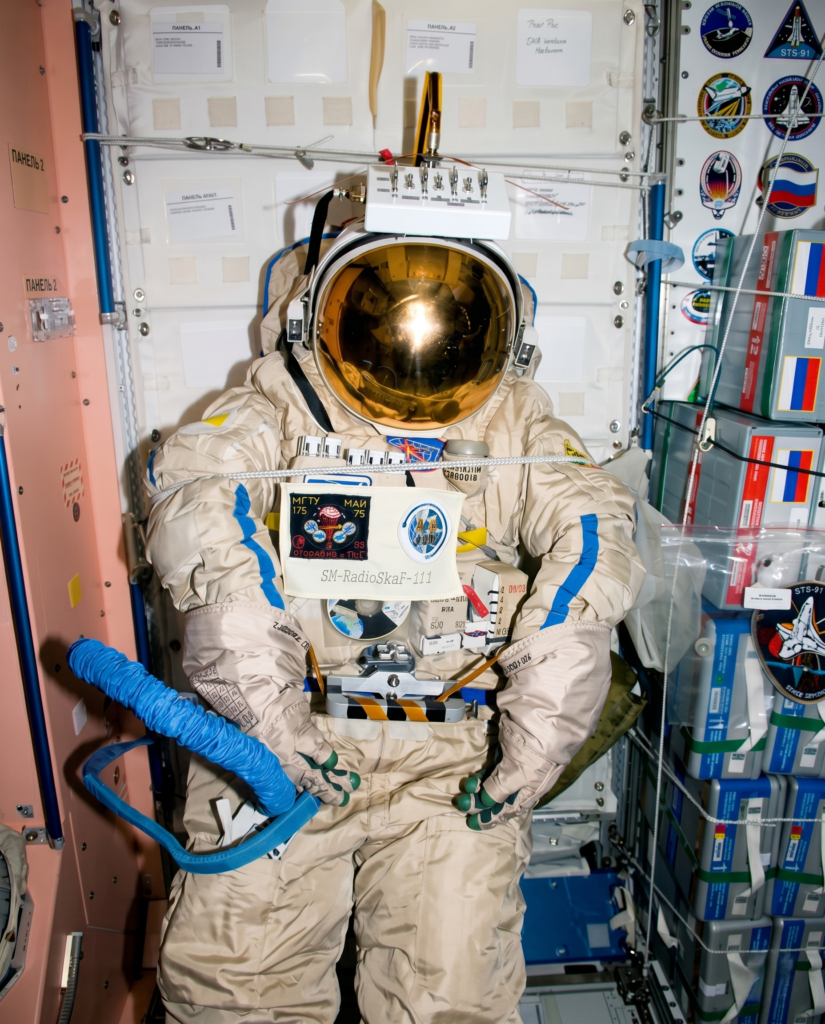
    At 5:44 p.m. EST on February 3, McArthur and Tokarev exited the Pirs airlock in their red-striped Orlan suits. The temperature outside fluctuated between negative 150 and positive 120 degrees Celsius depending on whether they were in sunlight or shadow. NASA TV broadcast the spacewalk live.

    Early in the EVA, Tokarev positioned SuitSat-1 at the edge of the station. He calculated the angle — about 30 degrees upward and 10 degrees to the left of the station’s rear — and pushed.

    He said: “Goodbye, Mr. Smith.”

    On NASA TV, viewers who hadn’t read the briefing notes saw what appeared to be a human figure tumbling away from the station. No tether. No jetpack. Just a body in a spacesuit, getting smaller, vanishing into black.

    Some viewers genuinely thought they were watching a disaster unfold live.

    They were not. But the thing that happened next was, depending on how you look at it, something close to one.

    The Signal That Died — Then Didn’t

    McArthur and Tokarev had not yet re-entered the airlock when Mission Control in Houston reported the first problem: no signal. SuitSat-1 had been released into its own orbit, confirmed operational, and then gone silent within minutes.

    The numbers told a grim story. The designed output was 500 milliwatts. Later analysis by AMSAT suggested the actual transmitter power was somewhere between 1 and 10 milliwatts. That is not a rounding error. That is a signal reduced to between 0.2 and 2 percent of what was intended.

    The empty suit had no thermal regulation. The internal temperature swung violently with each 90-minute pass through sunlight and shadow. Something broke, or glitched, or simply wasn’t strong enough for what the vacuum demanded.

    What is not disputed: NASA TV announced the mission had failed. Media reported SuitSat as dead on arrival. Educators who had planned classroom listening sessions sent apologies to students.

    Most people assumed that was the end of it.

    Instead, the amateur radio community did what it has always done best: it refused to accept the official account at face value.

    Across North America, Europe, Russia, and Japan, thousands of ham radio operators rotated antennas toward the sky. They cleaned connections, upgraded equipment, shared orbital tracking data online. They coordinated, in real time, across time zones and languages, to hunt a signal that the professionals had declared nonexistent.

    They found it.

    Faint, yes. Intermittent, certainly. But real. The SuitSat.org website, set up to log reception reports, absorbed the traffic of nearly 10 million visits during the mission. Reports came in from every continent. Students who had been told the experiment failed sent in their own reception logs instead.

    SuitSat-1 orbited Earth every 90 minutes, broadcasting its loop of children’s voices to anyone who would listen, until February 18, 2006 — when the last confirmed signal was received by a radio operator with the callsign KC7GZC as the suit passed over North America. After that, silence. Real silence.

    The suit remained in orbit for seven more months — silent and slowly tumbling through space.

    On September 7, 2006, at 4:00 p.m. GMT, SuitSat-1 reentered Earth’s atmosphere over the Southern Ocean, approximately 1,400 kilometers southwest of Australia’s Cape Leeuwin. It burned on the way down. The CD. The laundry. The antenna. The transmitter. Everything.

    What the Failure Actually Proved

    Here is the uncomfortable part of the SuitSat story, the part that tends to get smoothed over in retrospective accounts: the mission did not work the way it was designed to work.

    The transmitter dropped to a fraction of its expected strength, underperforming anywhere from 50 to 500 times over. The signal that was supposed to be receivable with a basic police scanner required serious antenna equipment and extraordinary persistence to detect. Most of the students the mission was designed to reach heard nothing. The technical objectives — validating the use of retired spacesuits as functional satellites — produced data that was, at best, ambiguous.

    Sergey Samburov announced that SuitSat had broadcast nearly 3,500 messages to Earth. That number comes from reception reports, which depended on dedicated enthusiasts operating well beyond the casual listener the mission was designed for. Whether that qualified as a success depended entirely on who was judging the mission. It is a bit like declaring a lighthouse functional because a ship with night-vision gear spotted it from miles away.

    None of this diminishes what the mission accomplished in human terms. But it should inform how we think about the follow-up experiment. SuitSat-2 was never actually a SuitSat. The Orlan suit reserved for the project had to be discarded in 2009 to free up storage space. The satellite that launched in 2011 under the name ARISSat-1 was a metal box with solar panels — more capable, longer-lived, but not a spacesuit. The specific idea that Samburov proposed, the recycled human shape broadcasting from orbit, was never tested again.

    The ghost astronaut circled Earth once. That was enough for people to remember it. Whether it was a success depends entirely on what the mission was truly meant to achieve.

    The Shape That Stayed

    The photograph from February 3, 2006 — the actual NASA image, ISS012-E-16905, taken by McArthur or Tokarev from outside the station — shows the suit already small against the black. Earth’s atmosphere glows at the edge of the frame. The suit is tumbling slightly. It looks unsettlingly like a person who has been abandoned.

    That image resurfaced in 2015 when it became NASA’s Astronomy Picture of the Day. A new generation of internet users encountered it without context, and the reaction was the same as in 2006: confusion, then unease, then the slow recognition that something was wrong with what they were seeing. A person-shaped thing, alone in space, with no visible means of survival.

    In 2021, a short film called Decommissioned dramatized what would happen if SuitSat returned. The premise required no explanation to anyone who had seen the photograph. In the film, an ISS commander spots debris on a camera, radios Houston, and is told not to worry. He keeps watching. The debris gets closer. “This is SuitSat,” says a voice on the ham radio. Mission Control tells him it’s impossible — the suit burned up years ago.

    The film won a competition. It was not surprising. The image of SuitSat — empty suit, deep space, no one coming — already carried the fear people understood instantly. People understood exactly why that image refused to leave their minds.

    A Korean drama, When the Stars Gossip, used the same premise in its plot. A character sees SuitSat on camera and believes it is a dead astronaut. The scene works because the image works. The suit looked exactly like a dead astronaut — until people realized there had never been anyone inside.

    Archive Notes

    Why did SuitSat-1’s signal fail so dramatically after release?

    No single cause was ever confirmed. AMSAT estimated the actual output was between 1 and 10 milliwatts against a designed 500 milliwatts — a reduction of roughly 98 to 99 percent. The freeze inside the empty suit likely drained the batteries, or the transmitter glitched into low-power mode. As the suit tumbled blindly through the dark, the antenna simply kept pointing the wrong way. The ARRL bulletin from February 14, 2006 notes that “extremely low transmitter output power” was the leading working hypothesis at the time.

    How long did SuitSat-1 actually remain in orbit?

    SuitSat-1 was released on February 3, 2006, and reentered Earth’s atmosphere on September 7, 2006 — a total of about 217 days in orbit. Active signal transmission lasted until February 18, 2006. For the remaining seven months, the suit orbited silently before burning up over the Southern Ocean, roughly 1,400 kilometers southwest of Australia.

    Was SuitSat-1 ever given an official satellite designation?

    Yes. SuitSat-1 was officially designated AMSAT-OSCAR 54 by the Radio Amateur Satellite Corporation. It was also known by the Russian designation RadioSkaf and Radio Sputnik, and informally by the crew nicknames “Ivan Ivanovich” and “Mr. Smith.” The suit itself was Orlan-M number 14, which had served on the ISS since September 2001 and logged over 20 hours of EVA time before conversion.

    What You Now Know

    A retired spacesuit filled with dirty laundry, wired to an underperforming transmitter, orbited Earth 217 days and became a ghost that filmmakers still keep returning to. Technically, parts of the mission failed. The image never did.

    Tip For Readers

    The original NASA photograph ISS012-E-16905 is a U.S. government work in the public domain, available in full resolution through the NASA Image and Video Library. The ARISS program that sponsored SuitSat-1 continues to operate amateur radio contact sessions between ISS crew members and schools worldwide — details at the ARISS International website.

    Verified Sources

    NASA Johnson Space Center — ISS Expedition 12 Press Kit, September 2005
    NASA Johnson Space Center — International Space Station Status Report #06-5, February 3, 2006
    NASA Goddard Space Flight Center / ARISS Program — SuitSat-1 Mission Overview, Frank Bauer, 2006
    American Radio Relay League (ARRL) — W1AW Space Bulletin 001, ARLS001: SuitSat-1 Keeps on Ticking, February 14, 2006
    AMSAT-NA — SuitSat-1 Orbital and Transmitter Power Analysis, 2006
    Phys.org / Space Daily — SuitSat Experiment Ended Successfully, March 8, 2006
    Wikipedia (ARRL-verified facts cross-referenced) — SuitSat article, last reviewed May 2026
    Image sources: NASA/JSC — ISS012-E-16905 (SuitSat-1 after release, February 3, 2006); NASA/JSC — ISS012-E-15652 series (SuitSat-1 interior preparation, January 2006); NASA/JSC — Expedition 12 Official Crew Portrait (Tokarev and McArthur, 2005); NASA/JSC — Expedition 12 EVA February 3, 2006 (external camera footage). Image 5 (5_우주_빈우주복_2.png): digitally composited illustration, not part of the original NASA photographic record; created for editorial purposes and does not represent original scientific data.

  • The Lady Who Checked the Stars: How Katherine Johnson’s Mathematics Sent Men to the Moon (Hidden Figures Reality)

    The Lady Who Checked the Stars: How Katherine Johnson’s Mathematics Sent Men to the Moon (Hidden Figures Reality)

    John Glenn was already inside the capsule. The rocket was fueled. The machine had already answered. But Glenn was waiting for a human being.

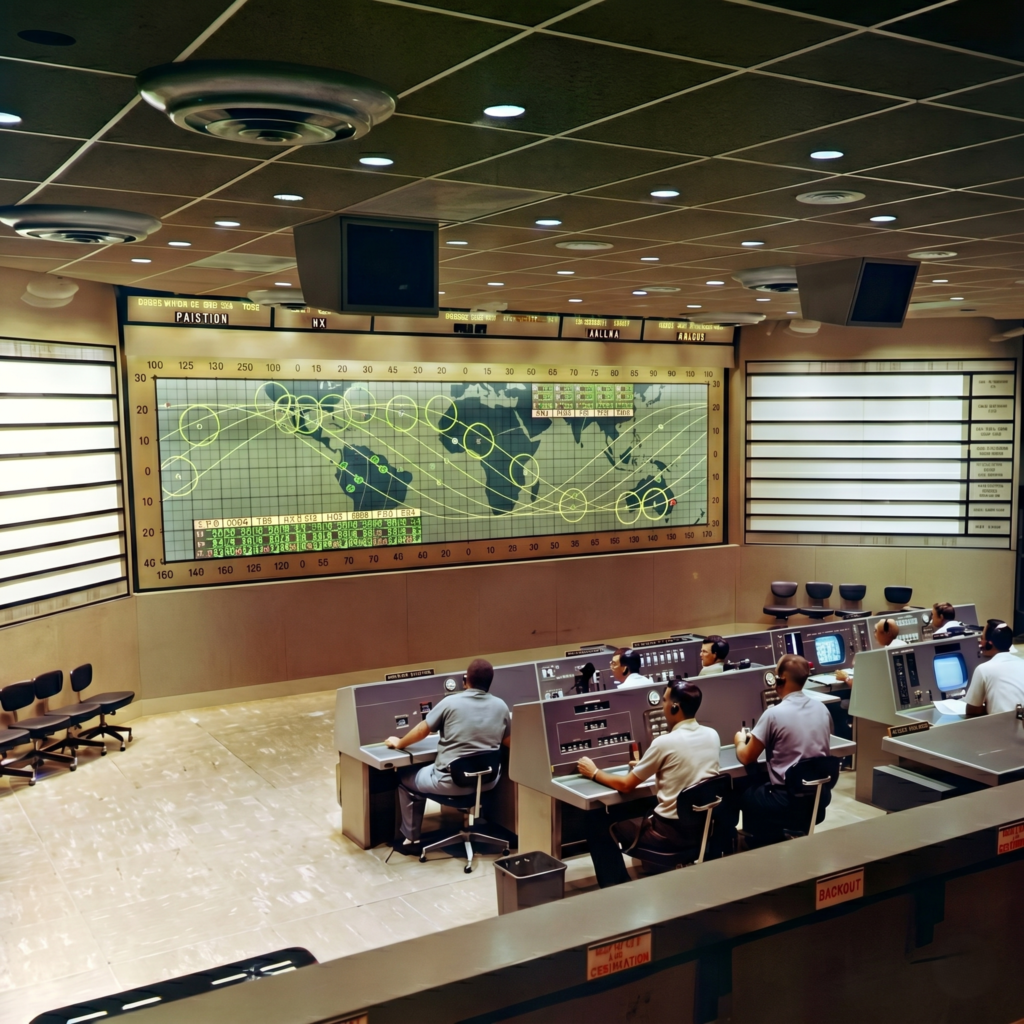
    It was February 20, 1962. IBM’s 7090 — a computer the size of a living room — had processed the orbital trajectory and returned its verdict: safe. Every engineer in the building was ready. The countdown clock was running. And Glenn, strapped into Friendship 7 seventy feet above the Florida coast, asked for one specific person. Not about fuel pressure. Not about weather. A person. And he made it plain: if she didn’t check the numbers herself, he wasn’t going anywhere.

    Her name was Katherine Johnson. And almost nobody outside that building knew she existed.

    The Building Had Two Americas Inside It

    Langley Research Center in Hampton, Virginia looked like one place. It was not. There were two cafeterias. Two sets of bathrooms. Two sides of the same American dream, separated by a painted sign that read “Colored Computers.” That sign hung on a door at the end of a hallway. Behind it, a group of Black women did the same mathematics as the white men across the building — and in many cases, did it better.

    Katherine Johnson arrived at Langley in the summer of 1953. She had graduated from West Virginia State College at eighteen, summa cum laude, with degrees in both mathematics and French.

    She had taught school for years. She was, by any measure, one of the most capable mathematical minds the National Advisory Committee for Aeronautics had ever hired. None of that changed where she was allowed to eat lunch.

    Every morning, Johnson walked the length of a corridor — approximately 800 meters round trip — to use the bathroom designated for Black women. On cold mornings, she felt it in her fingers. On rainy afternoons, she felt it in her shoes. She never complained about it publicly. She went to the bathroom, she came back, and she kept working. According to NASA’s own biographical records and Margot Lee Shetterly’s research, the segregated facilities at Langley were not formally abolished until 1958, when NACA became NASA.

    The system was comfortable. The math kept coming out right. Nobody had to change anything.

    She Wasn’t Supposed to Be in the Room — So She Never Left

    In 1958, Johnson was temporarily assigned from the all-Black West Area Computing pool to assist a flight research team. The assignment was supposed to last a few weeks. It lasted the rest of her career. She had asked to attend the team’s technical briefings. Women didn’t attend those briefings. She kept asking. According to NASA’s archival records, she was eventually allowed in — and she never stopped going.

    The system wasn’t broken for Johnson. It was working exactly as designed. She was paid less. She was excluded from credit. In 1960, she co-authored a research report with engineer Ted Skopinski on orbital spaceflight trajectories — the first time a woman in the Flight Research Division received authorship on a Langley technical paper. One paper. After years of calculations that had already shaped the early space program.

    Her specialty was trajectory analysis. Where a spacecraft needs to be, how fast, at exactly what re-entry angle so it lands in the recovery zone instead of burning up or skipping into permanent orbit. Get it slightly wrong — a fraction of a degree, a rounding error compounded across orbital mechanics — and the capsule doesn’t come home.

    Some nights, after everyone else had gone, she stayed. The hallway outside went quiet. The cleaning crew came through. She turned back to the page. Erased something. Wrote it again. The numbers had to be right, and she was the only person in that building who could know for certain whether they were.

    “Get the Girl” — Four Words That Stopped a Countdown

    The phrase was recorded. Glenn’s own account, preserved in NASA oral history archives and confirmed in Shetterly’s research, is that he told supervisors: “Get the girl to check the numbers.” In 1962, in the language of that building, “the girl” meant Katherine Johnson specifically. The engineers knew exactly who he meant.

    IBM’s 7090 had calculated the trajectory correctly given the data it received. Johnson’s job was to verify that the data, the equations, and the assumptions behind both were actually correct. She worked through the same calculations by hand, on a mechanical desktop Frieden calculator, cross-referencing the computer’s output against her own derivations. She confirmed the numbers. Glenn flew. Three orbits. Safe return.

    The machine was faster. She was right.

    In 1962, the most advanced computing technology the United States government operated was not trusted by its own astronaut unless a Black woman with no title on her door confirmed it.

    Glenn had passed hundreds of people inside that building. Most of them he would never remember. But before climbing into space, there was one person he trusted enough to bet his life on. Nobody in that room asked him to.

    The Moon Landing Was a Calculation Before It Was a Moment

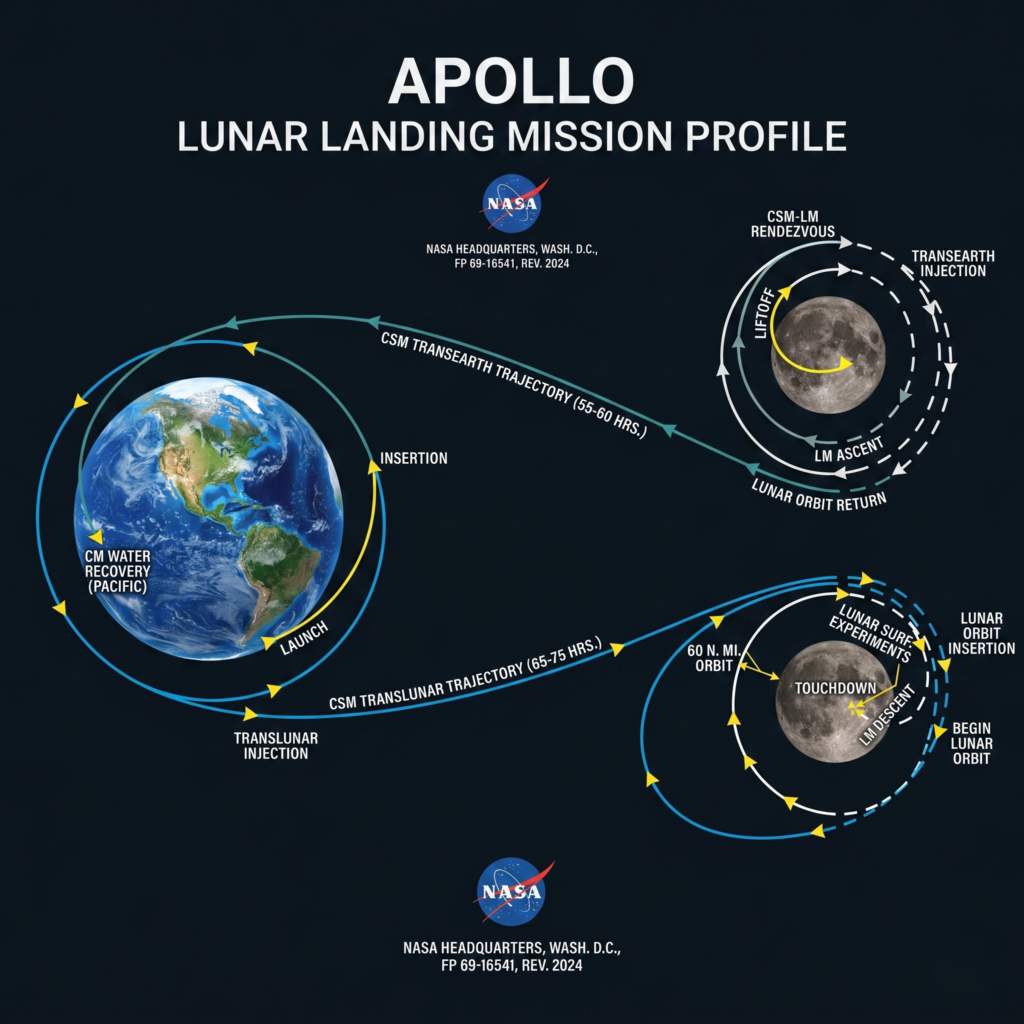
    By 1969, Johnson had been at NASA for sixteen years. Her specific contribution to Apollo 11 — confirmed by NASA’s own mission documentation — was the trajectory that allowed the lunar module Eagle to lift off from the moon’s surface, rendezvous with the command module Columbia in lunar orbit, and return to Earth on a path precise enough to hit the re-entry corridor. Miss that corridor in either direction and the spacecraft either burns or bounces. There is no second attempt from 240,000 miles away.

    The mathematics already existed before Apollo 11 had a launch date. Johnson had worked out the rendezvous path on paper, at a desk in Hampton, Virginia, while the mission was still a political speech and a budget request. The lunar module ascent engine would fire for approximately seven minutes. The burn had to place Eagle into a trajectory intersecting with Columbia — a target moving at roughly 3,700 miles per hour, 60 nautical miles above a surface no human had ever touched.

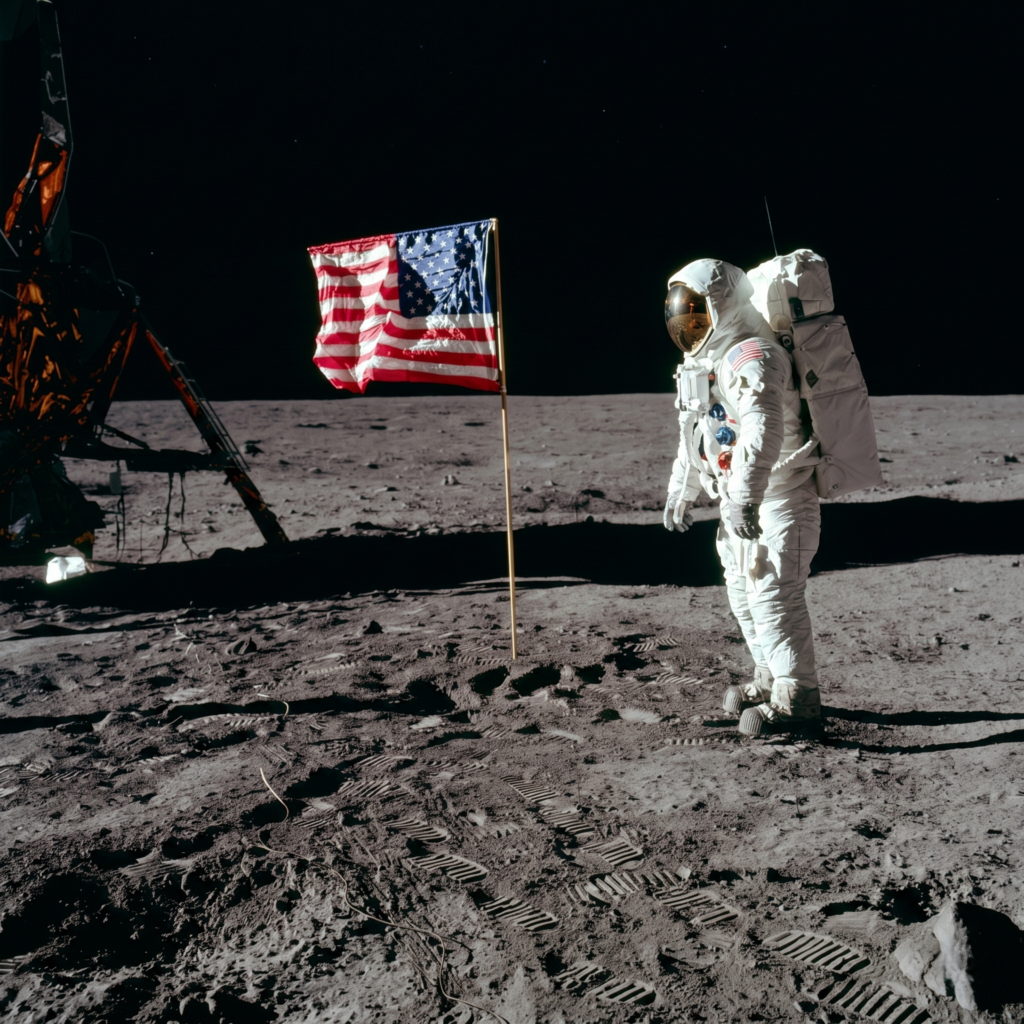
    Neil Armstrong stepped onto the lunar surface on July 20, 1969. The moment was broadcast to an estimated 530 million people, according to NASA historical records. Photographs of his bootprints became some of the most reproduced images in human history. Johnson was not in the photographs. She was not in the broadcast. She was a name on a technical report that most people who watched the moon landing had never heard.

    The world watched the moon. She stayed with the calculations. She was usually still inside the building long after sunset.

    The decisions that kept men alive in space were not made in front of cameras. They were made at a desk covered in pencil shavings, with the eraser worn down to nothing.

    The Recognition Came. Decades After the Work Was Already Done.

    In 2015, President Barack Obama awarded Katherine Johnson the Presidential Medal of Freedom — the highest civilian honor in the United States. She was 97 years old. She arrived in a wheelchair. The room gave her a standing ovation.

    Johnson spent 33 years at NASA, from 1953 to 1986. The Presidential Medal of Freedom arrived 29 years after she retired. The Congressional Gold Medal — awarded to Johnson, Dorothy Vaughan, Mary Jackson, and Christine Darden — came in 2019, when Johnson was 100 years old. The building named after her at Langley, the Katherine G. Johnson Computational Research Facility, was dedicated in 2016.

    A society that allows a person to do the work for three decades, then waits another three to say thank you, has not simply overlooked someone. It has made a choice about whose contributions are urgent and whose can wait.

    The medal exists. The math existed first. Thirty-three years of it, written by hand, in a building that made her walk 800 meters to find a bathroom with her name on it. Congress awarded the gold in 2019. The calculations were done in 1953. The distance between those two dates is not an oversight. It is a record.

    Where the Story Gets Complicated — and Why That Matters

    The story of Katherine Johnson has been amplified significantly since the 2016 film Hidden Figures, and that amplification has introduced distortions worth naming. The film depicts Johnson manually delivering calculations to a control room during Glenn’s live countdown. The historical record, including the Smithsonian National Air and Space Museum’s own editorial assessment, indicates the verification process happened in the days before launch — not during the countdown itself. The Mercury Control Center was located at Cape Canaveral in Florida, not at Langley in Virginia, as the film implies.

    None of this changes the core fact. Glenn requested Johnson’s verification. She performed it. He flew. The calculation was hers.

    The response followed a familiar pattern. When a story about a marginalized person gains cultural traction, there is often a reflexive effort to locate the inaccuracies and use them to diminish the whole. The inaccuracies in Hidden Figures are real and minor. The central truth — that a Black woman’s mathematics played a critical role in American human spaceflight, and that her name was absent from the public record for decades — has not been disputed by any credible historical source.

    Archive Notes

    Did John Glenn really refuse to fly without Katherine Johnson’s confirmation?

    Yes. According to NASA’s official biography of Johnson and Glenn’s own recorded accounts, he requested that she personally verify the IBM computer’s trajectory calculations before his February 1962 Friendship 7 mission. His stated position, documented in NASA oral history archives, was that if Johnson confirmed the numbers were correct, he was ready to go. She confirmed them. He flew.

    What exactly did Katherine Johnson calculate for Apollo 11?

    Johnson calculated the trajectory for the lunar module’s ascent from the moon’s surface, its rendezvous with the command module in lunar orbit, and the transearth injection burn that placed the spacecraft on its return path to Earth. According to NASA’s Apollo mission records, she also developed backup navigation charts that astronauts could use if electronic systems failed — contingency work that proved critical during Apollo 13’s emergency return in 1970.

    When did NASA stop segregating its facilities?

    Segregated facilities at NASA’s Langley Research Center — including separate bathrooms, cafeteria sections, and the designated West Area Computing office for Black women — were formally abolished in 1958 when NACA became NASA. Dorothy Vaughan had been appointed supervisor of the West Area Computing unit in 1949, becoming the first Black supervisor at NACA. The segregation had been in place for approximately fifteen years from when Black women were first hired in significant numbers during World War II.

    The Calculation Behind the Moon

    The moon landing was not one moment. It was thousands of calculations, most of them made by people whose names were never projected onto any wall. No camera pointed at her desk when it happened. Katherine Johnson’s pencil reached the moon before any rocket did — and the country that sent her to that bathroom 800 meters away was the same country that could not have gotten there without her.

    Tip For Readers

    Johnson’s original technical reports are publicly available. Her 1960 paper co-authored with Ted Skopinski — Determination of Azimuth Angle at Burnout for Placing a Satellite Over a Selected Earth Position — is accessible through the NASA Technical Reports Server. Reading the actual document is a different experience than reading about it.

    Verified Sources

    NASA Langley Research Center — Katherine Johnson Official Biography, compiled by Margot Lee Shetterly, 2016
    NASA History Division — Mercury-Atlas 6 Mission Record (Friendship 7), February 20, 1962
    NASA History Division — Apollo 11 Mission Report, 1969
    NASA Technical Reports Server — Skopinski, T.H. and Johnson, K.G., “Determination of Azimuth Angle at Burnout for Placing a Satellite Over a Selected Earth Position,” 1960
    Smithsonian National Air and Space Museum — “Katherine Johnson, Hidden Figures, and John Glenn’s Flight,” editorial analysis, 2017
    NASA Science — Katherine Johnson (1918–2020), official career record, 2020
    White House Office of the Press Secretary — Presidential Medal of Freedom Ceremony, November 24, 2015
    United States Congress — Congressional Gold Medal Act, Public Law 116-9, 2019

    All images sourced from NASA public domain archives. Images 1, 2, 4, 7 digitally colorized for editorial illustration purposes by Vella Team; not part of the original scientific or photographic record. Image 3: NASA Headquarters official mission profile diagram, unmodified. Image 5: NASA/Neil Armstrong, Public Domain. Image 6: AI-generated conceptual illustration based on the Congressional Gold Medal awarded to Katherine Johnson, 2019; not a photograph of the physical object. No Getty, AP, or agency-watermarked images were used.

  • The Red Planet’s Secret: Mars Hides One of the Most Blue-Toned Sunsets in the Solar System

    The Red Planet’s Secret: Mars Hides One of the Most Blue-Toned Sunsets in the Solar System

    Mars is red. The surface is red. The dust is red. The storms are red. For over a century, “Red Planet” has been treated as a complete description — a fact so settled that it remained largely unquestioned, even as the sun went down over that rust-colored horizon.

    That assumption held for longer than powered flight has existed. No instrument had ever watched a Martian sunset in color. The planet had been labeled and filed away. That label missed one thing.

    On April 15, 2015, a machine the size of a car — alone on a crater floor, 225 million kilometers from the nearest human being — turned its cameras toward the horizon and recorded something the label had never predicted. The sky around the descending sun was not red. Not orange. Blue.

    Mars full-disk view. Every feature — the rust-colored plains, the polar ice cap, the ancient canyon systems — owes its color to iron oxide. The surface earned the name. The sky at sunset did not. Source: NASA/JPL-Caltech

    One Machine, One Crater, No One Watching

    In 2015, humans could not go to Mars. The technology did not exist, and the distance — ranging from 56 million to 401 million kilometers depending on orbital position — made a round trip measured in years, not months. What humanity had sent instead was a six-wheeled robotic laboratory called Curiosity, part of NASA’s Mars Science Laboratory mission, which had been operating in Gale Crater since August 2012.

    Curiosity moved slowly across a landscape that had not been touched by anything alive in billions of years, if ever. No wind sound registers on the surface the way it does on Earth — the atmosphere is too thin, roughly one percent the density of Earth’s, to carry sound in any meaningful way. The rover operated in something close to silence, its movements tracked from 225 million kilometers away by engineers at JPL who sent commands and waited minutes for confirmation that the machine had received them.

    On Sol 956 — the 956th Martian day of the mission — Curiosity’s Mastcam received instructions to photograph the sunset. The camera system was designed to match human color vision as closely as possible, calibrated against color targets mounted on the rover’s body. When the frames came back, the engineers looked at what the machine had seen.

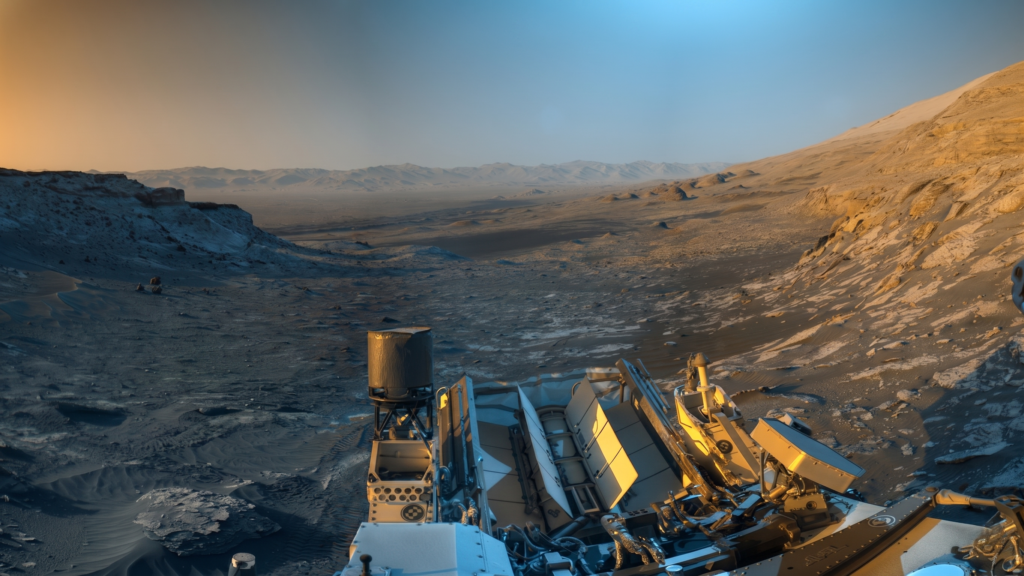
    Curiosity rover self-portrait on the Martian surface, showing the rust-colored terrain and the brownish-pink daytime sky produced by suspended iron oxide dust. The same dust that gives Mars its daytime appearance produces a different optical effect at sunset. Source: NASA/JPL-Caltech/MSSS

    Something Was Wrong With the Color

    The frames arrived. The sun was small and intensely bright near the horizon. Around it, the sky carried a color that did not match the planet’s name. Not orange. Not the expected extension of the rust tones that saturate every daytime image from the Martian surface.

    Blue.

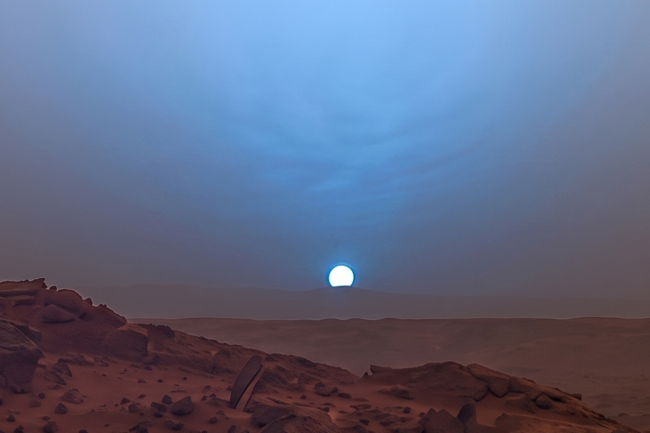
    A cold, concentrated blue — clustered around the sun’s position in the sky, fading to pale orange further out, then to the dull brownish-pink haze higher in the atmosphere. The machine had recorded something that no human eye had seen and no instrument had previously captured in calibrated color on the surface of another planet. The image was not a processing error. The calibration targets confirmed it. What Curiosity recorded was, as accurately as 2015 imaging technology could render it, what a human standing in Gale Crater on that afternoon would have seen with their own eyes.

    This raises a question that the “Red Planet” label had suppressed for over a century: if the planet is red, why is its sunset blue?

    Curiosity rover deck view during lower dust activity. The blue tone at the upper atmosphere hints at the optical conditions that produce the blue concentration at sunset. Source: NASA/JPL-Caltech/MSSS

    This raises a critical question: how many “known facts” have never been directly observed at the surface level?

    Mars Does the Opposite of Earth — and the Physics Explains Why

    Earth’s atmosphere is composed primarily of nitrogen and oxygen molecules. When sunlight enters that atmosphere, those molecules scatter shorter wavelengths — the blues — in every direction across the sky. That scattered blue is what makes the daytime sky appear blue. At sunset, sunlight must travel through a much longer column of atmosphere to reach human eyes. By then, most of the blue has scattered away. What survives the long passage is the red and orange end of the spectrum. Earth’s sunset spreads across the whole sky like a watercolor wash — color bleeding outward in every direction from the horizon.

    Mars works in the opposite direction. Its atmosphere is approximately 95 percent carbon dioxide, roughly 100 times thinner than Earth’s, with no significant nitrogen or oxygen. What it contains in large quantities is fine iron oxide dust — particles small enough to remain suspended for months, circulating in storms that periodically cover the entire planet. According to NASA Jet Propulsion Laboratory analysis of the Curiosity Mastcam imagery, these dust particles are sized to scatter and absorb longer red wavelengths while allowing blue light to pass through more efficiently. At sunset, when sunlight travels the longest available path through the Martian atmosphere, blue light survives. It concentrates near the sun’s direction rather than spreading outward. The result is not a wash of color across the whole sky. It is a single concentrated point of blue — a stage spotlight aimed at one precise location on the horizon.

    Same sun. Same light. Opposite result.

    The Martian blue sunset: the sun descends as the surrounding sky carries a concentrated blue halo produced by iron oxide dust scattering. The rust-colored terrain in the foreground is made of the same material responsible for the optical reversal — the dust that makes Mars red by day makes it blue at dusk. Source: NASA/JPL-Caltech/MSSS — PIA19401 sequence, Sol 956, Gale Crater, 2015

    Earth Spreads Color. Mars Focuses It.

    This isn’t a small difference. It works the opposite way.

    On Earth, sunset color spreads. Blue scatters first, then green, leaving orange and red to dominate as the sun approaches the horizon. The color fans outward across clouds, across water, across the whole visible sky. The entire dome above shifts toward the warm end of the spectrum. An Earth sunset is a spectacle of expansion — light filling space.

    On Mars, sunset color contracts. The dust particles filter out red and orange, leaving blue light to concentrate in the narrow cone of sky around the descending sun. The rest of the sky remains its usual brownish-pink. The blue does not spread. It holds its position, tight and cold, around the single point where the sun meets the horizon.

    This shows how an assumption can hide a physical reality. The dust that earned Mars its name is the same material that produces the blue. The cause of the red is the cause of the blue. The label was correct about the surface and wrong about the sky — not because the science was absent, but because no instrument had directly captured it in calibrated color.

    It also shows how easily humans trust labels over observation. A name given in the 1800s, from a telescope on Earth, shaped what an entire civilization assumed about the sky on another planet for over a century.

    This raises another question: what else have we labeled without ever seeing it directly?

    An Earth sunset over open ocean: color spreads across the entire sky as atmospheric molecules scatter blue light away, leaving red and orange wavelengths to dominate. On Mars, the same process runs in reverse. Source: Public Domain

    One Hundred Years of an Untested Label

    Mars received its color identity from Earth-based telescopes in the nineteenth century. Astronomer Giovanni Schiaparelli mapped the planet’s visible features in the 1870s and described the reddish coloration correctly identified as iron oxide coating the surface and suspended in the atmosphere. That observation was accurate as far as it went. But it went only as far as a telescope pointed across millions of kilometers of space could reach.

    The 1976 Viking landers sent back color images from the Martian surface, but the color processing of those images became a documented dispute. Initial releases showed a blue-tinted sky. The processed versions released to the public showed orange. The debate continued in the scientific literature for years. The specific phenomenon of the blue sunset — the concentration of blue light near the sun at low sun angles — was not documented until Curiosity’s Mastcam recorded it in April 2015.

    NASA’s Perseverance rover, which landed in Jezero Crater in February 2021, subsequently captured color sunset images confirming the blue halo phenomenon at a location approximately 3,700 kilometers from Gale Crater. The consistency across two separate missions reinforces that the effect is a global characteristic of Martian atmospheric optics, not a local anomaly.

    Mars had been producing blue sunsets every day for billions of years. There was no one there to see them, and no calibrated instrument on the surface capable of recording them in color until Curiosity turned its cameras west on Sol 956.

    What the Images Show — and What They Do Not

    The blue coloration in the Curiosity sunset images is real and the calibration is documented. The JPL color correction process removed camera artifacts using the calibration targets mounted on the rover body, and the methodology has been reviewed by the Mars Science Laboratory science team. The blue halo around the sun is a genuine atmospheric optical effect.

    The effect is, however, localized. Blue appears in the region of sky immediately surrounding the sun at low angles. The broader Martian sky during daytime, and at positions further from the sun during sunset, retains the characteristic brownish-pink hue from suspended dust. Mars does not have a blue sky the way Earth does. What it has, for a few minutes each evening and morning, is a blue sun against a rust-colored atmosphere.

    The distinction carries practical weight. NASA’s current long-range mission documentation identifies a crewed Mars landing as a target for the 2030s. Understanding how dust, light, and atmospheric conditions interact at the surface — including how solar panel efficiency varies with dust load and how human visual perception functions in reversed lighting conditions — is part of the engineering problem that any crewed mission will need to resolve. The blue sunset is data, not only spectacle.

    Frequently Asked Questions

    Q. Is the blue color in Mars sunsets real, or a result of image processing?

    A. The blue color is real. NASA’s Jet Propulsion Laboratory calibrated the Curiosity Mastcam images using documented color correction methods and physical calibration targets mounted on the rover. The blue halo around the sun during Martian sunset is a genuine atmospheric optical effect produced by iron oxide dust particles scattering blue wavelengths more efficiently than red wavelengths at low sun angles. The calibration methodology is described in JPL mission documentation and has been reviewed by the Mars Science Laboratory science team.

    Q. Does Mars have a blue sky during the day as well?

    A. No. The blue sunset effect is specific to low sun angles — sunrise and sunset — when sunlight travels through the longest available path in the Martian atmosphere. During daytime, the same iron oxide dust that concentrates blue light near the sun at dusk instead produces the characteristic pale brownish-pink sky color visible in Curiosity and Perseverance daytime imagery. The blue is a transitional effect present only during the narrow window when the sun is near the horizon.

    Q. Have other Mars missions confirmed this observation?

    A. Yes. NASA’s Perseverance rover, which landed in Jezero Crater in February 2021, captured color sunset images confirming the blue halo effect documented by Curiosity in 2015. The two missions operated at locations approximately 3,700 kilometers apart on the Martian surface. The consistency of the observed effect at both locations supports the interpretation that the blue Martian sunset is a global characteristic of Martian atmospheric optics rather than a location-specific phenomenon.

    What You Now Know

    Mars produces a blue sunset every day. It has done so for billions of years. The first human instrument to record one in calibrated color did so on April 15, 2015, in Gale Crater, in four frames taken over 6 minutes and 51 seconds. The mechanism is documented: iron oxide dust particles scatter red light outward while concentrating blue light near the direction of the descending sun. The dust that gives Mars its name is the same dust that produces the blue.

    The Red Planet was not red at the moment that mattered most. It had been hiding its bluest moment every single day — and for over a century, no one had been there to see it.

    Tip For Readers

    The original Curiosity sunset images — catalog number PIA19401 — are publicly available in full resolution at NASA JPL Photojournal. The four-frame sequence is best viewed at full resolution, where the color difference between the blue near-sun region and the surrounding orange-pink sky is significantly more visible than in compressed reproductions. Perseverance sunset imagery is available through the NASA Mars 2020 raw image archive. Both collections are US Government works with no copyright restriction.

    Verified Sources

    NASA Jet Propulsion Laboratory, Mars Science Laboratory Mission — “NASA’s Curiosity Rover Views Serene Sundown on Mars,” official press release, 2015
    NASA Jet Propulsion Laboratory Photojournal — PIA19401: Sunset Sequence in Mars’ Gale Crater, image catalog entry and technical calibration notes, 2015
    NASA Jet Propulsion Laboratory, Mars Science Laboratory Mastcam Team, Texas A&M University — Sol 956 color-calibrated image sequence and atmospheric optical analysis, 2015
    NASA Mars 2020 Mission, Mastcam-Z Science Team — Perseverance rover sunset color imagery and atmospheric confirmation data, Jezero Crater, 2021
    NASA Science, Mars Exploration Program — Mars Atmosphere and Climate reference documentation, 2023

  • The Exposed Cranium Nebula: Why This Dying Star Looks Like a Human Brain

    The Exposed Cranium Nebula: Why This Dying Star Looks Like a Human Brain

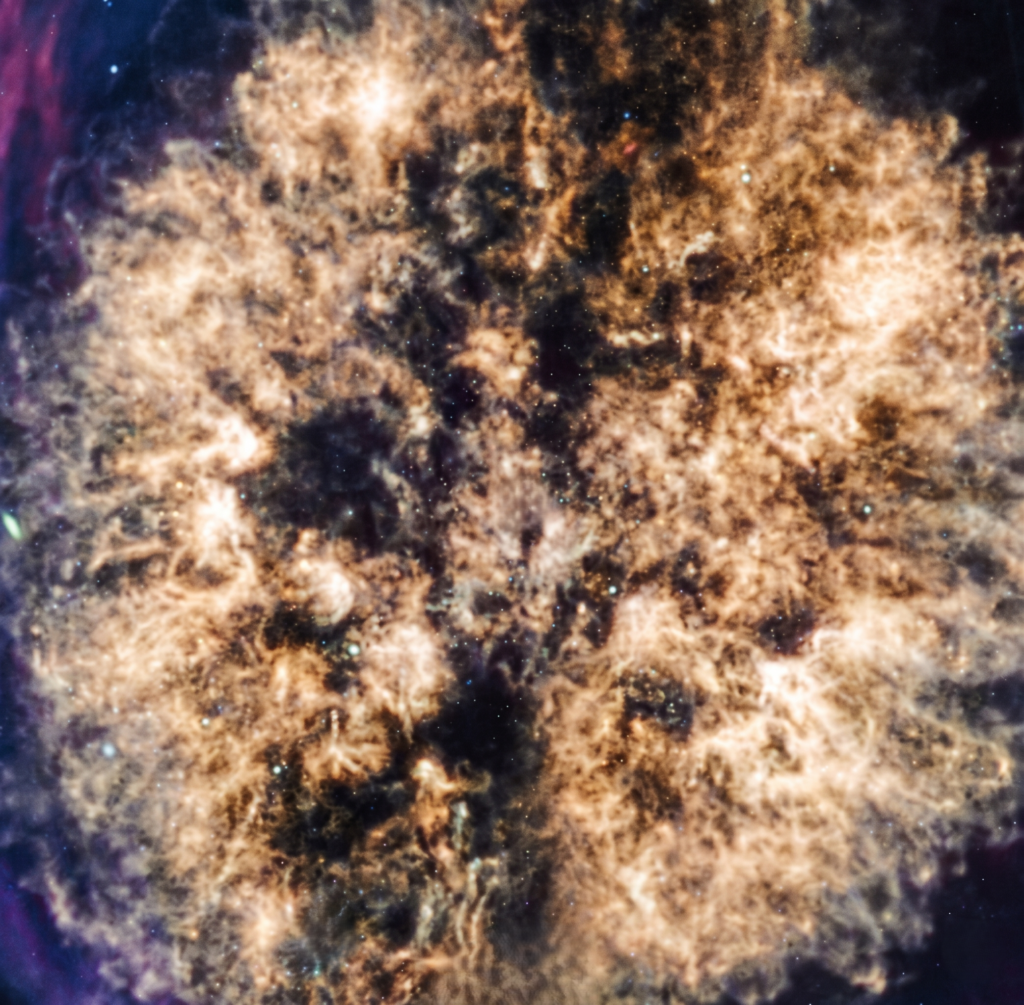
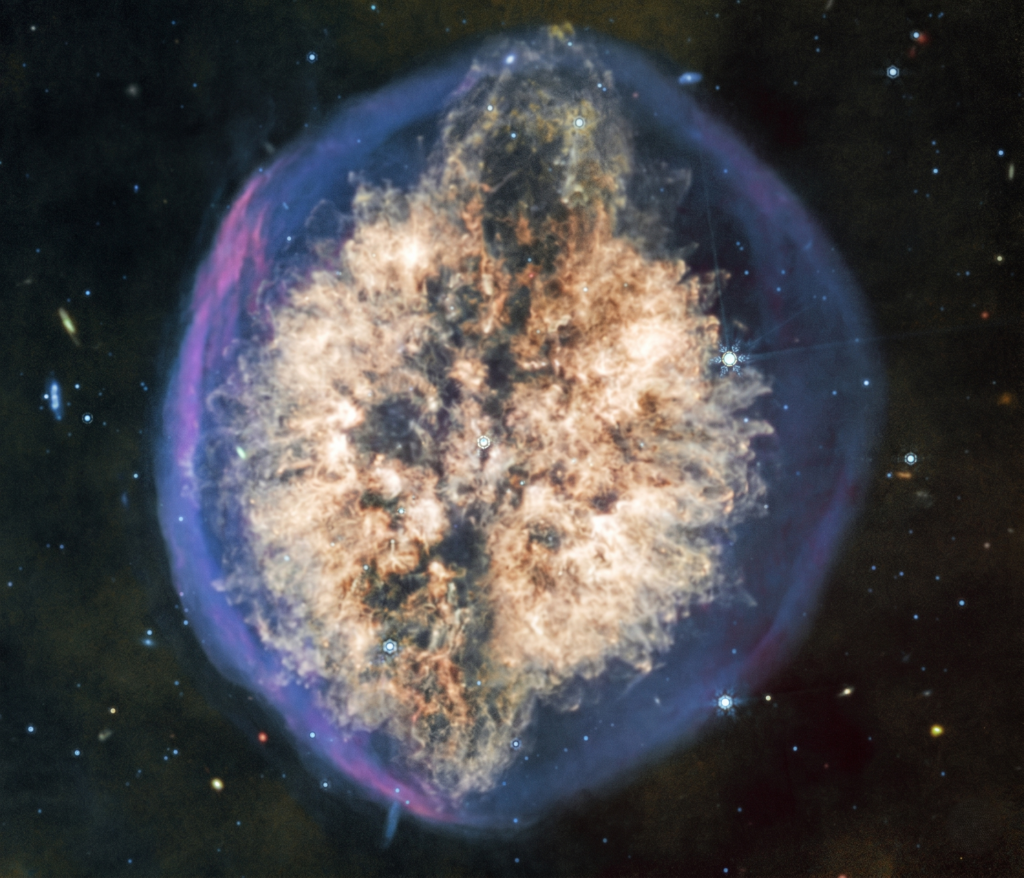
    On February 25, 2026, NASA released new James Webb Space Telescope images of PMR 1, a planetary nebula located approximately 5,000 light-years from Earth in the constellation Vela. Many viewers initially thought they were looking at a medical scan. A pale outer bubble reads as a skull. Two glowing inner regions suggest hemispheres of tissue. A dark vertical lane runs down the center like the brain’s longitudinal fissure. To the naked eye, the structure looks remarkably like the internal folds of a human brain. What it actually is, however, is a cloud of gas and dust — the slow-motion disintegration of a star that has been dying for thousands of years.

    This pattern has a physical explanation. The resemblance to a brain is not coincidence in any mysterious sense — it is a product of gas dynamics, ejection geometry, and the specific infrared wavelengths in which Webb observes. What matters more is not the resemblance itself but what the image reveals about the object and the limits of how well we currently understand it.

    PMR 1, the Exposed Cranium Nebula, captured by the James Webb Space Telescope’s MIRI instrument, February 2026. Source: NASA, ESA, CSA, STScI; Image Processing: Joseph DePasquale (STScI). CC BY 4.0 (Public Domain equivalent for NASA imagery). The pale outer shell is an older hydrogen layer; the inner glowing regions are denser mixed gases ejected in a later phase of the star’s evolution.

    What Planetary Nebulae Actually Are

    Planetary nebulae are among the more misleadingly named objects in astronomy. They have nothing to do with planets. The term dates to the 18th century, when early telescopes produced low-resolution images and these glowing clouds looked vaguely like the disk of Uranus or Neptune. The name stuck after the true nature of these objects was understood. All planetary nebulae are remnants of dying stars, unconnected to planets in any way.

    PMR 1 — also cataloged as IRAS 09269-4923 — is one of these objects. It sits approximately 5,000 light-years from Earth in the constellation Vela, the Sails, a region of the southern sky named after a Roman warship. The nebula spans roughly 3.2 light-years across, meaning that light takes more than three years to travel from one side of the structure to the other. The star at its center is in active decline, losing mass at a measurable rate and exposing its hot inner core to the surrounding gas.

    That exposed core is the reason the nebula glows. Ultraviolet radiation from the hot central star ionizes the surrounding gas, causing it to emit light at specific wavelengths. Different gases emit at different wavelengths, which is why Webb’s infrared instruments — each sensitive to different parts of the spectrum — revealed different details within the same structure. What looks uniform to the eye is, in infrared, a layered record of the star’s history of mass loss.

    The structure reflects the star’s history of mass loss recorded in surrounding gas.

    The Features That Produce the Brain-Like Shape

    The pale outer bubble visible in the Webb image is not a skull. It is an older shell of hydrogen gas, ejected first during an earlier phase of the star’s mass loss, expanding outward and now forming the outermost boundary of the nebula. The two glowing inner regions that suggest brain hemispheres are not tissue. They are denser clouds of heavier mixed gases, ejected during a later phase of the star’s evolution, still closer to the center and glowing more brightly under the radiation of the exposed core.

    The dark vertical lane running down the center of the structure — the feature most responsible for the brain-like appearance — is likely not a gap in the gas. Current analysis suggests it is connected to a jet or outflow driven by the central star. In NIRCam imagery, it reads as a sharp dark streak. In MIRI imagery, that streak appears connected to paired eruptions at the top and bottom of the nebula, consistent with a bipolar outflow: material being ejected in two opposing directions along the star’s polar axis. The brain’s apparent central fissure is, in this reading, an active structure rather than an absence.

    The bright dense region at the core — what some descriptions compare to a brain stem — is the dying star itself, still shedding its outer layers and driving the entire visible structure through its radiation. The faint objects visible in the background of the NIRCam image are actual background stars and distant galaxies, visible through the outer shell of the nebula. The nebula is transparent enough at those wavelengths to show what lies behind it at 5,000 light-years’ distance.

    The observed structure is explained by geometry, timing, and infrared wavelength, not biological processes.

    What Webb Revealed That Spitzer Could Not

    PMR 1 was featured in a Spitzer Space Telescope release in 2013, when scientists first popularized the nickname Exposed Cranium. Spitzer’s resolution was limited, however, and for more than a decade the nebula remained a curiosity with a striking nickname and relatively little structural detail behind it.

    Webb changed that on February 25, 2026. Using two separate instruments — NIRCam, sensitive to near-infrared wavelengths, and MIRI, sensitive to mid-infrared — the telescope captured the nebula at a resolution and sensitivity that Spitzer could not match. Webb’s primary mirror is 6.5 meters across, roughly 2.5 times the diameter of Spitzer’s. Webb also operates at significantly lower temperatures, reducing interference from the telescope’s own infrared emission and allowing it to detect fainter signals in the mid-infrared range. This type of multi-wavelength comparison is one of Webb’s key capabilities, and PMR 1 is a useful demonstration of why it matters.

    NIRCam’s image shows the outer shell, the glowing inner clouds, and thousands of background stars and galaxies visible through the gas. MIRI’s view suppresses much of that background and instead emphasizes the nebula’s dustier, cooler material, including the bipolar outflow structure at the top and bottom. The dark central lane looks different in each image, revealing that what reads as a simple gap in one wavelength is a dynamically active structure in another. Thirteen years passed between Spitzer’s first close look and Webb’s corrected one.

    PMR 1 in wider context, captured by Webb’s NIRCam instrument, February 2026. Source: NASA, ESA, CSA, STScI; Image Processing: Joseph DePasquale (STScI). CC BY 4.0. Background stars and distant galaxies are visible through the nebula’s outer shell, demonstrating its partial transparency at near-infrared wavelengths.

    Two Stages of Dying, Visible at Once

    The Webb image captures multiple stages of the star’s evolution simultaneously, which is one of the features that makes PMR 1 scientifically useful. Stars in the late stages of their lives do not shed material at a constant rate. They go through multiple episodes of mass loss, each with different velocity, composition, and direction. The outer shell of PMR 1 is older material — mostly hydrogen, ejected first and expanding outward for longer. The inner cloud is more recent, consisting of a denser, more complex mix of gases including heavier elements produced during later stages of nuclear burning.

    What makes PMR 1 notable among planetary nebulae is that both layers happen to sit at angles and distances that produce the specific visual geometry visible in the image. The alignment is a product of the viewing angle from Earth, not an inherent symmetry in the object itself. Viewed from a different angle, the same nebula would look entirely different. The brain resemblance is, among other things, a consequence of the particular direction from which the constellation Vela happens to face Earth.

    Most planetary nebulae do not appear this way, and the observed shape depends on the viewing angle from Earth.

    What Happens Next — and Why It Is Not Yet Known

    The future of PMR 1 depends on the mass of the central star, which has not been determined with certainty. Some reports describe the central star as Wolf-Rayet-like — a classification associated with very high surface temperatures and strong, rapid mass loss — though its exact classification and current mass remain under investigation.

    If the mass is low enough, the star will keep shedding layers until only a white dwarf remains — an Earth-sized core that stays incredibly dense as it cools over billions of years. That is the expected outcome for stars similar to or somewhat more massive than the Sun. If the central star proves to be unusually massive, a supernova remains one possibility, though astronomers have not confirmed that scenario. Under that outcome, rather than a slow fade, the core would collapse under its own gravity and rebound in a shockwave that briefly outshines the entire galaxy.

    Astronomers are still actively investigating which path PMR 1 will take. This uncertainty is part of why Webb’s data is scientifically valuable — it provides a high-resolution baseline from which to track how the star and surrounding gas change over time. A single image is not sufficient for full interpretation, and continued observation will be required.

    What the Brain Resemblance Actually Tells Us

    The tendency to see familiar shapes in astronomical images is called pareidolia — a well-documented feature of human visual processing in which the brain actively searches for patterns, particularly faces and body structures, in ambiguous stimuli. The Exposed Cranium Nebula is a case where that tendency aligns with a genuine structural coincidence: the gas dynamics of a dying star, viewed from a specific angle, at a specific wavelength, happened to produce an image that mirrors a biological structure on the scale of centimeters. The star is 5,000 light-years away and roughly 3.2 light-years across. The brain it resembles fits inside a skull.

    This highlights a question about how astronomical images are interpreted when widely shared. The image of PMR 1 spread widely because it looks like a brain. The scientific content — the bipolar outflow, the multi-phase mass loss, the unresolved question of the central star’s fate — received considerably less attention. Webb will release many more images in the coming years. The visual impact of those images and their scientific content are not always the same thing, and they are frequently reported as if they were.

    FAQ

    Q: Why is it called a planetary nebula if it has nothing to do with planets?

    A: The term dates to the 18th century. Early telescopes produced low-resolution images, and these glowing clouds looked to astronomers of that era like the visual disk of planets such as Uranus. The name persisted after the true nature of these objects was understood. All planetary nebulae are remnants of dying stars, unconnected to planets.

    Q: How does Webb see things that Spitzer could not?

    A: Webb’s primary mirror is 6.5 meters across, roughly 2.5 times the diameter of Spitzer’s. Webb also operates at significantly lower temperatures, which reduces interference from the telescope’s own infrared emission and allows it to detect fainter signals. The result is considerably sharper images across a wider range of the infrared spectrum.

    Q: Could the star at the center of PMR 1 become a black hole?

    A: Only if it is sufficiently massive. Stars below roughly 8 to 10 solar masses typically end as white dwarfs. More massive stars can produce neutron stars or black holes depending on the core mass at collapse. The central star of PMR 1 has been described as Wolf-Rayet-like in some coverage, implying high mass loss rates, but its current mass and final fate remain undetermined as of April 2026.

    What You Now Know

    PMR 1 is a planetary nebula located approximately 5,000 light-years from Earth in the constellation Vela, spanning roughly 3.2 light-years. Webb captured it on February 25, 2026 using both NIRCam and MIRI instruments, producing the highest-resolution images of the object to date. The brain-like appearance results from two distinct phases of mass loss — an older outer hydrogen shell and a more recent, denser inner cloud — separated by a dark lane that current analysis connects to a bipolar outflow from the central star. The mass of that central star has not been determined, and whether it will end as a white dwarf or follow a different path remains an open question. The Wolf-Rayet-like classification referenced in some coverage has not been formally confirmed. Planetary nebulae like PMR 1 are the visual record of how stars similar to the Sun end — and the universe produces these structures without reference to biology.

    Tip for Readers

    In images of space that resemble familiar objects — a skull, a face, a human organ — the resemblance is always a product of viewing angle, wavelength selection, and the human tendency to find patterns in ambiguous shapes. When a Webb image stops you because of what it looks like, it is worth asking separately what physical process produced the shape. Those are two different questions, and popular coverage frequently answers only the first one.

    Verified Sources

    NASA Science, Astrophysics Division — “NASA’s Webb Examines Cranium Nebula”, science.nasa.gov, February 25, 2026
    European Space Agency, Webb Science Programme — “Exposed Cranium Nebula”, esawebb.org, CC BY 4.0, February 2026
    NASA Jet Propulsion Laboratory, Spitzer Science Center — PMR 1 Image Release and Object Description, 2013
    Space Telescope Science Institute, Image Processing Department — DePasquale, J., Webb Image Processing Notes for PMR 1, STScI, 2026