February 8, 1587. Two in the morning.
Fotheringhay Castle, England.
Inside, there’s a woman locked in a room.
Her name is Mary Stuart.
She used to be the Queen of Scotland. Now she’s just a prisoner waiting to be executed.
In six hours, at eight in the morning, she’s going to be walked out to her death.
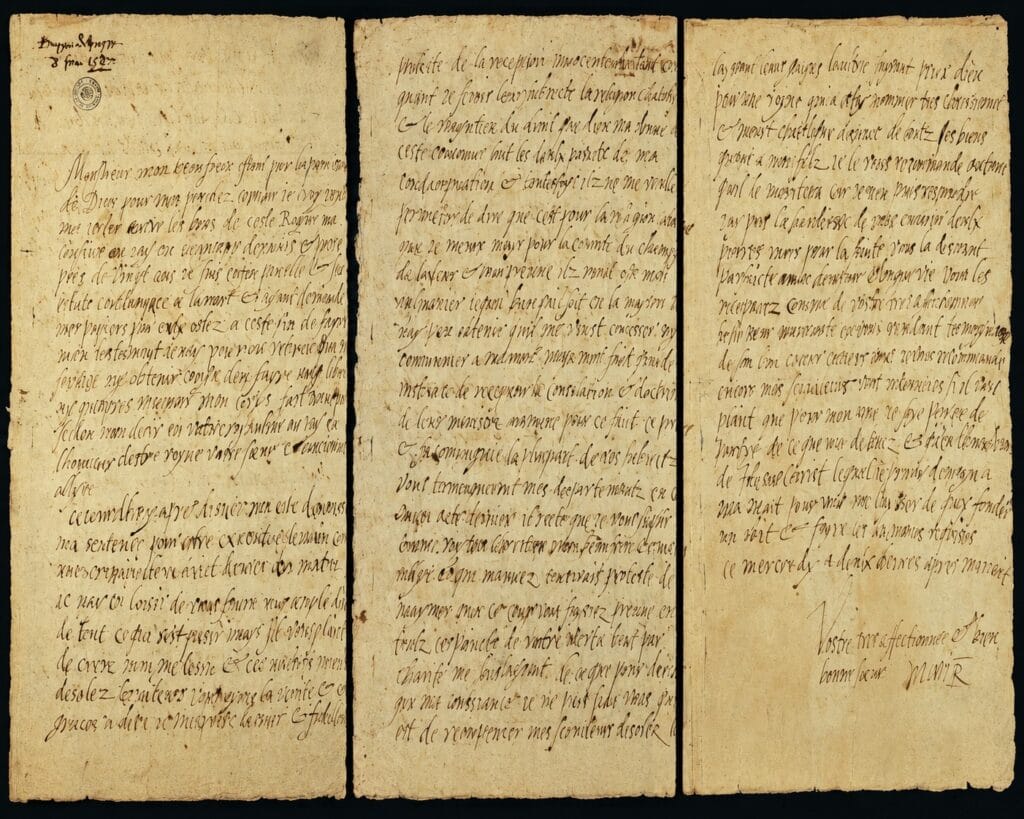
But right now, in the middle of the night, she picks up a pen.
She’s writing to Henry III, the King of France. He’s the younger brother of her first husband.
No anger. No revenge. Not a single word of “you’ll regret this.”
Instead, she asks for two things: bury me in France, and please take care of my people.
So here’s the question. On the last night of her life, why France? What was even there for her anymore?
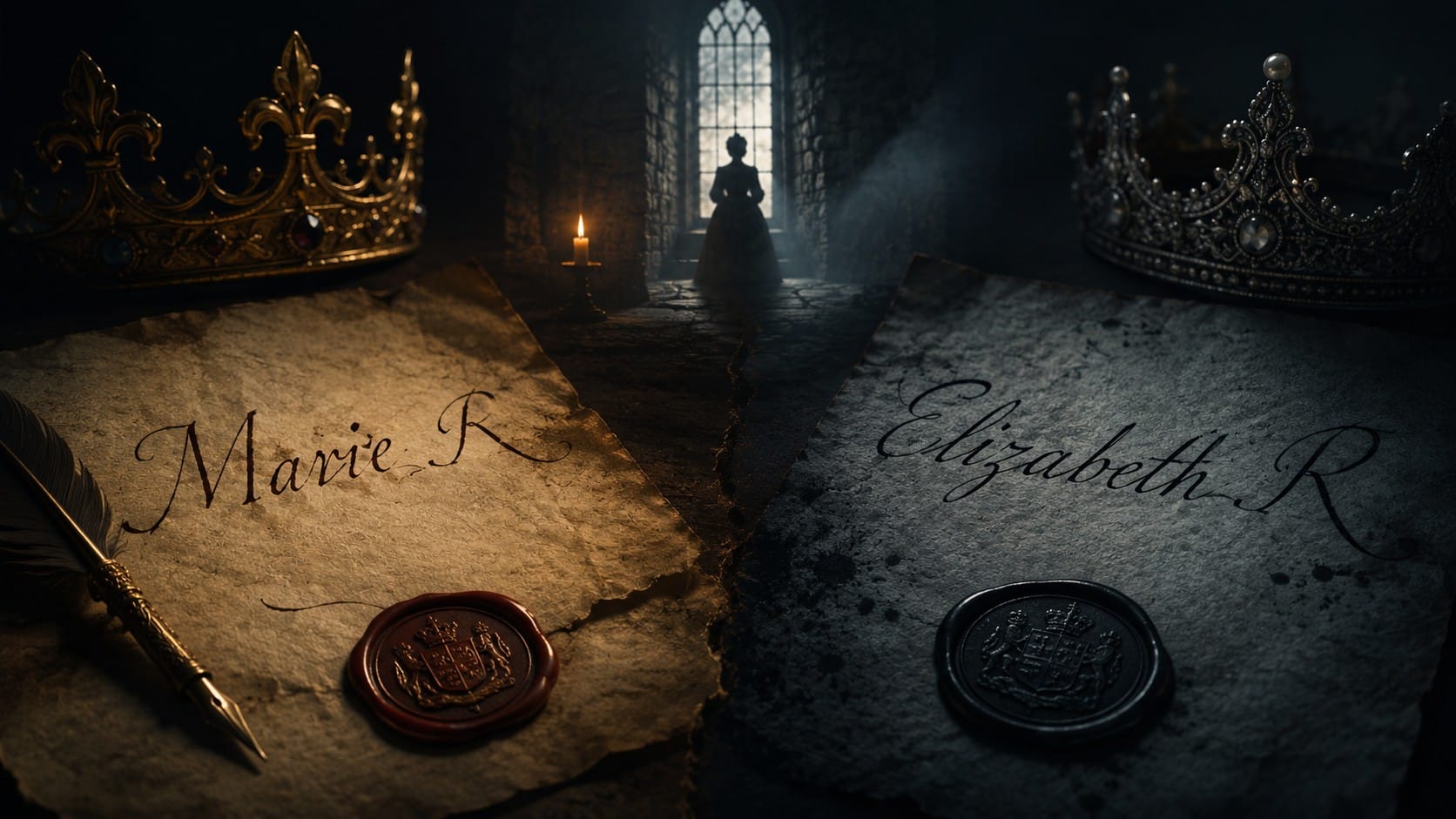
“Marie R” — Her Final Signature
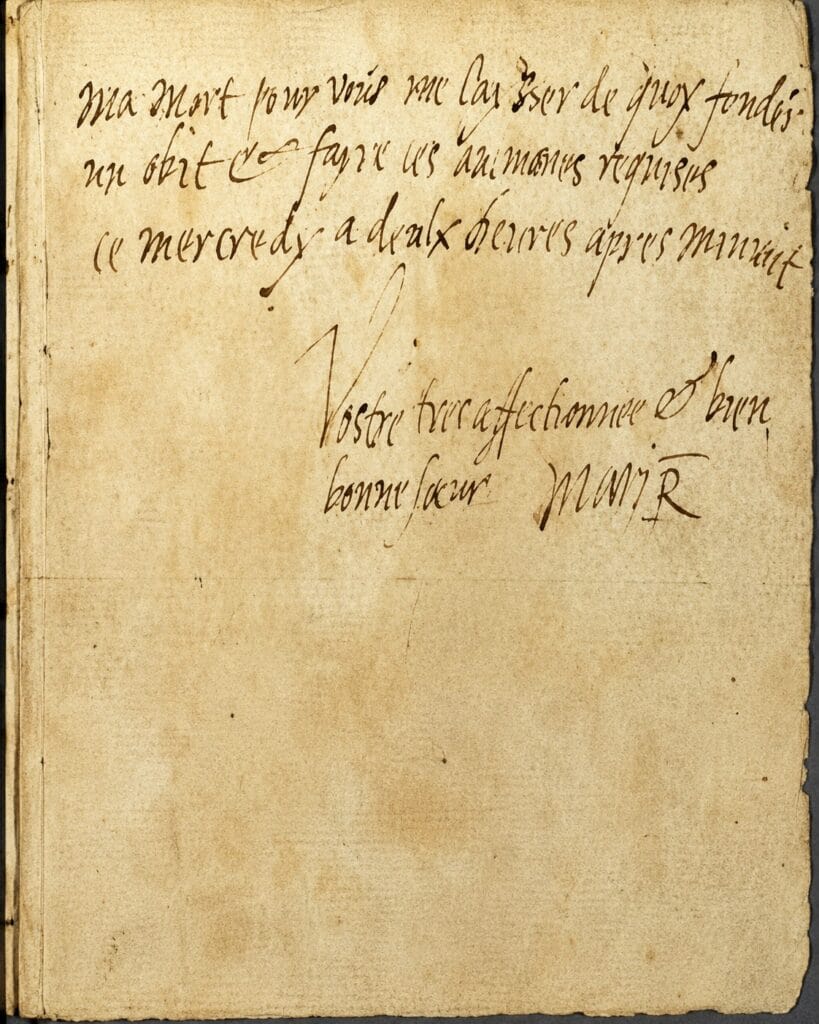
At the bottom of the letter, there’s a short signature.
Marie R.
The “R” stands for Regina — Queen.
The person who wrote this name will be gone from this world in just a few hours.
Imagine that. Writing your own signature, knowing it’s the last time you’ll ever do it. What would that even feel like?
And here’s the thing — somewhere else in this story, there’s another signature that ends in the same letter. We’ll come back to that one at the end.
A Six-Day-Old Queen
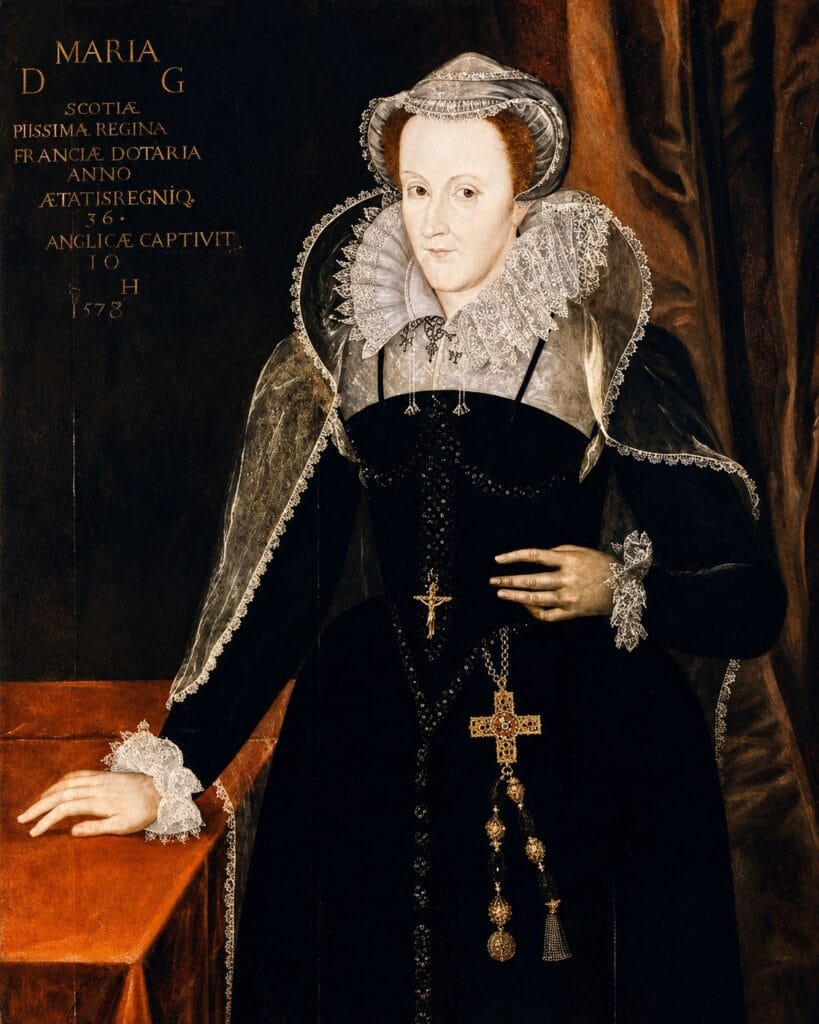
Mary became Queen of Scotland six days after she was born.
No mom, no dad in the picture — just a baby placed on a throne.
When she turned five, she was sent to France.
Here’s why. Scotland was at war with England.
England’s King Henry VIII wanted to marry his son to Mary, basically a plan to swallow Scotland whole.
To dodge that, Scotland teamed up with France instead — and as part of the deal, little Mary had to go live there.
The French royal family decided to raise her as their future daughter-in-law.
So Mary grew up in the French court.
She learned music, learned poetry, joked around in French, and grew up alongside one boy in particular.
His name was Francis. He was going to be the next king.
Picture this: the Queen of Scotland… who’s actually more comfortable speaking French than her own language.
Married at 15, Widowed at 17
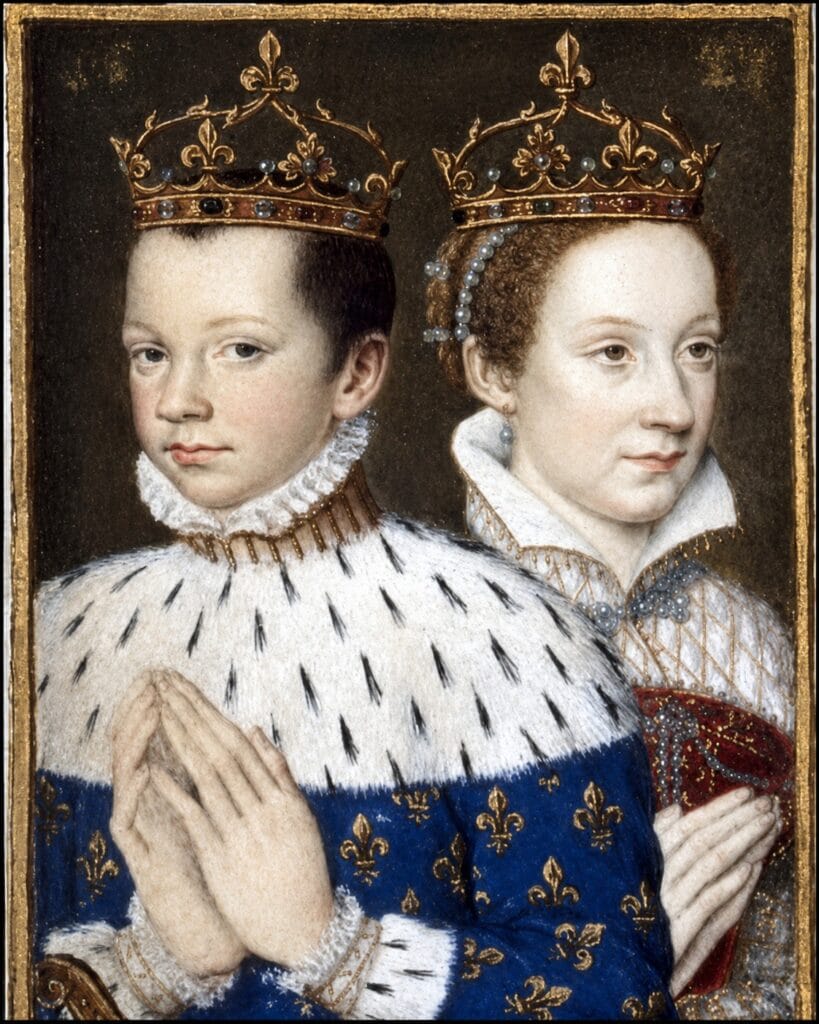
1558. Mary is 15. Francis is 14.
They get married.
On paper, it was just politics — a marriage to tie Scotland and France together.
But these two had grown up together since they were kids. They played together, studied together, got sick and got better together.
In 1559, Francis becomes king. Mary becomes Queen of France.
A 15-year-old girl, suddenly running the most glamorous court in Europe.
But one year later, in 1560, Francis dies of illness. He’s 16.
Mary becomes a widow at 17.
The marriage lasted less than two years.
And just like that, Mary has to leave France. This court isn’t her place anymore.
Twenty-seven years later, the night before she dies, she writes that she wants to be buried in this country.
The same place she was forced to leave at 17 — at 44, she’s asking to go back.
Coming Home to a Country That Felt Like a Stranger
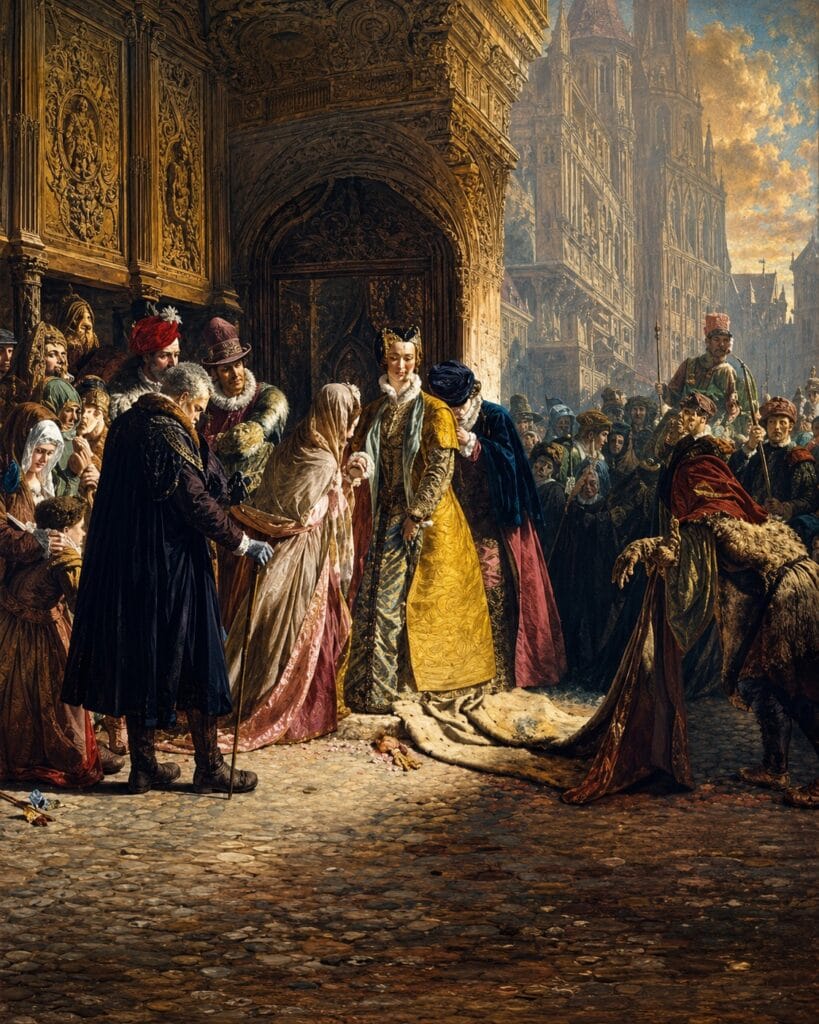
In 1561, Mary returns to Scotland.
But this wasn’t the country she left at five.
The Reformation had swept through, and Protestant nobles were now running the show. Mary, meanwhile, was a Catholic queen with a French accent.
On top of that, she wasn’t just Queen of Scotland — she also had a claim to the English throne.
To Catholics, that made Mary an opportunity. To Elizabeth I, it made her a threat.
To regular Scottish people, Mary was basically a stranger.
French clothes, French speech, French manners — their own queen, who somehow felt foreign.
So which was it? Did people see her as their true queen, or just some outsider who happened to wear the crown?
A Handsome Face, A Dangerous Ambition
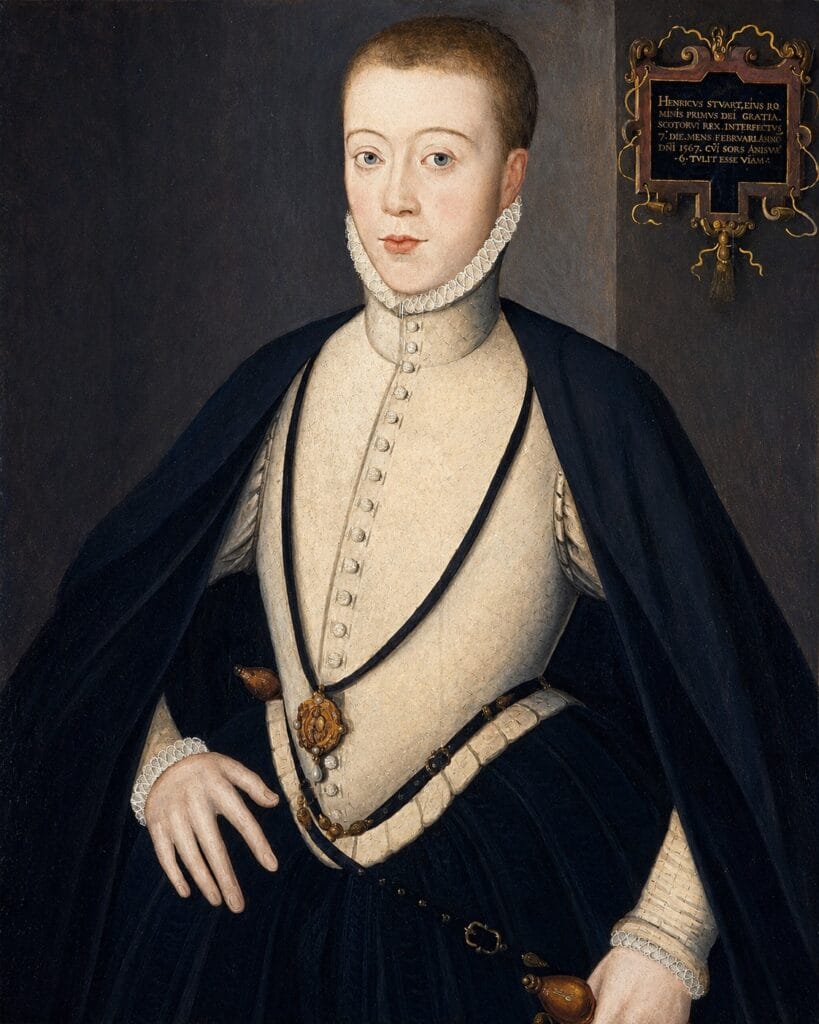
In 1565, at 22, Mary marries Henry Stuart, better known as Lord Darnley.
He was tall, good-looking, and came from royal blood.
This marriage was supposed to strengthen Mary’s claim to the English throne.
At first, both of them seemed happy with the deal.
But not long after the wedding, Darnley’s true colors showed.
He drank too much, got jealous easily, and most of all — he didn’t want to just be “the Queen’s husband.” He wanted to be King. Full stop.
Under Scottish law, though, Darnley simply didn’t have that kind of power.
And he couldn’t accept that.
So what happens to a marriage when the husband wants more power than his wife?
Murder, Right in Front of the Pregnant Queen
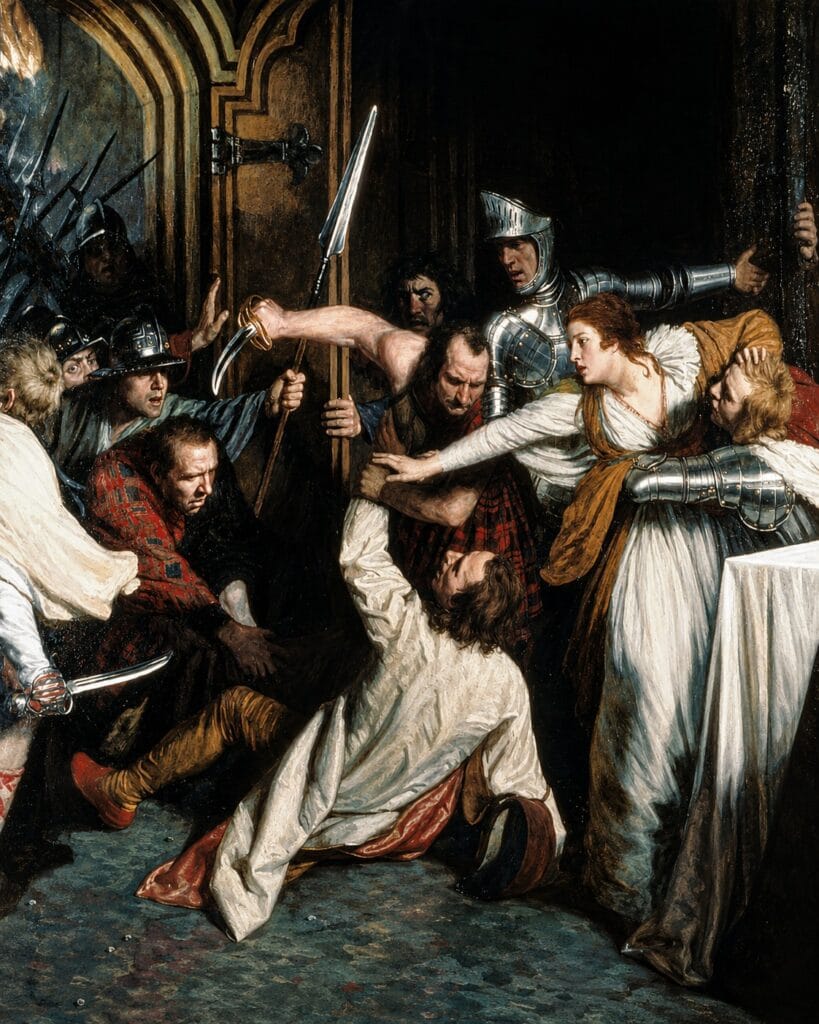
March 1566, Holyrood Palace.
Mary is six months pregnant — carrying the baby who will one day rule both Scotland and England.
That evening, she’s having dinner in a small room with her secretary, David Rizzio.
The nobles at court never liked Rizzio. He was Italian, low-born, and way too close to the Queen for their taste.
But to Mary, he was different. She could talk politics with him. She could laugh with him. He was someone she didn’t have to be suspicious of.
Then the door bursts open. Her husband Darnley walks in.
He’s not alone. Armed men follow him in.
Rizzio instantly ducks behind Mary’s chair.
The men drag him out. He grabs onto Mary’s dress, begging for his life.
His hands are pried off.
Mary can’t even stand up — she’s pregnant, and someone is holding her down.
From outside the room, screaming. Then the sound of blades. Once, twice, and it doesn’t stop.
According to records, dozens of stab wounds were found on Rizzio’s body.
Then, suddenly, everything goes quiet. A deep, heavy silence falls over the palace.
Her own husband had just ordered a man to be killed — right in front of her.
A Body Found Outside the Explosion
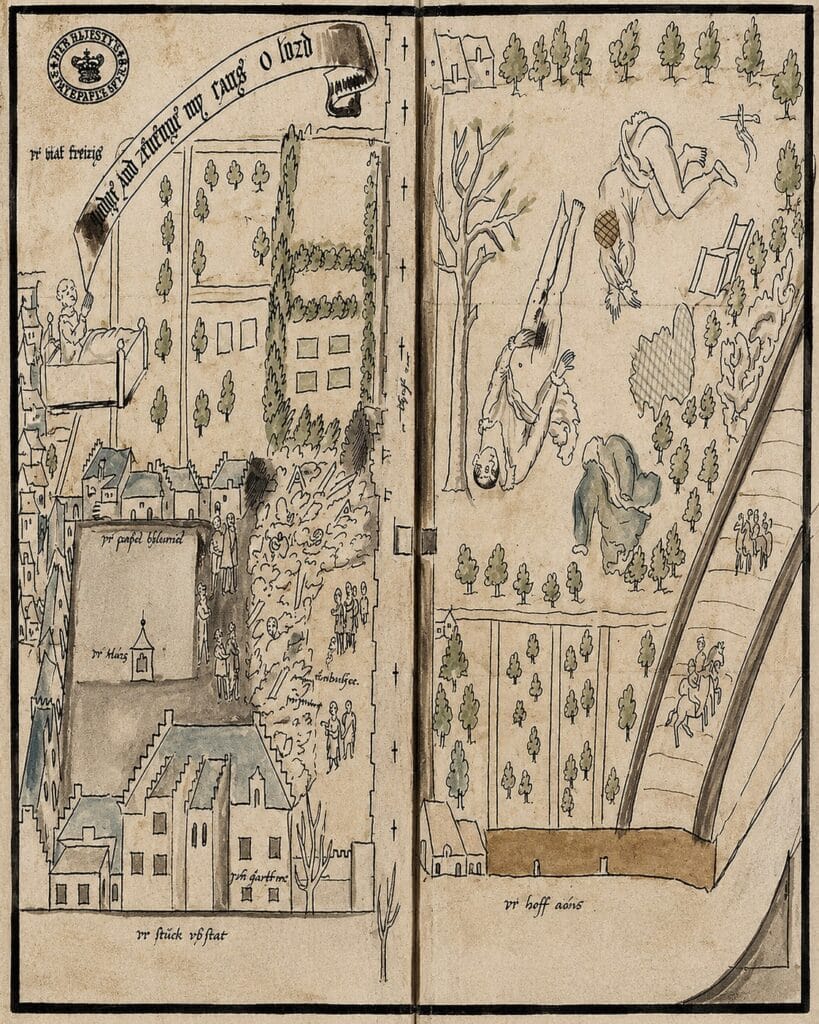
February 1567, Kirk o’ Field, just outside Edinburgh.
Darnley was staying in a small house, recovering from an illness.
Early morning — a massive explosion. The house is destroyed.
But here’s the strange part: Darnley’s body wasn’t found inside the wreckage.
It was found outside, in a corner of the garden.
His clothes were barely damaged, and there was almost no sign of the blast on his body.
It looked like someone had taken him outside before the explosion and killed him some other way — maybe strangled him.
No one was ever officially convicted.
But suspicion immediately landed on Mary and the Earl of Bothwell.
And a few months later, Mary marries Bothwell.
A queen, marrying the man suspected of killing her husband, just months after his death.
So how do you think people reacted to that?
A Castle on a Lake, Everything Taken Away
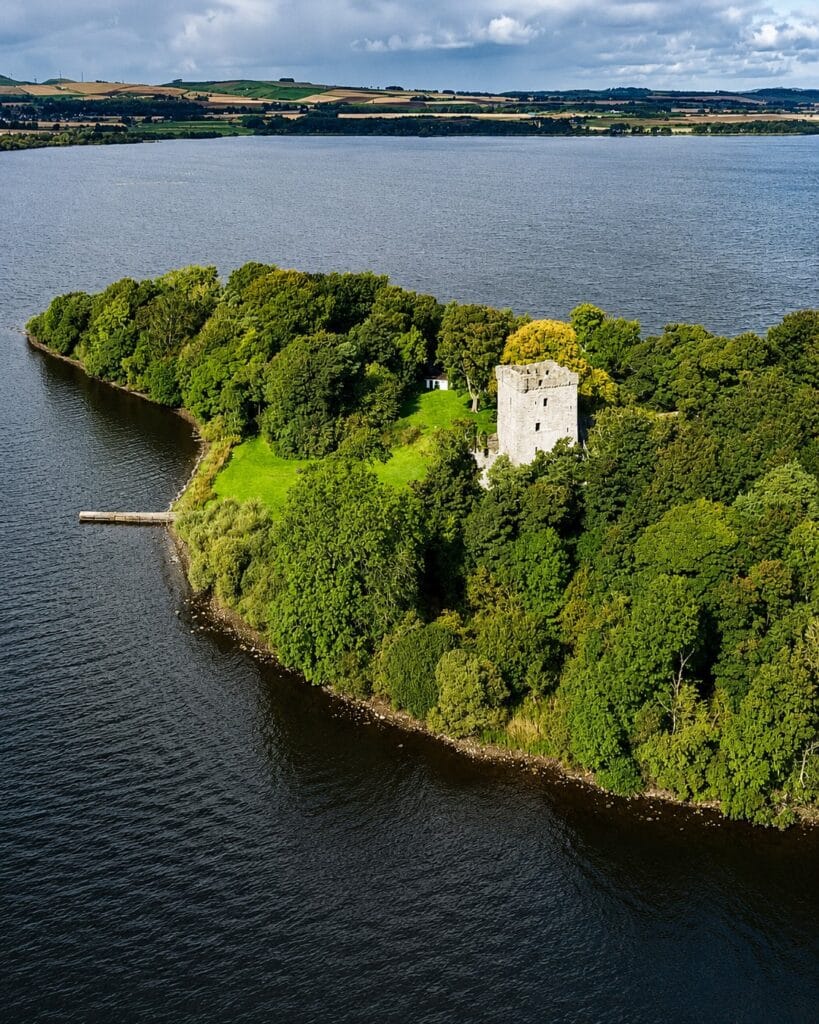
The nobles had had enough. They rebel.
Mary is captured and sent to Loch Leven Castle.
A castle on a tiny island, in the middle of a lake. Water on every side. Nowhere to run.
Here, Mary is forced to sign documents giving up her crown.
The throne goes to her son James — who is barely one year old.
Mary will never see this son again.
And during her time here, she loses a set of twins to miscarriage.
Think about that. A woman who became queen six days after birth, now at 25, loses her crown and her child on the same tiny island.
Escape — Right Into Another Cage
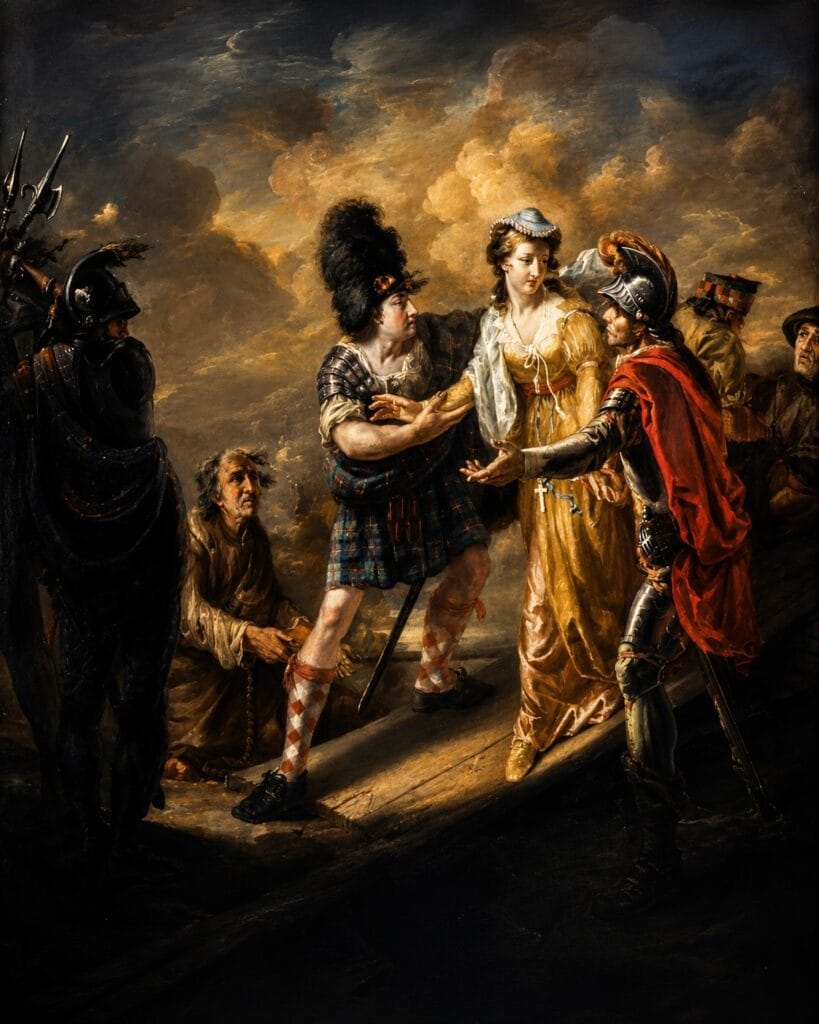
May 1568. About ten months into her imprisonment.
Mary escapes. She has help.
A night, a stolen key, a small boat.
She crosses the lake and is free again — for now.
But it doesn’t last.
She raises an army, loses the battle, and finally heads to England.
Her plan? Ask Elizabeth I for help.
On that night, crossing the lake in the dark, could Mary have guessed that where she was headed… was just another prison?
Two Queens Who Never Met
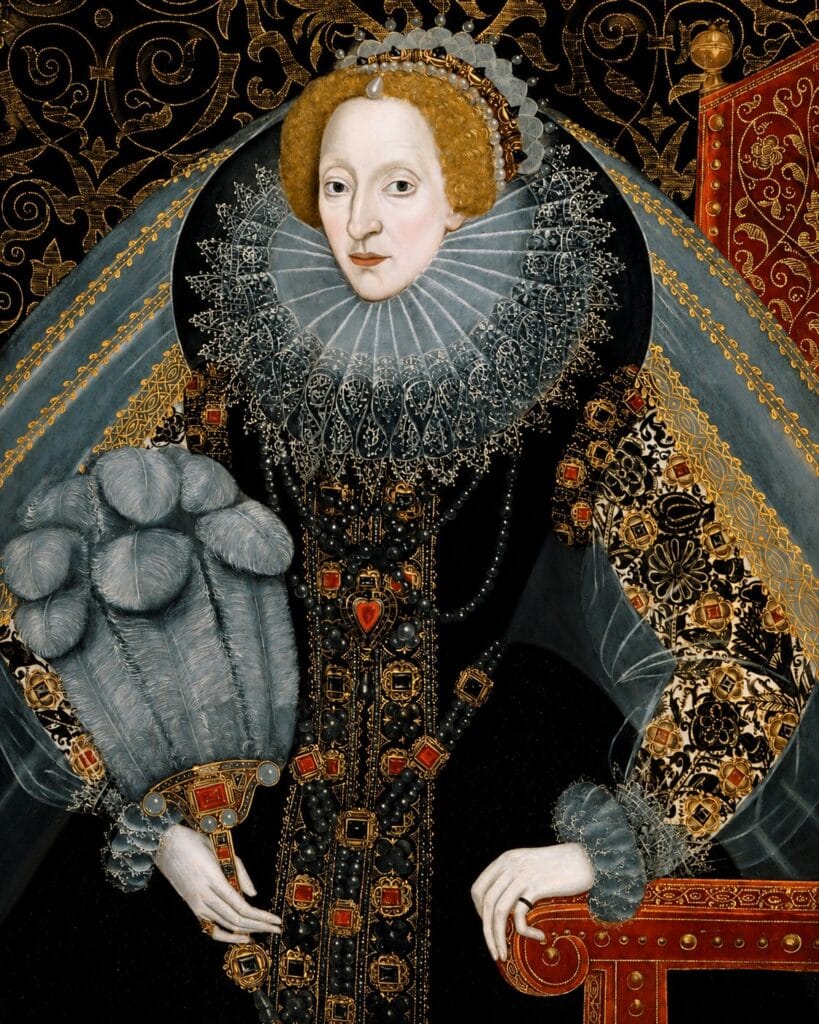
This is where another major character enters the story.
Elizabeth I.
She never personally killed Mary. But she’s the one who decided Mary’s last 19 years.
The relationship between these two is honestly strange.
They’re cousins. Both queens. Both from the same royal bloodline.
And both of them spent their whole lives extremely aware of each other.
And yet — they never met. Not once.
So why was Elizabeth so afraid of Mary?
It wasn’t just “she’s my cousin, kinda awkward.”
Back then, a huge chunk of Catholic Europe believed Mary actually had a stronger claim to the English throne than Elizabeth did.
Then in 1570, Pope Pius V excommunicated Elizabeth.
From that moment on, anyone who hated Elizabeth had a ready-made replacement queen sitting right there.
To Elizabeth, Mary stopped being just “cousin.” She became a living symbol that could shake her entire throne.
Letting her go was dangerous. Executing her could set off a war with Catholic Europe.
So Elizabeth picked the third option: just lock her up.
Two queens who, for their whole lives, were obsessed with thinking about each other — and never once stood in the same room.
Fifteen Years Where Nothing Happened — and That Was the Worst Part
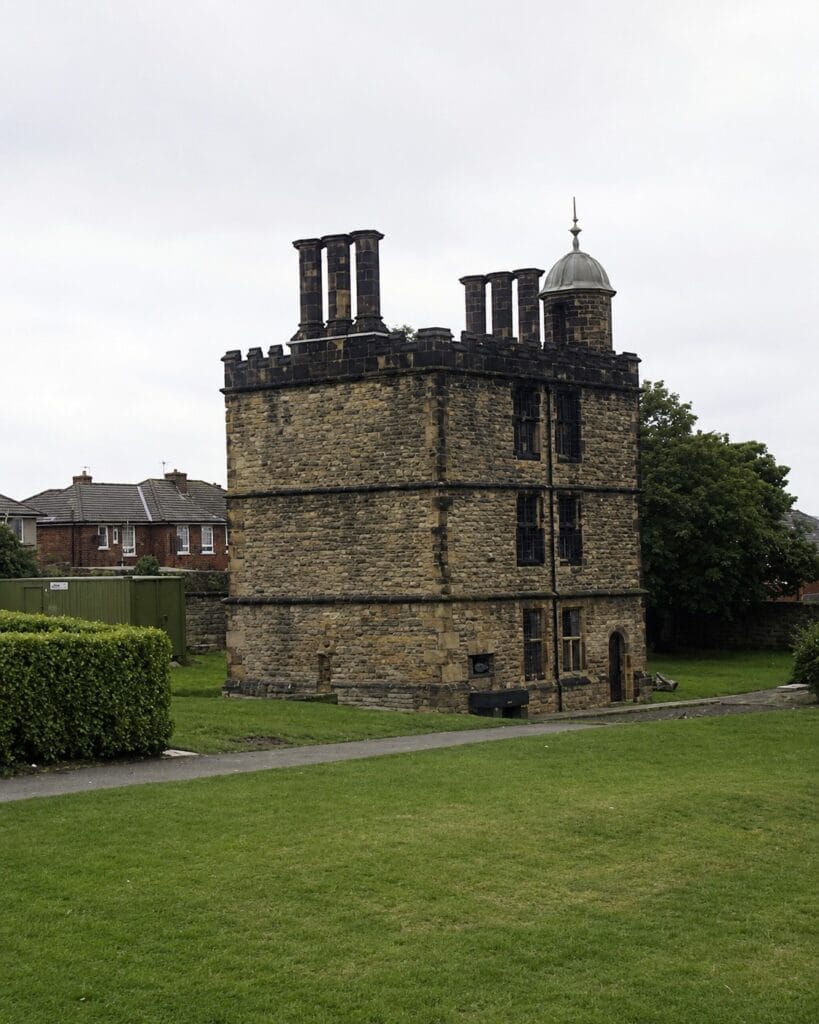
From 1569 to 1584.
Out of Mary’s 19 years in captivity, the longest stretch — 15 years — happens right here.
No escape attempts. No battles. No assassinations.
Basically nothing you’d call a “big event.”
And that might be exactly why this was the cruelest part of her entire life.
Because here, there was nothing except time.
A day passes. A month passes. A year. Then five years. Ten. Fifteen.
Mary arrived in England at 25. She doesn’t leave this place until she’s in her 40s.
There’s more than one way a prison can break a person.
Some prisons break you in a single day. Others take fifteen years, grinding away slowly, piece by piece.
Every morning, in this room, Mary opens her eyes. What do you think was going through her head?
The Cat, the Mouse, and What She Sewed Into It
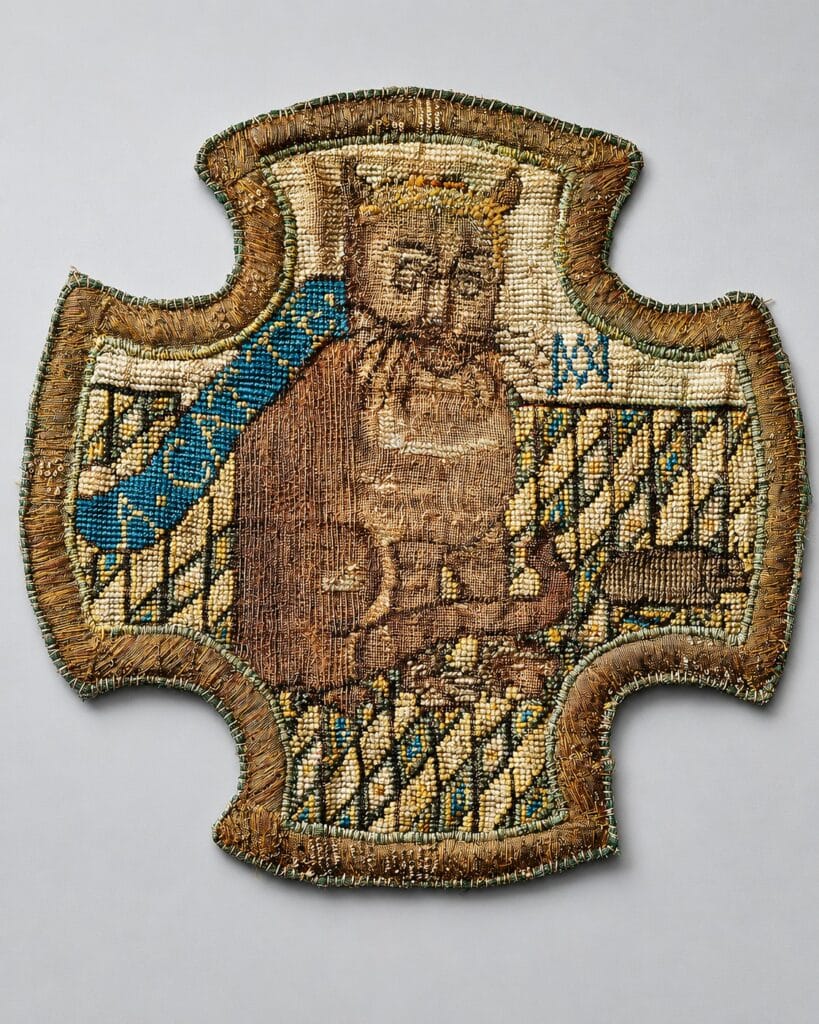
During all those years locked up, Mary wrote letters, prayed, and embroidered.
Those embroidered pieces still exist today — they’re called the Oxburgh Hangings, and they’re kept at the V&A Museum in London.
She made them together with a woman named Bess of Hardwick.
One piece in particular is famous: a cat, staring down a mouse.
A lot of historians look at this and immediately think of Elizabeth and Mary.
The cat — the one with all the power. The mouse — the one who got caught.
No one can actually prove Mary meant it that way.
But if she did — picture her, holding the needle, threading it through, stitching herself into the scene as the mouse.
What expression do you think was on her face in that moment?
Two Letters, “R,” Two Very Different Fates
1586. The Babington Plot is uncovered — a plan to kill Elizabeth and put Mary on the throne instead.
But here’s the thing: the plot was being watched from the very beginning.
Every letter Mary sent and received was secretly being decoded.
Her own handwriting, her own words, became the evidence used to trap her.
A trial happens. She’s found guilty.
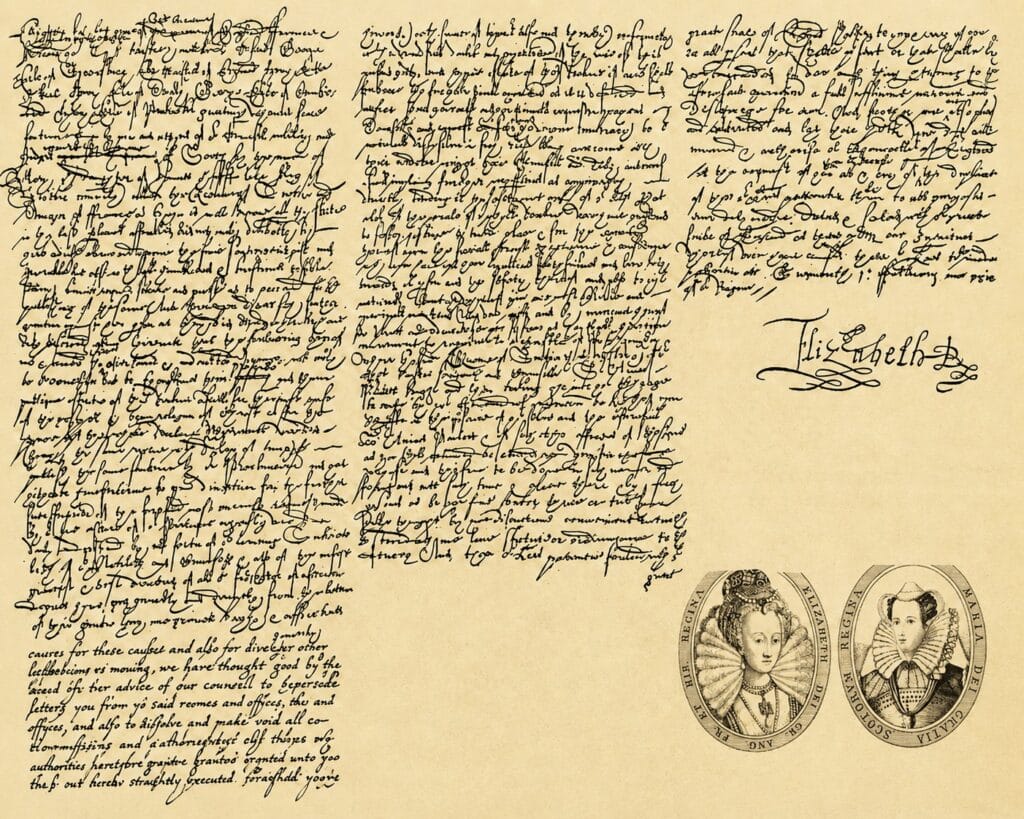
And one document gets created: the execution warrant.
It still exists today, kept at The National Archives in the UK.
At the bottom of that document is a signature: Elizabeth R.
That “R” stands for Regina — Queen, in Latin.
The same letter Mary signed on her last letter: Marie R.
One woman picked up a pen to wrap up her own life. The other picked up a pen to end it.
Same letter. But everything waiting at the end of that letter was completely different for each of them.
In that moment, what do you think was going through Elizabeth’s mind?
Where the Last 24 Hours Happened

Now the story comes full circle.
Fotheringhay Castle.
This is where the trial happened, where the death sentence was confirmed, where the last letter was written, and where the execution took place — all in one place.
The final 24 hours of Mary’s life, all inside these walls.
The evening of February 7, 1587.
Mary is told: tomorrow morning, you die.
So what does she do that night? Cry? Get angry? Or sit quietly and get ready to write?
Two in the morning.
She picks up her pen and starts writing to King Henry III of France.
A country she’d been apart from for decades. A place she figured she’d never see again.
And she decides — this is where her last words go.
Why him? Why France, of all places?
“I Want to Be Buried in France”
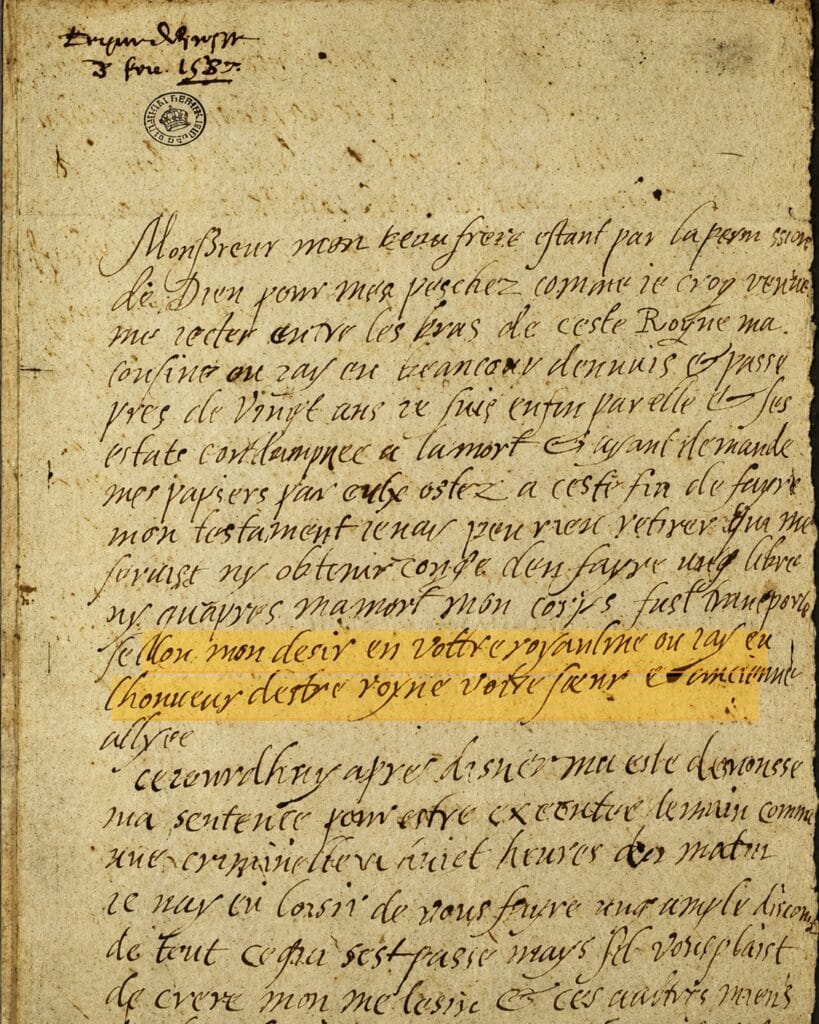
Here’s what the letter says:
“I have suffered for almost twenty years. Tomorrow at eight in the morning, I will be executed like a criminal. I do not wish my body to remain in this country (England). I wish to be buried in France.”
Twenty years earlier, at 17, Mary had to leave France. She didn’t want to.
Now, at 44, she’s asking to go back.
And just like before, there’s no guarantee it’ll actually happen.
When someone can’t even choose where their own body ends up — what’s left for them?
“Please Take Care of My Poor Servants”
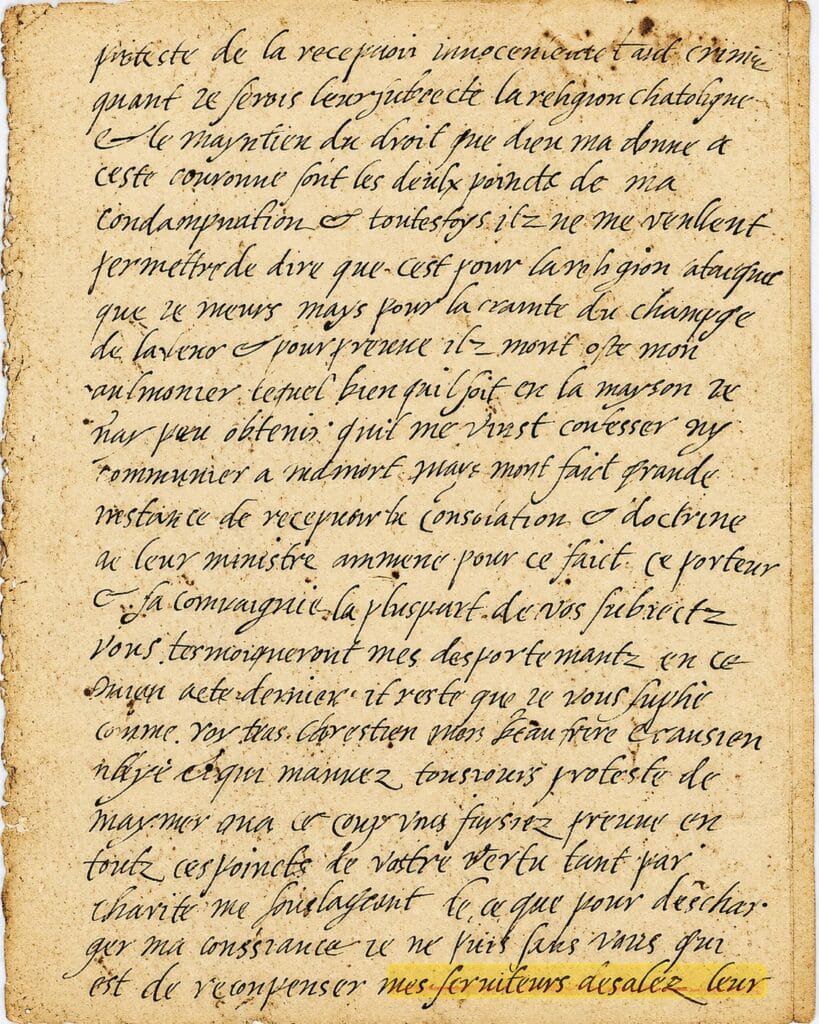
The letter continues:
“Please take care of the servants who served me. They have suffered alongside me for a long time. Pray for my soul.”
At this point, Mary stops talking about herself.
Instead, she starts thinking about other people.
People who stayed by her side for 19 years. People who, in some ways, may have endured this imprisonment even longer than she did.
A woman, hours from death, finishes her own story — and switches to talking about everyone else.
What does that tell you about her?
The Queen in Crimson Underclothes
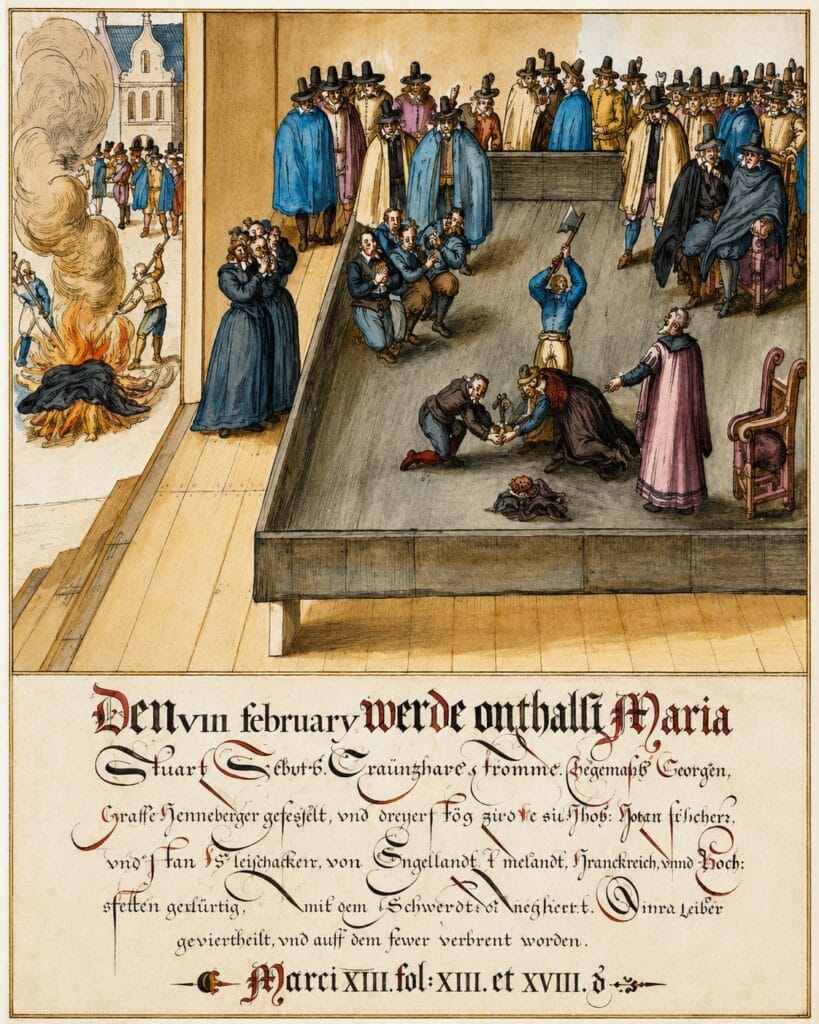
February 8, 1587. Eight in the morning.
Mary walks out to the execution site, holding a prayer book.
She’s dressed in black. But underneath, she’s wearing crimson red — the color associated with martyrs.
Everyone watching saw her differently.
Some saw a traitor. Some saw a martyr. Some saw a dangerous woman. Some just saw someone unlucky.
But how did Mary see herself, in that exact moment?
Did she see her own death as defeat — or as something else entirely?
Buried by the Country That Locked Her Up
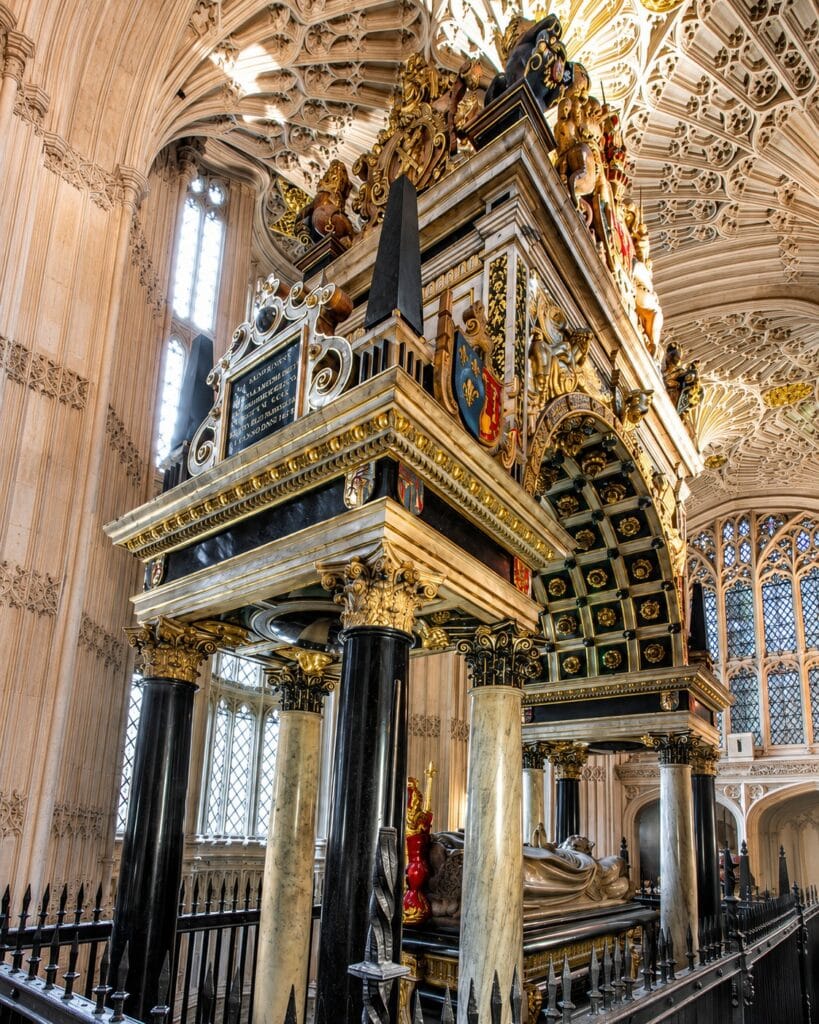
Mary wrote that she wanted to be buried in France.
That didn’t happen.
Years later, her son James — the one she barely ever saw — becomes King James I of England.
He has his mother’s remains moved to Westminster Abbey.
The same country that locked her up for 19 years. The same country that executed her.
And now, she’s buried right in the middle of one of its most magnificent churches.
Locked up while alive. Honored in a royal tomb once dead.
Why would the kingdom that executed her turn around and give her one of the best spots in its royal burial ground?
Marie R, Elizabeth R — The Night Between Two Signatures
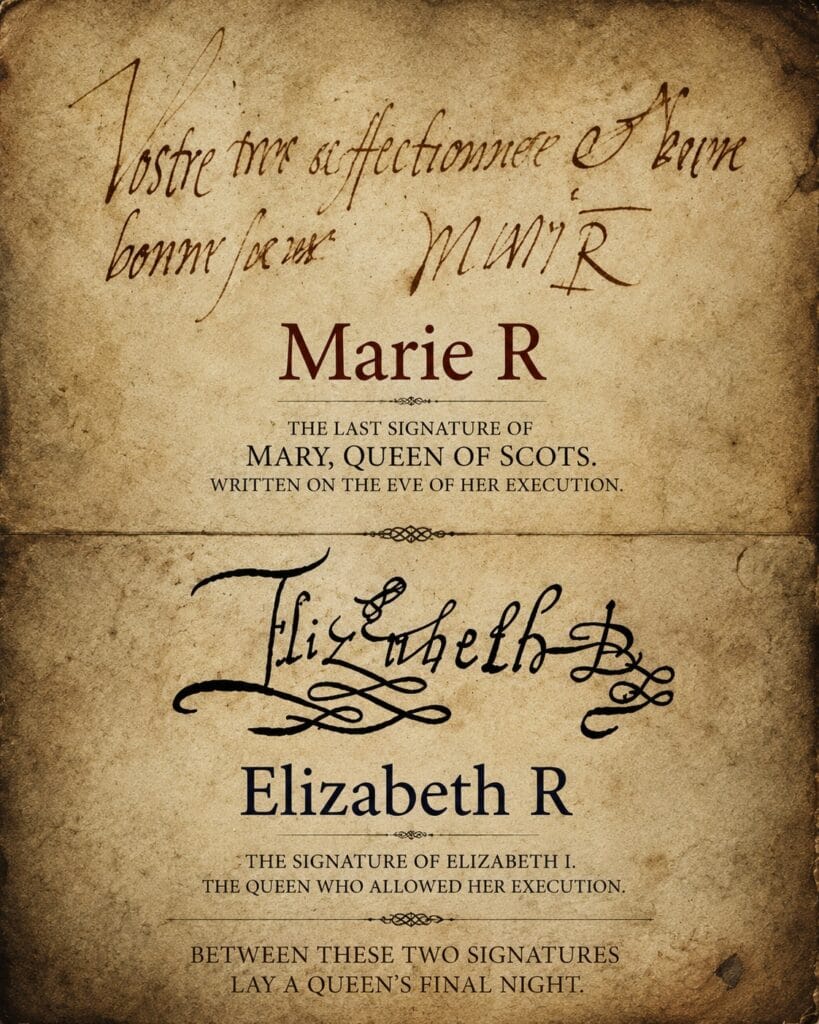
And we’re back to that signature.
Marie R.
And below it, another one.
Elizabeth R.
One woman wrote this, hours before her own death.
The other wrote the same letters while approving that death.
Marie R.
Elizabeth R.
Between those two signatures — there was one queen’s last night.
Almost everything Mary wanted never came true.
She never made it back to France. She never saw her son again. She lost her crown. She never got her freedom back. She lost her life.
But one thing survived.
The last words she wrote herself.
The crown is gone. The prison is gone. The execution site is gone.
But this letter — four hundred years later — is still here.
And through it, we learn something.
When someone has just hours left to live, what they think about isn’t revenge.
It’s the happiest time of their life. And the people who stayed by their side until the end.
Four hundred years ago, someone wrote those two things on the last line of their life.
If you were writing your last line right now — what would it say?
What Remained
The crown didn’t survive. The marriages didn’t survive. The throne, the freedom, the years — none of it survived.
What survived was a single piece of paper, written in the dark, in someone else’s handwriting on top of her own.
Two names. Two letters, both ending in “R.” One queen who was about to die, and one queen who decided she would.
Everything else from that night is gone. The signatures are still here.
Archive Notes
Mary’s last letter, written to Henry III of France in the early hours of February 8, 1587, is held today as one of the most studied documents from her imprisonment.
The Oxburgh Hangings, including the cat-and-mouse panel, are part of the permanent collection at the Victoria and Albert Museum in London.
The execution warrant bearing Elizabeth I’s signature, “Elizabeth R,” is preserved at The National Archives, Kew.
What You Now Know
You now know that Mary became queen six days after birth, before she could even open her eyes properly.
You know that she was married at 15 and widowed at 17 — and that the seventeen years that followed never let her forget it.
You know that two queens who spent their whole lives thinking about each other never once stood in the same room.
And you know that on the last night of her life, the woman who had lost everything didn’t write about revenge. She wrote about a country she hadn’t seen in decades, and about the people who were still waiting outside her door.
If You Liked This, You’ll Want These Too
Abraham Lincoln carried something in his pocket the night he died — and it tells you more about him than any speech ever did. Read the story behind the pocket watch and the letter from an eleven-year-old girl that may have changed his face forever.
Robert Falcon Scott froze to death just eleven miles from safety — but it’s the 16 kilograms of rock samples found beside his body that turn this from a tragedy into something else entirely. Read what he refused to leave behind.
Verified Sources
The National Archives, Kew — Archival material related to the execution of Mary, Queen of Scots, including the 1587 execution warrant.
Bibliothèque nationale de France — Archival material related to Mary Stuart’s final letter to Henri III, written on 8 February 1587.
Victoria and Albert Museum — Collection material related to the Oxburgh Hangings.
Westminster Abbey — Historical information related to the tomb of Mary, Queen of Scots.
Antonia Fraser, Mary Queen of Scots (1969).
John Guy, Queen of Scots: The True Life of Mary Stuart (2004).
Image Credits
Selected public-domain and open-license historical images were sourced from Wikimedia Commons and related museum or archive collections, including portraits, castle views, manuscript details, embroidery details, and historical engravings used for visual context.
The final signature comparison image is an editorial composite created for storytelling purposes. It pairs two historically separate signatures side by side and is not an original archival document.