Mars is red. The surface is red. The dust is red. The storms are red. For over a century, “Red Planet” has been treated as a complete description — a fact so settled that it remained largely unquestioned, even as the sun went down over that rust-colored horizon.
That assumption held for longer than powered flight has existed. No instrument had ever watched a Martian sunset in color. The planet had been labeled and filed away. That label missed one thing.
On April 15, 2015, a machine the size of a car — alone on a crater floor, 225 million kilometers from the nearest human being — turned its cameras toward the horizon and recorded something the label had never predicted. The sky around the descending sun was not red. Not orange. Blue.
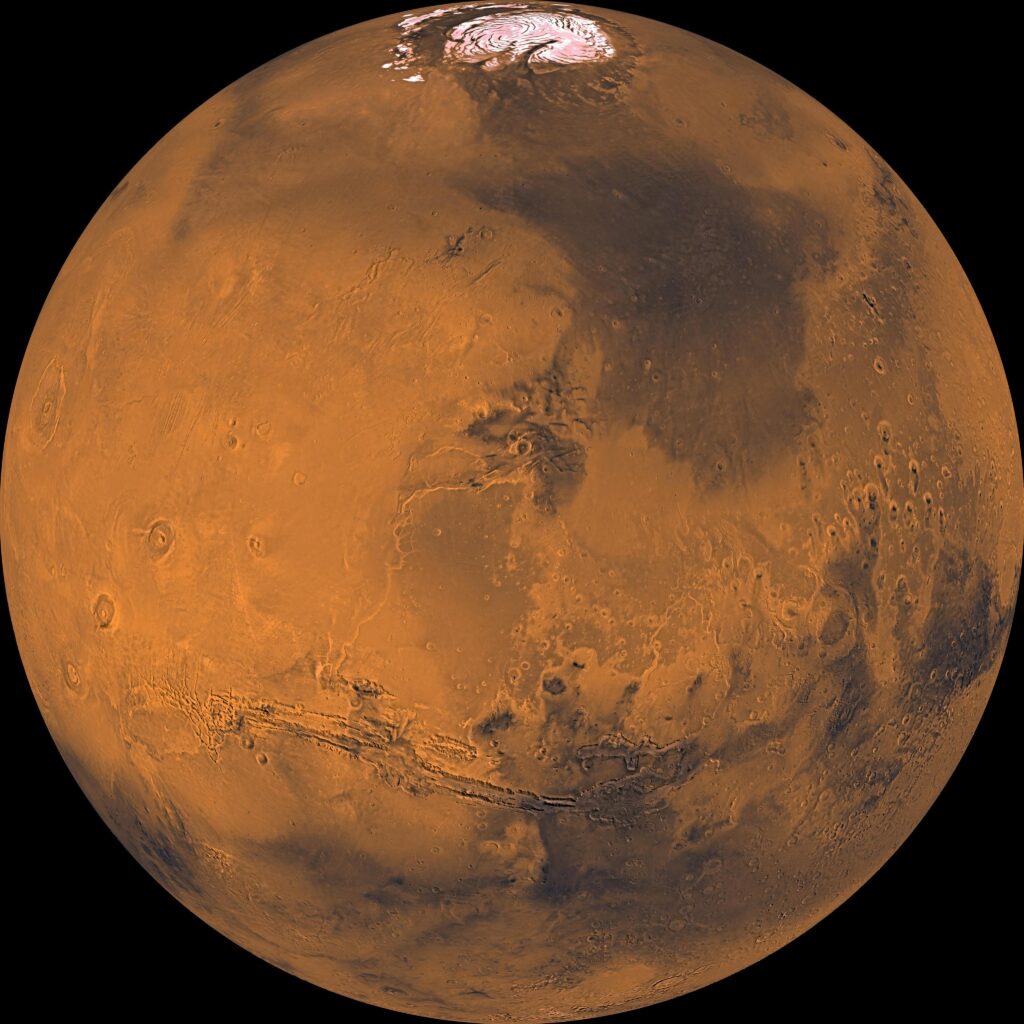
Mars full-disk view. Every feature — the rust-colored plains, the polar ice cap, the ancient canyon systems — owes its color to iron oxide. The surface earned the name. The sky at sunset did not. Source: NASA/JPL-Caltech
One Machine, One Crater, No One Watching
In 2015, humans could not go to Mars. The technology did not exist, and the distance — ranging from 56 million to 401 million kilometers depending on orbital position — made a round trip measured in years, not months. What humanity had sent instead was a six-wheeled robotic laboratory called Curiosity, part of NASA’s Mars Science Laboratory mission, which had been operating in Gale Crater since August 2012.
Curiosity moved slowly across a landscape that had not been touched by anything alive in billions of years, if ever. No wind sound registers on the surface the way it does on Earth — the atmosphere is too thin, roughly one percent the density of Earth’s, to carry sound in any meaningful way. The rover operated in something close to silence, its movements tracked from 225 million kilometers away by engineers at JPL who sent commands and waited minutes for confirmation that the machine had received them.
On Sol 956 — the 956th Martian day of the mission — Curiosity’s Mastcam received instructions to photograph the sunset. The camera system was designed to match human color vision as closely as possible, calibrated against color targets mounted on the rover’s body. When the frames came back, the engineers looked at what the machine had seen.

Curiosity rover self-portrait on the Martian surface, showing the rust-colored terrain and the brownish-pink daytime sky produced by suspended iron oxide dust. The same dust that gives Mars its daytime appearance produces a different optical effect at sunset. Source: NASA/JPL-Caltech/MSSS
Something Was Wrong With the Color
The frames arrived. The sun was small and intensely bright near the horizon. Around it, the sky carried a color that did not match the planet’s name. Not orange. Not the expected extension of the rust tones that saturate every daytime image from the Martian surface.
Blue.
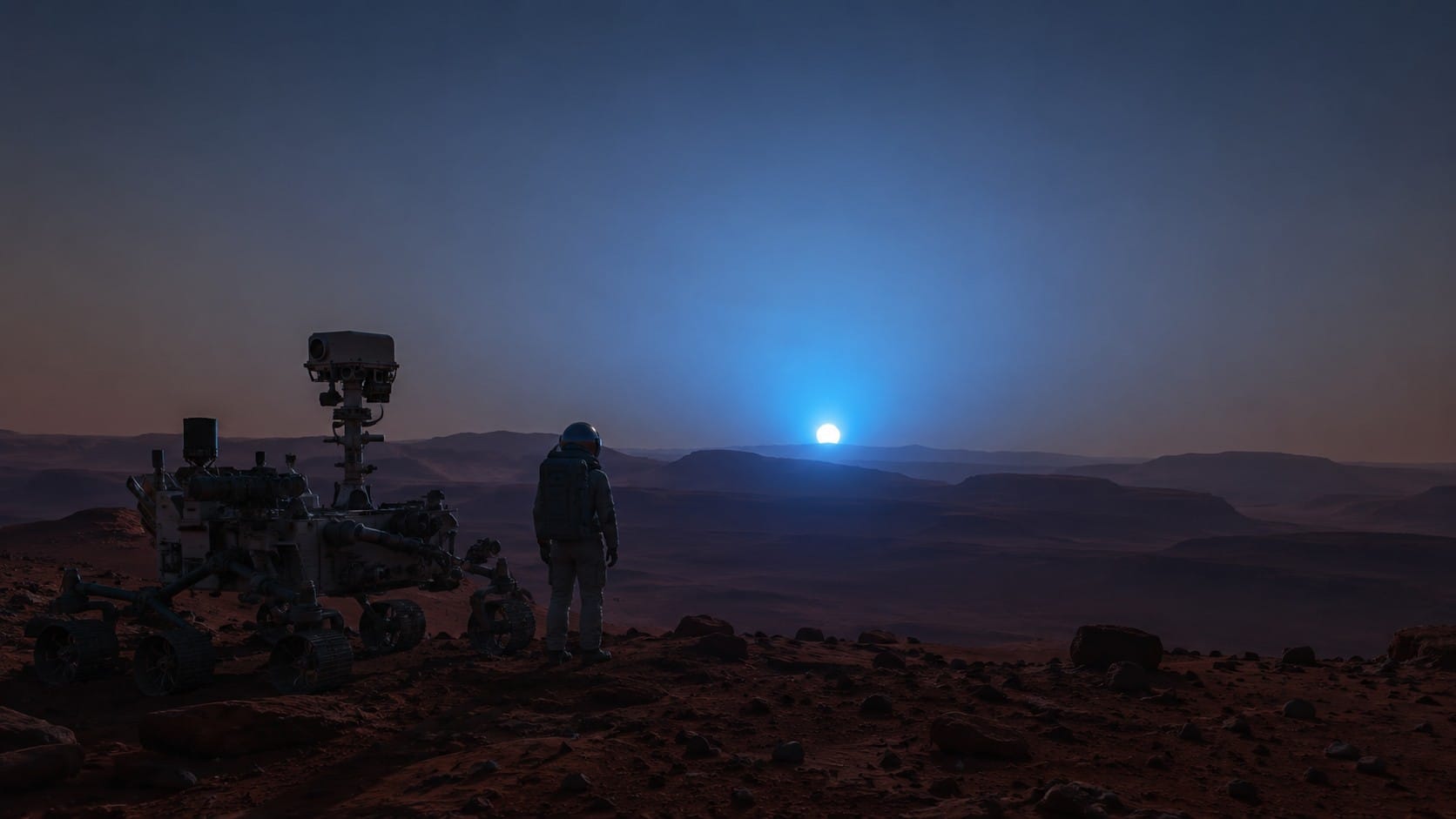
A cold, concentrated blue — clustered around the sun’s position in the sky, fading to pale orange further out, then to the dull brownish-pink haze higher in the atmosphere. The machine had recorded something that no human eye had seen and no instrument had previously captured in calibrated color on the surface of another planet. The image was not a processing error. The calibration targets confirmed it. What Curiosity recorded was, as accurately as 2015 imaging technology could render it, what a human standing in Gale Crater on that afternoon would have seen with their own eyes.
This raises a question that the “Red Planet” label had suppressed for over a century: if the planet is red, why is its sunset blue?
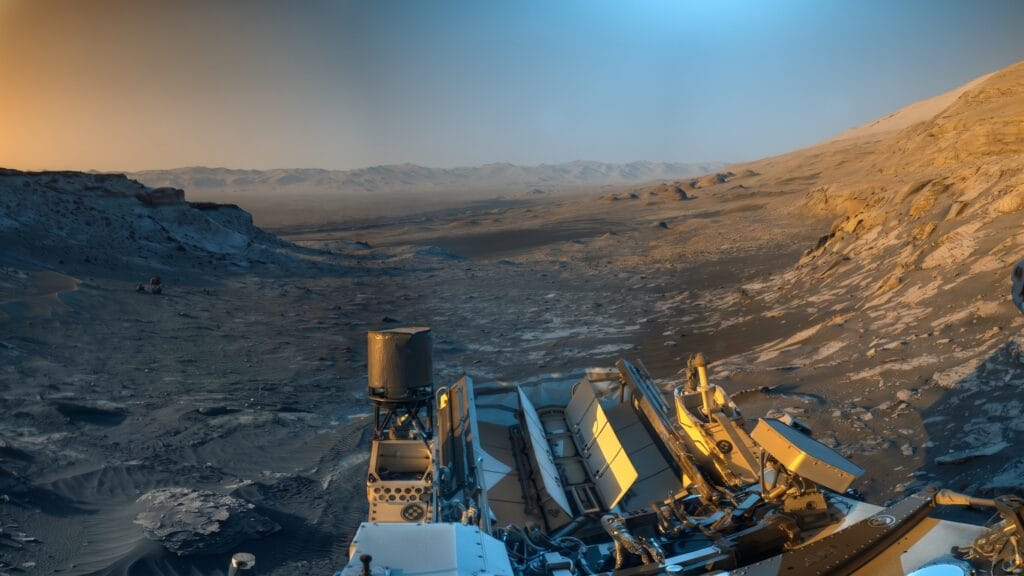
Curiosity rover deck view during lower dust activity. The blue tone at the upper atmosphere hints at the optical conditions that produce the blue concentration at sunset. Source: NASA/JPL-Caltech/MSSS
This raises a critical question: how many “known facts” have never been directly observed at the surface level?
Mars Does the Opposite of Earth — and the Physics Explains Why
Earth’s atmosphere is composed primarily of nitrogen and oxygen molecules. When sunlight enters that atmosphere, those molecules scatter shorter wavelengths — the blues — in every direction across the sky. That scattered blue is what makes the daytime sky appear blue. At sunset, sunlight must travel through a much longer column of atmosphere to reach human eyes. By then, most of the blue has scattered away. What survives the long passage is the red and orange end of the spectrum. Earth’s sunset spreads across the whole sky like a watercolor wash — color bleeding outward in every direction from the horizon.
Mars works in the opposite direction. Its atmosphere is approximately 95 percent carbon dioxide, roughly 100 times thinner than Earth’s, with no significant nitrogen or oxygen. What it contains in large quantities is fine iron oxide dust — particles small enough to remain suspended for months, circulating in storms that periodically cover the entire planet. According to NASA Jet Propulsion Laboratory analysis of the Curiosity Mastcam imagery, these dust particles are sized to scatter and absorb longer red wavelengths while allowing blue light to pass through more efficiently. At sunset, when sunlight travels the longest available path through the Martian atmosphere, blue light survives. It concentrates near the sun’s direction rather than spreading outward. The result is not a wash of color across the whole sky. It is a single concentrated point of blue — a stage spotlight aimed at one precise location on the horizon.
Same sun. Same light. Opposite result.
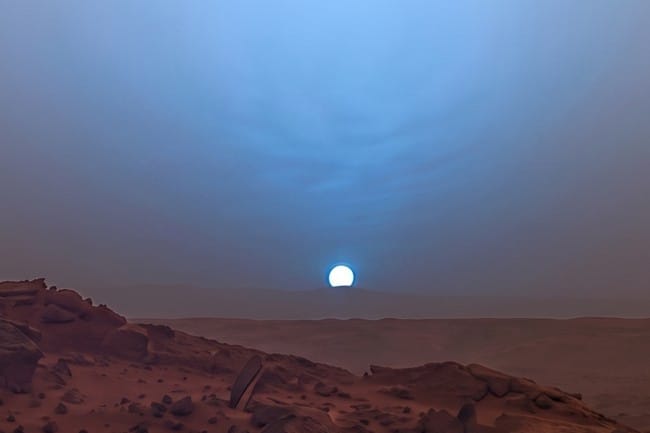
The Martian blue sunset: the sun descends as the surrounding sky carries a concentrated blue halo produced by iron oxide dust scattering. The rust-colored terrain in the foreground is made of the same material responsible for the optical reversal — the dust that makes Mars red by day makes it blue at dusk. Source: NASA/JPL-Caltech/MSSS — PIA19401 sequence, Sol 956, Gale Crater, 2015
Earth Spreads Color. Mars Focuses It.
This isn’t a small difference. It works the opposite way.
On Earth, sunset color spreads. Blue scatters first, then green, leaving orange and red to dominate as the sun approaches the horizon. The color fans outward across clouds, across water, across the whole visible sky. The entire dome above shifts toward the warm end of the spectrum. An Earth sunset is a spectacle of expansion — light filling space.
On Mars, sunset color contracts. The dust particles filter out red and orange, leaving blue light to concentrate in the narrow cone of sky around the descending sun. The rest of the sky remains its usual brownish-pink. The blue does not spread. It holds its position, tight and cold, around the single point where the sun meets the horizon.
This shows how an assumption can hide a physical reality. The dust that earned Mars its name is the same material that produces the blue. The cause of the red is the cause of the blue. The label was correct about the surface and wrong about the sky — not because the science was absent, but because no instrument had directly captured it in calibrated color.
It also shows how easily humans trust labels over observation. A name given in the 1800s, from a telescope on Earth, shaped what an entire civilization assumed about the sky on another planet for over a century.
This raises another question: what else have we labeled without ever seeing it directly?
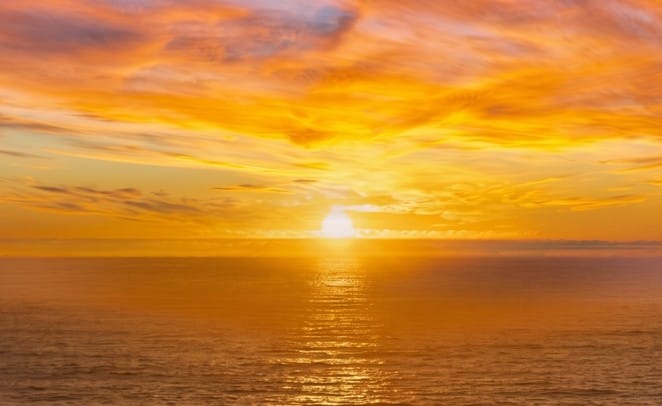
An Earth sunset over open ocean: color spreads across the entire sky as atmospheric molecules scatter blue light away, leaving red and orange wavelengths to dominate. On Mars, the same process runs in reverse. Source: Public Domain
One Hundred Years of an Untested Label
Mars received its color identity from Earth-based telescopes in the nineteenth century. Astronomer Giovanni Schiaparelli mapped the planet’s visible features in the 1870s and described the reddish coloration correctly identified as iron oxide coating the surface and suspended in the atmosphere. That observation was accurate as far as it went. But it went only as far as a telescope pointed across millions of kilometers of space could reach.
The 1976 Viking landers sent back color images from the Martian surface, but the color processing of those images became a documented dispute. Initial releases showed a blue-tinted sky. The processed versions released to the public showed orange. The debate continued in the scientific literature for years. The specific phenomenon of the blue sunset — the concentration of blue light near the sun at low sun angles — was not documented until Curiosity’s Mastcam recorded it in April 2015.
NASA’s Perseverance rover, which landed in Jezero Crater in February 2021, subsequently captured color sunset images confirming the blue halo phenomenon at a location approximately 3,700 kilometers from Gale Crater. The consistency across two separate missions reinforces that the effect is a global characteristic of Martian atmospheric optics, not a local anomaly.
Mars had been producing blue sunsets every day for billions of years. There was no one there to see them, and no calibrated instrument on the surface capable of recording them in color until Curiosity turned its cameras west on Sol 956.
What the Images Show — and What They Do Not
The blue coloration in the Curiosity sunset images is real and the calibration is documented. The JPL color correction process removed camera artifacts using the calibration targets mounted on the rover body, and the methodology has been reviewed by the Mars Science Laboratory science team. The blue halo around the sun is a genuine atmospheric optical effect.
The effect is, however, localized. Blue appears in the region of sky immediately surrounding the sun at low angles. The broader Martian sky during daytime, and at positions further from the sun during sunset, retains the characteristic brownish-pink hue from suspended dust. Mars does not have a blue sky the way Earth does. What it has, for a few minutes each evening and morning, is a blue sun against a rust-colored atmosphere.
The distinction carries practical weight. NASA’s current long-range mission documentation identifies a crewed Mars landing as a target for the 2030s. Understanding how dust, light, and atmospheric conditions interact at the surface — including how solar panel efficiency varies with dust load and how human visual perception functions in reversed lighting conditions — is part of the engineering problem that any crewed mission will need to resolve. The blue sunset is data, not only spectacle.
Frequently Asked Questions
Q. Is the blue color in Mars sunsets real, or a result of image processing?
A. The blue color is real. NASA’s Jet Propulsion Laboratory calibrated the Curiosity Mastcam images using documented color correction methods and physical calibration targets mounted on the rover. The blue halo around the sun during Martian sunset is a genuine atmospheric optical effect produced by iron oxide dust particles scattering blue wavelengths more efficiently than red wavelengths at low sun angles. The calibration methodology is described in JPL mission documentation and has been reviewed by the Mars Science Laboratory science team.
Q. Does Mars have a blue sky during the day as well?
A. No. The blue sunset effect is specific to low sun angles — sunrise and sunset — when sunlight travels through the longest available path in the Martian atmosphere. During daytime, the same iron oxide dust that concentrates blue light near the sun at dusk instead produces the characteristic pale brownish-pink sky color visible in Curiosity and Perseverance daytime imagery. The blue is a transitional effect present only during the narrow window when the sun is near the horizon.
Q. Have other Mars missions confirmed this observation?
A. Yes. NASA’s Perseverance rover, which landed in Jezero Crater in February 2021, captured color sunset images confirming the blue halo effect documented by Curiosity in 2015. The two missions operated at locations approximately 3,700 kilometers apart on the Martian surface. The consistency of the observed effect at both locations supports the interpretation that the blue Martian sunset is a global characteristic of Martian atmospheric optics rather than a location-specific phenomenon.
What You Now Know
Mars produces a blue sunset every day. It has done so for billions of years. The first human instrument to record one in calibrated color did so on April 15, 2015, in Gale Crater, in four frames taken over 6 minutes and 51 seconds. The mechanism is documented: iron oxide dust particles scatter red light outward while concentrating blue light near the direction of the descending sun. The dust that gives Mars its name is the same dust that produces the blue.
The Red Planet was not red at the moment that mattered most. It had been hiding its bluest moment every single day — and for over a century, no one had been there to see it.
Tip For Readers
The original Curiosity sunset images — catalog number PIA19401 — are publicly available in full resolution at NASA JPL Photojournal. The four-frame sequence is best viewed at full resolution, where the color difference between the blue near-sun region and the surrounding orange-pink sky is significantly more visible than in compressed reproductions. Perseverance sunset imagery is available through the NASA Mars 2020 raw image archive. Both collections are US Government works with no copyright restriction.
Verified Sources
NASA Jet Propulsion Laboratory — Mars Science Laboratory Mission
NASA Jet Propulsion Laboratory — Photojournal (Mars Image Archive)
NASA Science — Mars Exploration Program
NASA Mars 2020 Mission
NASA Science — Mars Exploration Program: Mars Atmosphere