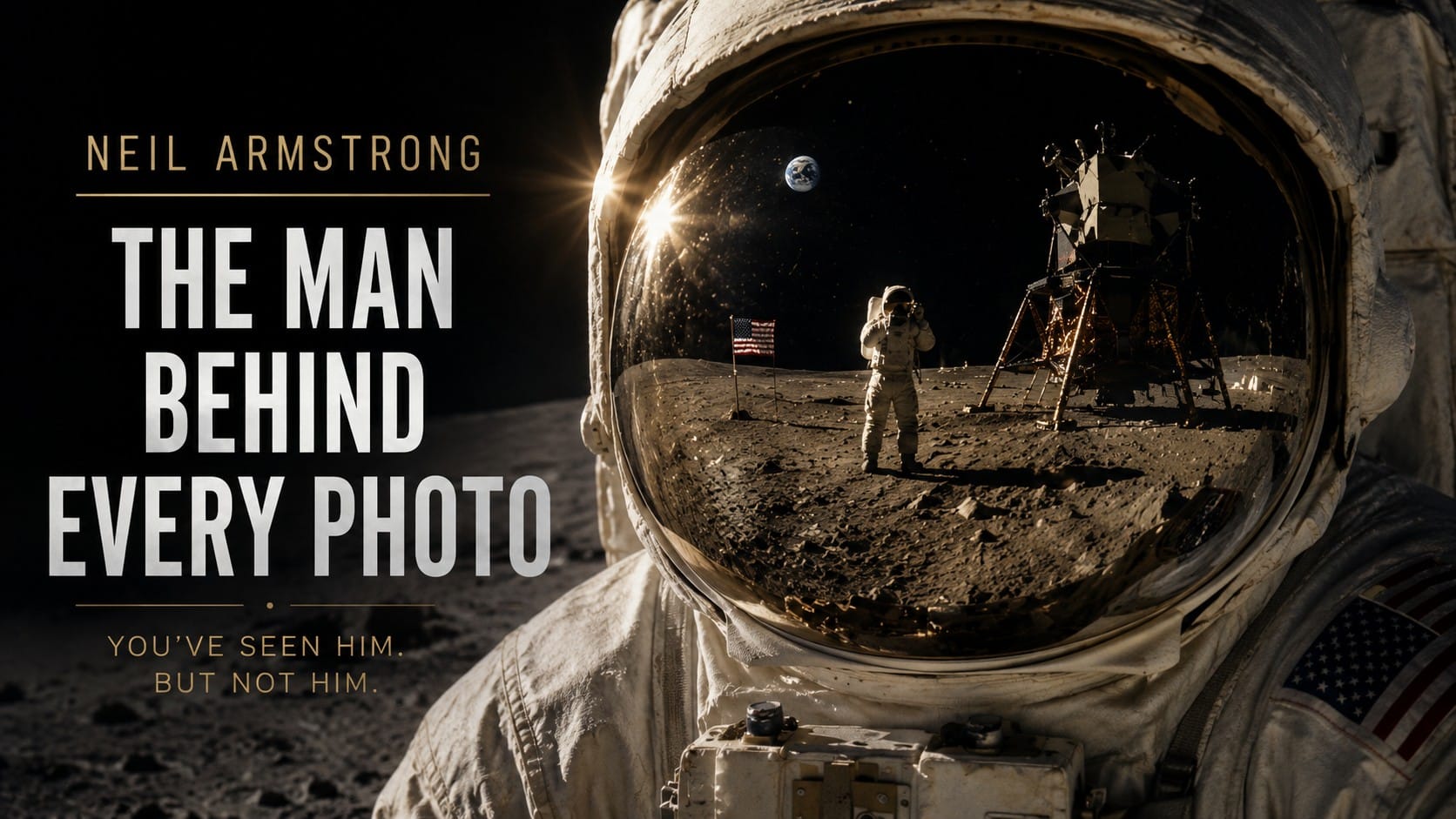
You’ve seen this photograph.
Most people have.
A man in a white spacesuit. Standing on the Moon. Gray dust beneath his boots. Black sky above. Footprints stretching behind him into the silence.
You think you know exactly who that is.
Except you don’t.
And very few people noticed.
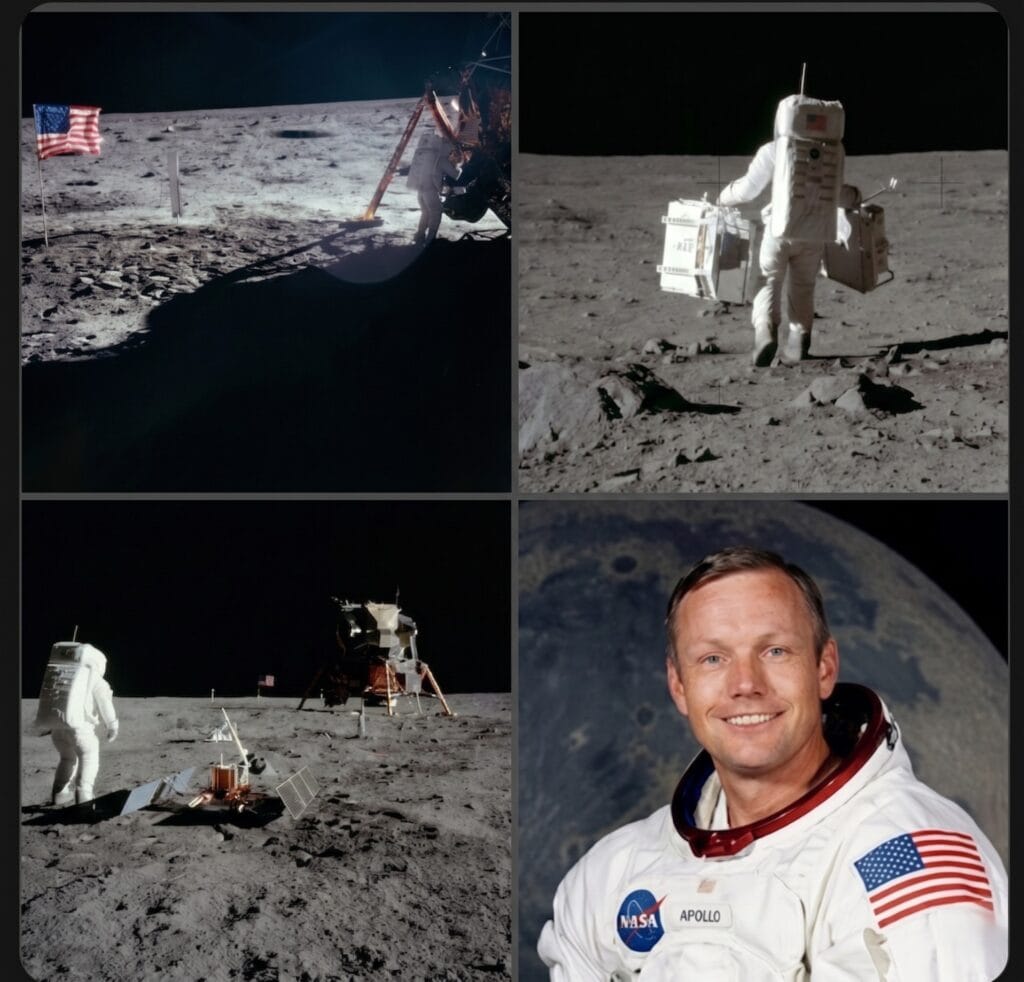
The known photographs in which Neil Armstrong appears on the lunar surface, Apollo 11, July 20, 1969. Source: NASA Image Library (Public Domain). Of roughly 121 frames taken during the EVA, Armstrong is clearly identifiable in approximately three.
Go Ahead. Find Him.
Pull up the Apollo 11 surface photographs. Every famous one. The man walking near the lunar module. The man standing beside the American flag. The man crossing the crater rim with equipment in his hands.
Look at each one carefully.
Now ask yourself: where is Neil Armstrong?
He was the first human being to walk on another world. His voice is the one everyone remembers. His words are carved into history. So his face should be everywhere in these photographs.
Keep looking.
More than a hundred photos were captured during those two and a half hours on the surface, but no clear shot of Armstrong’s face is visible.
Not because he wasn’t there.
Because he was holding the camera.
The Man Who Erased Himself
The Hasselblad camera used during the moonwalk was mounted to the chest of whoever carried it. No viewfinder. You aimed by pointing your body. Armstrong carried it for most of the EVA — which means every photograph he took shows something in front of him. Never himself.
Aldrin had scientific tasks. Sample collection. Experiment deployment. Armstrong had one camera and limited time to document the surface. He worked like the professional he was — focused on the mission, never stopping to hand off the camera for a pose.
Frame after frame, he recorded Aldrin.
Standing. Working. Walking across the Moon.
And with each frame, he disappeared a little more from his own story.
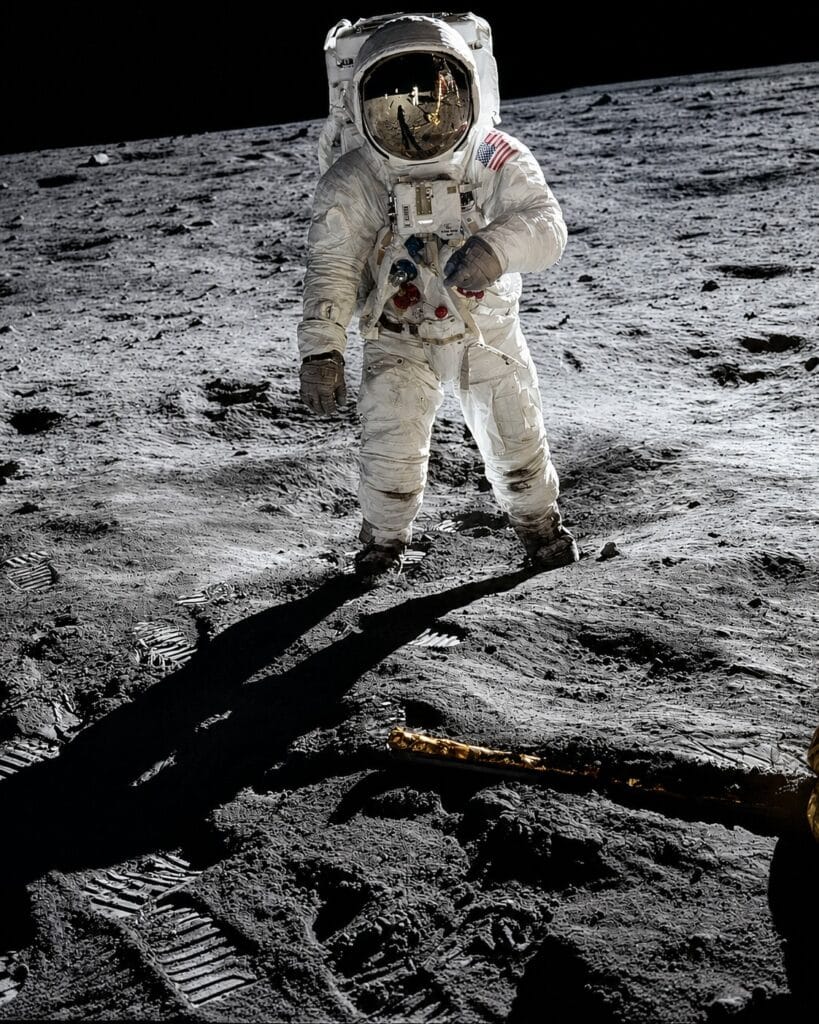
Buzz Aldrin walks on the lunar surface near the Eagle, July 20, 1969. NASA catalog AS11-40-5902, photographed by Neil Armstrong. Source: NASA Image Library (Public Domain). Armstrong composed this frame. He is not in it. He is behind it.
NASA’s Midnight Panic
Apollo 11 splashed down on July 24, 1969. The world was ready for the front page of a lifetime.
NASA’s public affairs team went through the photographs that night. All of them. Thousands of frames. They were looking for one thing: a photograph of Neil Armstrong — the first man on the Moon — on the Moon.
What they found instead was Aldrin.
Over and over. Frame after frame. Clean, sharp, iconic images of the second man. Almost nothing usable of the first.
One of history’s most significant moments was documented without a portrait of the man who led it.
When Armstrong returned to Earth, NASA faced an unexpected problem: there was no clear photograph of him on the lunar surface to release.
And then NASA said something official.
No clearly identifiable still photograph of Neil Armstrong on the lunar surface was known at the time.
That statement stood for eighteen years.
The Frame Nobody Saw for 18 Years
In 1987, two British researchers working independently went through the Apollo 11 archive frame by frame.
They found something in a panoramic sequence taken by Aldrin from the rim of Double Crater — a sweep of images from the brief window when Aldrin held the camera.
One frame. AS11-40-5886. A figure on the right side of the image, back to the camera, working at the equipment bay of the Eagle. Packing lunar samples. Facing away.
Because the frame falls within Aldrin’s sequence, the figure cannot be Aldrin.
It is Armstrong.
A clear photograph of Neil Armstrong on the Moon had been sitting in the NASA archive since 1969. Not selected for release. Not identified. For eighteen years, NASA said it did not exist — while the image waited, undisturbed, in the archive.
Armstrong himself confirmed it. He had always believed at least one photograph of him must exist.
He was right.
His back is to the camera. You still cannot see his face.
Then You Look at the Visor
Now go back to the most famous Apollo 11 photograph.
Aldrin. Standing on the Moon. White suit. Black sky.
You have seen this image a hundred times. Maybe more.
This time, do not look at Aldrin.
Look at his visor.
The outer surface of the Apollo helmet visor was coated with a layer of vacuum-deposited gold twenty nanometers thick — a radiation shield, nothing more. But that gold surface is convex. It curves outward. And a curved gold surface in direct sunlight acts like a wide-angle mirror.
Inside that mirror:
The lunar module. The flag. The horizon.
And then you see it.
Not clearly.
Not at first.
A shape. A reflection. Something standing in the middle of that curved gold surface, holding something in its hands.
You look closer.
And then it hits you.
That is not part of the landscape.
That is not Aldrin.
That is the photographer.
That is Neil Armstrong.
He did not pose for this. He did not plan it. The visor was there to protect Aldrin’s eyes from radiation, not to capture a portrait. Yet simple physics captured what the mission plan never scheduled: Armstrong on the Moon, visible, camera in hand, standing in the middle of the scene he was in the act of documenting.
He is not the subject.
He is the reflection.
For decades, that image was publicly available. Few people looked closely enough to notice him.
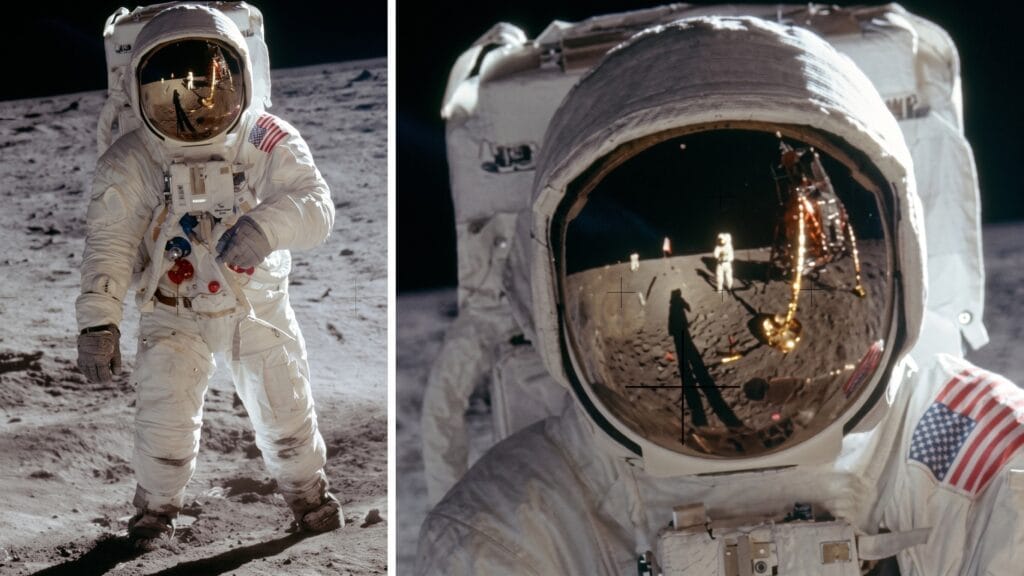
Left: Buzz Aldrin on the lunar surface, AS11-40-5903, July 20, 1969, photographed by Neil Armstrong. Right: High-resolution enlargement of Aldrin’s gold visor — inside the curved reflective surface, Armstrong stands holding the Hasselblad camera, with the Eagle lunar module behind him. Source: NASA Image Library (Public Domain).
The Shadow Is Also Him
Look at the ground in these photographs.
There is a long shadow stretching across the lunar dust toward the astronaut being photographed. In frame after frame, it appears — reaching from just outside the image edge toward the subject in the center.
That shadow belongs to the photographer.
It is Armstrong.
He appears in many of the photographs. Not as a subject. As a shadow. As the source of every composition. The sun cast his silhouette across the Moon whether he wanted it there or not, and it appears throughout the archive as the most consistent evidence that he was present at every moment his camera fired.
You were looking for Armstrong in the frame.
He is rarely in the frame.
He was the frame.
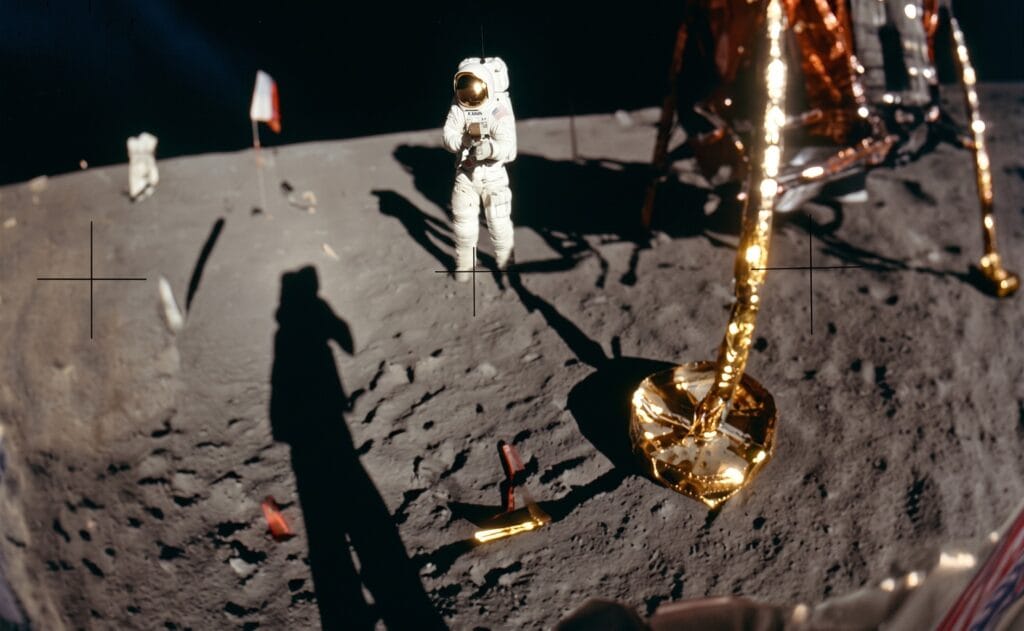
Overhead-angle view of the Apollo 11 landing site, Aldrin visible in the mid-ground, Armstrong’s shadow extending across the lunar surface in the foreground, July 20, 1969. Source: NASA Image Library (Public Domain). The shadow appears throughout the surface photography — the most consistent proof of his presence at the moment of exposure.
When Someone Finally Asked Him
Years later, people asked Armstrong why he never handed Aldrin the camera. Why he never asked for a photograph of himself on the Moon.
His answer was quiet. Immediate. Entirely without regret.
“It simply didn’t occur to me,” he said. “We had a great deal of work to accomplish. It wasn’t a portrait studio.”
No frustration. No awareness that history might find the absence strange. He had been on the Moon. He had documented what the mission required. His own face was not among the things that needed documenting.
The first man to walk on another world did not think to record himself doing it.
He was focused on recording the mission.
What the Limits of Film Could Not Show — Until Now
The Apollo 11 EVA was also recorded on 16mm film — a camera running automatically throughout the two-and-a-half hours, capturing everything at a low frame rate in grainy, degraded footage. Armstrong appears in that footage. Moving. Working. Crossing the surface.
For fifty years, the resolution was too poor to see him clearly.
In the late 2010s, digital restoration specialist Andy Saunders applied multi-frame stacking techniques — averaging dozens of consecutive frames to reduce grain and recover buried detail. The result was the clearest images of Armstrong on the Moon that currently exist. Still not a clean portrait. Still not what a single Hasselblad frame could have produced in 1969. But recognizably him.
It took fifty years and newer technology to reveal details hidden in the original film.
A clearer image is now available.
His face is still not entirely clear.
What This Means — And What Most People Miss
Here is the part that changes how you see all of it.
Armstrong’s absence from the photographs is not a gap in the record. It is not a failure or a missed opportunity. It is the direct result of a man doing exactly what he was there to do.
Every photograph in the Apollo 11 surface archive is Armstrong looking at the Moon. His composition. His choice of subject. His angle, his timing, his eye. The images do not show you what Armstrong looked like on the Moon.
They show you what the Moon looked like to Armstrong.
That is a different thing entirely.
And it is the only version of him that the photographic record of that day contains. Not a portrait. Not a hero shot. A perspective. Two hours of vision, pressed into frames, pointing outward from where he stood.
You have likely never seen Neil Armstrong clearly on the Moon.
You have only ever seen what he saw.
The whole time.
FAQ
Q: Is there really only one clear photograph of Armstrong on the lunar surface?
A: Yes. AS11-40-5886 — Armstrong from behind, working at the Eagle’s equipment bay — is the only clear 70mm Hasselblad still in which he is identifiable as the primary subject. It was not publicly identified as containing Armstrong until 1987, eighteen years after the mission. He also appears in the visor reflection of AS11-40-5903 and partially in several other frames, but 5886 is the only conventional photograph that shows him directly on the surface.
Q: Why didn’t Aldrin take more photographs of Armstrong?
A: Mission planning assigned Armstrong the primary camera role. Only one Hasselblad went onto the surface. Aldrin held it briefly during a panoramic sequence — the window that produced AS11-40-5886. The flight plan did not schedule a photography exchange, and the operational timeline did not leave room for one. Armstrong later said asking Aldrin to photograph him simply did not occur to him.
Q: Can you actually see Armstrong in Aldrin’s visor?
A: Yes. High-resolution digital scans of the AS11-40-5903 negative show Armstrong’s figure clearly in the curved gold visor — holding the camera, Eagle visible behind him. The reflection was always present in the original negative. First-generation prints were too small to read it. It is not a reconstruction. It was always there.
What You Now Know
Neil Armstrong appears clearly in roughly three of the approximately 121 photographs taken on the lunar surface during Apollo 11’s EVA on July 20, 1969. The only conventional still photograph of him — AS11-40-5886, his back to the camera — sat unidentified in the NASA archive for eighteen years. NASA officially stated no such photograph existed. The visor reflection in AS11-40-5903 shows him holding the Hasselblad camera inside the curved gold surface of Aldrin’s helmet and is the most complete visual record of Armstrong on the Moon available today. His shadow appears throughout the surface photography. He carried the primary camera for most of the EVA by mission plan. Every iconic image from the Moon landing is a photograph Armstrong took. His face is in none of them. When asked why, he said it wasn’t a portrait studio. He had work to do.
Tip for Readers
The next time you see the Apollo 11 photographs, do not look for Armstrong in the frame. Look from where he was standing. Every composition, every subject, every angle was his choice. The photographs do not show you what Armstrong looked like on the Moon. They show you what the Moon looked like to Armstrong. That distinction is the whole story.
Verified Sources
NASA Image Library — Apollo 11 Photography Archive, images.nasa.gov
NASA History Division — Apollo Lunar Surface Journal
Smithsonian National Air and Space Museum — Apollo 11 Photography Collection
RR Auction — Apollo 11 Original Photography Archive
PetaPixel — Apollo 11 Photography Feature
Andy Saunders — Apollo Remastered, 2022