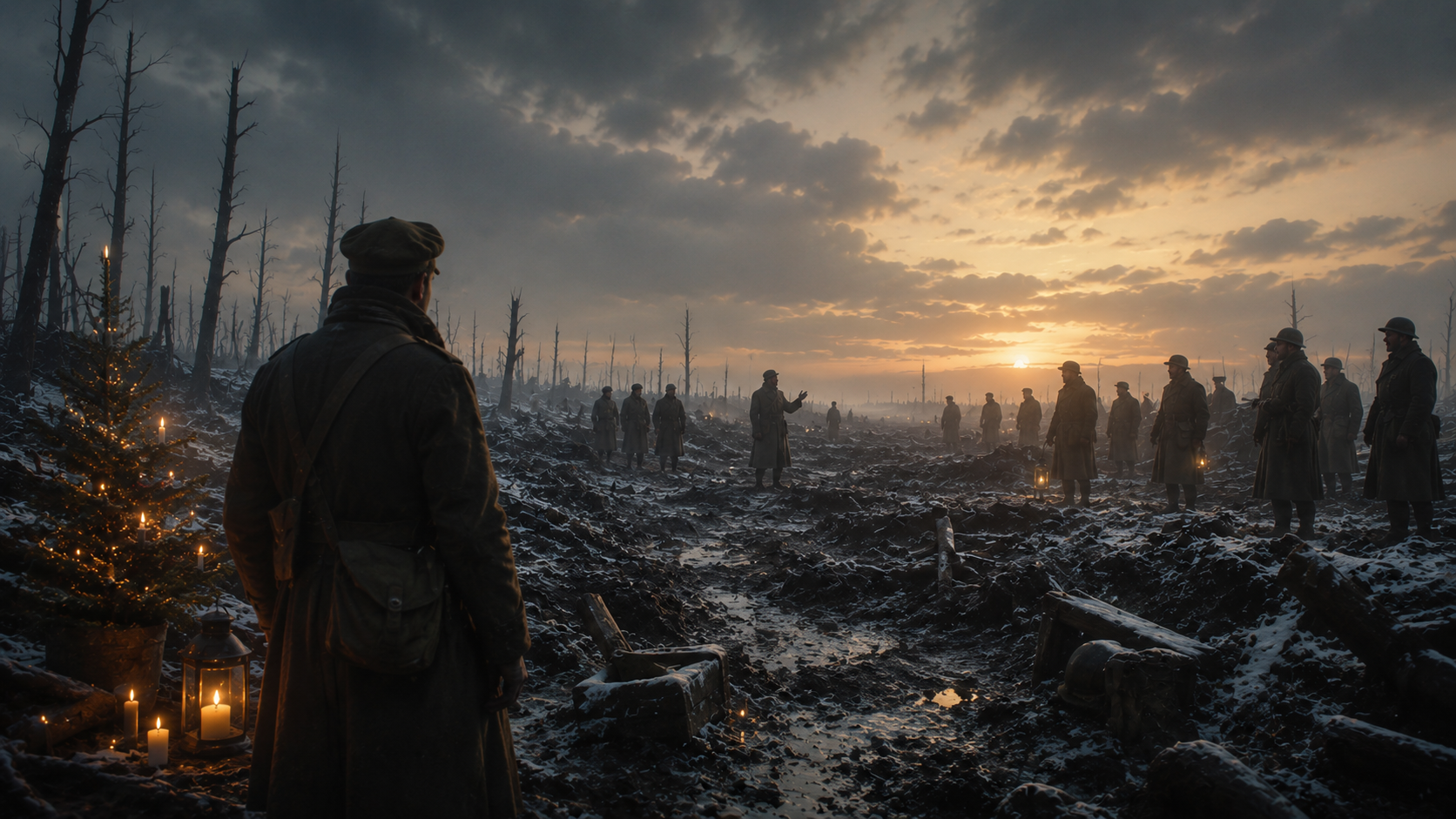
You’ve likely heard the story. A truce. Christmas 1914. Two sides putting down their weapons for a single day. You’ve seen the films, heard the lessons, nodded at the sentiment. But here’s what most retellings leave out: it didn’t start with generals or treaties or white flags. It started with a single voice in the dark, singing a song every man in that trench already knew by heart — leaving those listening to decide whether to fire or respond.
December 24, 1914. Western Front, Belgium. The war was only five months old, and already the men who fought it had stopped believing in the reasons they were given. They had been promised it would be over by Christmas. It wasn’t. And now Christmas had come anyway, uninvited, dragging its carols and candlelight into one of the ugliest stretches of mud and death Europe had ever seen.
What happened next was not planned. It was not coordinated. No officer ordered it. No government sanctioned it. Somewhere along a 27-mile stretch of trenches near Ploegsteert, Belgium — a place the British soldiers called “Plug Street” because they couldn’t pronounce the Flemish — an estimated 100,000 men on both sides lowered their rifles and let the night change shape. For one night, and into the following day, the Great War paused. Not because anyone in power decided it should. Because for one night, the men holding the rifles no longer wanted to pretend.
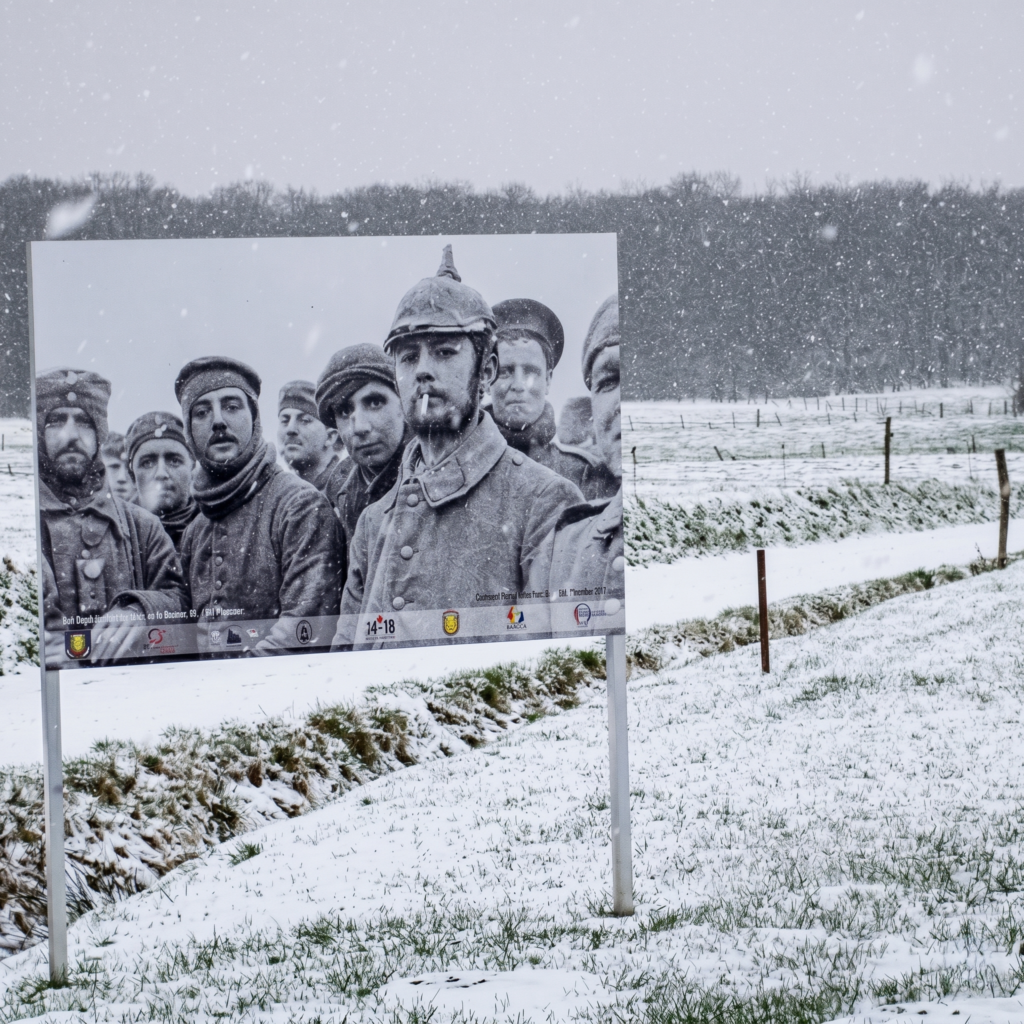
The Trench No Longer Felt Like Part of the Earth. It Felt Like a Sentence Being Carried Out Slowly.
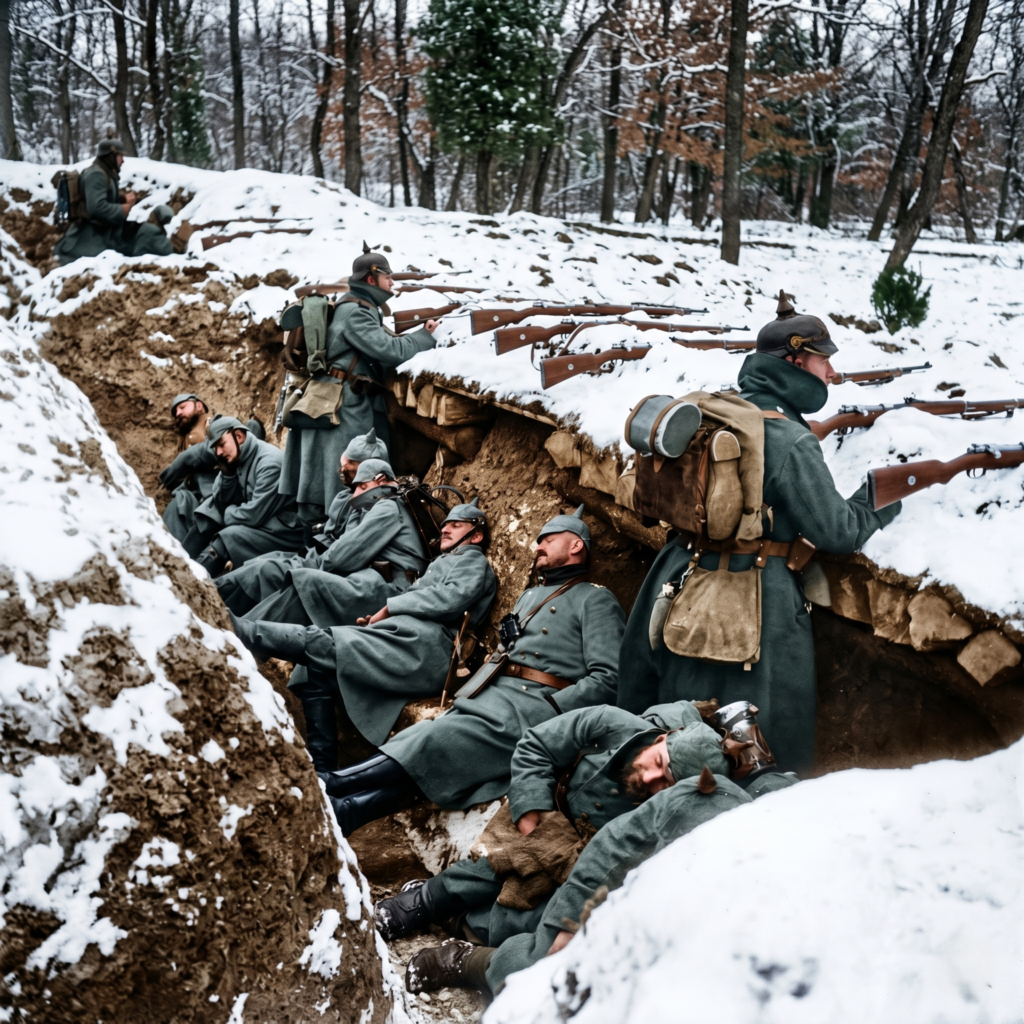
By December 1914, the men of the Western Front had been living in the earth for nearly three months. The trenches were not the neat, structured lines you see in diagrams. They were collapsing channels of frozen mud and standing water, filled with the constant stench of decay and waste that defined daily life along the line. The ground between the British and German positions, the stretch called No Man’s Land, was sometimes fewer than 50 yards wide. Close enough to hear the other side cough in the night.
Henry Williamson was 19 years old and standing in it. He would later become one of England’s most celebrated nature writers, but in December 1914, he was a private in the London Rifle Brigade, his boots soaked through, his fingers too cold to feel the trigger he’d been gripping for months. He wrote about that Christmas Eve for the rest of his long life — still writing about it when he was in his seventies — because that night never quite let him go.
The mud was the thing nobody was ready for. Military planners had imagined movement, cavalry, the clean sweep of advancing lines. What they got was this: men sunk to their knees in sucking Belgian clay, unable to advance, unable to retreat, unable to do anything except endure. The poet Siegfried Sassoon, who fought in the same sector not long after, described the trenches as places where men lived “like animals.” He meant it literally. You adapted or you died slowly in ways that had nothing to do with bullets.
The gap between those two walls of mud — No Man’s Land — was littered with the dead from earlier assaults. Some had been there for weeks. The cold had slowed the decay but not stopped it. On quiet nights, you could hear rats. The psychological weight of that — of sleeping 40 yards from men you’d killed, knowing they could see your parapet from theirs — is something history books flatten too easily. Without that reality, what happened next feels impossible.
And somehow, it happened there anyway.
A Light Appeared Where No Light Should Have Been
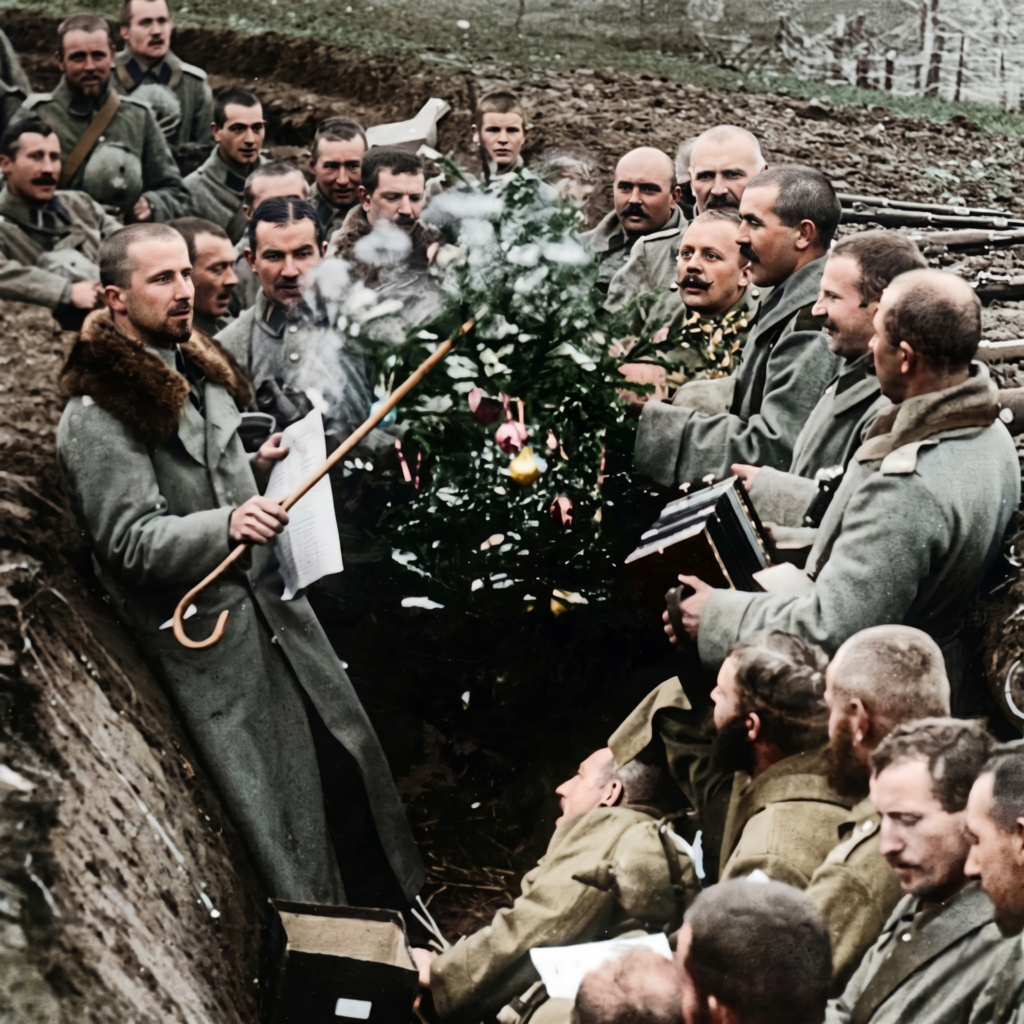
It started with the trees. Small ones — tannenbaum, Christmas firs — that German soldiers had somehow obtained and placed along the tops of their parapets. Even now, the detail sounds invented. The trees appeared after dark on December 24th, fitted with candles, flickering in the cold.
British soldiers saw them and didn’t know what to think. In the logic of the trench, a light on the enemy parapet meant one thing: a trap. A lure. Something to draw your eye before the shot. Private Albert Moren of the 2nd Queens Regiment later recorded his confusion: he thought the Germans were trying to signal something, maybe a warning, maybe a feint. His officer thought it was some kind of psychological operation. They waited. Nothing happened. The lights just kept burning.
Then the singing began.
Across the darkness, from the German trenches, a voice rose. “Stille Nacht. Heilige Nacht.” Silent Night. One voice, then others joining. The singing carried across No Man’s Land, audible to everyone in the quiet night air. German opera tenor Walter Kirchhoff is one of the names preserved in this account — a man who, before the war, had performed at the Berlin Royal Opera, and who was now crouched in a ditch in Belgium, singing a carol into the enemy dark.
For a few seconds, nobody fired.
The British trenches went quiet. Then, section by section — not all at once, not with any coordination — they answered. The same song. Different words. Same melody. Two armies, 50 yards apart, singing to each other in the dark because for a few minutes, singing felt more natural than killing.
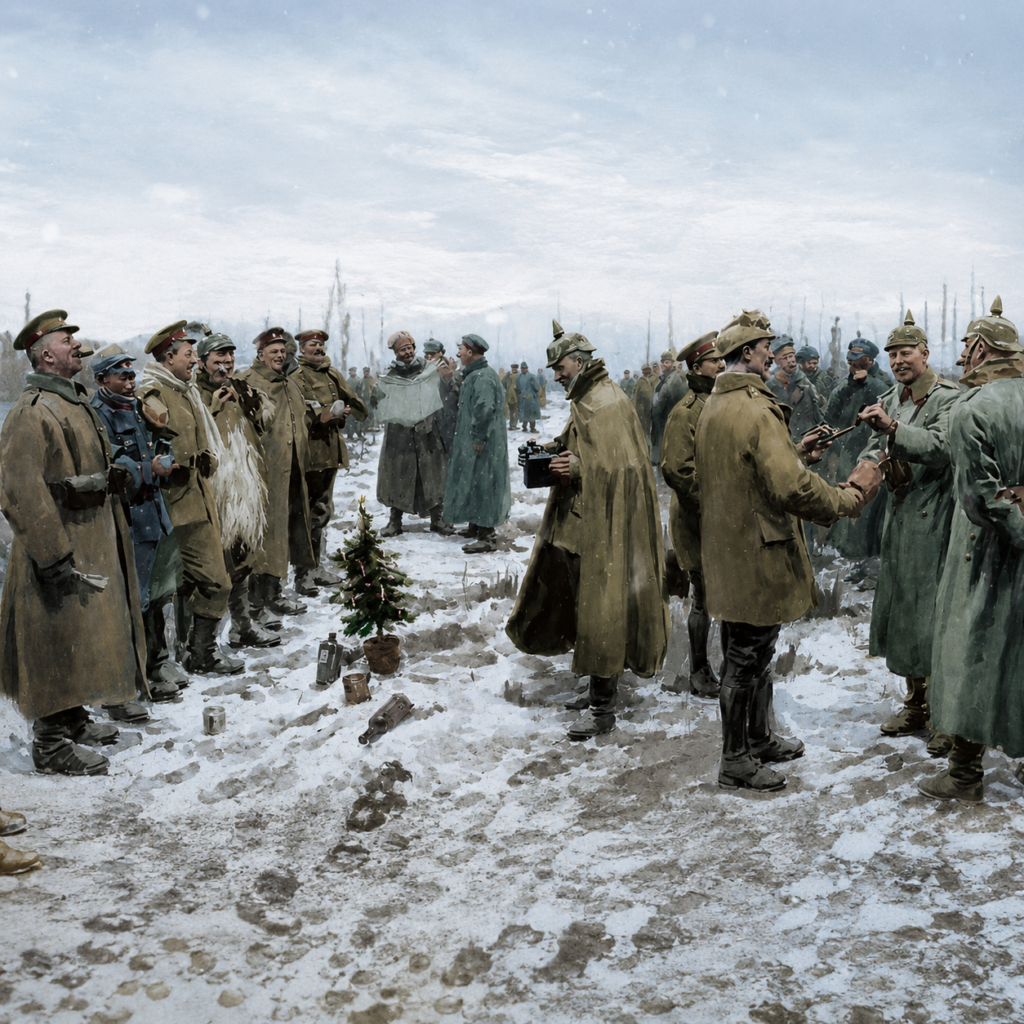
They Walked Out With Their Hands Open
By dawn on December 25th, something unprecedented was happening up and down the line. Soldiers were climbing out of their trenches. Unarmed. Hands visible. Walking into No Man’s Land toward the men they had been ordered to kill.
The Imperial War Museum’s documentary archive — one of the most comprehensive collections of First World War personal testimonies in existence — contains dozens of letters written by British soldiers in the days immediately following. Lieutenant Edward Hulse of the Scots Guards wrote a letter to his mother on December 28th describing what he witnessed with the directness of a man who knows he is recording something that will not be believed. Both sides came out, he wrote. They shook hands. They exchanged cigarettes and buttons as souvenirs. A German soldier who spoke English told him he had studied at Brighton. Another had worked in a hotel in London. These were not, Hulse wrote with genuine disbelief, the monsters the newspapers had described. They were people who were homesick.
Homesick. That one word — the exact sentiment that the newspapers of 1914 could not afford to print.
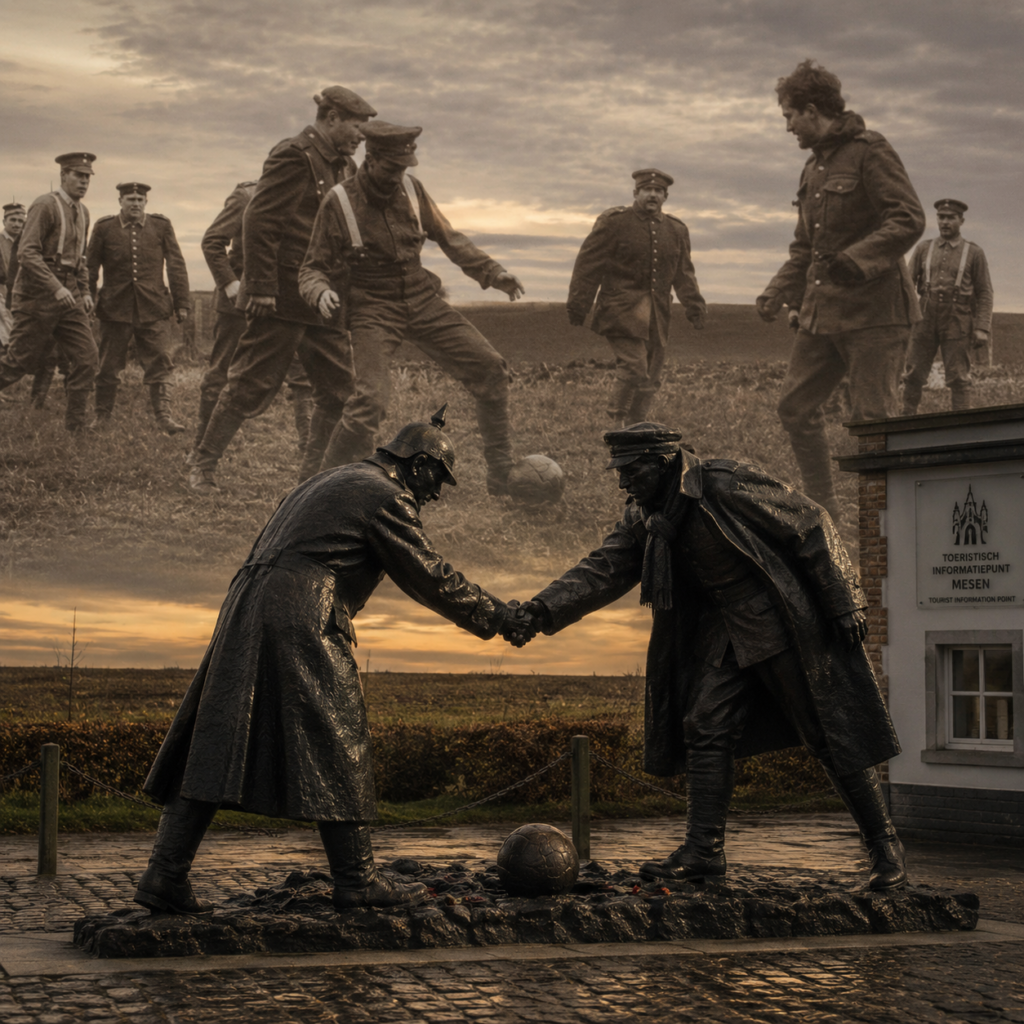
Johannes Niemann, a German officer whose account is held in the Bavarian State Archives, recorded that his men exchanged chocolate and tobacco with British soldiers. Some accounts — disputed, but documented in enough independent sources to warrant serious consideration by historians including Malcolm Brown and Shirley Seaton in their 1994 study “Christmas Truce” — describe an improvised football match, goals marked by helmets. Men playing football in No Man’s Land while bodies still lay buried in the mud sounds invented. But the story appears in enough independent accounts that historians have integrated these accounts into the broader narrative of the truce rather than dismissing them as mere legend.
The truce was not universal. Not every sector participated. At some points along the line, the war continued without interruption — artillery exchanges, sniper fire, while the rest of the front kept killing as usual. This is not a story of universal redemption. It’s a story of specific men making a specific choice in a specific place, and the choice being extraordinary enough that 110 years later, we are still not entirely sure what to do with it.
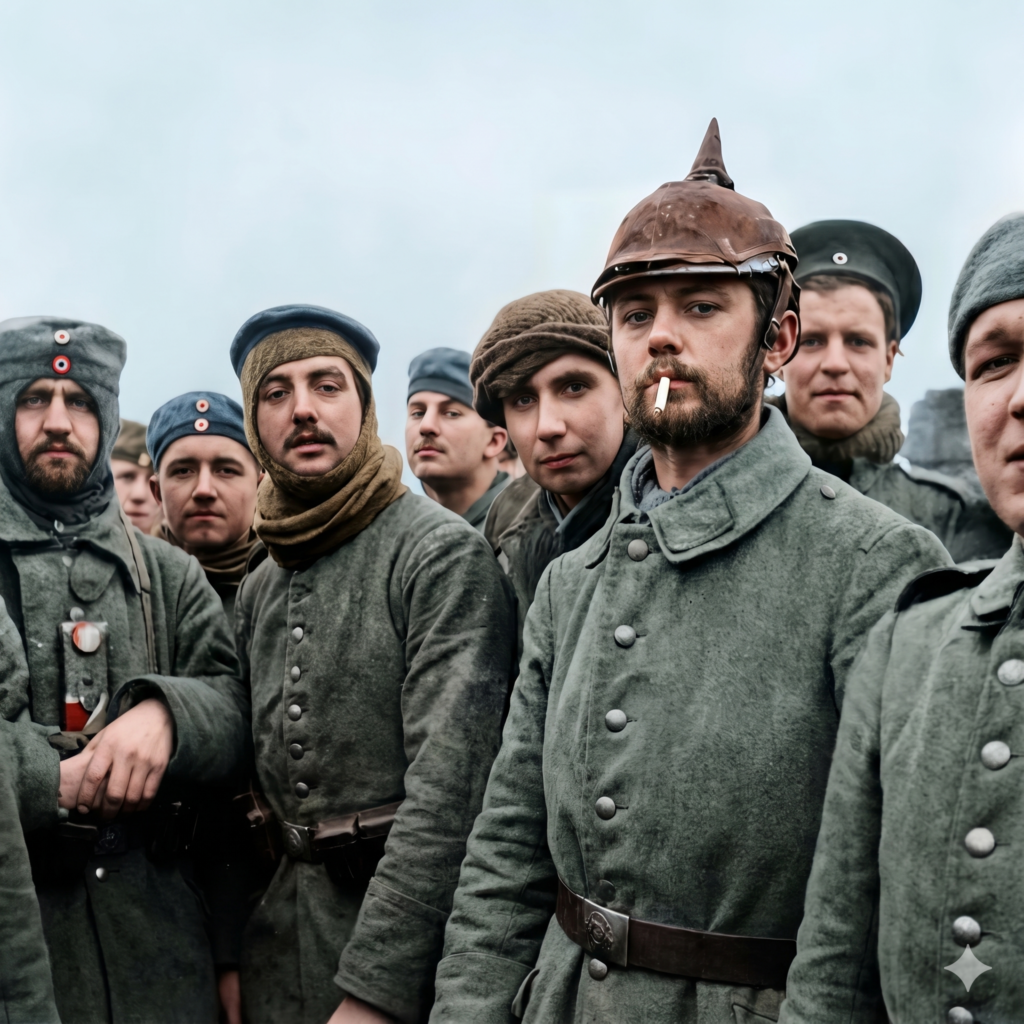
Their Faces Make the War Harder to Explain
Look at the men in that photograph. Really look.
Not the uniforms, not the equipment, not the military context. The young man in the center keeps staring into the lens as if he already knows nobody looking at him 100 years later will understand how young he really was. Pickelhaube tilted slightly. Cigarette between his lips. The others around him, varying degrees of awareness that a lens is pointing at them, some looking away, some looking straight through you.
They are absurdly young. That’s the first thing. That is always the part that stays with you. The average British soldier at the start of the war was 22 years old. German conscripts ran even younger in some units. The man in the center looks like someone’s younger brother. He looks like someone who should be worried about something small and ordinary — an exam, a girl, whether he’d be home in time for dinner.
Decades later, researchers began trying to identify the men in photographs like this one. One name came back. A family in Bavaria had been looking at this photograph for years. When they contacted the Imperial War Museum in London in 2016, they pointed to the young soldier in the center — the one with the cigarette, the one staring directly into the lens. Based on their account, that soldier is believed to be Arno Bohm. No historian can prove it completely. But his family never doubted the face. And that word, in this context, carries its own weight — because it means someone who loved him looked at that photograph for the rest of their lives and never stopped recognizing his face. He wasn’t “a German soldier.” He was Arno Bohm. He had a family who said: that’s him. That’s ours.
One fact sits quietly at the center of the Christmas Truce: the men who fought World War One were not ideologically committed to killing each other. Many of them, when given the choice, chose not to. What held the war together — the orders, the officers, the propaganda, the industrial scale of the operation — required the suspension of exactly this recognition. The moment it was suspended, even briefly, the men across the wire became people again. And once that happened, the question of why they were supposed to kill them became very difficult to answer.
The Ground They Were Standing On
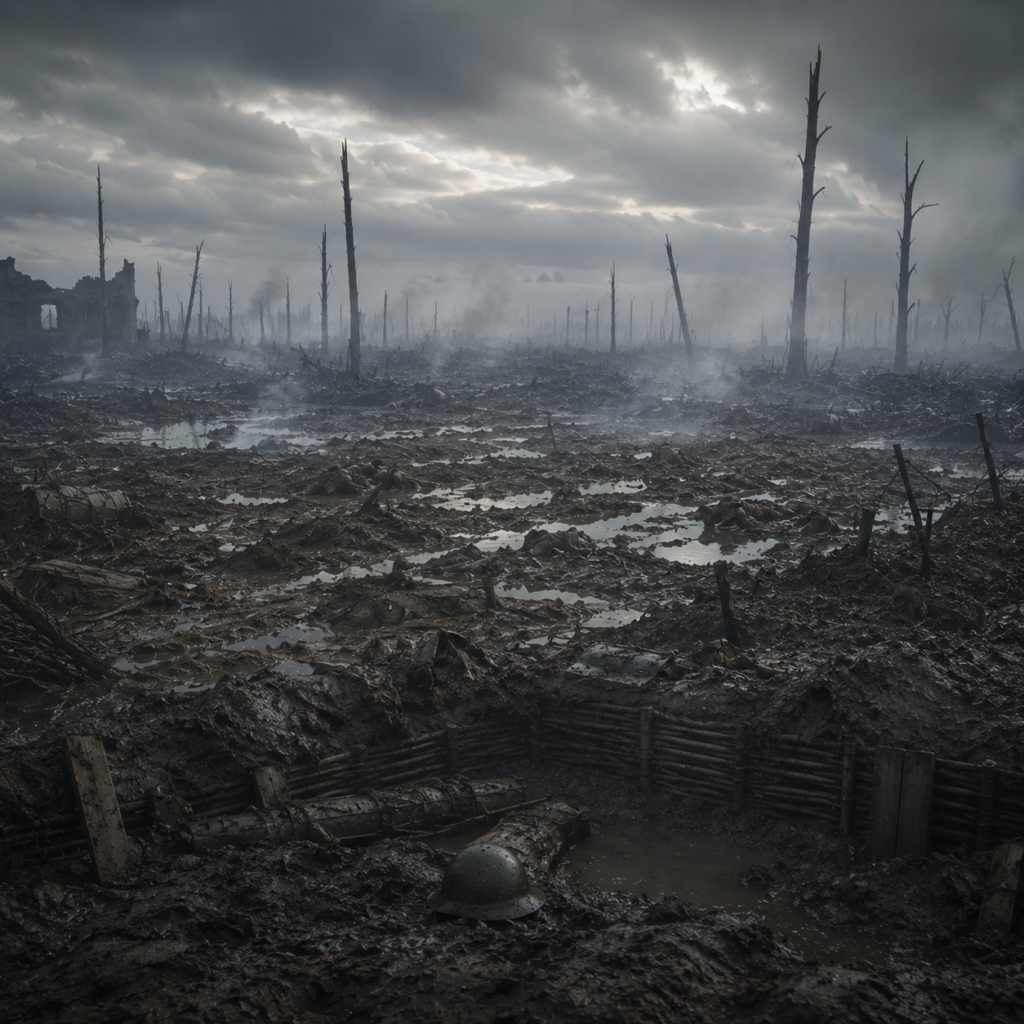
There is a tendency, in telling this story, to make No Man’s Land beautiful. To describe it in the soft focus of sentiment, to let the snow cover the worst of it, to lean into the carol-and-candlelight imagery until the setting becomes something from a Dickens illustration rather than a graveyard.
But that version of the story leaves out what the ground actually looked like. The snow helped from a distance. Up close, nothing was hidden.
The ground where those men shook hands on December 25, 1914, was a wreckage. Shell craters filled with standing water, their edges collapsing. Broken wood from destroyed farmhouses and fence lines, half-submerged. The remnants of men who had gone over the top in the preceding weeks and not come back — their equipment visible, their positions preserved by the cold in ways that made looking away necessary. The trees — the actual trees, the ones that had been standing when the war started — had been reduced to splinters by artillery. What remained looked like black stakes driven into grey earth, like a landscape that had given up.
The men who walked into that space on Christmas Day did not do so because it was peaceful. They did so despite the fact that it was the worst place any of them had ever stood. That distinction matters more than almost anything else about this event. It was not an easy choice made in comfortable circumstances. It was a choice made by exhausted, traumatized, half-frozen men who had been living in a sewer trench for months, looking at that ground every day, and who chose — on one specific morning — to walk into it without weapons anyway.
Walking into No Man’s Land with empty hands required a quieter kind of courage. Charging is kinetic, adrenaline-driven, you’re moving before you’ve thought. This was different — slower, deliberate, chosen with full awareness of what the ground beneath your boots had been used for.
The Morning They Sang Together — And What It Cost Them
British officer Captain J.C. Dunn, Medical Officer of the Royal Welch Fusiliers, kept meticulous unit diaries that are archived at the National Library of Scotland. His entry for December 25, 1914, is measured in tone — the tone of a man trying to record accurately something he suspects will not be believed — and records that his men spent several hours in the open with German soldiers before both sides returned to their positions. He notes the exchange of gifts. He notes, with some precision, the atmosphere: not festive, not euphoric, but quiet. The kind of quiet that follows something that has shifted but cannot be named.
Henry Williamson wrote about it differently. He wrote about it the way a writer writes about something that changed the shape of everything that came after. In a letter to his mother dated December 26th — a letter archived at the British Library — he described standing in No Man’s Land and looking at a German soldier his own age and understanding, with absolute clarity, that neither of them wanted to be there. “I shook the hand of a man I had been trying to kill,” he wrote. “And he shook mine.”
He was nineteen years old.
What happens to a person after that? He goes back to the trench. The war continues. He keeps firing when ordered to fire. He survives, unlike the majority of his generation. He comes home and he writes about nature — about rivers, about otters, about the particular quality of English light in autumn — for the rest of his life. He never quite explains the connection. Maybe he didn’t have to.
What the Commanders Thought of All This
Here is the part of the story that doesn’t fit the sentiment, and that therefore tends to get left out.
The high commands on both sides were not pleased. British General Sir Horace Smith-Dorrien issued orders before Christmas explicitly forbidding any fraternization with the enemy, threatening courts-martial for officers who permitted it. The order was largely ignored. After the truce, General Sir John French — commander of the British Expeditionary Force — expressed displeasure in terms that make clear he understood exactly what the truce represented: a temporary collapse of the dehumanization that industrial warfare requires to function. If soldiers on the ground decided the men across the wire were human beings like themselves, the logic holding the war together began to crack. The truce was not repeated at scale in subsequent years. High commands on both sides took measures to ensure it wouldn’t be.
This is the critical point that the soft-focus version of this story suppresses: the Christmas Truce was not tolerated. It was managed, minimized, and systematically prevented from happening again. Artillery barrages were pre-scheduled for Christmas Eve in 1915 specifically to prevent the conditions that had allowed 1914 to happen. The men who joined the truce were quietly warned afterward. Some disappeared into different units soon after. The lesson the military leadership took from the Christmas Truce was not “our soldiers are capable of remarkable humanity.” It was “our soldiers need to be prevented from recognizing the humanity of the enemy.”
That realization — that the war required the suppression of exactly this — is what the truce actually reveals. Not that war can be interrupted by goodwill. But that war depends on systematically preventing men from seeing each other clearly.
Archive Notes
How many men actually participated in the Christmas Truce of 1914?
Historian Malcolm Brown, in his study based on Imperial War Museum archives, estimated that the informal truces involved somewhere between 100,000 and 150,000 men along the Western Front on December 24th and 25th, 1914. The participation was not uniform — some sectors maintained active hostilities throughout — but the scale was large enough that high commands on both sides received multiple reports and took formal note of the event. It remains one of the largest spontaneous ceasefires ever recorded during wartime.
Was the Christmas football match real, or is it a legend?
The football match question is genuinely contested by historians. Multiple independent accounts from both British and German soldiers describe some form of improvised football game, but no contemporary photographs confirm it, and the accounts vary significantly in detail. The Imperial War Museum treats the football match as “possibly historical” rather than confirmed fact. What is documented beyond dispute is the exchange of gifts, the handshakes, and the extended conversations in No Man’s Land — these appear in enough independent primary sources to be considered reliable.
Did the Christmas Truce happen again in 1915 or later?
Small, localized informal truces occurred in December 1915 in some sectors, but nothing approaching the scale of 1914. High commands on both sides had taken active measures to prevent repetition, including pre-scheduled artillery barrages on Christmas Eve 1915 designed to keep both sides in their trenches. By 1916, with the introduction of mass casualties at Verdun and the Somme — roughly 700,000 and 420,000 dead respectively — the psychological conditions that had allowed 1914 had been replaced by something harder and less recoverable.
What You Now Know
The Christmas Truce was not a story about the power of peace. It was a story about what happens when the logic of dehumanization breaks down for 24 hours — and about how quickly those in power moved to rebuild it. The men who sang across No Man’s Land in 1914 were not fools. For one night, they simply stopped pretending the other side was less human. For one night, the war forgot what it needed the men to become. And the men never completely forgot it afterward.
Tip For Readers
The Imperial War Museum in London maintains an extensive digital archive of first-hand accounts from the 1914 Christmas Truce, including original letters, diary entries, and photographs, accessible through their collections portal at Imperial War Museum Collections. The Bavarian State Archives (Bayerisches Hauptstaatsarchiv) hold significant German-language primary sources from the same period for researchers seeking the other side of the wire.
Verified Sources
Imperial War Museum, London — Christmas Truce Personal Testimonies Archive, 1914–1918 Collections
Imperial War Museum, London — Letters of Lieutenant Edward Hulse, Scots Guards, December 28, 1914
British Library, London — Personal Correspondence of Henry Williamson, December 26, 1914
National Library of Scotland — Unit Diaries of Captain J.C. Dunn, Royal Welch Fusiliers, December 1914
Bayerisches Hauptstaatsarchiv (Bavarian State Archives) — Field Diary of Johannes Niemann, December 1914
Brown, Malcolm and Seaton, Shirley — “Christmas Truce: The Western Front December 1914,” Pan Books, 1994
Weintraub, Stanley — “Silent Night: The Story of the World War I Christmas Truce,” Free Press, 2001
Wikimedia Commons / Public Domain — Archival photographs of Western Front trenches and soldiers, 1914–1918
Image sources: Vella Team editorial compositions (Images 2, 4) — created for editorial purposes, not part of the original historical record. Images 3, 5, 6 — colorized from public domain archival photographs for editorial purposes; colorization not part of the original photographic documentation. Image 1 — contemporary photograph of Ploegsteert memorial site, Belgium. Image 7 — “All Together Now” memorial sculpture by Andy Edwards, Mesen, Belgium.