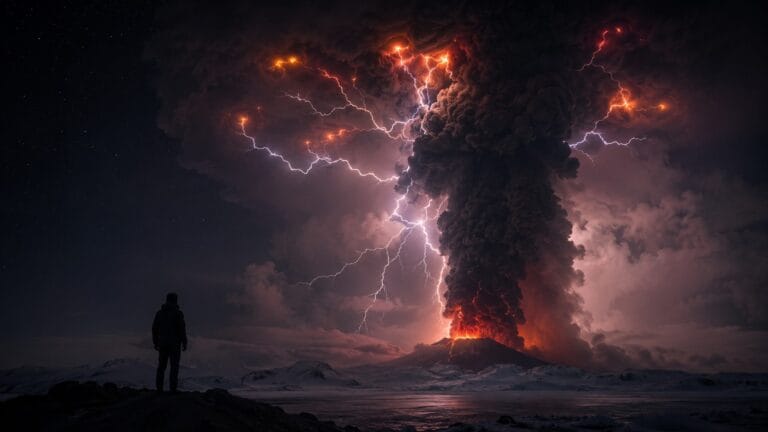
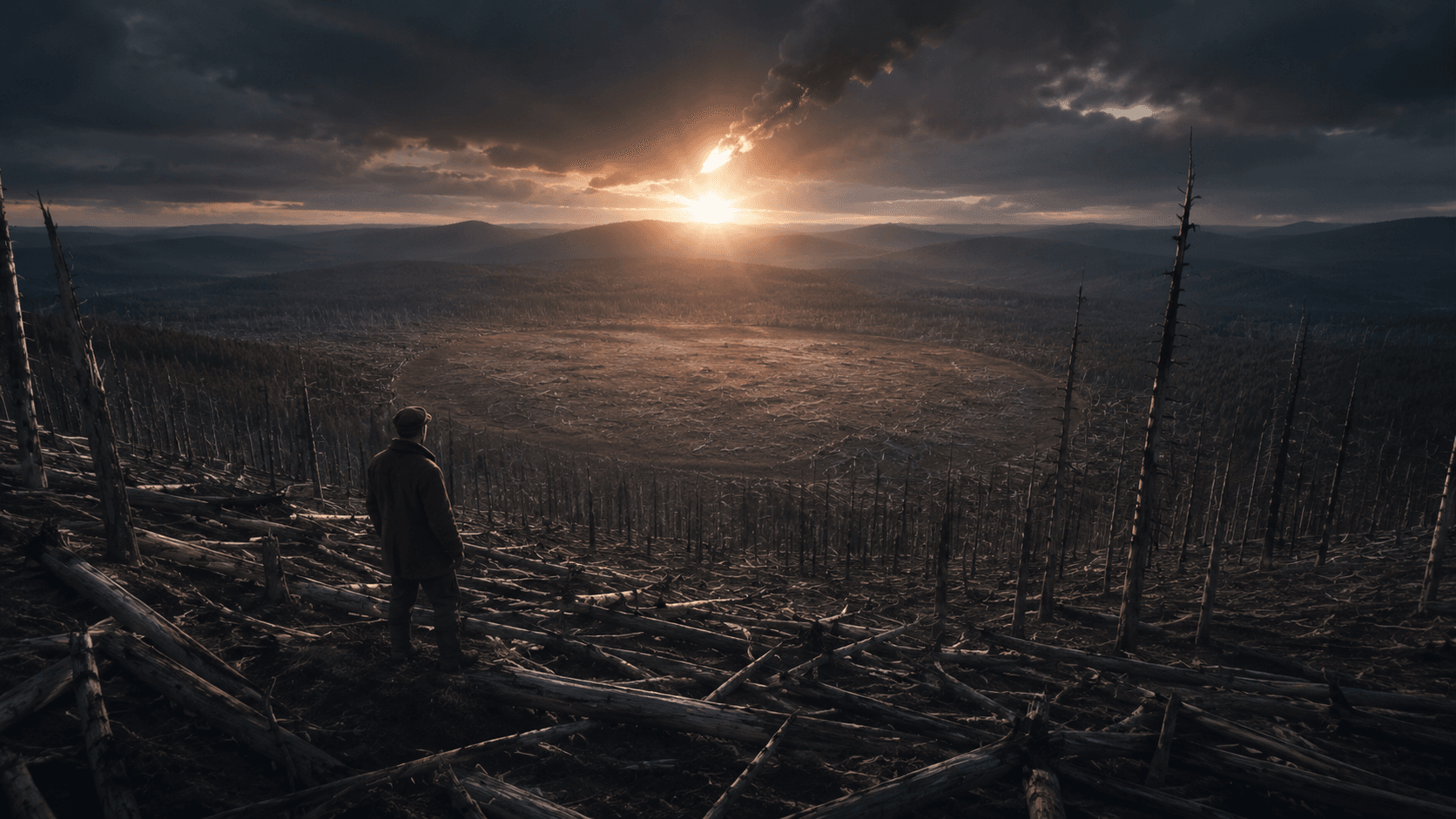
You already know what an explosion looks like. A bomb goes off, a crater forms, wreckage scatters. Something always remains. That is how we expect the world to work — until June 30, 1908, at 7:17 in the morning, when a force estimated at 10 to 15 megatons of TNT detonated over a Siberian forest and left investigators standing in front of nothing.
No crater. No fragments. No meteorite. Just silence, and 80 million trees lay flat on the ground.
The Morning the Forest Went Silent
The Podkamennaya Tunguska River winds through one of the most remote stretches of land on Earth. In 1908, the Siberian taiga in that region was all but uninhabited — a place of vast spruce forests, shallow bogs, and the occasional camp of Evenki reindeer herders. The region was almost completely isolated, with barely any human presence.
At 7:17 a.m. on June 30, that silence cracked open. Evenki herders and Russian settlers northwest of Lake Baikal reported a column of bluish light cutting across the sky, nearly as bright as the sun itself, trailing a thin streak of smoke. It moved fast. Too fast. Within seconds, a flash erupted at the horizon, followed by a sound that witnesses described as artillery fire, as if cannons were going off one after another across the entire northern sky.
Semen Semenov, a farmer sitting outside his home at the Vanavara Trading Post, roughly 65 kilometers south of the explosion, later told investigators: the sky split in two, fire appeared high and wide over the forest, and the heat became so intense he felt his shirt was burning. Then he was thrown several yards into the air by the shockwave. He was 65 kilometers away.
At that distance, the blast knocked him off his feet. The sound reached as far as 1,000 kilometers. Seismographs trembled across Europe. In London, people could read newspapers outdoors at midnight because the sky glowed without explanation for weeks afterward.
It entered the atmosphere — and broke apart almost instantly.
Eighty Million Trees, One Direction
When Leonid Kulik, a Russian mineralogist working for the Soviet Academy of Sciences, finally reached the blast site in 1927 — nineteen years after the event — he expected to find a crater. The logic was straightforward. An explosion that powerful had to have come from something solid hitting the ground. He brought tools to excavate. He brought instruments to measure.
What he found instead stopped him cold.
The trees were down. Not scattered randomly, not toppled by wind from different directions — but laid out in a radial pattern stretching 15 to 30 kilometers from a central point, every trunk pointing away from the same origin. An area of 2,150 square kilometers of forest had been flattened, shaped like a giant butterfly with a wingspan of 70 kilometers.
Kulik later wrote of his first glimpse from an observation point: thick giant trees snapped across like twigs, their tops hurled many meters to the south, everything devastated and burned, with young twenty-year-old forest growth pushing in at the edges, hungry for the light that had suddenly opened up.
At ground zero — the precise point directly below the blast — there was no crater. There was a bog. A marshy, undisturbed bog. The trees closest to the center were still standing. But they were stripped bare: no branches, no bark, no needles. They stood like rows of telephone poles, scorched to the wood. The blast had come straight down on them with such perfect vertical force that it could not knock them sideways. It simply peeled them.
The fallen trees reveal exactly how the blast moved — like a giant invisible hammer pressing straight down from the sky, then spreading outward in every direction from the point of detonation.
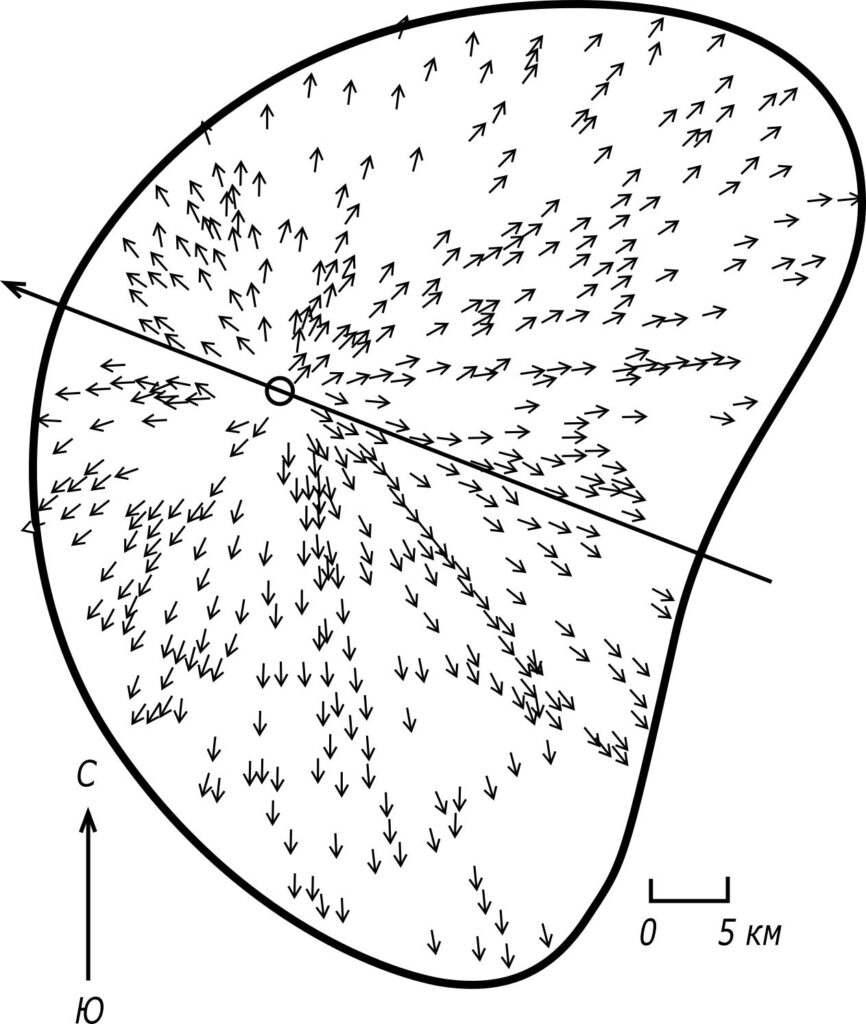
A schematic map of the Tunguska blast zone showing the radial pattern of felled trees, arrows indicating the direction each trunk fell outward from the central epicenter. The asymmetric shape reflects the asteroid’s east-southeast approach angle.
Originally published in Soviet Academy of Sciences expedition reports.
The Numbers That Should Not Exist
For over a century, scientists have tried to explain how powerful the explosion really was. The range is wide — estimates run from 3 to 50 megatons of TNT — but even the lower figures are difficult to contextualize. The atomic bomb dropped on Hiroshima on August 6, 1945, released approximately 15 kilotons. Estimates place the Tunguska yield significantly higher, with figures ranging from several hundred to roughly 1,000 times the Hiroshima output depending on the model used.
The asteroid itself, scientists now believe, was a stony body approximately 50 to 60 meters wide. The size of a modest office building. Traveling at around 27 kilometers per second — that is Mach 80, or nearly 100,000 kilometers per hour — it entered the atmosphere from the east-southeast. As it descended, the air in front of it compressed faster than the object could push through. Temperature at the surface of the asteroid spiked to approximately 24,700 degrees Celsius. The structural integrity of the rock failed. It did not hit the ground. It detonated, 5 to 10 kilometers above the surface, converting nearly all of its mass into a directed jet of superheated gas that slammed downward at supersonic speed.
The result was 830 square miles of forest reduced to splinters in less than a second.
This raises a critical question: if an object that size can do that much damage without touching the ground, what does our assumption about “impact events” actually protect us from?
Not enough.
The Search for a Piece of It
Kulik was convinced a meteorite was buried somewhere in the bog. He spent years digging. He returned to the site three more times, each expedition more determined than the last. He pumped water out of the marshy depressions he found near the epicenter, certain they were impact holes. What he found at the bottom of each one was rotting tree stumps. Not iron. Not rock. Not anything that had fallen from space.
Subsequent Soviet expeditions in the 1950s and 1960s brought more sophisticated tools. They mapped the blast zone from the air, confirming the butterfly shape and outlining the full 830-square-mile perimeter. They drilled into the soil. They analyzed tree resin. Italian researchers at the University of Bologna, working in the 1990s, extracted resin from trees that had been alive in 1908 and found elevated levels of iridium and other materials associated with rocky asteroids — but these were microscopic traces, each fragment less than a millimeter across. No piece of the object was ever recovered that could be definitively tied to the blast.
The asteroid had vaporized completely.
The object that caused one of the largest known impact events in modern history had destroyed the physical evidence of its own existence before investigators could reach the site.
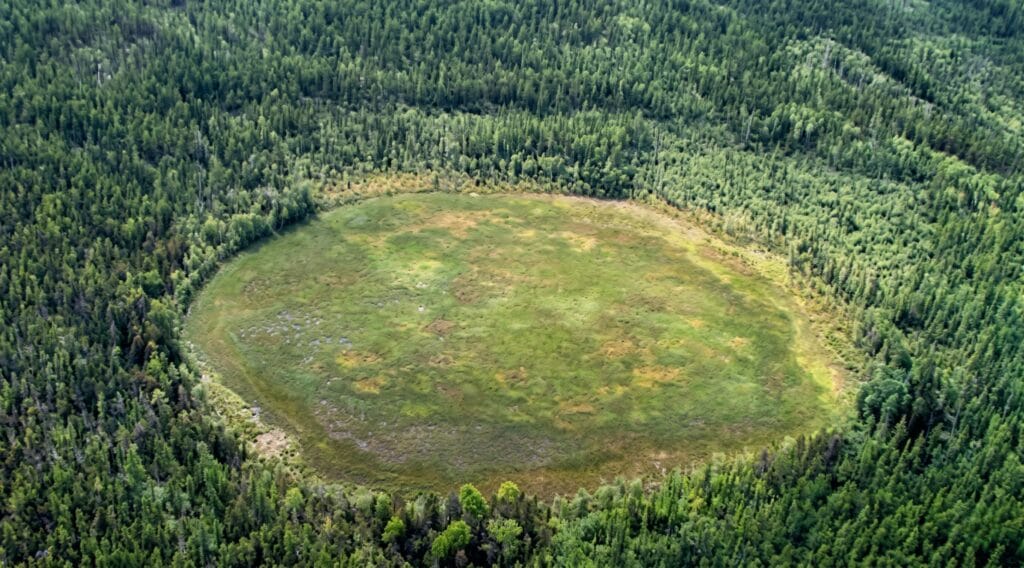
Aerial photograph of a circular clearing in the Siberian taiga near the Tunguska epicenter. The geometry of the cleared zone, visible only from altitude, enabled Soviet researchers in the 1960s to establish the full 2,150-square-kilometer extent of the blast.
Wikimedia Commons (public domain); colorized by Vella Team.
What the Trees Remember
The fallen trees in the Tunguska region are not ruins. They are data.
Because the blast occurred in the atmosphere rather than at ground level, the pattern of destruction encoded information about the explosion’s altitude, trajectory, and energy with a precision that no instrument of 1908 could have matched. Each fallen trunk is an arrow pointing back toward the epicenter. The angle of fall, the depth of scorching on the wood, the direction of char relative to the stripped standing trees at ground zero — all of it became a three-dimensional record that researchers have spent decades reading.
In the 1960s, Soviet scientists used this data to confirm that the zone of leveled forest stretched across 2,150 square kilometers in a shape that resembled a spread-eagled butterfly. The asymmetry — heavier destruction to the north and northwest — reflected the asteroid’s angle of entry. The object had come in at a shallow trajectory from the east-southeast, traveling at roughly 30 degrees above the horizontal. Had it entered at a steeper angle, the energy would have been concentrated in a smaller area. Had it been shallower still, it might have skipped off the upper atmosphere entirely and continued into space.
Each fallen trunk acted like a compass needle, pointing back toward the source. No trace of where it finally ended up has ever been found.
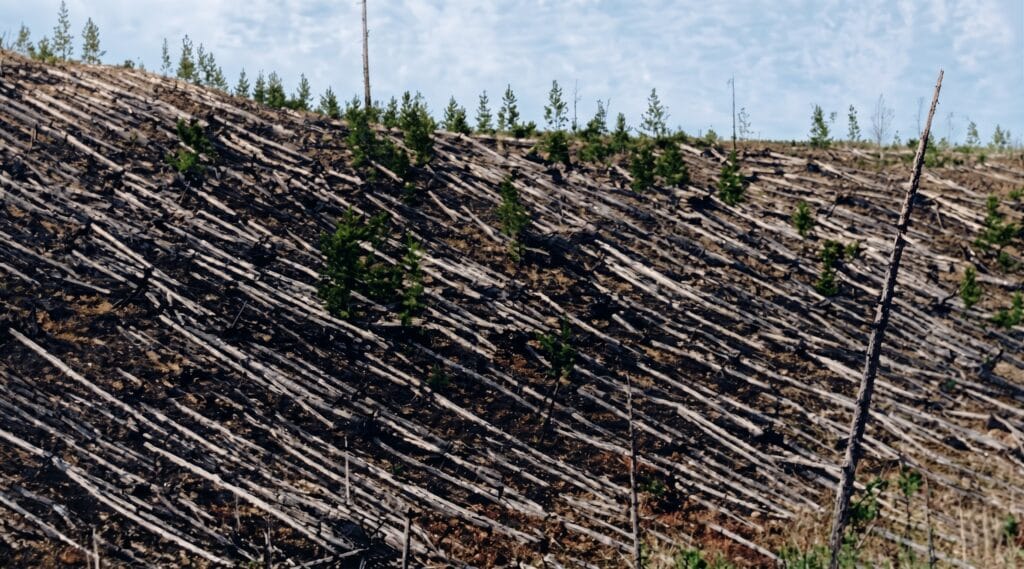
Ground-level view of felled trees lying in uniform parallel formation across a hillside in the Tunguska blast zone. The consistent direction of fall across hundreds of meters of terrain is physically consistent only with a single-origin pressure wave from an airburst explosion, not a ground impact or wind event.
Wikimedia Commons (public domain); colorized by Vella Team.
Four Hours That Almost Changed Everything
The explosion occurred at 60 degrees, 55 minutes north latitude, 101 degrees, 57 minutes east longitude. That is the middle of Siberia. The population density of that region in 1908 was roughly one person per hundred square kilometers. At most two or three people are believed to have died. Thousands of reindeer perished. Several Evenki camps were destroyed.
Now consider the geometry. The Earth rotates. A cosmic object approaching on the same trajectory, arriving four hours later in the morning, would have encountered a different patch of Earth’s surface rotating into its path. Depending on precise calculations, that patch could have included the densely populated urban centers of western Russia or northern Europe.
An explosion of Tunguska’s scale centered over London, according to estimates published by the Royal Observatory at Greenwich, would result in significant structural damage to a majority of buildings within the M25 motorway ring. Over any major city, it would have represented one of the most significant catastrophes of the twentieth century — before the century had even fully begun.
It happened in the only place where it could go unnoticed — far from any major population.
The Ghost That Came Back
On February 15, 2013, at 9:20 in the morning, a similar event occurred over Chelyabinsk, Russia — 1,500 miles west of Tunguska. A smaller asteroid, approximately 20 meters wide, entered the atmosphere and exploded at roughly 30 kilometers altitude with a yield of around 500 kilotons. No one saw it coming. It injured around 1,500 people, mostly from shattered glass blown out by the shockwave. It was not detected by any planetary defense system before it arrived.
The Chelyabinsk event gave scientists something they had never had before: high-quality video footage, sensor data, and modern atmospheric modeling applied to a real airburst in real time. The data confirmed what the Tunguska trees had been saying for 105 years. Airbursts are real. They leave no crater. They arrive without warning. And the one in 1908 was exponentially larger than what shook Chelyabinsk.
NASA’s Planetary Defense Coordination Office now tracks near-Earth objects and has designated June 30 as International Asteroid Day in recognition of the 1908 event. But as of 2026, no system exists that could intercept an object of Tunguska’s size on short notice.
We have named the day. We have not solved the problem.
What the Science Cannot Resolve
The airburst hypothesis is the scientific consensus, and the evidence supporting it is overwhelming. A stony asteroid approximately 50 to 60 meters in diameter, traveling at Mach 80, disintegrating under aerodynamic pressure at an altitude of 5 to 10 kilometers — this model accounts for the radial tree fall, the absence of a crater, the global seismic signature, and the microscopic extraterrestrial material found in the soil and tree resin.
But the debate has not fully closed.
A team of Italian geologists proposed in the 2000s that nearby Lake Cheko might be a fragment impact crater, formed by a dense piece of the asteroid that survived the main explosion and struck the ground. Russian scientists countered that sediment cores from the lakebed indicate the body of water predates 1908 by thousands of years. The argument remains unresolved.
More fundamentally, the exact composition of the Tunguska object — asteroid or comet — is still debated. Russian scientists have long favored a comet origin, partly because of the noctilucent cloud activity observed over northern Europe in the days following the event, a phenomenon caused by massive quantities of water vapor injected into the upper atmosphere. Western researchers lean toward a dark, carbonaceous asteroid. Both hypotheses produce nearly identical physical outcomes, and the vaporization of the object means that definitive chemical analysis may never be possible.
A century of expeditions, more than 1,000 scientific papers, and the answer still carries uncertainty.
The People Who Went to Look
The photograph below was taken during one of the early Soviet expeditions to the Tunguska region — researchers, guides, and local Evenki hunters who led the scientific teams into territory most maps of the era barely acknowledged. Kulik himself called his first glimpse of the blast zone chaotic and impossible to process all at once. He was a trained mineralogist who had cataloged meteorite falls across Russia, and he could not immediately make sense of what he was looking at.
That says something about the scale of what happened in that forest. And it raises a point that extends beyond 1908: when an event exceeds everything a trained expert has previously encountered, the frameworks we rely on to assess risk stop working.
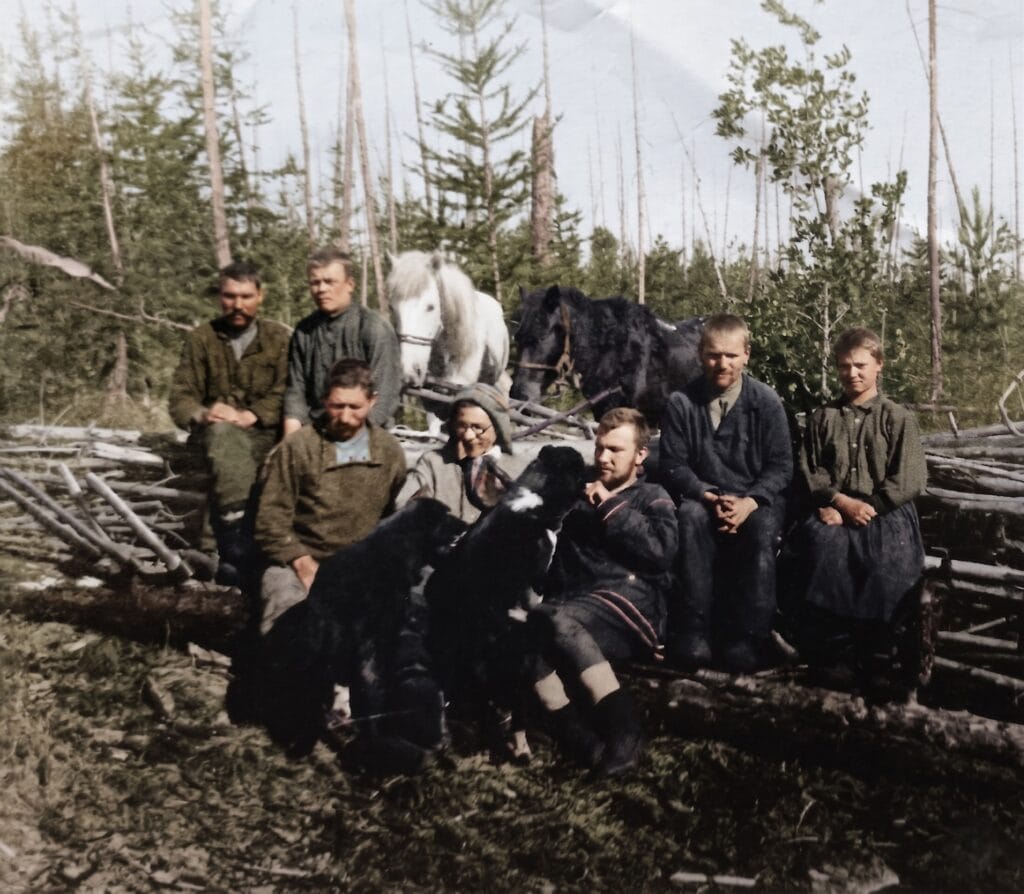
Members of the Leonid Kulik expedition at the Tunguska blast site, circa 1927, with local Evenki guides who led the team through territory nearly inaccessible by any available map of the era.
Soviet Academy of Sciences archive photograph; colorized by Vella Team from the original black-and-white source.
FAQ
Q: Why did the Tunguska explosion leave no crater?
A: The asteroid detonated in the atmosphere before reaching the ground — a phenomenon called an airburst. At an altitude of 5 to 10 kilometers, aerodynamic pressure exceeded the structural strength of the rock, causing it to explode and vaporize entirely. Without a solid object striking the surface, no crater forms. The energy released was directed downward as a pressure wave, flattening the forest without excavating the ground.
Q: Could a Tunguska-scale event happen over a city today?
A: Yes. Objects in the 50 to 60 meter size range are difficult to detect far in advance because they are small and dark. NASA’s Planetary Defense Coordination Office tracks near-Earth objects, but the 2013 Chelyabinsk event — smaller than Tunguska — arrived completely undetected. An airburst of Tunguska’s energy over a metropolitan area would be catastrophic. The Royal Observatory at Greenwich has estimated that a comparable event over London would destroy everything within the M25 ring road.
Q: Has anything similar happened since 1908?
A: The Chelyabinsk meteor event of February 15, 2013, was the closest modern parallel. A 20-meter asteroid exploded at roughly 30 kilometers altitude over southern Russia, releasing approximately 500 kilotons of energy and injuring around 1,500 people, mostly from glass broken by the shockwave. It was not detected before it entered the atmosphere. That event was roughly one percent of the energy released at Tunguska.
What You Now Know
On June 30, 1908, one of the largest impact events in recorded human history occurred in a place where almost no one was watching. A stony asteroid roughly 50 to 60 meters wide, traveling at Mach 80, detonated 5 to 10 kilometers above a Siberian forest and released between 10 and 15 megatons of energy — enough to flatten 2,150 square kilometers of trees and register on seismographs across Europe. It left no crater, no recoverable fragments, and no warning. The explosion vaporized itself. What remains is the testimony of 80 million fallen trees, all pointing back toward the same empty sky. That the object arrived over uninhabited taiga rather than a major city was not planning or preparedness. It was geometry and luck.
Statistical data suggests that while such atmospheric detonations are infrequent on human timescales, they are recurring events in geological history.
Tip for Readers
The Tunguska event tends to be treated as a historical curiosity — a strange thing that happened in a remote place a long time ago. The more useful frame is to treat it as a proof of concept. The physics that produced it have not changed. Objects of that size cross Earth’s orbit regularly. The difference between Tunguska and a civilization-altering catastrophe is not technology or preparedness — it is where the planet happened to be pointing at 7:17 on a summer morning in 1908. That is not a comfortable thing to sit with. It is, however, an accurate one.
Verified Sources
NASA History Division — Tunguska Event Resources
NASA Planetary Defense Coordination Office — Near-Earth Object Resources
Encyclopaedia Britannica — Tunguska Event
Royal Observatory Greenwich — Tunguska Event Resources
Scientific American — Tunguska Research and Analysis